

The simplest-looking property title can have the biggest effect on who inherits. The difference between tenants in common vs joint tenants is not just legal terminology: it can determine whether a co-owner’s interest passes to the survivor or can be left to someone else in a will.
It’s understandable if the arrangements seem difficult to distinguish. The registered legal title and the owners’ beneficial interests are related, but they aren’t always the same thing. Knowing how they fit together can help you assess whether the ownership reflects your intentions.
This guide explains how each arrangement treats ownership shares, what may happen when an owner dies, and how the choice can affect a will and wider estate planning in England and Wales. It also gives you practical points to check, including who should benefit from each share and whether the relevant documents record that clearly.
Key Takeaways
- With tenants in common vs joint tenants, the key distinction is whether a co-owner’s interest passes automatically to the survivor or can pass under their will.
- Compare how each arrangement deals with beneficial shares, inheritance and the intentions behind the co-ownership.
- When reviewing the title, remember that the register identifies legal proprietors but may not show the full detail of beneficial ownership.
- Check that the title, any documents recording beneficial interests and your estate plan reflect the same intentions.
- This comparison relates to England and Wales; property ownership rules may differ in other UK jurisdictions.
Tenants in common vs joint tenants: what do the terms mean?
These terms describe different ways of holding the beneficial ownership of a property. The distinction matters because it affects what happens to an owner’s interest when they die. In England and Wales, co-owners hold the legal title jointly, but their beneficial ownership can be held jointly or as tenants in common.
Legal title concerns who holds the property on the legal documents. Beneficial ownership concerns who is entitled to the property’s value and, where relevant, defined shares in it. The Concurrent estate overview explains forms of shared ownership. The key difference is that joint beneficial ownership generally carries survivorship, while a tenant in common has a distinct share.
What does joint tenancy mean when you own a property together?
Joint tenants own the beneficial interest together rather than holding separate, defined shares such as 50 per cent each. If one owner dies, the right of survivorship generally means their interest passes automatically to the surviving joint tenant or tenants. It doesn’t pass under the deceased owner’s will, so a will generally can’t redirect that interest to someone else.
What does tenants in common mean for each owner’s share?
Tenants in common each have a distinct beneficial share. Those shares may be equal or unequal, depending on the ownership arrangement. When an owner dies, their share doesn’t automatically pass to the other co-owner through survivorship. It may pass to a beneficiary named in their will or, if there is no valid will covering it, under the intestacy rules.
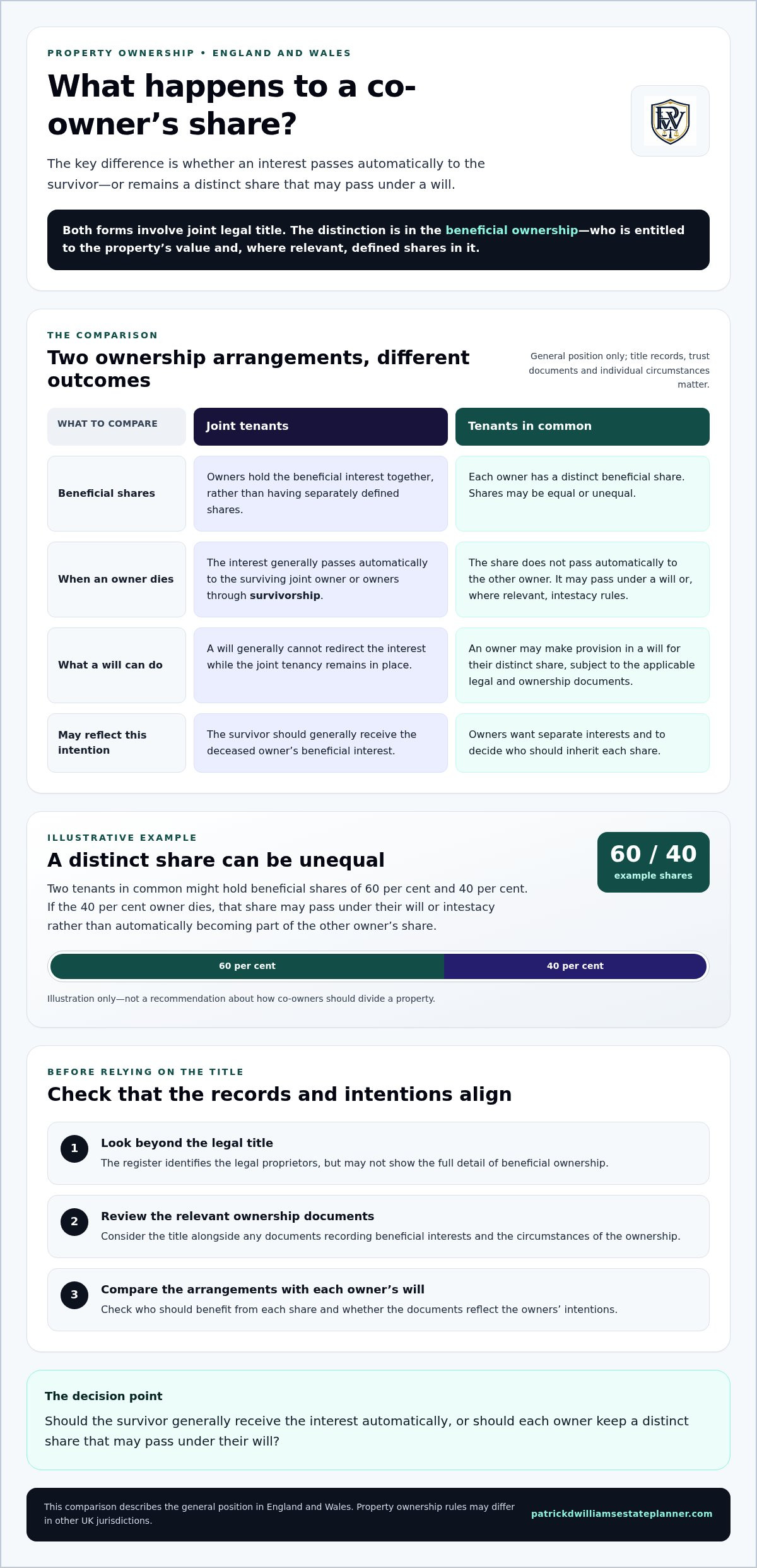
Unequal-share example: Two owners might hold beneficial shares of 60 per cent and 40 per cent. If the 40 per cent owner dies, that share may pass under their will or intestacy, rather than automatically becoming part of the other owner’s share. This is an illustration, not a recommendation about how co-owners should divide a property.
How do joint tenants and tenants in common differ?
The practical difference between tenants in common vs joint tenants is most apparent when an owner dies. This comparison describes the general position in England and Wales; property law and terminology may differ in other UK jurisdictions. The title, trust documents and individual circumstances can affect how ownership is recorded and what happens in practice.
| Feature | Joint tenants | Tenants in common |
|---|---|---|
| Beneficial shares | Owners hold the beneficial interest together, rather than having separately defined shares. | Each owner has a distinct beneficial share. Shares may be equal or unequal. |
| When an owner dies | The deceased owner’s interest generally passes to the surviving joint owner or owners through survivorship. | The deceased owner’s share doesn’t pass automatically to the other owner. It may pass under a will or intestacy rules. |
| Will | A will generally can’t redirect the interest while the joint tenancy remains in place. | An owner may leave their distinct share by will, subject to the applicable legal and ownership documents. |
| Common intention | May suit co-owners who intend the survivor to take the property’s beneficial interest. | May suit co-owners who intend to keep separate interests and decide who should inherit each share. |
What happens to the property when one co-owner dies?
With a joint tenancy, survivorship generally transfers the deceased owner’s interest to the surviving joint owner or owners. With a tenancy in common, the deceased person’s beneficial share remains distinct and may pass under their will or, if there is no valid will dealing with it, under intestacy rules. This is the general distinction. For a particular property, consider the ownership records, any relevant trust documents and the circumstances together.
Can each owner leave their share to someone in a will?
A tenant in common can generally make provision in a will for their distinct beneficial share. A joint tenant’s interest is subject to survivorship, so a will cannot override that arrangement whilst it remains in place. Cornell Law School’s Tenancy in common entry gives a general explanation of the concept, but it isn’t a guide to the law of England and Wales.
Owners’ contributions do not, by themselves, establish that beneficial shares are equal or unequal. The title and any trust documents may help explain the arrangement. Review these alongside each owner’s will to see whether the documents align with their intentions. A considered review of ownership and will planning can help bring those questions together.
Which ownership arrangement fits different co-ownership intentions?
There is no single arrangement that suits every household. A useful starting point when considering tenants in common vs joint tenants is to decide what each owner wants to happen to their interest if they die. The answer may depend on family circumstances, intended beneficiaries and how the property is owned, rather than relationship status or who contributed more at the outset.
When might joint tenants suit co-owners?
Joint tenancy may reflect an intention that, if one owner dies, the surviving co-owner or owners should generally receive the deceased person’s interest through survivorship. This can express a clear shared intention, but it does not settle every later inheritance decision. Consider the wider estate plan too, including what the survivor may want to happen to the property or its value in the future.
Being married, being in a relationship or paying equal amounts towards a purchase does not automatically determine the right ownership form. The owners’ intentions and the legal documents matter.
When might tenants in common better reflect separate shares?
Tenancy in common may be worth considering where owners want distinct interests to be recognised, whether their shares are equal or unequal. Different contributions may prompt a discussion about shares, but they do not automatically establish what those shares are. Owners may also have different intended beneficiaries. A distinct share can form part of its owner’s estate, so the will and wider estate plan should reflect who they intend to benefit.
For general background on co-ownership concepts, you can explore further co-ownership background resources. Individual outcomes depend on the ownership records, any relevant trust documents and the circumstances.
At a glance: joint tenancy may suit owners who want survivorship to apply between them, whilst tenancy in common allows separate beneficial shares. Joint tenancy provides a direct route for the survivor to inherit the deceased owner’s interest, but limits what that owner can direct through a will. Tenancy in common gives each owner a distinct share to plan for, though the share’s destination depends on their will or intestacy rules. These are general considerations, not guarantees of a particular outcome.
A will alone does not decide what happens to every jointly owned home. Ownership arrangements can affect whether a will applies to a deceased owner’s interest, so consider the will and property records together. A careful review of your intentions and estate planning arrangements with Patrick D Williams Estate Planners can help clarify whether the documents reflect what you want.
What should you check before relying on either form of ownership?
Before relying on a particular arrangement, take a step-by-step approach. Clarify what each owner intends, review the property title, compare it with any documents recording beneficial interests, then consider whether the wills and wider estate plan fit those intentions. The distinction between tenants in common vs joint tenants can’t always be confirmed by looking at one document in isolation.
How can you check what the property records say?
HM Land Registry title records are a useful starting point for checking registered ownership. The register identifies the legal proprietors, but it may not set out the full beneficial ownership arrangement or the shares each person holds. Don’t assume that the names or wording in the register alone establish equal or unequal beneficial shares.
A Form A restriction may appear on the register where the beneficial ownership is held as tenants in common. It places a limit on certain dispositions by a sole proprietor. Its presence is a useful point to investigate, but it doesn’t state the owners’ precise shares or tell the full story of their arrangements. Read it alongside any relevant trust document or declaration of trust.
When should ownership and estate-planning documents be reviewed?
Review the documents when circumstances or intentions change. This may include a change in a relationship, different contributions to the property, a new family situation or a change in who an owner wants to benefit. Compare the title, documents recording beneficial ownership, wills and any relevant trust arrangements to see whether they express a consistent plan.
If owners intend to change from joint tenants to tenants in common, the change may involve severing the joint tenancy. The legal effect and procedure depend on the circumstances, so don’t treat a general description as instructions. Read this guide to severance of the joint tenancy for more information.
A property protection trust may be relevant to some wider estate plans, but it isn’t a substitute for understanding how the property is owned. The property protection trust guide explains how this type of planning may fit into broader arrangements.
Patrick D Williams Estate Planners provides will writing, lasting powers of attorney and trust planning, including property protection trusts and joint tenancy severance. Arrange an estate-planning discussion to consider how your ownership intentions fit with your documents.
How can ownership choices fit into a clear estate plan?
Property ownership and estate planning work best when they reflect the same intentions. The central difference in tenants in common vs joint tenants is what happens to an owner’s interest on death: joint tenancy generally passes it to the survivor through survivorship, whilst a tenant in common has a distinct beneficial share that may form part of their estate.
A will doesn’t usually redirect a joint tenant’s interest whilst the joint tenancy and right of survivorship remain in place. By contrast, a tenant in common may make provision for their share in a will. If there is no valid will dealing with that share, intestacy rules may apply. The result for an individual property depends on its title, relevant trust documents, family circumstances and the applicable jurisdiction.
How do ownership arrangements and wills work together?
Consider the ownership arrangement alongside the will, rather than assuming the will determines what happens to the whole home. Relevant trust arrangements may also form part of the wider plan, but their effect depends on the circumstances and documents. No ownership change or trust should be treated as a guaranteed way to achieve a particular tax or care-fee outcome.
For co-owners, clarity starts with recording what each person intends. A review can help identify whether the ownership records and estate-planning documents appear consistent, and whether further advice is needed about the individual arrangements.
What are sensible next steps for co-owners?
Set aside time to consider what should happen to each owner’s interest during their lifetime and after their death. Then review the title and any documents relating to beneficial ownership alongside existing wills and trust documents. If circumstances or intentions have changed, note what needs to be addressed as part of the estate plan.
- Write down each owner’s intentions for their interest.
- Review the title and documents recording beneficial ownership.
- Compare those records with current wills and relevant trust arrangements.
- Consider whether the documents still reflect family circumstances and intended beneficiaries.
There’s no single ownership structure that is right for every co-owner. Patrick D Williams Estate Planners offers a free 15-minute consultation to discuss estate-planning questions. You can arrange a free 15-minute consultation to explore your circumstances and possible next steps.
Bring your property intentions and estate plan together
The key difference between tenants in common vs joint tenants is how ownership is treated when a co-owner dies. Joint tenancy generally means survivorship applies, while tenants in common hold distinct beneficial shares that may be dealt with through an estate. Neither arrangement is right for everyone; the choice should reflect what the owners intend.
Before relying on a will alone, consider the title, any documents recording beneficial ownership and relevant trust arrangements alongside your estate plan. The legal and practical outcome can depend on the documents, family circumstances and jurisdiction. A clear review can help you identify whether they still reflect your wishes.
Patrick D Williams Estate Planners offers a free 15-minute consultation to discuss your estate-planning questions, with support available through Zoom, Teams or in-person appointments. Arrange a free 15-minute consultation to consider your next steps. A little clarity now can help you plan with greater confidence.
Frequently Asked Questions
What is the main difference between tenants in common and joint tenants?
The main difference is how each co-owner’s beneficial interest is held and what happens when they die. Joint tenants own the beneficial interest together, with survivorship generally passing a deceased owner’s interest to the survivor. Tenants in common each hold a distinct beneficial share, which may be equal or unequal and may pass under a will or intestacy rules. The legal title and beneficial ownership are related, but they are not identical.
Does a joint tenant automatically inherit the other owner’s share?
Generally, yes. The right of survivorship means that when one joint tenant dies, their beneficial interest passes automatically to the surviving joint owner or owners. It doesn’t usually pass under the deceased person’s will, so a will cannot redirect that interest whilst the joint tenancy remains in place. The specific position depends on the ownership documents and circumstances, which is why it’s sensible to review these alongside the estate plan.
Can tenants in common have unequal shares?
Yes. Tenants in common can hold distinct beneficial shares in different proportions, or in equal shares. For example, co-owners might hold shares of 60 per cent and 40 per cent. That example doesn’t determine what shares apply to another property. The owners’ intentions and relevant documents matter, so don’t assume that different contributions automatically establish unequal shares, or that equal contributions mean the beneficial shares must be equal.
Can joint tenants leave their share of the property in a will?
Generally, no. A joint tenant’s interest passes under the right of survivorship, rather than under their will, whilst the joint tenancy remains in place. A will alone cannot usually change this. If the co-owners’ intentions have changed, they may need to consider whether the ownership arrangement should change as well. The title, relevant trust documents and individual circumstances should be reviewed before relying on a will to determine what happens to a property.
Can joint tenants become tenants in common?
Yes. In England and Wales, a joint tenancy can be severed so that the beneficial ownership is held as a tenancy in common. Severance has legal and practical consequences, so it shouldn’t be treated as a simple change of wording or attempted without understanding the position. Consider the relevant title and documents, as well as how the change would fit with each owner’s will and wider estate plan.
Does being tenants in common mean each owner has a separate part of the house?
No. A tenant in common’s share is a distinct beneficial interest in the property as a whole, not necessarily a particular room or physical section. For example, holding a 40 per cent share doesn’t by itself mean the owner owns 40 per cent of the rooms. The arrangement concerns beneficial ownership and each person’s share of the property’s value, subject to the relevant documents and circumstances.
Do these ownership rules apply throughout the UK?
No. The comparison in this article concerns England and Wales. Scotland and Northern Ireland have different legal systems, and property ownership terminology and rules may differ. If a property or owner has connections to another UK jurisdiction, don’t assume the same principles apply. The relevant location, title and ownership documents all matter. Consider the applicable jurisdiction before making decisions about a property, inheritance or estate-planning arrangements.
Leave a Reply