
A gift meant to support a grandchild later can give them control sooner than you intend. If you’re researching setting up a trust fund for grandchildren UK, the first decision is not simply how much to give, but when and on what terms your grandchild should benefit.
It’s natural to want to provide for the next generation while keeping the arrangement clear and manageable for your family. In England and Wales, a beneficiary of a bare trust has an absolute right to the assets at 18. A discretionary trust gives trustees power to decide when and how much to distribute, but brings different tax considerations and responsibilities.
This guide explains the main trust options and the decisions to make before transferring assets. You’ll learn how purpose, access, trustee appointments, documentation and tax treatment fit into the process. It also explains why rules can differ across the UK, and how a trust may be established during your lifetime or through your will.
Key Takeaways
- Clarify who you want to benefit, which assets to set aside and how much discretion trustees should have before choosing a structure.
- When setting up a trust fund for grandchildren UK, consider how the trust’s terms will shape access and control over time.
- Assess inheritance tax, income tax and capital gains tax separately, as treatment depends on the trust, assets and circumstances.
- Plan the practical steps, including trustee appointments, trust documentation and how the trust will be funded.
- Consider the trust alongside your will and wider estate intentions, and review its suitability as family circumstances change.
Setting up a trust fund for grandchildren: what it can and cannot do
Grandparents often want to help their grandchildren build a secure future while having a say in when support is provided. Setting up a trust fund for grandchildren UK families may consider means placing assets under agreed terms, rather than making an unconditional gift directly to a child.
A trust is a legal arrangement in which trustees hold and manage assets for beneficiaries according to written terms. It isn’t simply a savings account with a different label. The terms determine who can benefit, when they may receive support and what decisions trustees can make. The practical effect depends on the trust structure, the assets and the family’s circumstances.
Who creates, manages and benefits from a grandchildren’s trust?
The person who establishes the trust is called the settlor. They decide its purpose, set out the terms and transfer assets into it. A trust may be created during the settlor’s lifetime or included in a will to take effect after death.
Trustees are appointed to manage the trust. They must follow its terms and make decisions for the beneficiaries, rather than treating trust assets as their own. Their responsibilities may include keeping records, managing assets and deciding whether a payment is permitted. The wording of the trust determines how much discretion they have.
Beneficiaries are the people the trust is intended to benefit. They may receive support at a particular age, for a stated purpose or when trustees consider a payment appropriate under the terms. For example, a trust could provide for more than one grandchild, with access structured differently for each. The legal position and relevant age rules can vary across UK jurisdictions, so the terms need to reflect the applicable rules. A broad introduction to trust principles is available in Understanding UK Trust Law.
Why grandparents consider putting assets into trust
A trust can provide a planned way to set aside money or other assets for education, future needs or inheritance. It can also establish how and when beneficiaries may benefit, which may suit grandparents who don’t want an outright gift to be available immediately. A trust cannot remove every uncertainty: its operation depends on its terms, trustee decisions where discretion is allowed and the circumstances at the time.
Before transferring assets, decide whether your priority is a fixed entitlement for a grandchild or more flexibility for trustees. Consider whether the arrangement should support one child or several, and how it fits with your wider family intentions. These choices shape the documentation and ongoing administration, as well as the tax treatment, which depends on the trust and individual circumstances.
A trust lets the settlor set the terms, trustees manage the assets and beneficiaries receive support as those terms allow.
Bare or discretionary trust: which structure suits your grandchildren?
The right structure depends on the balance you want between certainty and flexibility. A bare trust gives a named beneficiary a fixed beneficial interest in the assets. A discretionary trust gives trustees power to decide how and when beneficiaries benefit, within the trust deed. Neither is automatically better. Match the arrangement to your intentions about access, control and possible changes in family needs.
| Consideration | Bare trust | Discretionary trust |
|---|---|---|
| Control | The beneficiary has a fixed interest in the assets. | Trustees decide how to use the assets within the trust terms. |
| Access | The beneficiary’s right to control the assets begins at the applicable age. | Trustees determine when distributions are made, subject to the deed. |
| Flexibility | Limited scope to change who benefits or their shares once established. | Can accommodate changing needs among the beneficiaries, within the deed’s limits. |
| Key consideration | Consider whether a fixed entitlement and eventual control suit your intentions. | Consider the trustees’ ongoing responsibility and the trust’s administration and tax treatment. |
When a bare trust may fit a straightforward gift
A bare trust may suit a grandparent who wants assets assigned to a named grandchild, rather than leaving trustees to choose between potential beneficiaries. The child has a fixed beneficial entitlement, so there is less scope to change the arrangement later. In England and Wales, a beneficiary generally becomes entitled to control the assets at 18. Rules can differ elsewhere in the UK, so establish which jurisdiction applies before setting the terms.
The bare trust guide explains the structure in more detail. Before choosing this option, consider whether the grandchild may be ready to manage the assets when they gain control, and whether you’re comfortable with their entitlement being fixed.
When discretionary trustee powers may matter
A discretionary trust may suit a family whose needs could change over time, or a grandparent who wants trustees to consider which beneficiary should receive support and when. The deed sets the boundaries for those decisions, so trustees don’t have unrestricted powers. This flexibility comes with an active role: trustees must make decisions in line with the terms and manage the trust’s administration.
The discretionary trust guide explains how trustee discretion works. Trust taxation also varies by structure and circumstances; UK Government guidance on trust taxation outlines key considerations.
When setting up a trust fund for grandchildren UK families should weigh a fixed entitlement against trustee flexibility, including the responsibilities each option creates. Patrick D Williams Estate Planners provides bespoke trust planning to help align the terms with your intentions. The trust planning consultation is an opportunity to consider these choices before assets are transferred.
Trust funds for grandchildren and tax: what to assess before transferring assets
Before funding a trust, consider how the transfer and the assets held within it may be taxed. The outcome depends on the trust type, the value and nature of the assets, the timing of the transfer and the circumstances of the people involved. Trusts don’t automatically reduce tax, and some arrangements bring tax charges or reporting responsibilities. The figures below relate to the 2026/27 tax year and should be considered alongside current guidance and individual circumstances.
Trust choice and tax treatment are related, but they are not interchangeable decisions. Choose terms that reflect your intentions first, then assess the tax consequences of that structure before assets change hands.
Inheritance tax and lifetime gifts to grandchildren
A direct gift and a transfer into trust can receive different inheritance tax treatment. For 2026/27, the standard inheritance tax nil-rate band is £325,000. A transfer into most relevant property trusts, including many discretionary trusts, may face an immediate 20% charge on the value above the settlor’s available nil-rate band. The precise calculation depends on the transfer and other relevant circumstances, so the nil-rate band should not be treated as an automatic tax-free allowance for every trust.
Relevant property trusts may also face periodic inheritance tax charges of up to 6% at each ten-year anniversary, with exit charges potentially applying when assets leave the trust. Some transfers may be treated differently, and a gift to a trust may qualify as a potentially exempt transfer only where the relevant conditions are met. Asset type matters too. Reliefs and special rules can affect the result, so don’t assume that transferring an asset will produce a particular tax outcome.
Income tax, capital gains tax and trust administration
Income tax treatment varies by trust. For 2026/27, discretionary and accumulation trusts generally pay 45% on most other income and 39.35% on dividend-type income, subject to the rules applying to the trust. A limited £500 income band may be available across trusts created by the same settlor, with a minimum of £100 per trust where five or more trusts exist. In a bare trust, income is generally taxed as the beneficiary’s income at their applicable rate. The source and type of income can affect how the rules apply.
Capital gains tax is separate from income tax and inheritance tax. For 2026/27, most trusts have a £1,500 annual exempt amount, and trustees generally pay capital gains tax at 24% on taxable gains. The actual calculation depends on the asset, its acquisition and disposal, and any reliefs that apply.
Trustees may need to keep records, report taxable income or gains and meet registration requirements. Most new UK express trusts must be registered with HMRC’s Trust Registration Service within 90 days, although exemptions apply, including for some bare trusts for minors. Before setting up a trust fund for grandchildren UK families should review the proposed transfer, tax position and administrative duties together, ideally before funding or changing the arrangement.
How to set up a trust fund for grandchildren step by step
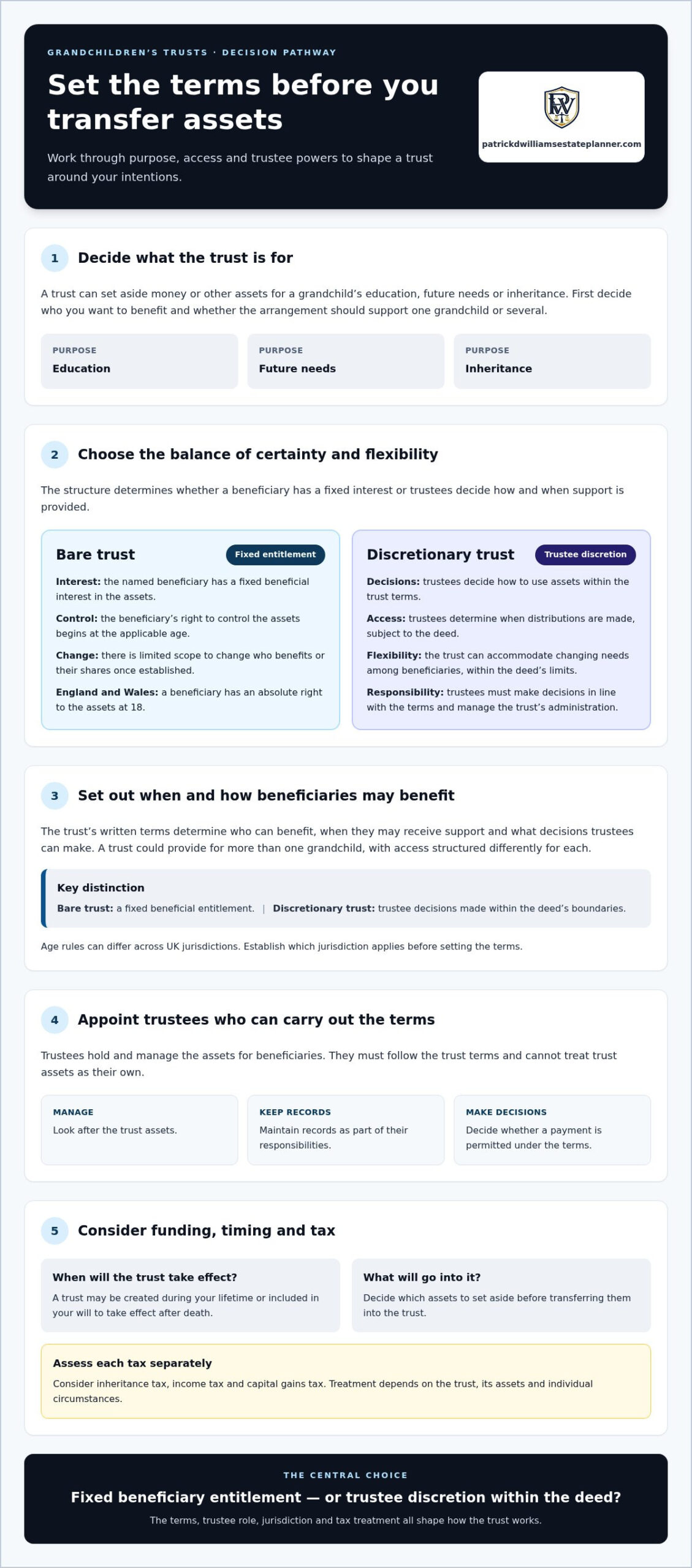
A clear sequence helps turn your intentions into workable trust terms. Before setting up a trust fund for grandchildren UK families should decide who the arrangement is for, what it will hold and how much discretion trustees should have. These decisions guide the legal document, the transfer of assets and the administration that follows.
- Define the purpose and beneficiaries. Decide whether the trust is intended to support one grandchild or several, and whether it should provide for education, future needs or broader financial support. Consider how it should work if family circumstances change, such as the arrival of another grandchild.
- Choose the assets and access terms. Identify what you may transfer, such as cash or other assets, and consider how that transfer could affect your own financial plans. Set out when beneficiaries may benefit and whether trustees should have discretion over the timing or amount of distributions.
- Select suitable trustees. Choose people who can act responsibly, understand the trust’s purpose and manage its practical requirements. Consider whether they can work together and remain involved over time. Their role is to follow the trust terms and keep appropriate records, not to use trust property for themselves.
- Set out the terms in the right document. A trust created during your lifetime will generally be documented in a trust deed. Alternatively, your will can provide for a trust to take effect after your death. The document should reflect the chosen structure, beneficiaries, permitted decisions and distribution terms. For a bare trust, the UK bare trust overview explains how a beneficiary’s fixed entitlement affects the arrangement.
- Complete the transfer and retain evidence. Establishing the trust and funding it are separate steps. Once the terms are prepared, transfer the intended assets in the appropriate way and keep records of what was transferred, when it happened and any related valuations or documents. Asset-specific requirements may apply, so the transfer should match the trust documentation.
- Check tax, registration and ongoing duties. Before funding the trust, establish which tax returns, records and reporting duties apply to its type and assets. Most new UK express trusts must be registered with HMRC’s Trust Registration Service within 90 days of creation, although exemptions apply, including to some bare trusts for minors. Confirm whether the particular trust qualifies for an exemption and note any relevant deadlines.
- Review the arrangement periodically. Keep the trust documents and records accessible to trustees, and review whether its terms and administration still reflect your intentions as family circumstances or applicable requirements change.
Careful drafting can help ensure the arrangement reflects your wishes and gives trustees clear guidance. Patrick D Williams Estate Planners supports clients with trust planning and documentation. Details of the trust planning consultation are available online.
Putting your grandchildren’s trust into a wider estate plan
A trust for your grandchildren is one part of your wider estate planning. Its terms should sit comfortably alongside your will and other plans for your assets, so that each document reflects the same intentions. The decisions involved in setting up a trust fund for grandchildren UK families make should be considered in that wider context, not in isolation.
A trust can support a planned inheritance, but it can’t guarantee a particular outcome, prevent every family disagreement or remove tax. Its effect depends on the wording, the assets and the circumstances when decisions are made. Clear, consistent planning helps everyone involved understand the purpose of the arrangement and the role it plays in your estate.
Coordinate the trust with your will and family plans
If you establish a trust during your lifetime, consider how it fits with the assets and gifts described in your will. If your will is intended to create a trust after your death, its provisions should explain how that arrangement is meant to operate. In either case, check that your documents don’t leave uncertainty about which assets are intended for your grandchildren or how your plans relate to other beneficiaries.
Your wider intentions may include providing for a spouse or partner, supporting children and grandchildren, or distributing different assets in different ways. Reviewing your will and estate planning alongside the trust can help keep those decisions aligned. Where appropriate, explain the purpose of the plan to relevant family members. A clear conversation may help them understand your intentions, although it can’t guarantee agreement or prevent disputes.
Trust arrangements also need attention as life changes. A trustee’s ability to continue, a beneficiary’s needs or your own financial position may shift. Review whether the people involved remain suitable and whether the trust terms still reflect your intentions. Consider any proposed change in light of the document and the legal and tax consequences, rather than assuming it will be straightforward.
Take a measured next step with professional guidance
Before seeking guidance, bring together the main decisions: the trust’s purpose, who should benefit, which assets you may transfer, when beneficiaries should have access and how much discretion trustees should have. It can also help to note how the trust should fit with your will and what questions you have about administration. This gives the planning discussion a practical starting point.
Patrick D Williams Estate Planners offers a free 15-minute consultation by Zoom, Teams or in person. It provides an opportunity to discuss how trust documentation and will planning can reflect your family intentions, without needing to have every detail settled beforehand.
Reviewing the whole plan can bring greater clarity to your decisions. Information about estate planning is available online.
Make your next estate-planning decision with clarity
A thoughtful plan starts with the intentions you want your documents to express. Before taking the next step, consider what matters most to you: how your grandchildren may benefit, who you trust to carry out your wishes and how the arrangement fits the future you envisage for your family. These priorities can guide setting up a trust fund for grandchildren UK families can include in a considered wider plan.
Professional guidance can help turn those intentions into clear documentation. Patrick D Williams Estate Planners supports clients with bare trusts, discretionary trusts and will writing. A free 15-minute consultation is available by Zoom, Teams or in person, offering a starting point for discussing your plans.
Arrange a free 15-minute estate planning consultation to discuss your plans and the next steps. A clear plan can help you approach your family’s future with greater confidence.
Frequently Asked Questions
Can grandparents set up a trust fund for a grandchild?
Yes, grandparents can establish a trust for a grandchild during their lifetime or make provision for one in a will. The grandparent can decide which assets the trust is intended to hold and who should benefit, subject to the trust’s terms and applicable law. Before transferring anything, consider how the arrangement fits with your own financial needs and other family commitments. Document the trust to reflect those intentions clearly.
At what age can a grandchild access money in a trust?
There isn’t one age that applies to every trust across the UK. Under a bare trust in England and Wales, a beneficiary generally becomes entitled to control the assets at 18. A discretionary trust works differently: the deed sets the framework, and trustees decide whether and when to make permitted payments. Rules can differ between UK jurisdictions, so the trust’s jurisdiction and terms matter.
Can grandparents change the beneficiaries of a trust?
It depends on the trust deed and structure. A bare trust gives its named beneficiary a fixed entitlement, so changing the beneficiary after creation is generally not straightforward. A discretionary trust may let trustees distribute benefits among a defined group, but that doesn’t mean the settlor can freely add or remove beneficiaries. If the trust is only planned in a will, the will can generally be revised while the maker has capacity and follows the applicable formalities.
Do trust funds for grandchildren have to be registered with HMRC?
Not every trust must be registered. Most new UK express trusts need registration with HMRC’s Trust Registration Service within 90 days of creation, but exemptions apply, including to some bare trusts for minors. Whether an exemption applies depends on the trust’s specific circumstances. Registration is separate from tax returns or other reporting duties, so trustees should identify each requirement and its deadline rather than assume one process covers them all.
Can a trust fund pay for a grandchild’s education?
Yes, a trust may pay education costs if its terms permit that use and the trustees have authority to make the payment. For example, trustees might pay a school or course provider directly rather than give money to the grandchild. Before making a distribution, trustees should check that the expense benefits someone covered by the trust and keep records of the decision and payment. Tax treatment may depend on the trust and the payment.
Is setting up a trust for grandchildren a way to avoid inheritance tax?
No. Setting up a trust isn’t a guaranteed way to avoid inheritance tax. The tax position depends on the trust structure, the value and type of assets, the transfer and the people’s circumstances. Some transfers may lead to an immediate charge, and some trusts can face periodic or exit charges. A gift to trust may receive different treatment if specific conditions are met, so assess the consequences before transferring assets.
Leave a Reply