

A bare trust can separate the handling of an asset from the right to benefit from it. That distinction matters: the trustee holds legal title, but the beneficiary has the beneficial ownership and an immediate, absolute entitlement to the trust property.
It’s understandable to expect a trust to give the trustee lasting control or protect assets from claims. A bare trust generally does neither. The trustee administers the property but has no discretion to decide who benefits or how the assets are used, and the beneficiary’s rights can limit the flexibility the arrangement offers.
This guide explains how the trustee, beneficiary and trust property relate, and what that means in practice. It also outlines the responsibilities and limits to consider, including how tax and registration requirements may apply. The right arrangement depends on your intentions and wider estate plan, so understanding the beneficiary’s entitlement is an important step before deciding whether a bare trust is suitable.
Key Takeaways
- Learn how a bare trust separates legal title from the beneficiary’s entitlement, and why that distinction matters when assets are held for someone else.
- Follow the practical stages of setting up and administering a trust, while accounting for the asset type and the arrangement’s terms.
- Recognise the limits of trustee discretion and why a bare trust should not be assumed to protect assets from claims or other consequences.
- Use a clear planning sequence to define the purpose, identify the beneficiary, review the assets and document your intentions.
- See how bespoke documentation and structured advice can help align a trust with your circumstances and wider estate plan.
What is a bare trust, and who owns the assets?
A bare trust is an arrangement in which a trustee holds assets for an identified beneficiary, who has the beneficial interest in them. The trustee holds legal title, but the beneficiary is entitled to the benefit of the trust property. This distinction between holding and benefiting is central to understanding how the arrangement works.
The beneficiary’s entitlement is generally fixed rather than decided by the trustee. The trustee may manage or safeguard assets, but usually has no discretion to choose who benefits or change the beneficiary’s share. The precise legal effect depends on the trust’s terms and circumstances. For a broader introduction to the concept across legal systems, see What is a Bare Trust?
Trustee, beneficiary and trust property in plain English
The trustee is the person who holds legal title and carries out the responsibilities set out for the trust. The beneficiary is the person entitled to benefit from the assets. The trust property is what the trust holds, such as money or investments. These roles describe different relationships to the same property: one involves holding and administration, the other the right to benefit.
For example, a grandparent might transfer money into a trust naming a grandchild as beneficiary, with a family member acting as trustee. The family member may hold and administer the money, but that role alone does not make them entitled to use it for their own benefit. This is a hypothetical illustration, not a recommendation; the document and circumstances shape how an arrangement operates.
How a bare trust differs from a discretionary arrangement
In a bare trust, the beneficiary is identified and has a defined entitlement to the trust property. The trustee’s role is therefore principally to hold and administer it in line with that entitlement, rather than decide how to distribute benefits.
A discretionary arrangement works differently. Its terms give trustees discretion over matters such as which eligible beneficiaries receive benefits and when. That can provide flexibility, but it also means a beneficiary may not have the same fixed entitlement. Exploring discretionary trust planning can help clarify how a different structure may suit different intentions.
This difference affects both control and expectations. Naming someone as trustee does not, by itself, give them the freedom to redirect the assets. Equally, identifying a beneficiary does not necessarily explain every practical detail, such as how an asset can be managed or transferred. The wording, the type of property and the people involved all matter.
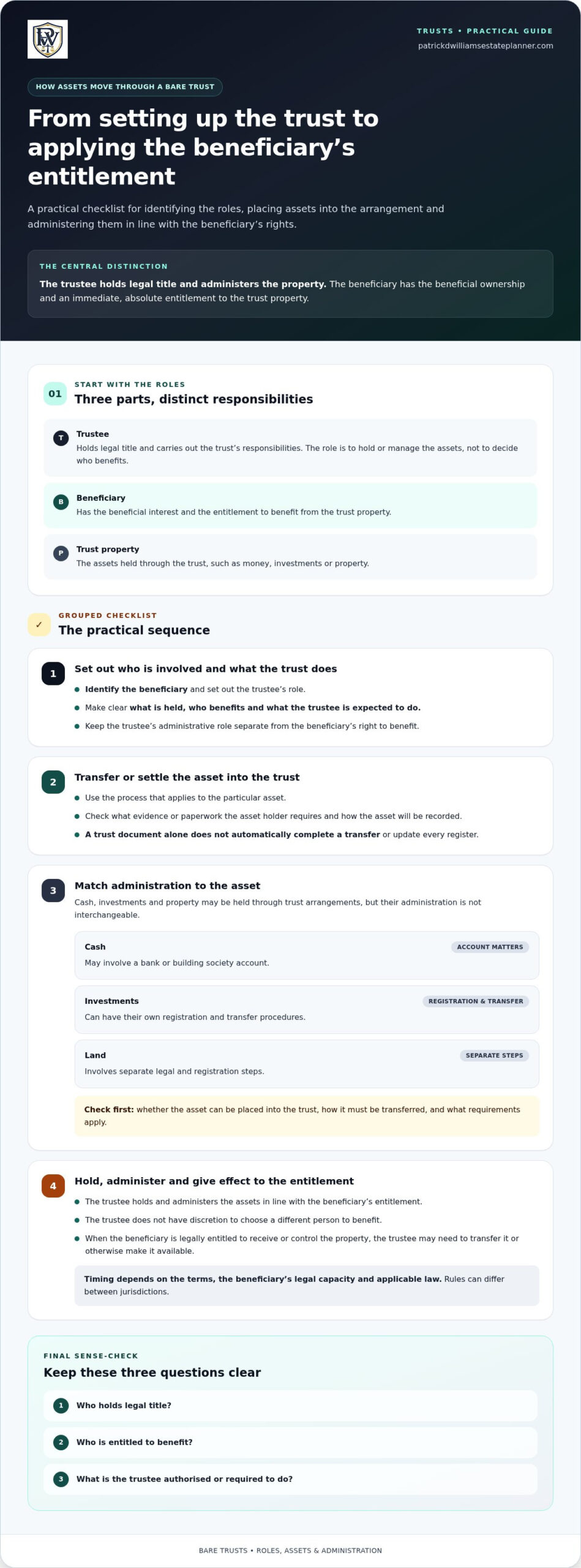
It is useful to separate three questions when reading or considering trust documentation: who holds legal title, who is entitled to benefit, and what actions the trustee is authorised or required to take? Clear answers help prevent the trustee’s administrative role from being mistaken for ownership of the benefit, while keeping the arrangement’s actual terms at the centre of the discussion.
How does a bare trust hold and distribute assets?
A bare trust moves through a practical sequence: the arrangement is established, assets are transferred or settled into it, the trustee holds and administers them, and the beneficiary’s entitlement is then applied. The steps can look different depending on the trust’s terms and the asset involved. Setting up a trust is not the same as completing every transfer needed to place an asset under its administration.
The beneficiary is entitled to the trust property and its benefits, subject to the trust’s terms and applicable law. The trustee’s role is to hold or manage assets in line with that entitlement, not to choose a different person to benefit. Clear documentation helps explain what is held, who benefits and what the trustee is expected to do.
From setting up the trust to administering assets
First, the arrangement identifies the beneficiary and sets out the trustee’s role. Next, the relevant asset is transferred or settled into the trust, using the process appropriate to that property. The trustee then keeps and administers it for the beneficiary. Finally, when the beneficiary is legally entitled to receive or control it, the trustee takes the practical steps needed to give effect to that entitlement.
This sequence is a guide, not a universal checklist. The deed or other documents, the circumstances in which the trust is created and the type of asset can affect what needs to happen at each stage.
What assets can be held?
Cash, investments and property are general examples of assets that may be held through trust arrangements. They are not interchangeable for administration purposes. Money may involve a bank or building society account; investments can have their own registration and transfer procedures; land involves separate legal and registration steps. Whether a particular asset can be placed into a trust, and how, depends on its ownership and applicable requirements.
Before a transfer, the trustee and settlor need to understand what evidence or paperwork the asset holder requires and how the asset will be recorded. A document creating a trust does not automatically complete every transfer or update every register.
Entitlement and the practical transfer
Where the beneficiary is legally entitled to call for the trust property, the trustee may need to transfer it or otherwise make it available. The point at which that right can be exercised depends on the terms, the beneficiary’s legal capacity and the applicable law. Rules can differ between jurisdictions, so an age or timing rule should not be assumed without checking the circumstances.
Even once entitlement is established, administration takes time and care. The trustee may need to confirm the beneficiary’s identity, arrange the relevant account or property transfer, and keep suitable records. Those practical steps do not necessarily change who is entitled to benefit; they are the means of putting that entitlement into effect.
Careful drafting can set out how the arrangement is intended to operate and how it fits the wider estate plan. A structured consultation and bespoke bare trust documentation can help align the paperwork with those intentions.
What can a bare trust do and what are its limitations?
A bare trust can provide a clear arrangement for holding assets for a named beneficiary, but it is not automatically an asset-protection solution. The trustee’s role in holding or administering property does not, by itself, determine how the arrangement will be treated for tax, creditor, care-fee or benefits purposes. Those outcomes depend on the facts, applicable rules and the beneficiary’s circumstances.
The fixed nature of the beneficiary’s entitlement is central. A trustee generally has limited freedom to decide who benefits or redirect the assets. This can make the intended beneficiary clear, but offers less flexibility if circumstances or plans change.
| Feature | What it can mean in practice |
|---|---|
| Defined beneficiary entitlement | The identified beneficiary has a set interest in the trust property, subject to the terms and applicable law. |
| Limited trustee discretion | The trustee administers the assets, but generally cannot choose a different beneficiary or decide freely how benefits are allocated. |
Where it may fit into family or estate planning
A family might consider this type of arrangement when assets are intended for a particular person but need to be held or administered by a trustee. The relevant questions include which asset is involved, who should benefit, what the trustee needs to do and how the arrangement fits alongside a will or other planning documents. These are examples to explore, not recommendations or assurances of a particular outcome.
Clarity matters. If the purpose is uncertain, or the settlor expects trustees to respond flexibly to changing family needs, the structure may not match those intentions. Property protection trust planning is another subject to consider when exploring different estate-planning aims, although each structure has its own purpose and limits.
The trade-off between certainty and flexibility
A named beneficiary and defined entitlement can make the intended destination of assets easier to understand. The corresponding limitation is that trustees usually cannot adapt distributions to changing needs in the way trustees with wider discretion may be able to. The precise position depends on the documents and legal circumstances.
Changing the arrangement later may not be straightforward. A settlor should not assume they can simply revise the beneficiary or terms once assets have been transferred. The beneficiary’s rights, the trust wording and the relevant law can all affect whether a change is possible and what steps it requires.
Before proceeding, consider how the trust could interact with tax, benefits, creditor issues and family relationships. These matters require case-specific review, particularly where assets or beneficiaries are connected to different parts of the UK. Rules can differ between England and Wales and other jurisdictions. A careful assessment of the people, property and intended outcome helps show whether the structure offers suitable clarity without promising protection or flexibility it may not provide.
What should you consider before setting up a bare trust?
Before making arrangements, work through the purpose, beneficiary, assets, possible consequences and documentation in that order. This helps show whether the proposed structure reflects your circumstances and intended outcome, rather than simply matching a general description of how a trust works.
A useful starting point is to be clear about the result you want. Consider whether the aim is to hold a particular asset for an identified person, and whether a fixed entitlement matches your intentions. If you expect trustees to respond to changing needs or choose between potential beneficiaries, that expectation should be examined before settling assets.
Clarify the purpose, beneficiary and assets
Identify who is intended to benefit and which assets may be involved. Consider the beneficiary’s circumstances and future needs, including how receiving or controlling the asset could affect their plans. This is not a prediction of a particular outcome, but a way to make the decision with the beneficiary in mind.
Keep a clear note of the purpose and the reasons behind important decisions. This record can help ensure the trust documentation reflects what you intend, rather than leaving key details to assumption.
Review documentation, tax and administration
Documentation should set out the intended arrangement clearly, including the asset, beneficiary and trustee responsibilities. The steps required to transfer an asset depend on its type and ownership. Cash, investments and property may each involve different records or procedures, so there is no single transfer process that applies to every case.
Tax treatment and reporting responsibilities depend on the facts and current rules. Consider what income or gains might arise, who may be responsible for reporting them, and what records the trustee should retain. Registration or filing requirements may also need to be reviewed against current guidance. These points can change with circumstances, so avoid relying on a broad rule without checking how it applies to the proposed arrangement.
Use this preparation checklist to organise the key details before decisions are made:
- Purpose: Record what the arrangement is intended to achieve.
- Beneficiary: Identify who should benefit and consider their circumstances.
- Assets: List what may be settled and note how each asset is currently held.
- Consequences: Identify questions about tax, reporting, benefits, creditors or family circumstances for professional review.
- Documentation: Set out the intended terms, trustee role and practical administration needs.
This checklist is a preparation aid, not legal or tax advice. A structured review can test whether the proposed terms fit your intentions and how the arrangement sits alongside wider estate planning. For bespoke bare trust advice, arrange a consultation to discuss the purpose, assets and documentation relevant to your circumstances.
How can bespoke bare trust advice support informed planning?
General guidance can explain how a trust works, but the documents need to reflect the people, assets and intentions involved. Bespoke drafting can help set out the proposed arrangement clearly and show how it may fit with a will and wider estate planning. It also provides an opportunity to identify points that need careful consideration before decisions are made.
A structured discussion can bring practical details into focus. The intended beneficiary, the assets to be held and the purpose of the arrangement all shape the questions to address. Family circumstances and future plans may also affect whether the proposed terms are suitable.
What a structured trust-planning discussion can cover
A planning discussion can clarify who is intended to benefit, which assets are involved and what you want the arrangement to achieve. It can also consider relevant family circumstances, trustee responsibilities and how the trust might sit alongside a will or other estate documents. A wider estate planning checklist for UK families can help organise related matters for consideration.
The discussion can identify questions that require legal or tax consideration, such as the implications of transferring a particular asset or how reporting responsibilities may apply. These matters depend on individual facts and current rules, so they should not be assumed from a general explanation.
A measured next step for your estate plan
Patrick D Williams Estate Planners provides bespoke bare trust documentation and structured consultations. The drafting process can focus on expressing your intentions clearly, while considering how the proposed arrangement fits with your wider estate plan. It does not guarantee a particular legal, tax or financial outcome, and the right approach depends on your circumstances.
To prepare for a discussion, you may find it helpful to note:
- Who you intend to benefit and the assets you are considering.
- The purpose of the arrangement and any relevant family circumstances.
- Questions about documentation, administration, tax or reporting that you would like to explore.
Consultations are available by Zoom, Teams or in person. If you would like to discuss whether a bespoke arrangement may fit your intentions, you can arrange a free 15-minute consultation.
Take the next step with a clear plan
Estate planning is most useful when each document supports the outcome you have in mind. Before deciding whether a bare trust belongs in your plans, consider how it relates to your will, the assets you want to provide for and the needs of those who may benefit. A joined-up review can help bring these intentions into focus and identify points that may need further legal or tax consideration.
Patrick D Williams Estate Planners can discuss your circumstances and prepare bespoke trust documentation to reflect your intentions. The aim is to help you make an informed decision, not to assume that one structure suits every family or guarantees a particular result.
If you would value a calm discussion about your estate-planning options, you can arrange a free 15-minute consultation. A considered next step can help you move forward with greater clarity and confidence.
Frequently Asked Questions
Is a bare trust the same as a nominee arrangement?
Not necessarily. A nominee arrangement generally describes someone holding legal title on another person’s behalf, while a bare trust describes a trust relationship in which a beneficiary has a defined beneficial entitlement. A nominee may hold an asset as trustee under a bare trust, but the label alone does not settle the legal position. The documents, conduct and circumstances need to be considered to establish what arrangement exists.
Can a beneficiary demand the assets in a bare trust?
A beneficiary may be able to require the trustee to transfer the assets if they are legally entitled and have capacity to act. The answer can depend on the trust terms, the beneficiary’s age and capacity, the asset and the law that applies. Even where entitlement is clear, transfer may involve additional steps, such as updating account or property records. A review of the documents can clarify the position.
Can you change or cancel a bare trust after it is created?
Not necessarily. Once assets have been transferred and the trust is established, the person who created it may not be free to take them back or change the beneficiary. The trust terms, how it was created and the beneficiary’s rights all matter. A power to amend or revoke should not be assumed. Before taking action, obtain advice based on the documents and circumstances, as an attempted change may not have the intended effect.
Does a bare trust reduce inheritance tax or protect assets from care fees?
No outcome should be assumed. Creating a trust does not automatically reduce inheritance tax or shield assets from care-fee assessments, creditors or other claims. The result can depend on ownership, timing, purpose, the people involved and the relevant rules. For example, transferring an asset while continuing to benefit from it may raise different issues from a genuine transfer. Individual circumstances need professional review before relying on any expected protection or tax result.
How are bare trusts taxed in the UK?
Tax treatment is generally linked to the beneficiary rather than treated as a separate trust tax regime. Income is usually taxed as the beneficiary’s income, and capital gains are generally assessed using the beneficiary’s position. A special rule can apply when a parent provides assets for a minor child: if the income from that parent’s gifts exceeds £100 a year, it may be taxed as the parent’s. Check current HMRC rules for the specific facts.
Does a bare trust need to be registered with HMRC?
Possibly. Trust registration and tax-return filing are separate requirements. Many express trusts, including some bare trusts, may need registration on HMRC’s Trust Registration Service, although exemptions can apply depending on the trust and its assets. Trustees are generally not required to file a trust tax return where the beneficiary reports the taxable income or gains, but exceptions may arise. Confirm current registration and reporting duties against HMRC guidance for the particular arrangement.
What happens to a bare trust if the beneficiary dies?
If the beneficiary dies while entitled to the trust property, the assets will generally form part of their estate rather than automatically returning to the person who created the trust. Their will, or intestacy rules if there is no valid will, may determine who inherits. The trustee may need to establish the correct personal representative and follow asset-specific transfer procedures. The trust wording and applicable law should be checked before deciding how to administer the property.
Is a bare trust suitable for every child receiving money or property?
No. A bare trust may give a child a fixed entitlement, which can mean they gain control at the legally relevant age rather than when a parent or grandparent considers them ready. That may not suit every family or asset. Consider the child’s circumstances, the purpose of the gift, tax consequences and whether flexibility is needed. Age and trust rules can vary across UK jurisdictions, so the applicable law matters.
Leave a Reply