

A family home is neither automatically safe from care fees nor automatically included in every financial assessment. The rules depend on the person’s circumstances, how the property is owned and where they live. Protecting property from care home fees therefore calls for careful, individual planning.
It’s understandable to want to preserve a home for your family, especially when advice about gifts, joint ownership and trusts can seem contradictory. Planning ahead can help you understand your options, but no transfer or trust guarantees that a property will be excluded from an assessment. A local authority may consider whether assets were deliberately given away to reduce care costs. There is no simple seven-year rule that makes a transfer safe.
This guide explains how care assessments and property ownership interact in England and Wales, what a trust may and may not achieve, and how wills and joint-tenancy severance can fit into a wider estate plan. It also explains why care-funding rules differ across the UK and what to consider before making decisions for your family.
Key Takeaways
- Understand how care assessments may consider property, other capital and personal circumstances in England and Wales.
- Learn why protecting property from care home fees has limits, and why gifts or ownership changes may be examined as possible deprivation of assets.
- Compare lifetime gifts, changes to ownership and will-based trusts by their effect on control, family intentions and assessment uncertainty.
- Use a practical checklist to clarify ownership, family wishes and existing documents before changing your estate plan.
- See how wills, property protection trusts and joint-tenancy severance can support wider estate planning without guaranteeing a home is excluded from care fees.
Protecting property from care home fees: what planning can realistically do
Care-fee planning is part of wider estate planning. It can help you understand who owns a property, record your wishes and consider how your estate may pass to family. It cannot guarantee that a home or its value will be excluded from a financial assessment. The local authority applies the charging rules to the person’s circumstances when care is needed, rather than simply accepting how a family has arranged its affairs.
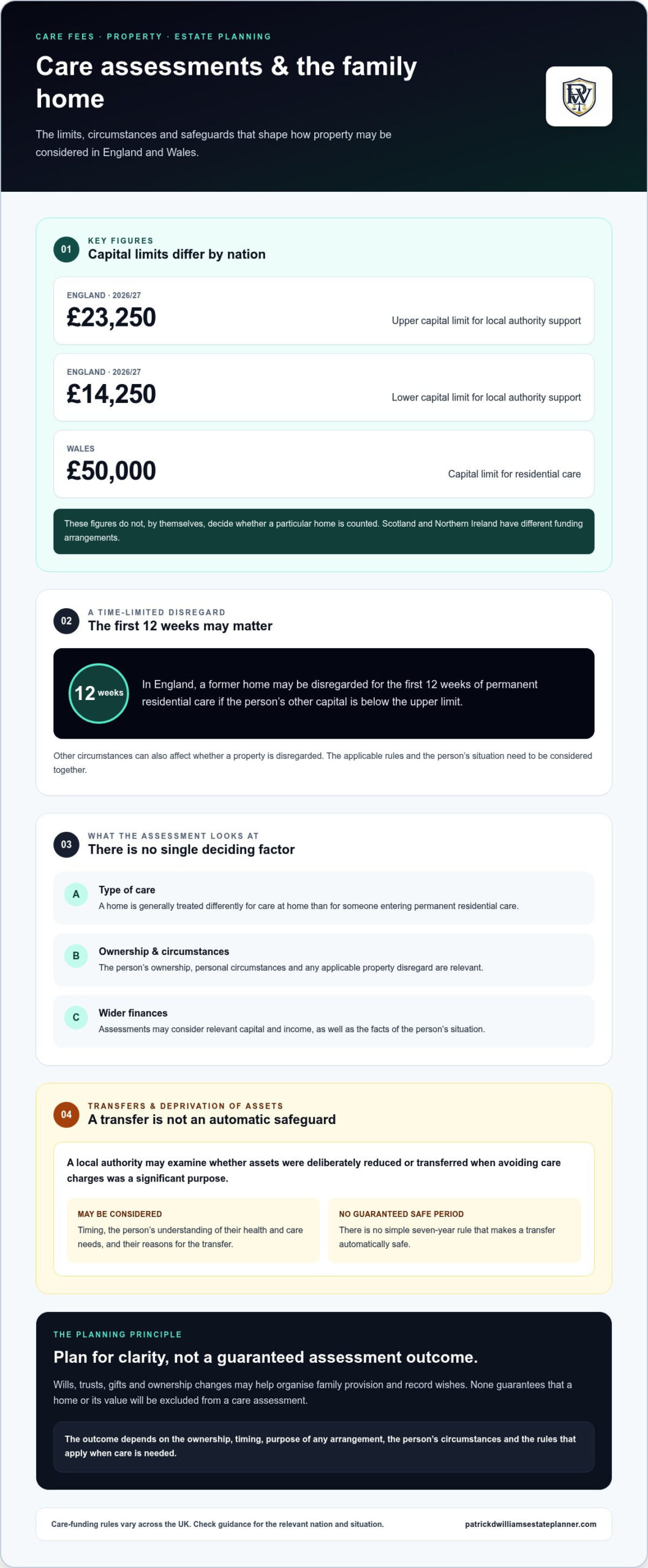
An assessment may consider relevant capital, income and personal circumstances. In England, for 2026/27, the upper capital limit for local authority support is £23,250 and the lower limit is £14,250. Wales has a £50,000 capital limit for residential care. These figures do not, by themselves, determine whether a particular home is counted. Scotland and Northern Ireland have different funding arrangements, so England and Wales rules should not be applied across the whole UK.
Whether a home is taken into account depends on ownership, the person’s circumstances and the facts considered in the assessment. No single planning measure decides the outcome.
When might a property be considered in a care assessment?
The treatment of a home depends on the type of care and any applicable disregard. For care at home, the person’s home is generally treated differently from property owned by someone entering permanent residential care, although income and other capital may still be assessed. In England, a former home may be disregarded for the first 12 weeks of permanent residential care if the person’s other capital is below the upper limit. Other circumstances can also affect whether a property is disregarded. Current local authority and government guidance explains how the rules apply to the relevant nation and situation.
What does “protecting the home” mean in estate planning?
Protecting a home can mean clarifying ownership and inheritance wishes, or planning how a share of a property may pass under a will. That is different from avoiding a contribution that care-funding rules lawfully require. A will or trust may help organise provision for family, but it does not guarantee a particular assessment result. Good planning considers both future care needs and what a person hopes to pass on.
For example, a couple may want to provide for the surviving partner while also deciding what should happen to the deceased partner’s share later. The right approach depends on the legal ownership, the couple’s wishes and the needs of anyone who may rely on the property. The plan should also account for the fact that care needs can arise after documents are made, and that an authority will assess the relevant facts under the rules in force at that time.
Consider estate planning as a way to make informed decisions, not as a promise that care costs will be avoided. Reviewing ownership, wills and family circumstances can help identify suitable options and set realistic expectations about how assessments work.
How care assessments and deprivation-of-assets rules affect property planning
A local authority assesses a person’s finances under the charging framework that applies where they live and receive care. In England and Wales, the assessment considers relevant capital, income and circumstances, including whether particular assets or parts of a property should be disregarded. The authority looks at the person’s actual financial position and the applicable rules, not simply the label attached to a gift or trust.
Deprivation of assets means deliberately reducing or transferring assets in circumstances where avoiding care charges is a significant purpose. The authority may consider what the person intended and whether they could reasonably have expected to need care when they made the transfer. A past gift does not automatically amount to deprivation, but calling a transfer estate planning does not settle the matter.
A gift or trust does not automatically prevent a home or its value from being assessed. The outcome depends on ownership, timing, the purpose of the arrangement and the person’s circumstances under the applicable rules. Protecting property from care home fees should not be treated as a guaranteed result of transferring an asset. Carehome.co.uk’s guide to deprivation of assets and care home fees explains common misconceptions and examples.
How can a local authority consider a gift or transfer?
The authority may examine when an asset was transferred, what the person understood about their health and care needs, and their reasons for making the decision. For instance, a gift made as part of an established pattern of modest giving may raise different questions from a substantial transfer made after care needs became apparent. The details matter. There is no universal time limit that makes a transfer automatically safe, so do not rely on a fixed period as a guarantee. Decisions should be based on relevant evidence and current guidance.
Keep documents that help explain the circumstances, such as records of the transfer, the person’s stated reasons and relevant estate-planning documents. This cannot ensure a particular assessment, but it can help establish what happened and why. Care-funding rules differ across the UK, so the guidance you use should relate to the nation responsible for the assessment.
What happens if a family disagrees with an assessment?
Request the authority’s written reasons and the information it relied on, including how it treated a property interest or earlier transfer. Check that the facts about ownership, dates and care circumstances are accurate. Keep copies of correspondence and supporting documents, and note any deadlines for responding.
Review or challenge routes depend on the decision, the nation and the process that applies. Ask the authority to explain its review or complaints procedure, then follow the relevant current guidance. A disagreement can be distressing, but understanding the decision and gathering the evidence gives the family a practical basis for responding.
Where ownership arrangements and family intentions need to be considered together, a tailored estate-planning discussion can help clarify the choices without promising a care-funding outcome. Discuss your property and estate-planning circumstances as part of a wider plan for family provision.
Comparing gifts, ownership changes and trusts for care-fee planning
There’s no single option that suits every household. The right choice depends on how the property is owned, who needs security from it and what the owners want to happen to their estate. Each approach also carries assessment uncertainty. Use this comparison to identify questions to explore, not as a promise that any option will keep a home outside a care assessment.
Lifetime gift
Control: Giving away a property or share can mean giving up control. The recipient may gain rights or responsibilities, and the transfer can have consequences beyond care-fee assessment.
Family intentions and complexity: A gift may suit a clear wish to transfer ownership during a person’s lifetime, but it can be difficult to reverse if circumstances or relationships change.
Assessment uncertainty: The authority may consider the purpose and timing of a gift, particularly if care needs were foreseeable.
Ownership change
Control: Changing how co-owners hold a property can clarify their respective interests, but each owner’s rights and future needs still need consideration.
Family intentions and complexity: Joint tenants own the property together with survivorship applying, whilst tenants in common hold separate shares that can pass under a will. The change should reflect the owners’ intentions and be recorded correctly.
Assessment uncertainty: A revised ownership arrangement does not determine how a local authority will treat a person’s interest. The joint-tenancy severance guide explains the ownership mechanics.
Will-based trust planning
Control: A trust created by a will takes effect under its terms after death, rather than transferring the property during the owner’s lifetime.
Family intentions and complexity: It may be considered where a person wants to provide for a surviving partner while directing what happens to an interest in the estate later. The terms need to account for the survivor’s needs as well as the intended beneficiaries.
Assessment uncertainty: A will-based trust is an estate-planning arrangement, not a guarantee that a property share will be disregarded. How it operates depends on ownership and the estate’s circumstances. The property protection trust guide explains more about how this type of trust works.
Lifetime gifts and changes to property ownership
Before making a gift or changing ownership, consider how much control you may give up and how the arrangement could affect everyone involved. Severing a joint tenancy can change how an owner’s interest passes on death, but it does not automatically determine future care-funding treatment. Both the legal ownership and the reasons for the change matter.
Will-based trusts and the limits of protection
A trust in a will can help express inheritance intentions, but it takes effect according to the will and the estate that exists at the time. Consider whether the surviving owner can meet their ongoing needs and whether the beneficiaries’ interests are compatible. When protecting property from care home fees, weigh these aims against the uncertainty of any later assessment rather than treating the trust as a shield.
A practical checklist before making changes to your home or estate plan
Before changing ownership, making a gift or creating a trust, gather the facts and clarify what you want the plan to achieve. A step-by-step review helps you consider care preferences, family needs and inheritance intentions together. It can also make a discussion about protecting property from care home fees more focused, without assuming that any arrangement will determine a future assessment.
- Establish ownership. Check whose names are on the property records and how the home is legally owned. Note any co-owners, shares, mortgage or existing arrangements that may affect what each person can decide.
- Map family wishes and needs. Record who may need to live in the home, who relies on it and what each person hopes will happen to it. Include practical care preferences and the surviving owner’s housing needs, not only what beneficiaries may inherit.
- Review current documents. Gather wills, property records and paperwork relating to trusts or changes in ownership. Check that the documents reflect the current family situation and identify any significant gifts or transfers already made.
- Assess suitable options. With the facts and wishes in view, consider whether documents need updating or whether an ownership or trust arrangement merits discussion. Weigh the effect on control, family provision and future needs, as well as uncertainty around care assessments.
Gather the facts before deciding
A clear record is useful. Write down when ownership changed, what interest was transferred, who received any gift and the reasons for the decision. Include relevant circumstances at the time, such as known care needs or changes in health. This record cannot guarantee how an authority will view a transfer, but it can help explain the history accurately rather than relying on memory later.
Set out each person’s priorities separately. One co-owner may value remaining in the home, whilst another may focus on providing for children. Making those differences visible early can reveal where a proposed arrangement needs careful thought, particularly if one person’s inheritance intentions could affect another’s security or use of the property.
Review the plan as circumstances change
Review an estate plan after a change in health, relationships, property ownership or family needs. A new partner, a bereavement, a move or a relative becoming dependent on the home may alter what a document needs to achieve. Reviewing the plan before pressure builds gives you space to make considered decisions rather than rushing in response to an immediate concern.
Planning early gives you more time to understand the choices, but it does not remove assessment uncertainty or make a transfer automatically safe. The aim is to make informed decisions that consider care as well as succession. A free 15-minute estate-planning consultation can provide a starting point for discussing ownership, family wishes and the documents you’ve gathered.
How Patrick D Williams Estate Planners can help with property planning
Estate planning brings property ownership, family wishes and future care considerations into one discussion. Patrick D Williams Estate Planners provides will writing, property protection trusts and joint-tenancy severance to help organise how property is held or passed on. These are not guaranteed ways to exclude a home from a care assessment. A plan should reflect the owners’ circumstances and intentions, rather than rely on a promised funding outcome.
A will can set out what should happen to an estate after death, whilst a trust can structure provision for family members. Joint-tenancy severance can change how co-owners hold their interests. Each option has different effects, so start by understanding the current ownership and what each person wants to achieve. The will-writing service guide offers related considerations for planning a will.
What a tailored estate-planning discussion can cover
A useful discussion brings together your wishes, property ownership and existing documents. It can help identify whether a will or trust arrangement may suit your family’s circumstances and what questions need further consideration. The needs of a surviving owner, anyone living in the home and intended beneficiaries all matter. No discussion can predict how a local authority will assess care needs or guarantee a particular inheritance outcome.
It may be helpful to consider:
- How the property is owned and whether there are existing shares or arrangements.
- What you want to happen to your estate, and who may depend on the home.
- Whether your current will reflects your family’s circumstances and intentions.
- How a proposed change could affect control, future housing needs and family provision.
Choose a straightforward next step
Before a conversation, gather your current will, property ownership records and details of significant transfers. Note the questions you want to resolve, including how your wishes can be recorded and what trade-offs a proposed arrangement may involve. These details can make the discussion more focused and help distinguish your estate-planning aims from assumptions about care-fee treatment.
Planning around a family home can involve sensitive decisions. A measured review gives you space to explain what matters and consider options in context, without treating any trust or ownership change as a guaranteed fee shield. This is particularly valuable where family members have different needs or a surviving partner’s security must be considered alongside future inheritance intentions.
Patrick D Williams Estate Planners offers a free 15-minute consultation by Zoom, Teams or in person. Request a free 15-minute consultation to discuss your property and estate-planning needs.
Take the next step with clarity
Planning for a family home is not about making every future outcome certain. It is about recording your wishes in considered arrangements and understanding the choices available before circumstances become difficult. A useful next step is to discuss the priorities that matter most to you, including who may need a home, how you want your estate to pass and what questions remain about care planning.
This can help you consider protecting property from care home fees within the wider context of your family’s needs, rather than treating one document or ownership change as a complete solution. Bring your questions and relevant property or will documents so the discussion can focus on your situation and the decisions ahead.
Patrick D Williams Estate Planners offers a free 15-minute consultation by Zoom, Teams or in person. Arrange a free 15-minute estate-planning consultation to take a measured first step towards a plan that reflects your wishes.
Frequently Asked Questions
Can a local authority make relatives pay a family member’s care home fees?
Usually, no. In England and Wales, care charges are generally assessed against the person receiving care, not automatically passed to adult children or other relatives. A relative could become liable if they signed an agreement accepting responsibility, such as a guarantee, or separately agreed to pay. Before signing care-home paperwork, read any payment undertaking carefully and establish whose funds are being used. Don’t sign on someone else’s behalf unless you understand the commitment.
Can a local authority force the sale of a home to pay care home fees?
A local authority doesn’t usually order an immediate sale simply because someone needs residential care. If a property is counted in an assessment, the person may need to fund their fees, but a deferred payment arrangement may be available in England or Wales if the relevant conditions are met. This can allow care costs to be deferred against the property. Ask for the options and any implications to be explained in writing before deciding how to proceed.
Is a jointly owned home always included in a care-fee assessment?
No. A jointly owned home isn’t automatically counted in full. The assessment may depend on whether the person is receiving care at home or permanent residential care, who else lives in the property and whether a disregard applies. If only one co-owner enters care, the authority may need to consider that person’s interest rather than treating the whole property as theirs. Check that the ownership details and circumstances relied on in the assessment are accurate.
Can I give my house to my children and continue living in it?
A person may transfer ownership and arrange to remain living in the home, but the transfer can have serious consequences. You may give up control, and your children’s circumstances could affect the property, for example if they face financial difficulties. A gift is not a guaranteed way to exclude the home when protecting property from care home fees. The authority may examine its purpose and timing, particularly if care was foreseeable. Consider tailored estate-planning advice before transferring ownership.
Does the 12-week property disregard apply to everyone entering a care home?
No. In England, the 12-week disregard applies in specified circumstances when someone enters permanent residential care, including where their other capital is below the upper limit. It doesn’t automatically apply to every care-home stay, such as a temporary placement, and other rules may affect the assessment. Wales has its own care-funding framework. Ask the council to explain whether the disregard applies to the person’s circumstances and how it has treated the property.
What can I do if I disagree with a council’s care-fee financial assessment?
Ask the council for a written breakdown of its decision, including how it treated income, capital, property interests and any disregards. Check the details against ownership records and provide documents that correct or clarify the information. Then follow the council’s review or complaints process, keeping copies of correspondence and noting any response deadlines. The available challenge route depends on the decision and the relevant UK nation, so request clear instructions on the next step.
Leave a Reply