

A change to how a home is owned can alter who inherits a share, even when the names on the legal title stay the same. The severance of the joint tenancy changes the beneficial ownership: instead of the surviving owner automatically receiving the whole property, each owner holds a distinct share that may pass under a will. The legal title usually remains in joint names.
It’s understandable to be unsure whether every owner must agree, or how the legal title differs from beneficial ownership. In England and Wales, one owner can generally sever a joint tenancy without the others’ consent, but the decision has lasting implications for inheritance and estate planning.
This guide explains what severance changes, the general steps and records involved, and why making or updating a will is an important part of the process. It also considers how severance may fit with your wider estate plans, so you can decide whether it reflects your intentions and whether professional drafting support would help.
Key Takeaways
- Understand how the severance of the joint tenancy can change inheritance arrangements while the legal title remains in joint names.
- See the general steps involved, from reviewing ownership and giving notice to applying for a restriction at HM Land Registry.
- Compare survivorship with ownership as tenants in common to consider which arrangement better reflects your intentions.
- Review the title register, mortgage position and existing wills before changing the ownership arrangement.
- Learn why severance alone does not settle questions about occupation, sale or the value of each share, and how coordinated estate planning can bring greater clarity.
What severance of the joint tenancy changes in property ownership
The severance of the joint tenancy changes the beneficial ownership of a property. It ends the joint-tenancy arrangement for the owner who severs it, creating a distinct beneficial share held as a tenant in common. Severance does not, by itself, transfer the property to someone else or require the owners to sell it.
To understand the effect, separate two concepts. The legal title identifies the registered proprietors who hold the property’s legal estate. The beneficial ownership describes who is entitled to its value and how that interest may pass. These concepts are connected, but they are not the same. Beneficial ownership can therefore change while the co-owners remain on the legal title.
Joint tenancy and tenancy in common: the essential distinction
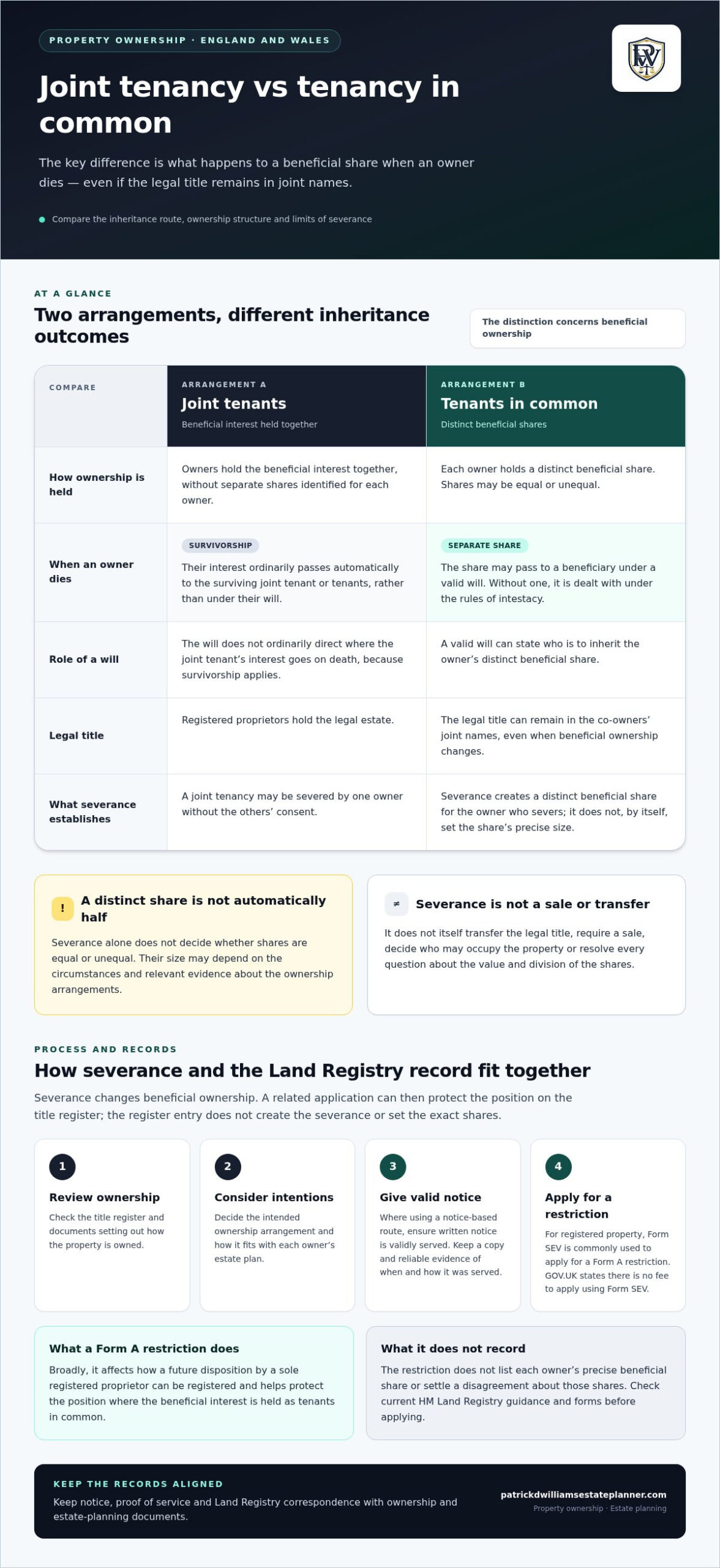
Joint tenants own the beneficial interest together, without separate shares identified for each owner. The right of survivorship applies: when one joint tenant dies, their interest ordinarily passes automatically to the surviving joint tenant or tenants, rather than under their will.
Tenants in common, by contrast, hold distinct beneficial shares. Those shares may be equal or unequal, but severance alone does not decide their precise size. For example, severance does not automatically establish that two owners each hold half. The shares may depend on the circumstances and relevant evidence about the ownership arrangements.
These forms of co-ownership are types of concurrent estate. The distinction matters because it affects what happens to an owner’s beneficial interest on death, even if the names on the registered title do not change.
What happens to survivorship after severance
Once an owner’s interest has been severed, survivorship no longer applies to that distinct share. The owner can leave it to a beneficiary in a valid will. If there is no valid will, the share is dealt with under the rules of intestacy, which may not reflect the owner’s preferred arrangements.
Survivorship passes a joint tenant’s interest automatically to the surviving joint tenants; inheritance under a will passes a distinct beneficial share according to the deceased owner’s instructions.
The surviving co-owner may remain registered as a legal proprietor, even where another person becomes entitled to the deceased owner’s beneficial share. This difference makes careful estate planning and clear records important. Severance does not itself transfer the legal title, force a sale, decide who may occupy the property or resolve every question about the value and division of the shares.
How joint tenancy severance works and what HM Land Registry records
The process has two distinct parts. First, the beneficial ownership arrangement is severed. Then an application can be made to HM Land Registry to protect the resulting position on the title register. The register entry does not create the severance or decide every aspect of beneficial ownership.
A practical sequence is to:
- Review the title register and any documents setting out how the property is owned.
- Decide what ownership arrangement is intended and how it fits with each owner’s estate plan.
- Give notice of severance where using a notice-based route, taking care that it is validly served.
- Apply to HM Land Registry for the appropriate restriction, using the current form and guidance.
Notice of severance and the importance of valid service
In England and Wales, one joint tenant may generally sever unilaterally, without the other owner’s agreement. Section 36(2) of the Law of Property Act 1925 provides for severance by written notice. The notice and its service must meet the relevant requirements. An intention to sever, without effective notice, may not be enough. Keep a copy of the notice and reliable evidence of when and how it was served. GOV.UK explains the process to sever a joint tenancy.
Because service details can affect whether severance has taken effect, do not rely on an informal conversation or an undocumented exchange. If the ownership history or circumstances are complicated, professional support can help clarify the appropriate route before documents are sent.
The HM Land Registry record after severance
For registered property, Form SEV is commonly used to apply for a Form A restriction following severance. HM Land Registry’s current guidance and form set out the application and any required information. GOV.UK states there is no fee to apply using Form SEV. Check the latest instructions before submitting, as forms and evidence requirements can change.
A Form A restriction helps protect the position where the beneficial interest is held as tenants in common. Broadly, it affects how a future disposition by a sole registered proprietor can be registered. It does not list each owner’s precise beneficial share or settle a disagreement about those shares. The application is also distinct from the severance itself: notice may sever the beneficial joint tenancy, while registration records a related restriction on the title.
Keeping the notice, proof of service and Land Registry correspondence with the ownership and estate-planning documents provides a clearer record of what was intended. Patrick D Williams Estate Planners’ joint tenancy severance and estate-planning support can help bring those documents into alignment.
Joint tenancy or tenancy in common: compare the consequences
Choosing between these arrangements means considering which inheritance route reflects the owners’ intentions. A joint tenancy centres on automatic survivorship. A tenancy in common separates the beneficial interests, allowing each owner’s share to be dealt with through their estate. Neither arrangement is right for every household.
| Consideration | Joint tenants | Tenants in common |
|---|---|---|
| Beneficial ownership | Owners hold the interest together, without separately defined shares. | Each owner has a distinct beneficial share, which may be equal or unequal. |
| On an owner’s death | Survivorship ordinarily passes the deceased owner’s interest to the surviving joint tenant or tenants. | The deceased owner’s share may pass under their will or, if there is no valid will, under intestacy rules. |
| Will planning | A will generally cannot redirect an interest that passes by survivorship. | A will can set out who should inherit the owner’s distinct share. |
| Key limitation | The arrangement may not match an intention to benefit someone other than the surviving co-owner. | Separate shares do not by themselves settle their value, occupation arrangements or what happens to the property as a whole. |
When retaining a joint tenancy may fit
Keeping a joint tenancy may suit co-owners who intend the survivor to receive the beneficial interest automatically. That can be a considered choice where owners want the survivor’s position to take priority over a separate inheritance route. The legal definition of joint tenancy offers a general explanation of the concept, though property rules vary by jurisdiction. In England and Wales, assess the decision against the owners’ circumstances and estate plans.
Family relationships alone do not determine what is appropriate. A joint tenancy may not reflect an owner’s wider intentions, such as providing for children from an earlier relationship or leaving a share to another beneficiary. A will generally cannot override survivorship while the beneficial interest remains jointly held.
When separate beneficial shares may be worth considering
Distinct shares may be worth considering where each owner wants their interest to follow a planned route through their will. They can also make the ownership arrangement clearer where contributions or an agreement between owners point to separate interests. However, the severance of the joint tenancy does not itself confirm the value or proportions of each share. Those matters may need to be understood and documented separately.
Severance is one part of estate planning, not a guarantee about who will ultimately receive or benefit from a property. Owners considering how a trust could work alongside their arrangements can read this Property Protection Trust guide.
How to assess severance risks before changing ownership
Before changing the ownership arrangement, establish what is recorded, what the owners have agreed and what each person wants to happen. Severance does not, by itself, determine who can live in the property, require a sale or establish the final value of each beneficial share. It also does not guarantee a particular inheritance or protect an asset from care costs or tax.
Questions to resolve about shares and the property
Start with the title register, then gather any trust documents, written agreements or other records about contributions and beneficial shares. Do not assume the shares are equal simply because there are two owners or because both names appear on the title. The evidence and any agreement may affect how the interests are understood.
Consider the mortgage too. Severance does not itself change the mortgage contract or decide who remains responsible for payments. Existing co-ownership arrangements may also address contributions, occupation or what happens if the property is sold. If owners disagree or the records are unclear, tailored guidance can help clarify the position before documents are changed.
- Title: Check the registered proprietors and any restrictions recorded on the register.
- Shares: Gather agreements and records of contributions, and identify what is known and what remains uncertain.
- Mortgage: Review the current borrowing and obligations alongside the proposed ownership arrangement.
- Wills: Check whether each will reflects the intended destination of that owner’s share.
- Practical arrangements: Consider how occupation, expenses and a possible sale are addressed between co-owners.
Aligning severance with a will and wider estate plan
Once an owner holds a distinct beneficial share, their will should reflect who they intend to inherit it. The will and ownership records should tell a consistent story. If there is no valid will, intestacy rules may determine who inherits instead of the owner’s preferred beneficiary.
Trust planning may also be relevant to the wider estate plan, depending on the owners’ circumstances and aims. A trust does not automatically resolve ownership questions or guarantee a tax or care-fee outcome. Consider the arrangements together, with their limits understood.
A lasting power of attorney is another part of planning for future decision-making. Patrick D Williams Estate Planners offers support aligning ownership documents with your will and wider estate plan.
Plan joint tenancy severance with a clear estate-planning route
A sound decision starts with your intentions, not with a form. Clarify who you want to benefit from your share, understand how the property is currently owned, consider the effects of changing that arrangement, then align the relevant documents. Severance is one part of that plan. It does not guarantee that a particular person will inherit or benefit from the property.
Joint tenancy severance and estate planning are closely connected. If severance creates a distinct beneficial share, the owner’s will should reflect where that share is intended to go. Trust planning may also be relevant in some circumstances. Consider each document alongside the others so the ownership arrangement, will and any trust provisions work towards the same intentions.
What a coordinated review can cover
A review can bring together the current title and ownership information, any records about beneficial shares, your intended beneficiaries and existing estate-planning documents. It can help you assess whether the current ownership structure reflects your wishes and how a proposed change might affect the way your share is dealt with.
Where severance is appropriate, professional support can help prepare the relevant documents and consider the associated registration steps. Will writing and trust planning can be considered alongside this work where appropriate. The aim is clarity and consistency, not a promised inheritance, tax or care-fee outcome.
A calm next step for co-owners
Before a discussion, gather the title register, any mortgage or co-ownership documents, and your current will. Make a note of your intended beneficiaries and any questions about shares, notice or the effect of severance. These records provide a useful starting point, particularly if co-owners have different expectations or past contributions are not clearly documented.
Patrick D Williams Estate Planners provides support with joint tenancy severance, wills and trusts. A free 15-minute consultation offers an opportunity to discuss your circumstances and the questions you would like to resolve. Consultations can take place remotely through Zoom or Teams, or in person.
Learn about joint tenancy severance and estate-planning support
Choose an ownership plan that reflects your wishes
The severance of the joint tenancy can change how a beneficial share is passed on, while the registered legal title may remain in joint names. The choice between joint tenancy and tenancy in common turns on whether automatic survivorship or a separate inheritance route better fits your intentions.
Before deciding, review the title, any records of agreed shares, mortgage arrangements and existing wills. Severance alone does not settle the value of each share or determine occupation and sale arrangements. If you proceed, keeping the ownership documents and your will aligned can make your intentions clearer, without guaranteeing a particular inheritance outcome.
Patrick D Williams Estate Planners provides joint tenancy severance support alongside will and trust planning. A free 15-minute consultation is available remotely or in person, giving you space to discuss your circumstances and possible next steps.
Arrange a free 15-minute consultation to discuss an estate plan that reflects your wishes.
Frequently Asked Questions
What is severance of the joint tenancy?
Severance of the joint tenancy ends joint beneficial ownership, so the owner’s interest is held as a distinct beneficial share under a tenancy in common. The registered legal title may remain in the co-owners’ names. The key change is that the severed share no longer passes automatically to the surviving joint tenant through survivorship. Severance does not, by itself, decide the size of each owner’s share or require the property to be sold.
Can one joint tenant sever a joint tenancy without the other owner’s agreement?
In England and Wales, one joint tenant can generally sever a joint tenancy without obtaining the other owner’s consent, by serving written notice. The notice must meet the relevant legal requirements and be validly served, so simply telling the other owner of an intention may not be sufficient. Keep a copy of the notice and reliable evidence of service. If the circumstances or ownership records are unclear, tailored guidance can help clarify the appropriate steps.
Does severing a joint tenancy mean the property must be sold?
No. Severance changes the beneficial ownership arrangement, but it does not itself transfer the property, compel a sale or decide who may occupy it. The owners may continue to co-own and live in the property, subject to their circumstances and any relevant agreements. A later sale or disagreement about occupation may raise separate questions. Consider the mortgage, existing arrangements and each owner’s intentions before changing the ownership structure.
What happens to a property after a joint tenant dies following severance?
After severance, the deceased owner’s beneficial share does not ordinarily pass to the other owner by survivorship. It may pass under the deceased’s valid will or, if there is no valid will, under intestacy rules. The surviving co-owner may remain on the registered legal title, while the beneficial interest is dealt with through the estate. A will should clearly reflect the owner’s intentions and be consistent with the ownership arrangements.
Does severance automatically give each owner a 50 per cent share?
No. Severance creates distinct beneficial shares, but it does not automatically make them equal or establish their precise proportions. The shares may depend on the circumstances, relevant documents and any agreement between the owners. For example, two owners may have recorded unequal shares, or the available records may not clearly state the intended division. Review any trust document, co-ownership agreement and evidence of contributions rather than assuming that equal shares apply.
How is a joint tenancy severance recorded at HM Land Registry?
For registered property in England and Wales, Form SEV is used to apply for a Form A restriction after severance. The restriction helps reflect the property’s ownership as tenants in common for certain registration purposes. It does not set out each owner’s precise beneficial share or resolve a dispute about them. Check HM Land Registry’s current form and guidance for the application details and evidence requirements, as these may change.
Can a will leave a share of a jointly owned property to someone else?
A will generally cannot redirect a beneficial interest that is still held under a joint tenancy, because survivorship ordinarily passes that interest to the surviving joint tenant or tenants. If the joint tenancy has been severed, the owner’s distinct beneficial share may pass under their will. The will should be reviewed alongside the ownership documents so they reflect the intended inheritance route. Without a valid will, intestacy rules may apply to the share.
Is joint tenancy severance the same throughout the UK?
No. Property law and co-ownership procedures are not identical across the UK. This guide describes the position in England and Wales, where written notice may be used to sever a joint tenancy and HM Land Registry handles registered titles. Scotland and Northern Ireland have different legal systems, so the terminology and process may differ. If the property is outside England and Wales, seek guidance that reflects the law where it is situated.
Leave a Reply