

Giving a gift and dying within seven years doesn’t automatically mean an Inheritance Tax bill. Whether inheritance tax on gifts within 7 years is due depends on the type and value of the gift, the exemptions available and how much of the £325,000 nil-rate band remains.
It’s understandable to want clarity before making a gift, particularly when family members could be affected by an unexpected tax liability. The seven-year rule matters, but it isn’t the whole picture. Some gifts are exempt, gifts to individuals are usually treated differently from transfers into trusts, and taper relief may reduce tax due in certain circumstances. It reduces the tax on a gift, not the gift’s value.
This guide explains how common lifetime gifts are treated, how the nil-rate band and taper relief interact, and what records can help executors understand gifts made during the seven years before death. It also covers gifts that may remain part of an estate because the giver continues to benefit from them. These rules are one part of wider estate planning, so consider lifetime gifts alongside your will and overall intentions.
Key Takeaways
- Understand why inheritance tax on gifts within 7 years depends on the type of gift, available exemptions and how the nil-rate band is applied.
- Learn how outright gifts to individuals differ from exempt gifts and transfers into trusts.
- Follow the main steps for assessing gifts made before death, including how earlier gifts may affect the nil-rate band available for later gifts.
- Keep a clear record of each gift’s date, recipient, value and any exemption relied on, including details of regular gifts from income.
- See how an up-to-date will and a record of lifetime gifts can clarify wider estate intentions without changing the tax treatment of gifts already made.
What does the seven-year rule mean for Inheritance Tax on gifts?
The seven-year rule means that some lifetime gifts to individuals may be included when working out Inheritance Tax if the person who made the gift dies within seven years. It isn’t a universal exemption. The result depends on the type and value of the gift, any exemptions that apply and the donor’s circumstances. The rules for inheritance tax on gifts within 7 years differ from the treatment of money or property left to someone under a will.
An outright gift to an individual is generally a potentially exempt transfer, or PET. A potentially exempt transfer is an outright gift to an individual that may become exempt from Inheritance Tax if the giver survives for seven years. If the donor dies sooner, the gift may need to be considered when calculating tax. Gifts into most trusts are treated differently and may be subject to separate rules, so the seven-year rule doesn’t explain every transfer.
Other circumstances matter too. Giving away an asset but continuing to benefit from it may mean it remains part of the donor’s estate for Inheritance Tax purposes. A will sets out what happens to assets in the estate after death; it doesn’t change how a lifetime gift is treated. The overview of Inheritance Tax in the United Kingdom provides wider background, but the treatment of a particular gift depends on its circumstances.
Which transfers count as gifts for Inheritance Tax?
Gifts can include money, possessions and property. A transfer for less than market value can also count as a gift, because the value given away may be the difference between what the asset is worth and what the recipient pays. The relevant amount isn’t necessarily the cash that changes hands.
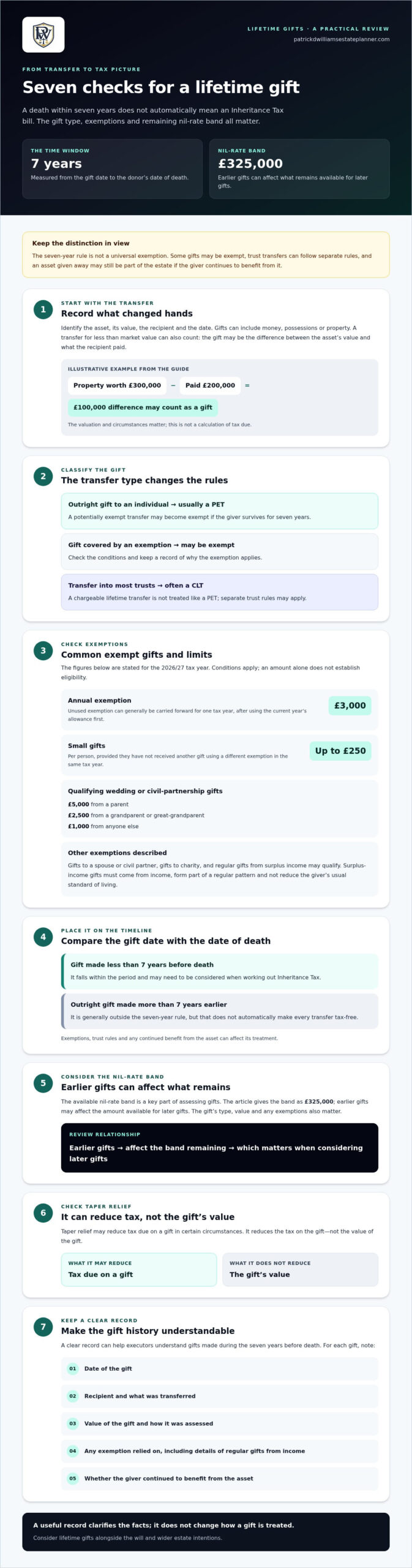
Illustrative example: If a parent transfers a property worth £300,000 to an adult child for £200,000, the £100,000 difference may count as a gift. This illustrates the below-market-value principle described in HMRC guidance; it isn’t a calculation of tax due. The property’s valuation and the circumstances of the transfer matter.
When does the seven-year period start and end?
The period runs from the date the gift is made to the donor’s date of death. A gift made less than seven years before death falls within that period and may need to be considered. An outright gift made more than seven years earlier is generally outside the seven-year rule, but that doesn’t automatically make every transfer tax-free. Exemptions, trust rules and whether the donor continued to benefit from the asset can affect its treatment.
Start by identifying what was transferred, when it happened, who received it and whether the donor retained any benefit. These details help distinguish an outright gift from other arrangements without trying to predict an individual tax bill.
How exemptions, potentially exempt transfers and trusts differ
Before applying the seven-year rule, identify what kind of transfer was made. An outright gift to an individual is usually treated differently from a gift that qualifies for an exemption or a transfer into a trust. This distinction is central to understanding inheritance tax on gifts within 7 years, because the seven-year rule doesn’t apply in the same way to every category.
First identify the gift category. It determines whether the seven-year rule applies, an exemption may remove the gift from account, or separate trust rules need to be considered. The comparison below summarises the main distinctions. The GOV.UK guidance on Inheritance Tax and gifts explains the current rules and conditions.
| Transfer type | General treatment | What to consider |
|---|---|---|
| Outright gift to an individual | Usually a potentially exempt transfer (PET). | It may become exempt if the donor survives seven years. If not, its treatment depends on the wider circumstances and available exemptions. |
| Gift covered by an exemption | May be exempt without relying on the seven-year rule. | Eligibility conditions and limits apply. Keep records showing why the exemption was used. |
| Transfer into a trust | Many trust transfers are chargeable lifetime transfers (CLTs), not PETs. | Separate rules may mean an immediate charge or later trust charges, depending on the transfer and trust. |
Which gifts may be exempt without relying on seven years?
For the 2026/27 tax year, common exemptions include gifts to a spouse or civil partner, gifts to charity and the annual exemption of £3,000. Any unused annual exemption can generally be carried forward for one tax year, after using the current year’s allowance first. Small gifts of up to £250 per person may also qualify, provided that person hasn’t received another gift using a different exemption in the same tax year.
Qualifying wedding or civil-partnership gifts are exempt up to £5,000 from a parent, £2,500 from a grandparent or great-grandparent, or £1,000 from anyone else. Regular gifts from surplus income may also qualify if they’re made from income, form part of a regular pattern and don’t reduce the giver’s usual standard of living. Each exemption has conditions, so the amount alone doesn’t establish eligibility.
Why can gifts into trusts follow different rules?
A transfer into most trusts may be a CLT and can be subject to different Inheritance Tax rules from an outright gift to an individual. For example, a 20% lifetime charge may apply to the value above the available £325,000 nil-rate band. Periodic charges, generally assessed every 10 years, and charges when trust assets leave the trust may also apply. The precise treatment depends on the trust and transfer, so a trust shouldn’t be viewed as an automatic way to avoid tax. The guide to discretionary trusts explains more about how that structure works.
Keeping the gift, exemption and recipient details together can make wider estate planning clearer. If you’re reviewing how your will records your intentions, Patrick D Williams Estate Planners provides will writing and estate planning, with a free 15-minute consultation.
What happens if you die within seven years of making a gift?
If the donor dies within seven years of making a gift, it may affect the Inheritance Tax calculation. That doesn’t mean tax is automatically due. The outcome depends on the type of transfer, exemptions, the nil-rate band available and, where relevant, how long before death the gift was made.
The nil-rate band determines how much value can be covered before Inheritance Tax is due, whilst taper relief reduces tax on a qualifying gift, not the gift’s value. For 2026/27, the standard nil-rate band is £325,000. Gifts are generally considered in date order, with earlier gifts using the available band before later ones. The estate and gifts must be considered together under the applicable rules.
Use this sequence to organise the information:
- Classify each transfer. Identify whether it was an outright gift to an individual, a potentially exempt transfer, a trust transfer or another type of transfer. Different categories can follow different rules.
- Apply any relevant exemptions. Work out whether an exemption covers all or part of each gift, and keep evidence supporting its use.
- Consider the nil-rate band. Account for relevant gifts in chronological order. Earlier gifts may use some or all of the available £325,000 before later gifts are assessed.
- Assess whether tax is due. If the value subject to tax exceeds the available band, calculate the tax and consider whether taper relief applies to a qualifying gift.
This is a framework, not an individual tax calculation. The treatment of inheritance tax on gifts within 7 years depends on the full gift history and estate circumstances. The GOV.UK guidance on Inheritance Tax and gifts sets out information on gifts, exemptions and tax calculations.
When can taper relief reduce the tax due?
Taper relief may reduce the tax payable on a gift made between three and seven years before death, but only where the relevant gifts exceed the available nil-rate band. The time between gift and death determines the rate: 0 to 3 years, 40%; 3 to 4 years, 32%; 4 to 5 years, 24%; 5 to 6 years, 16%; and 6 to 7 years, 8%. These are the rates of tax after taper relief. It doesn’t automatically make every gift within seven years tax-free.
Who may have to pay Inheritance Tax on a gift?
Tax attributable to a gift may be payable by its recipient, particularly when the value of gifts uses up the nil-rate band. In other circumstances, tax connected with gifts may be payable from the estate. Responsibility depends on the gift, its value and the applicable rules, so a general example can’t establish who is liable in a particular case. For a personal assessment, refer to HMRC guidance or seek suitable tax advice.
How to review a lifetime gift and keep useful records
A clear gift record helps the donor, family and executors understand what was transferred and when. It can also support a later review of whether an exemption may apply. Make a separate entry for each gift and gather documents that explain the transfer. This is especially useful if there have been several gifts over time, as dates and values can affect how inheritance tax on gifts within 7 years is assessed.
Use this checklist to organise the information:
- Date and recipient: Record when the gift was made and who received it.
- What was given: Describe the asset or record the amount of money transferred.
- Value and evidence: Note the value at the time of the gift and keep supporting evidence, such as a valuation, transfer record or relevant account statement.
- Exemption claimed: Record the exemption relied on and keep documents that support its conditions.
- Donor’s continuing use: Note whether the donor retained access to, use of or another benefit from the asset.
Keep relevant correspondence, agreements and proof of transfer with the record. If the gift was made for less than market value, retain information that helps explain how the value transferred was assessed. Records don’t establish an exemption or determine the final tax position by themselves, but they give executors a fuller account to review. The UK executor guide explains related responsibilities involved in administering an estate.
What information should a gift record include?
For regular gifts from income, keep records showing the pattern of giving and the donor’s income and outgoings. This can help explain whether gifts were made regularly from surplus income and whether they affected the donor’s usual standard of living, conditions relevant to the exemption. Bank statements and a note of the donor’s reasoning can support the record, but they don’t guarantee that the exemption applies.
What if the donor kept using the gifted asset?
A transfer needs separate consideration if the donor continued to benefit from what was given away. For example, if a parent gives a home to an adult child but continues living there rent-free, the arrangement may be treated as a gift with reservation of benefit. The home may remain part of the donor’s estate for Inheritance Tax purposes, even if the donor survives more than seven years after the transfer.
Consider what happened in practice, not only what the paperwork says. Continued occupation, use or enjoyment can affect the treatment, so signing over ownership alone doesn’t necessarily mean the asset has left the estate. Reviewing the documents alongside the facts can help clarify how the gift fits into wider estate planning. Patrick D Williams Estate Planners provides support with organising wills and estate intentions through a free 15-minute consultation.
Bring lifetime gifts into a clear will and estate plan
A will records your instructions for the estate you leave behind. It doesn’t retrospectively change how a lifetime gift is treated for Inheritance Tax or remove the need to consider the gift’s circumstances. Reviewing both together can help organise your intentions and give your family a clearer picture of the decisions you’ve made.
A current record of gifts can make an estate-planning discussion more useful. Bring details of what was given, when, to whom, its value and any exemption you believe may apply. Include information about any continued use or benefit, as well as your current will. This context can help you consider how lifetime gifts fit alongside your will without treating the will as a way to change the tax position.
When should a gift prompt a wider estate-planning review?
Consider reviewing your plans before making a substantial gift or transferring assets into a trust. Changes in family circumstances, such as a marriage, separation, new child or bereavement, may also be a natural point to revisit your intentions. These events don’t lead to the same solution for every family. A review can help you understand how your arrangements fit together and identify points that may need separate consideration.
If a trust is part of the discussion, its purpose and terms matter. A property protection trust has a particular role in estate planning, but trust arrangements have their own considerations and don’t automatically change the Inheritance Tax treatment of a lifetime gift. Reviewing the relevant documents and your wider intentions can help keep decisions grounded in your circumstances.
How can a will-writing discussion support next steps?
A will-writing discussion can help you organise who you want to benefit from your estate and how your instructions should be recorded. It’s one part of broader estate planning, alongside a clear account of lifetime gifts and any arrangements involving trusts. Keeping these elements together can make your wishes easier for your family and executors to understand.
The rules for inheritance tax on gifts within 7 years can depend on details that a will alone can’t resolve. Will-writing and estate-planning support can help bring your documents and intentions into order, but it isn’t a substitute for personal tax calculations or independent financial advice. If you need a tax assessment, the specific gift and your wider circumstances should be considered through suitable tax guidance.
Patrick D Williams Estate Planners offers a free 15-minute consultation, with support by Zoom, Teams or in person. Arrange a free 15-minute consultation to discuss your will and wider estate-planning needs.
Make your next estate-planning step a considered one
Lifetime-gift decisions are easier to approach when your records and intentions are clear. Before making another transfer, note what you have already given and consider how those gifts sit alongside the plans you want your will to express. This creates a more informed starting point for discussing inheritance tax on gifts within 7 years, without assuming that one rule or document settles every question.
Will writing can help organise your instructions for your estate and the people you wish to benefit. It doesn’t replace a personal tax calculation, but it can form part of a thoughtful wider plan for your family. Patrick D Williams Estate Planners supports families across the UK, with consultations available by Zoom, Teams or in person.
Use a free 15-minute consultation to discuss your will and estate-planning needs. Arrange your free 15-minute estate-planning consultation and take a considered next step for your family.
Frequently Asked Questions
Is a gift automatically free from Inheritance Tax after seven years?
No, not every gift automatically falls outside Inheritance Tax after seven years. An outright gift to an individual may become exempt if the donor survives seven years, but a gift where the donor keeps benefiting from the asset can be treated differently. Trust transfers also have separate rules. When reviewing a past gift, note whether it was made outright and whether the donor retained any use or benefit.
Do I pay Inheritance Tax if I give money to my child and die within seven years?
Not necessarily. A direct cash gift to your child will usually be treated as a potentially exempt transfer, but tax depends on the gift’s value, any exemptions and your other relevant gifts. A bank transfer may be straightforward to document, but its tax treatment still needs to be assessed alongside the wider estate. Keep the transfer date, amount and recipient details so the gift can be considered accurately.
How much can I give away each year without Inheritance Tax?
For the 2026/27 tax year, the annual exemption is £3,000. You can give it to one person or divide it between several people. If you didn’t use all of last year’s exemption, you may be able to carry the unused amount forward for one tax year, using the current year’s allowance first. Separate small-gift rules may also apply, but you can’t use that exemption for someone who has received another exempt gift that year.
What happens if I give my house away but continue living in it?
If you give your home away but continue living there without paying full market rent, it may be treated as a gift with reservation of benefit. This means the property may still count as part of your estate for Inheritance Tax, even if you live for more than seven years after the transfer. The paperwork alone won’t settle the position. Keep details of ownership, occupation and any payments made so the arrangement can be assessed.
Does taper relief reduce the value of a gift or the tax due?
Taper relief reduces the Inheritance Tax payable on a qualifying gift, not the gift’s value. It generally matters only where tax is due on gifts after taking account of the available nil-rate band. For example, the tax rate applicable to a gift made three to four years before death is 32%, compared with 40% within the first three years. The timing and full gift history affect whether relief applies.
Who pays Inheritance Tax on a gift made before death?
In many cases, Inheritance Tax linked to lifetime gifts is paid from the donor’s estate. A recipient may become personally liable for tax on a gift if the total value of relevant gifts exceeds the available nil-rate band. The answer depends on the gifts, their order and the estate’s circumstances. Executors should have a clear gift record, and HMRC guidance or suitable tax advice can help clarify liability in an individual case.
Do gifts into a trust follow the same seven-year rule?
No, gifts into trusts don’t always follow the same treatment as outright gifts to individuals. Transfers into most trusts are generally chargeable lifetime transfers, which may face an immediate Inheritance Tax charge if they exceed the available nil-rate band. Trusts may also have later tax charges. The type of trust and transfer matters, so don’t assume the seven-year rule alone determines the outcome. Keep the trust documents and transfer details for review.
Leave a Reply