

Flexibility can be valuable in an estate plan, but it comes at the cost of certainty. A discretionary trust gives trustees authority to decide how and when eligible beneficiaries may benefit from trust assets, rather than promising each person a fixed share. This may suit a family whose needs could change over time, but beneficiaries may not know exactly what they will receive.
Before choosing this arrangement, consider who will control the assets, how trustees will make decisions and whether the ongoing administration is justified by your family’s needs. A trust is not a universal solution. Its potential tax treatment and administration deserve careful consideration alongside its benefits.
This guide explains how a discretionary trust works, what trustees and beneficiaries can expect, and how it compares with leaving assets directly to someone. It also covers practical and tax considerations to weigh before including one in your estate plan, helping you assess whether it fits your family’s circumstances and priorities.
Key Takeaways
- A discretionary trust lets trustees decide how eligible beneficiaries may benefit, within the framework set out in the trust document.
- Understand the separate roles of the person creating the trust, its trustees and its potential beneficiaries before choosing this arrangement.
- Compare a discretionary trust with direct inheritance by weighing flexibility against certainty and ongoing administration.
- Consider your intended beneficiaries, trustee suitability and capacity for administration alongside the trust’s potential tax implications.
- Clarify your family’s aims before deciding how a trust should fit into your estate plan and related documents.
What is a discretionary trust, and why might a family consider one?
A discretionary trust is an arrangement in which trustees decide how eligible beneficiaries may benefit from assets held in the trust. Its terms are set out in a trust deed or, when the trust is created as part of estate planning, in a will. These terms establish the framework for decisions, including who may benefit and what powers trustees have.
A discretionary trust gives trustees choice over distributions within the trust’s terms; it does not promise each potential beneficiary a guaranteed inheritance. Someone may be named or included in a beneficiary class without being entitled to a particular asset or fixed share. This distinction matters when a family wants decisions to respond to changing needs, while recognising that a beneficiary cannot rely on receiving a distribution.
What does “discretionary” mean for beneficiaries?
Trustees make decisions within the rules set by the trust document and their legal duties. They must consider the trust’s purpose and relevant circumstances. They cannot treat the assets as their own or distribute them without regard to the terms. A beneficiary may be eligible for consideration, but that is different from having an immediate right to a particular sum or item.
For example, a will might establish a trust for a person’s children. The trustees could consider each child’s circumstances and decide whether and how to apply the trust assets in line with the will. Being part of the named group would not, by itself, give any child ownership of a defined portion.
When might families consider this type of trust?
Families may consider this arrangement when future needs, relationships or circumstances are difficult to predict. Trustees can take account of individual situations over time, rather than having to divide assets into fixed shares at the outset. The Discretionary Trust Wikipedia overview also describes the central role trustees play in deciding how eligible beneficiaries may benefit.
For instance, a beneficiary’s care, education or living circumstances may change. A trust could give trustees scope to consider those needs when making decisions, provided the support falls within the trust’s terms. It does not guarantee that a requested payment will be made, so weigh the flexibility against the beneficiary’s need for certainty.
Trust wording should reflect the family’s intentions and the law that applies to the plan. Trust law and terminology can differ across the UK, so the document needs to be prepared with the relevant legal framework in mind. A carefully considered trust provides a framework for decisions, but it cannot remove the need for suitable trustees or guarantee a particular outcome.
How does a discretionary trust work during estate planning?
Setting up a trust starts with a clear purpose. Consider who may need support, which assets the arrangement should cover and how much decision-making flexibility is intended. The structure and wording then need to be recorded in the appropriate legal document, taking the relevant law into account. A trust can be created during someone’s lifetime or through their will; the right approach depends on individual circumstances and tailored legal advice.
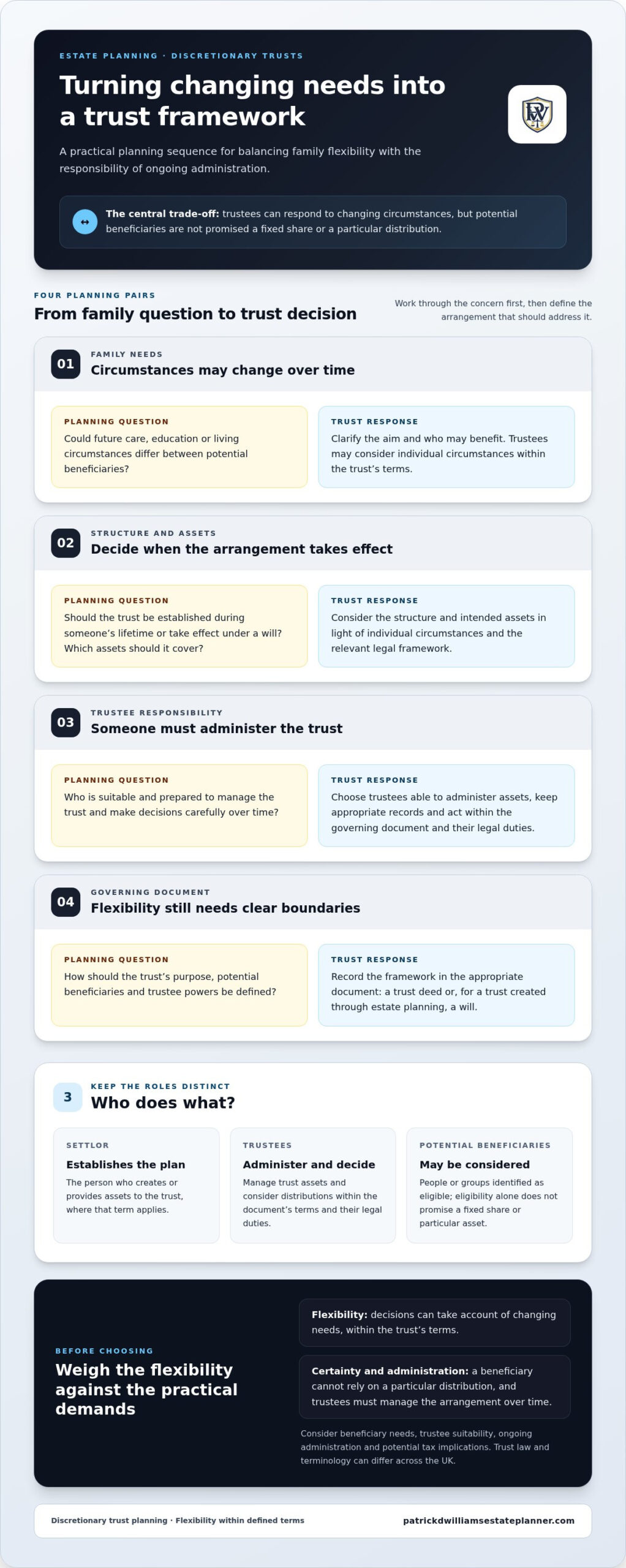
The planning process can be understood as a sequence:
- Clarify the aim. Identify the family circumstances the trust is intended to address and the people who may benefit.
- Consider the structure. Decide whether the arrangement is to be established during life or take effect under a will, and consider which assets it will cover.
- Choose suitable trustees. Consider who can take on the responsibility of administering the trust in line with its terms.
- Record the arrangements. Set out the trust’s framework, powers and potential beneficiaries in the governing document.
Who creates the trust, and who may benefit from it?
The person who creates or provides assets to a trust is generally described as the settlor, where that term applies. In a trust created by will, the arrangements are written into the will and take effect under its terms. Potential beneficiaries are the people or groups identified in the trust document as eligible to benefit. The document defines the boundaries of the arrangement; it is not simply a general instruction to distribute assets as trustees see fit.
Trust assets are administered according to the governing document and applicable law. The precise legal position can vary across the UK, so the wording should be prepared for the relevant circumstances. GOV.UK explains how trust types, including discretionary trusts, are treated in its guide to discretionary trusts and UK taxes.
What responsibilities do trustees take on?
The settlor establishes the plan, trustees administer it within its terms and potential beneficiaries are those the document identifies as eligible. Trustees do not have unrestricted authority. They must follow the governing document and act within their applicable legal duties. In practice, their role involves looking after trust assets, keeping appropriate records and making decisions carefully, with the trust’s terms and purpose in mind.
This responsibility continues after the document is signed. Trustees need to understand what the trust requires and be prepared to manage its administration over time. Drafting should therefore account for both the trust’s intended purpose and the practical demands on trustees. Families considering a discretionary trust can discuss how trust wording and will planning may fit their circumstances through a tailored estate-planning consultation.
Discretionary trust or direct inheritance: what trade-offs should you weigh?
Choosing how an inheritance should pass on involves more than deciding who receives it. A direct gift can make the intended share clear, while a discretionary trust gives trustees scope to respond to changing circumstances. That flexibility may be useful for some families, but beneficiaries have less certainty and the arrangement brings continuing administrative work.
Control: With a direct gift under a will, the beneficiary generally receives the specified asset or share, subject to the will’s terms. With a discretionary trust, trustees manage the assets and make decisions within the trust terms.
Certainty: A defined gift gives its intended recipient greater clarity about what they are to inherit. A potential beneficiary of a discretionary trust has no guarantee of receiving a particular asset or amount.
Flexibility: A direct gift usually fixes the distribution in advance. Trustees may be able to take account of a beneficiary’s needs and circumstances when deciding whether and how to distribute trust assets.
Administration: An outright gift generally passes to the beneficiary without ongoing trust management. A trust requires trustees to administer assets and act in line with the governing document and their duties.
Bare trust: This is a different type of arrangement in which a beneficiary has an entitlement to the trust assets, rather than trustees deciding between potential beneficiaries. Its suitability depends on the family’s aims and the legal details.
When can flexibility matter more than a fixed share?
Flexibility may be valuable if beneficiaries have different needs or their circumstances could change after the estate plan is made. For example, a beneficiary may need support at different stages of life, or the family may be unable to predict how circumstances will develop. Trustees can consider the situation at the time, provided their decisions stay within the trust terms.
That adaptability has a corresponding cost: an eligible beneficiary cannot assume access to a specific amount when they want it. Some people may prefer the certainty and control of a direct inheritance. Consider how each beneficiary’s needs, wishes and ability to manage an inheritance fit with the proposed arrangement.
What does a discretionary trust not guarantee?
A discretionary trust does not guarantee tax savings, protection from claims or a particular distribution. Outcomes depend on the trust wording, the assets involved, people’s circumstances and the law in force at the relevant time. It must not be treated as a way to defeat legitimate claims or avoid statutory obligations. The legal analysis of discretionary trusts discusses trustee discretion and beneficiary rights in its own legal context, which should not be assumed to determine the position under UK law.
There is no single feature that makes one route right for every family. Base the decision on the intended balance between control, beneficiary certainty, flexibility and administration. A considered review of your family’s circumstances can help shape suitable will and trust planning.
What practical, tax and administration questions should you consider?
Before settling on a trust, look beyond the intended benefit and consider how it will work in practice. A discretionary trust can provide room to respond to changing needs, but trustees must administer it, and its tax treatment depends on the trust, its assets, timing and the rules that apply. Start by setting out the family’s aims and responsibilities clearly.
Which tax and registration points need careful checking?
Inheritance Tax, Income Tax and Capital Gains Tax may apply differently according to the trust’s structure and circumstances. Do not assume that creating a trust will reduce tax, or rely on rates, thresholds or filing rules without checking current guidance. The relevant position may depend on when the trust is created, what it holds and how it is used, and the rules can change.
HMRC guidance and the Trust Registration Service are relevant where registration or reporting requirements apply. These requirements depend on the trust and its circumstances, so consult current HMRC information before making decisions or assuming a particular filing duty applies. Include tax and administration in the planning discussion, rather than treating them as matters to address only after the trust is established.
How can families prepare for a considered decision?
Write down who you intend to benefit, what assets may be involved and why you want flexibility rather than a fixed gift. Consider the practical demands of looking after those assets and keeping the arrangement in order. This outline can help you see whether discretion serves a real family need or adds complexity without a clear purpose.
- Beneficiaries: Identify the people or group the arrangement is intended to cover, and consider whether their needs may differ.
- Purpose: Describe what decisions you want trustees to be able to make and which limits should guide them.
- Trustees: Consider whether the people you have in mind are willing and able to take on ongoing responsibilities.
- Administration: Be realistic about record-keeping, asset management and checking applicable tax and registration obligations.
It can also help to compare the arrangement with other trust structures. A bare trust works differently because the beneficiary has an entitlement to the assets. Understanding that distinction can clarify whether trustee discretion is central to your aims or simply an additional feature.
There is no single checklist that determines suitability. Family circumstances, the assets involved and the applicable law all matter, and the plan should make sense as a whole. A tailored discussion can help you weigh these points alongside your will and wider estate plan. Arrange a free 15-minute consultation to discuss whether a trust fits your circumstances.
How can a discretionary trust be included in a tailored estate plan?
Including a trust in an estate plan is a considered process, not a default choice. Start with the outcome you hope to support, then look at your family’s circumstances, the role of potential beneficiaries and the practical responsibilities involved. You can then consider whether a trust is suitable and how it should be recorded alongside your will.
- Clarify your aims. Set out who you want to benefit and why flexibility may matter.
- Review family circumstances. Consider beneficiaries’ needs, relationships and possible changes over time.
- Consider the structure. Weigh the intended arrangements against the responsibilities they create.
- Prepare suitable documents. Record the plan in wording that reflects your intentions and the applicable law.
Trust terms should be written for the plan they are intended to carry out. Generic wording may not reflect the family’s priorities, intended beneficiaries or the powers trustees need. A tailored approach also helps ensure the trust is considered as part of the wider estate plan, rather than as a document standing on its own.
What should a tailored trust-planning discussion cover?
A useful discussion can begin with the people you hope to benefit, why you want trustees to have flexibility and any concerns about beneficiaries having certainty. It can also consider how the trust would work alongside your will and other estate-planning arrangements. Patrick D Williams Estate Planners provides will-writing and discretionary-trust support, with consultations available through Zoom, Teams or in person.
Bring the questions that matter to your family. For example, explain what future needs you hope trustees could take into account, or what you would want the trust to achieve if circumstances change. This helps shape a plan around your intentions without assuming that a trust suits every family or guarantees a particular outcome.
What is a practical next step for families?
You do not need to arrive with a finished plan. A simple outline of your family circumstances, intended beneficiaries, relevant assets and planning objectives can provide a helpful starting point. Include any concerns about how much certainty beneficiaries need and who may be suitable to take on trustee responsibilities. The discussion can then focus on whether a trust fits the wider plan.
A consultation is an opportunity to discuss suitability and possible next steps, not a promise of a particular distribution or result. If a trust is appropriate, its wording can be prepared to reflect the intended arrangements and applicable law. Considering whether it is the right fit is part of making a measured estate plan.
For a calm discussion of your family’s aims and trust planning, arrange a free 15-minute estate-planning consultation.
Take the next step with confidence
Estate planning is an opportunity to put your intentions into a clear, considered plan for the people who matter to you. Before deciding whether a discretionary trust belongs in that plan, focus on what you want it to achieve and how much flexibility feels right for your family. The structure should support those intentions, not add complexity without purpose.
Patrick D Williams Estate Planners provides will-writing and discretionary-trust services as part of tailored estate planning. A free 15-minute consultation, available by Zoom or Teams, gives you an opportunity to discuss your circumstances and consider how a trust may fit alongside your wider plans.
Arrange a free 15-minute estate-planning consultation to discuss a plan that reflects your family’s needs.
Frequently Asked Questions
Can a discretionary trust be created in a will?
Yes, a will can provide for a discretionary trust to take effect after the will-maker’s death. The will should set out the trust’s terms, identify the potential beneficiaries and explain how the trustees are appointed. For example, a parent may specify that assets are held for their children, with trustees administering them under the will. The document must be prepared and executed in accordance with the applicable legal requirements.
Who can be a trustee of a discretionary trust?
A trustee may be an individual, and some trusts may have a corporate trustee. The people appointed should be willing and able to manage the role, keep records and act in line with the trust terms and their legal responsibilities. A family member may understand the circumstances well, but should also consider whether they can make considered decisions if beneficiaries have competing needs. The trust document and applicable law shape who can serve.
Can the person creating a discretionary trust also benefit from it?
Sometimes, the person creating or funding a trust may be included among its potential beneficiaries, but this depends on the trust’s terms and relevant law. Including them can affect the trust’s purpose and may have tax or other legal consequences. For instance, someone transferring assets while retaining potential access should understand how that arrangement is treated before proceeding. Consider the proposed beneficiaries and intended control together when drafting the trust.
Does a discretionary trust need to be registered with HMRC?
Some trusts must be registered on HMRC’s Trust Registration Service, and registration can apply even where a trust has no tax to pay. There are exceptions, so the answer depends on the trust’s circumstances and current rules. Trustees should establish whether registration is required when the trust is created and keep its details updated where applicable. HMRC’s current guidance is the appropriate reference, as registration requirements and deadlines can change.
Can a beneficiary demand a payment from a discretionary trust?
Usually, being eligible to benefit does not by itself give someone the right to demand a particular payment or asset. Trustees must consider requests in accordance with the trust document and their duties, rather than being required to agree to every request. A beneficiary may, however, have rights concerning proper administration. If they believe trustees have acted outside the trust terms or failed in their duties, they can seek advice on the appropriate steps.
What happens to a discretionary trust if a trustee can no longer act?
The trust does not necessarily end if a trustee dies, becomes unable to act or wishes to retire. The trust document may explain how a replacement is appointed, and legal rules may also provide a route where needed. The remaining trustees should review the appointment provisions and take steps to maintain proper administration. The precise process depends on the wording and applicable law, so a change in trustees should be recorded and handled carefully.
Are discretionary trust rules the same throughout the UK?
No. Trust law is not identical across the UK, so terminology, procedures and legal effects may differ. Tax rules can also depend on the type of tax and the trust’s circumstances. A family with assets or beneficiaries connected to more than one legal jurisdiction may need the plan considered in that context. The trust document should be prepared with its governing law and relevant circumstances in mind.
Leave a Reply