

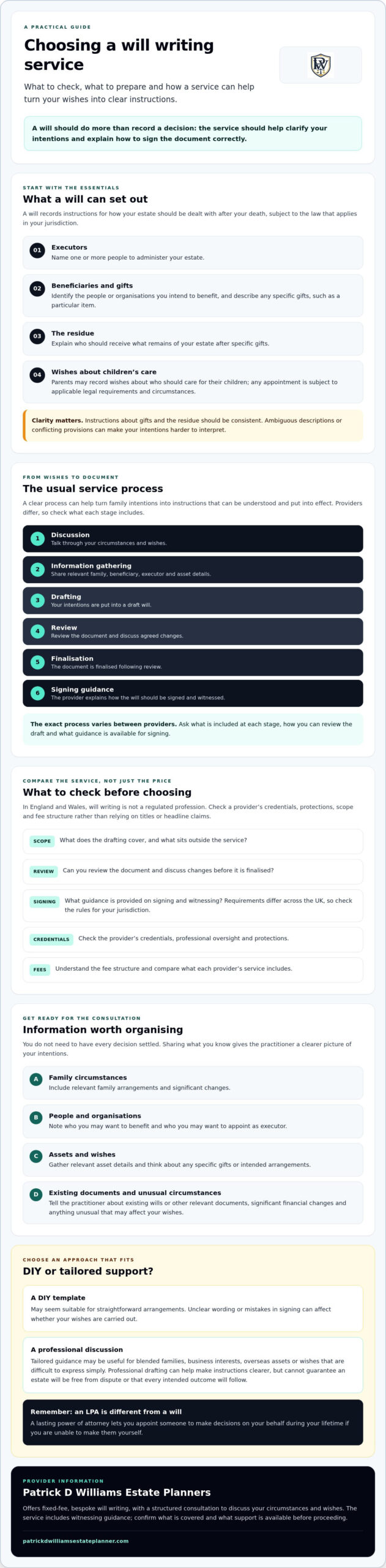
A will writing service should do more than prepare a document. It should help you clarify your intentions and explain the steps needed to make your will valid. A DIY template may seem suitable for straightforward arrangements, but unclear wording or mistakes in signing can affect whether your wishes are carried out.
It’s understandable to compare providers by price and convenience. The service behind the document matters just as much, particularly if your family or financial circumstances are more involved. In England and Wales, will writing is not a regulated profession, so check a provider’s credentials, protections, scope and fee structure before choosing.
This guide explains what professional will writing can involve and how to assess whether a provider’s approach suits your circumstances. It covers when a DIY will may be appropriate, what to check about execution and professional oversight, and which information to prepare before an initial consultation. With a clearer understanding of your wishes, you can compare your options with greater confidence.
Key Takeaways
- A will records instructions for how your estate should be dealt with after your death, subject to the law that applies in your jurisdiction.
- A suitable will writing service should explain its process, drafting scope, opportunities to review the document and guidance on signing.
- Compare providers by what their service includes. Verify credentials, oversight and protections rather than relying on titles or headline claims.
- Organise key details about your family, assets and intended beneficiaries before a consultation, even if some decisions are still open.
- Patrick D Williams Estate Planners offers fixed-fee, bespoke will writing, with a structured consultation to discuss your circumstances and wishes.
What a professional will writing service should help you put in place
A will-writing service helps you record clear instructions for how your estate should be dealt with after your death. Its practical purpose is to turn your wishes into a document that can be understood and followed, subject to the law that applies where you live. For a general introduction to what is a will and testament, see this overview. It isn’t a substitute for guidance on your own circumstances.
A will is one part of planning ahead, not a document that automatically covers every need. Your family arrangements, assets and wishes affect what may need to be addressed, and some matters require separate planning.
An LPA is different from a will: it lets you appoint someone to make decisions on your behalf during your lifetime if you’re unable to make them yourself.
What can a will set out
A will can name one or more executors to administer your estate and identify the people or organisations you intend to benefit. It can also describe specific gifts, such as a particular item, and explain who should receive the remainder of your estate, known as the residue.
Parents may record wishes about who should care for their children if they die, but any appointment is subject to applicable legal requirements and circumstances. A professional discussion can help identify the wording and arrangements that need consideration.
Clarity matters. Instructions should be consistent about who receives each gift and what happens to the residue. For example, if you leave an item to one person and divide the rest of your estate among others, the will should make each instruction clear. Ambiguous descriptions or conflicting provisions can make your intentions harder to interpret.
When professional will writing may be worth considering
Tailored guidance may be particularly useful if you have a blended family, business interests, assets overseas or wishes that are difficult to express simply. For example, you may want to provide for a partner while also considering children from an earlier relationship. A structured discussion can help clarify these intentions and identify questions that need further attention.
A straightforward family and financial situation still calls for careful drafting. In England and Wales, a will must meet legal signing and witnessing requirements to be valid. Requirements differ across the UK, so check the rules for your jurisdiction and follow the provider’s execution guidance.
Professional drafting can help make instructions clearer, but it can’t guarantee that an estate will be free from dispute or that every intended outcome will follow. Patrick D Williams Estate Planners offers bespoke will writing following a structured consultation, with witnessing guidance as part of its service. Before proceeding, confirm what the service covers and what support is available.
How a will-writing service turns your wishes into a usable document
A clear process helps turn family intentions into instructions that can be understood and put into effect. A will writing service will typically discuss your circumstances, prepare a draft for you to review, make agreed changes, finalise the document and explain how it should be signed and witnessed. Providers differ, so confirm what each stage includes before proceeding.
The usual stages are discussion, information gathering, drafting, review, finalisation and signing guidance, although the exact process varies between providers.
From first consultation to draft will
The initial discussion should establish the information needed to prepare your will. This may include your family circumstances, the people you wish to benefit, your chosen executors and relevant details about your assets. You don’t need to have every decision settled, but sharing what you know gives the practitioner a clearer picture of your intentions.
Follow-up questions can help if instructions are unclear or appear to conflict. For example, if you want to leave a particular asset to one person but also divide the whole estate equally, the draft needs to make clear how those wishes fit together. Tell the practitioner about existing wills or other relevant documents, significant family or financial changes, and any unusual circumstances. Omitting context may make it harder to reflect your wishes accurately.
Patrick D Williams Estate Planners uses structured consultations and bespoke document drafting to discuss clients’ wishes and prepare a will. Ask what information the consultation covers and how any questions raised will be addressed.
Review, signing and keeping the will accessible
Read the draft carefully before approving it. Check that names are spelt correctly, each gift is directed to the intended person, the residue is dealt with as you expect, and executor details are accurate. Ask yourself whether someone unfamiliar with your intentions could understand each instruction. Raise uncertainties before signing rather than relying on an assumption.
Signing and witnessing formalities matter. Requirements differ across the UK and can change, so confirm the current rules for the relevant jurisdiction and follow guidance that applies to your circumstances. Ask the provider to explain the steps clearly, including any witness requirements, before you execute the will.
Once finalised, keep the original document secure and tell appropriate people how to locate it. This could include your executors or a trusted family member. They don’t need to know the contents if you prefer privacy, but they should know where the valid final version can be found.
If you’re considering bespoke will writing, you can learn about the will-writing service and confirm its process and scope during an initial discussion.
How to compare will writing services without relying on headline claims
A low fee or reassuring title doesn’t tell you exactly what support you’ll receive. Providers can differ in who advises and drafts, how much discussion is included, and what happens after the document is prepared. Compare the service itself, then consider whether the provider’s experience and protections suit the complexity of your circumstances.
In England and Wales, will writing isn’t a regulated profession, while solicitors are regulated by the Solicitors Regulation Authority. Ask what qualifications, professional oversight and protections apply to the person handling your instructions. Don’t assume every will writing service provides the same level of legal advice or recourse if something goes wrong.
| Area to compare | What to clarify |
|---|---|
| Advice scope | What circumstances and planning questions will the discussion cover? |
| Drafting | Who prepares the will, and how are your individual instructions reflected? |
| Amendments | Can you request changes after reviewing the draft, and how are they handled? |
| Execution guidance | What guidance is provided on signing and witnessing under the rules that apply to you? |
| Aftercare | What support, if any, is available after the will is finalised? |
Questions to ask before choosing a will writer
Ask who will advise you, draft the document and review it, and what relevant qualifications or oversight apply. Check what the quoted service includes, what may be excluded, and how changes are handled. Also ask how signing guidance, storage, confidentiality and access to the final document are addressed. Clear answers make it easier to compare like with like.
When a will may need wider estate-planning advice
Trusts, property ownership arrangements and complex family circumstances may raise questions beyond the will itself. Ask whether the provider can discuss these topics and whether separate advice is appropriate. A trust isn’t automatically part of a will-writing service.
A will sets out instructions for your estate after death. A Lasting Power of Attorney (LPA) appoints someone to make decisions on your behalf during your lifetime if you’re unable to do so. They serve different purposes, so consider each separately. Guides to LPAs and property protection trusts can provide further reading where relevant, but they shouldn’t replace advice tailored to your situation.
There isn’t one provider type that suits everyone. Match the level of expertise and service scope to your needs, and verify any claims about qualifications, regulation or protection before deciding.
What to prepare before using a will-writing service
You don’t need to arrive with every decision made. A little preparation can help the adviser understand your family circumstances, what you own and who you hope to benefit. Use this checklist to organise your thoughts, not as a test you need to complete perfectly.
Information to gather before the consultation
- Start with family relationships. Note your partner, children, stepchildren and other people you may wish to provide for. Include any guardian wishes for children who are under 18.
- List possible executors. Consider who you might trust to administer your estate, and note any questions about their role or suitability.
- Make a broad record of assets and arrangements. Include property, savings, significant possessions, business interests and any existing will or other relevant documents. A complete valuation isn’t necessary for an initial discussion.
- Write down intended gifts and beneficiaries. Note who you would like to benefit and whether particular possessions or sums should go to specific people.
- Record questions and priorities. Flag anything uncertain, unusual or difficult to balance. You can discuss options rather than make a rushed decision.
A considered executor choice helps make estate administration more practical by identifying who you trust to carry out the instructions in your will.
How to make the consultation useful
Explain what matters most to you and where family circumstances may affect your wishes. For example, you may want to provide for a partner while also considering children from an earlier relationship. Sharing the context helps the adviser understand the intention behind your instructions and identify points that need clarification.
Use the meeting to establish the service’s boundaries. Ask what the fixed-fee terms cover, how you can review the draft, whether amendments are included, and what signing guidance is provided. Clarify any exclusions and how you’ll receive or access the final document.
Patrick D Williams Estate Planners offers a free 15-minute consultation. Confirm its current terms and appointment availability, and ask whether it’s suitable for discussing your circumstances and the scope of the will-writing service.
With your notes prepared, you can arrange a will-writing consultation to discuss your wishes and the information you’ll need to provide.
Choosing a will writing service and taking a considered next step
The right choice depends on how well a provider’s service fits your family and financial circumstances. Consider four points together: the complexity of your wishes, the competence and oversight of the person advising you, the work included in the service, and the guidance offered for signing and witnessing. A fixed fee can make the agreed scope clearer, but you still need to understand precisely what it covers.
There’s no single provider or service level that suits everyone. If your arrangements are relatively straightforward, you may need a different level of support from someone with a blended family, business interests or more involved planning wishes. Check that the provider can explain the service in plain language and is clear about where its scope ends. The aim is to make an informed decision, not to assume that one approach guarantees a particular outcome.
How Patrick D Williams Estate Planners supports will writing
Patrick D Williams Estate Planners offers fixed-fee will writing with structured consultations, bespoke drafting, witnessing guidance and legal compliance checks. These elements provide a clear basis for discussing your wishes and preparing a document tailored to your instructions. The service does not promise to prevent every future issue or dispute.
Fixed professional fees relate to the agreed service. Before proceeding, confirm what the fee includes, how draft reviews and amendments are handled, and what support is available after finalisation. Consultations are offered via Zoom, Teams or in person, subject to availability. If your circumstances raise separate questions about Lasting Powers of Attorney or trusts, clarify whether those topics fall within the discussion or require a separate service.
A straightforward route to discuss your wishes
Before making contact, note the family circumstances and priorities you want to discuss, along with any questions about the service, its scope or signing support. You don’t need to have every instruction decided. A consultation can help establish whether the approach is suitable for your needs and what information may be required next.
Patrick D Williams Estate Planners offers a free 15-minute consultation. Confirm its current terms and availability when arranging it. Arrange a free 15-minute consultation to begin a considered discussion about your will-writing needs.
Take the next step with confidence
Choosing a will writing service is about more than selecting a document or comparing headline claims. Look for an approach that fits your circumstances, explains its scope clearly and provides practical support through drafting and execution. Preparing your priorities and checking what is included can make your next decision more straightforward.
Patrick D Williams Estate Planners provides fixed-fee professional will writing, with bespoke drafting, witnessing guidance and legal compliance checks. Confirm the agreed scope and terms before proceeding. Consultations may be available through Zoom, Teams or in person, subject to current availability.
A free 15-minute consultation is offered, though you should confirm its current terms when arranging it. Arrange a free 15-minute consultation to discuss your wishes and whether the service suits your needs.
Frequently Asked Questions
What does a will writing service include?
A professional will writing service commonly discusses your circumstances and wishes, prepares a draft will, gives you time to review it and explains signing formalities. The precise scope varies between providers. Before proceeding, check who will advise and draft, whether amendments and aftercare are included, how fees are structured, and what support is offered for signing and storage. These details help you compare the service itself, not just its headline description.
Is a will-writing service the same as using a solicitor?
No, a will writer and a solicitor aren’t interchangeable descriptions. Providers can differ in qualifications, regulatory oversight and protections. Ask who will handle your instructions, what credentials apply and which complaints or compensation arrangements are available. In England and Wales, solicitors are regulated by the Solicitors Regulation Authority. Verify a provider’s status rather than assuming they are a solicitor or regulated as one.
Can I write my own will in England and Wales?
Yes, you can prepare your own will, but it must still meet the legal formalities that apply in England and Wales to be valid. Unclear wording, inconsistent instructions or errors in signing can create difficulties later. Whether professional drafting is appropriate depends on your circumstances. Consider tailored guidance if your wishes involve blended family arrangements, property, business interests or other matters that make your instructions less straightforward.
How much does a will writing service cost?
Fees vary according to the provider, the work involved and the complexity of your instructions. Some providers charge fixed professional fees, while other fee arrangements may differ. Ask for the service scope and fee terms in writing, including exclusions and whether revisions or related documents involve additional charges. Comparing headline figures alone can be misleading if one service includes more discussion, drafting or execution guidance than another.
What information should I take to a will-writing consultation?
Prepare a summary of your family circumstances, intended beneficiaries, possible executors and any wishes about guardians for children. It can also help to note property, significant assets, existing documents and questions you’d like answered. You don’t need to make every decision before the meeting. A clear outline of your priorities gives the adviser a useful starting point and helps identify matters that may need further discussion.
Do I need a solicitor to witness my will?
Not necessarily. The will must be signed and witnessed in line with the current legal formalities for the relevant UK jurisdiction, but don’t rely on general online guidance for your particular arrangements. Ask your will-writing provider for clear, current instructions and follow them carefully. If your circumstances are unusual or you’re uncertain about the requirements, seek appropriate legal advice before signing the document.
When should I update my will?
Review your will when a change in your family circumstances, assets or intended beneficiaries may affect your instructions. For instance, a new relationship or a change in who you wish to benefit could make existing wording outdated. Check names, gifts and other directions against your current wishes. The legal effect of particular life events can vary, so ask a suitable professional whether your will needs reviewing or replacing.
Leave a Reply