

Living together doesn’t give an unmarried partner automatic rights to inherit under intestacy rules. Will writing for unmarried couples owning property can state what should happen to each partner’s share, while the way the home is legally owned may determine whether it passes automatically to the survivor. Without a will, a partner could be left without the home or financial provision they expected.
It’s understandable to assume that sharing a home and finances offers some protection. In practice, the outcome depends on the ownership arrangement and the instructions each person leaves. This article explains when unmarried couples need wills, what may happen to a jointly owned or partner-owned home, and how a will or trust may help protect shared property. It also explains the difference between joint tenants and tenants in common, and why a life interest or property protection trust may be relevant to your plans.
Key Takeaways
- Unmarried partners don’t inherit automatically under the intestacy rules, so a will can set out who should receive each person’s estate.
- How a shared home passes depends on its ownership: joint tenancy generally passes the property to the survivor, while a tenant in common’s share passes under their will or intestacy rules.
- A life interest or property protection trust may help balance a surviving partner’s ability to remain in the home with plans for who inherits later.
- Include clear instructions for property, other assets, executors and beneficiaries, and review them when circumstances change.
- HM Revenue & Customs states that the inheritance tax nil-rate band is £325,000; the way a home and other assets are passed on can affect tax planning.
Rights to live in a jointly owned or partner-owned home
For unmarried partners, living together does not create automatic inheritance rights. What happens to the home, and whether the surviving partner can remain there, depends on ownership and the deceased partner’s will.
Living rights in a partner-owned home
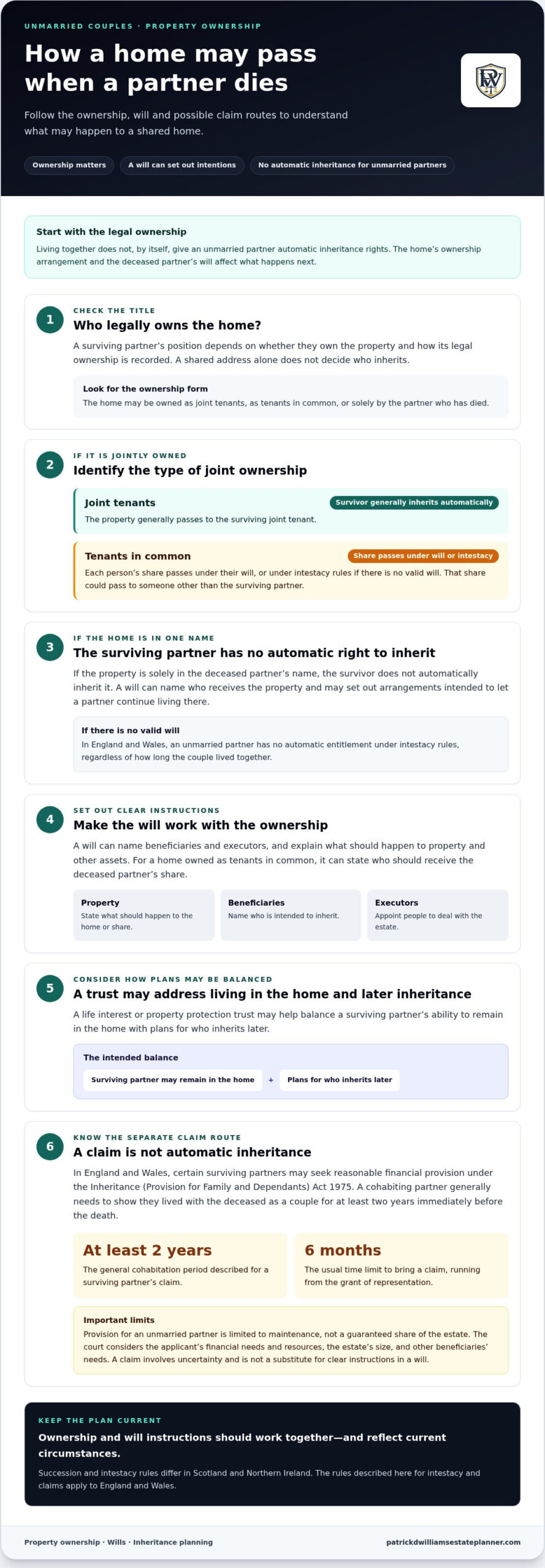
A surviving partner’s position depends on whether they own the home and how its legal ownership is recorded. If the property is solely in the deceased partner’s name, the survivor has no automatic right to inherit it. A will can specify who receives the property and may set out arrangements intended to let a partner continue living there.
Joint ownership also needs careful interpretation. Joint tenants generally pass ownership to the survivor automatically, while a tenant in common’s share passes through their will or under intestacy rules. For example, if one partner owns a defined share as a tenant in common, that share could pass to someone else, regardless of the surviving partner’s wishes. The ownership structure and will should therefore work together.
Claims against a partner’s estate
A claim against an estate is a legal request for financial provision, not an automatic inheritance. In England and Wales, the Inheritance (Provision for Family and Dependants) Act 1975 allows certain surviving partners to seek reasonable provision. A cohabiting partner generally needs to show they lived with the deceased as a couple for at least two years immediately before the death. Someone maintained by the deceased before their death may have a separate route.
An unmarried partner’s provision is limited to maintenance, rather than a guaranteed share of the estate. The court considers the applicant’s financial needs and resources, the estate’s size, and other beneficiaries’ needs. According to The National Archives, a claim in England and Wales normally must be brought within six months of the grant of representation. This route involves uncertainty and is not a substitute for clear instructions in a will.
Wills, relationship changes and sole-name money
Marriage or forming a civil partnership revokes an existing will in the UK, so the will should be updated after either change. This matters because an earlier will may no longer provide the intended protection. Review it after marriage, remarriage or forming a civil partnership, and ensure it reflects current home ownership and intended beneficiaries.
A will deals with what happens after death, but it does not give a partner authority to manage money during incapacity. Without a Lasting Power of Attorney, an unmarried partner may be unable to access money held in the other person’s sole name or take part in decisions during a medical emergency or long-term care planning. A separate LPA can appoint attorneys to make financial or health and care decisions.
Inheritance tax is another part of planning for a shared home. According to HM Revenue & Customs, the inheritance tax nil-rate band is £325,000, and inheritance tax is charged at 40% on assets above the nil-rate band. A will can clarify who inherits, while the estate’s value and chosen arrangements affect the tax position.
Do unmarried couples need a will?
Yes. A will lets each partner decide who inherits their estate, rather than leaving distribution to intestacy rules. In Scotland and Northern Ireland, succession and intestacy rules differ from those in England and Wales, so the rules below should not be assumed to apply there. Will writing for unmarried couples owning property can help make each partner’s intentions clear.
Intestacy rules for unmarried couples
Intestacy means someone dies without a valid will, so statutory rules determine who inherits their estate. In England and Wales, an unmarried partner has no automatic entitlement under those rules, regardless of how long the couple lived together. Cohabiting partners are outside the intestacy order that covers spouses or civil partners, children and wider family members.
This can affect a shared home. If the deceased owned a share as a tenant in common, it may pass to relatives rather than the surviving partner. A will can appoint executors and name beneficiaries, helping each person specify what should happen to their property and other assets. For couples considering will writing for unmarried couples owning property, the instructions should reflect both ownership and intended beneficiaries.
The contrast with marriage is important. If a married person dies leaving children, the surviving spouse or civil partner receives personal belongings, the first £322,000 and half the remainder under England and Wales rules. The children share the other half. An unmarried partner does not receive that statutory legacy simply because they shared a home or finances.
Inheritance rules across the UK
Succession law differs across the UK, so the home’s location and relevant legal jurisdiction matter. Scotland has its own succession framework, while Northern Ireland also applies separate rules. The intestacy outcome, and how a will deals with property, may therefore differ from the position in England and Wales.
For couples with homes or connections across more than one UK jurisdiction, a will should be considered in that context. Don’t assume that a rule applying in England and Wales will produce the same result in Scotland or Northern Ireland. The governing jurisdiction affects who may inherit and how property is dealt with.
A separate claim may be possible in England and Wales, but it is not the same as inheriting automatically. According to The National Archives, a cohabiting partner may need to have lived with the deceased for at least two years to claim under the Inheritance (Provision for Family and Dependants) Act 1975. Any claim is for reasonable financial provision, not a guaranteed share of the estate.
That distinction matters when deciding how to protect a partner. A claim seeks provision after a death, whereas a will records intentions in advance. Stating who receives each person’s share can clarify the intended inheritance and reduce reliance on intestacy or a later claim.
What happens to my house if my partner dies?
The outcome depends on how you own the property and whether your partner’s share passes automatically. In England and Wales, the distinction between joint tenants and tenants in common matters.
Joint tenants and tenants in common
Joint tenants own a home together, and when one dies, ownership generally passes automatically to the survivor. Tenants in common each own a distinct share, which passes under the deceased’s will or intestacy rules. This difference determines whether a surviving partner receives the whole home automatically or must inherit the other person’s share.
For example, if a couple are joint tenants, the deceased partner’s will cannot redirect their share of the home to another beneficiary. If they are tenants in common, that share forms part of the estate. The ownership type therefore affects both the surviving partner’s position and what the deceased can leave to others.
Property shares held as tenants in common
Tenants in common hold separate shares in a property, and those shares do not have to be equal. A common arrangement is 50/50, though partners can own different proportions. Their shares may reflect their contributions or an agreement about ownership, rather than equal division.
For instance, one partner might own a larger share and the other the remainder. If one dies, their share passes through their estate, not automatically to the surviving partner. A will can name who should inherit it. Without a valid will, intestacy rules decide who receives the share, which may not match the couple’s wishes.
Common-law marriage misconceptions
“Common-law marriage” is not a legal status created by living together in England and Wales. An unmarried couple gains no automatic inheritance rights simply by sharing a home for many years. The same principle applies in Scotland and Northern Ireland: cohabitation alone does not create that status or give partners automatic legal rights.
Marriage changes the legal position. Married couples have inheritance rights under intestacy rules that unmarried partners do not receive. A surviving partner who assumes years of cohabitation provide the same benefits as marriage may misunderstand what happens to the home when their partner dies.
Check the ownership record and any documents setting out beneficial shares. The names on the property title alone may not describe the intended division between tenants in common. If the title shows a joint tenancy but each partner wants their share to pass under their own will, they may need to change the form of ownership first.
That decision involves balancing two intentions: keeping the surviving partner secure in the home and deciding who ultimately inherits each share. A will can direct a tenant in common’s share, while a joint tenancy usually gives that share to the survivor automatically. The right arrangement depends on the couple’s ownership and inheritance plans.
Life interest trusts and property protection trusts
A trust in a will can separate the right to benefit from a home from the right to inherit its value. For unmarried partners, this may help provide a surviving partner with a home while preserving a share for children or other beneficiaries later.
How a life interest trust can work
A life interest trust gives a named beneficiary a defined benefit from trust assets, often the right to live in a home or receive income from it. The will can direct what happens to the trust property after that interest ends. For example, a surviving partner may be allowed to occupy the home, with the deceased partner’s share passing to their children later.
This structure can address competing wishes within one family. A partner may need a stable home, while the person making the will wants their children to inherit their share eventually. The trust’s terms should explain the beneficiary’s rights, who manages the assets as trustee, and when the remaining beneficiaries receive them. Clear provisions guide decisions rather than leaving them to assumptions.
What a property protection trust can provide
A property protection trust can be used in estate planning to hold or direct a share of a home for named beneficiaries. Its purpose depends on the will’s terms and the ownership arrangement. Where partners own as tenants in common, a will may direct the deceased’s distinct share into a trust, rather than passing that share automatically to the surviving owner.
This can preserve the intended destination of that share while giving the surviving partner a specified benefit. It does not mean the survivor owns the whole property or can make every decision alone. Trustees administer the trust according to its terms, and the survivor’s rights depend on what the will provides.
Choosing arrangements that reflect your wishes
Before choosing a trust, couples should consider who needs the home, who should inherit later, and how the property is owned. For example, a parent may want their partner to remain in the home while ensuring their children ultimately receive their share. A will can set out those wishes, but a trust cannot by itself resolve conflicting ownership arrangements.
Review the proposed trust alongside the property title, any agreement about beneficial shares, and each partner’s will. A joint tenancy usually passes the property to the survivor automatically, so it may not align with a plan to preserve the deceased’s share for other beneficiaries. Changing ownership to tenants in common can allow a defined share to be dealt with under a will.
Trusts also create responsibilities. Trustees must follow the written arrangements, and beneficiaries should understand the difference between a right to occupy and ownership of the property. A property protection trust or life interest trust is most useful when its terms clearly balance the surviving partner’s provision with the intended inheritance for others. The key decision is how to protect the partner’s immediate home arrangements while making clear who should ultimately receive each share.
What should an unmarried couple include in wills when they own property together?
Each partner’s will should make clear who inherits their property and other assets. For a shared home, the instructions need to reflect how the property is owned and the couple’s plans for the surviving partner and any later beneficiaries.
Describe the estate and property arrangements
List the money, property and belongings you own, including your home and savings. Explain who should receive your share of the property and what should happen if that beneficiary dies before you. For example, you might name your partner first, then identify children or another beneficiary as an alternative.
Make the will consistent with the ownership structure. If you own as tenants in common, state what should happen to your distinct share. If you are joint tenants, the home generally passes automatically to the survivor, so a will cannot redirect that share. A mismatch between the title and your wishes can undermine the intended outcome.
Name executors and address children’s needs
Appoint at least one executor to administer your estate and carry out the will’s instructions. Choose someone able to manage practical matters, including property and accounts. A clear appointment helps identify who is responsible for dealing with the estate, rather than leaving that role uncertain for your partner or beneficiaries.
If you have children under 18, consider naming a guardian and explaining how their inheritance should be managed. A will can name who should look after children under 18. In England, a child under 18 who inherits from a parent who died without a valid will has their inheritance held in trust until adulthood. Include provisions that reflect your family’s circumstances.
Consider trusts, tax and future changes
A trust may suit a couple who want a surviving partner to benefit from the home while preserving a share for children later. The will should state the partner’s rights, identify who receives the property after those rights end, and provide for trustees to administer the arrangement. A Property Protection Trust may form part of this planning, depending on ownership and intended beneficiaries.
Inheritance tax planning also matters. The residence nil-rate band is conditional on the main family home, or a share of it, passing to children or grandchildren. It is transferable between spouses but not cohabiting partners, and unmarried partners do not receive spouse inheritance tax relief on assets passed to them. An unmarried partner may therefore be liable for inheritance tax on inherited assets.
Sign the will in writing, in the presence of two witnesses, and review it after changes to your relationship, home ownership or family. To put your property and inheritance wishes into a will, arrange will-writing support.
Patrick D Williams Estate Planners: Will Writing
Patrick D Williams Estate Planners can help unmarried couples put clear instructions in place for a shared home and other assets. Its Will Writing service can record who should inherit each partner’s estate and support plans for a surviving partner. Where a trust may suit your wishes, a Property Protection Trust or Discretionary Trust can be part of your estate-planning discussion.
Planning can also address decisions during incapacity. A Lasting Power of Attorney lets you appoint attorneys for financial matters or health and care decisions if you can’t decide for yourself. A free 15-minute consultation offers an opportunity to discuss which arrangements fit your circumstances, including how your home is owned and who you intend to benefit.
Contact Patrick D Williams Estate Planners to discuss your will and shared-property plans.
Put your shared plans into writing
Estate planning works best as a shared conversation, not an assumption about what the other person wants. Set aside time to discuss who should benefit, what each of you hopes will happen to the home, and who could help manage matters if circumstances change. These decisions can be personal, but making them clear gives each partner a practical starting point.
A considered approach to will writing for unmarried couples owning property means treating your plans as something to revisit when life changes. A move, a change in finances or a new family responsibility may affect what feels appropriate. Keeping your documents aligned with your intentions helps give clarity to the people who may need to act on them.
For support putting your wishes into a clear plan, contact Patrick D Williams Estate Planners. Taking that next step can help you approach the future with greater confidence and a shared understanding.
Frequently Asked Questions
What legal rights do unmarried, common law or cohabiting partners have?
Unmarried partners don’t become spouses by living together, even for many years. Their rights depend on matters such as whose name is on the property and how it is owned. A partner named as a joint tenant generally receives the home automatically if the other dies. A cohabiting partner may also seek financial provision in qualifying circumstances, but this is not automatic inheritance.
Can my partner be left financially vulnerable without a will?
Yes. If you die without a will, intestacy rules may direct your estate to relatives rather than your partner. A partner might then have no automatic entitlement to assets in your sole name, which could affect access to funds and the ability to remain in the home. During your lifetime, a Lasting Power of Attorney addresses a different risk: it appoints someone to make specified decisions if you cannot decide for yourself.
Can an unmarried partner make a claim on an estate?
Yes. In England and Wales, a surviving cohabiting partner can seek reasonable financial provision under the Inheritance (Provision for Family and Dependants) Act 1975. They generally need to show they lived together as a couple for at least two years immediately before the death, or qualify through another route such as financial maintenance. Provision is maintenance-level, not a guaranteed inheritance. The National Archives says claims normally must be brought within six months from the grant of representation.
Can cohabiting couples make a joint will?
Yes, a couple can express both partners’ wishes in one document, but each person’s estate and intended beneficiaries need clear treatment. A practical alternative is for each partner to make a separate will, with matching provisions where appropriate. For example, both wills can state what should happen to each person’s share of a home. Each partner should understand their own document and keep it aligned with their ownership arrangements.
Do unmarried couples in England and Wales inherit each other’s property without a will?
No, not as a general entitlement under intestacy rules. The estate is distributed according to the statutory order, which does not include an unmarried partner as a spouse or civil partner. A jointly owned home may be different: if held as joint tenants, it generally passes automatically to the surviving owner. A tenant in common’s share follows the will, or intestacy rules if there is no valid will.
How can unmarried co-owners leave their share of a property in a will?
First identify whether the property is held as tenants in common or joint tenants. A tenant in common can direct their distinct share to a named beneficiary in their will. If the owners are joint tenants, the deceased’s share normally passes to the survivor automatically, so the will cannot direct it elsewhere. Co-owners who want individual control over their shares can consider severing the joint tenancy, then aligning their wills with the resulting ownership.
What is the difference between joint tenants and tenants in common for unmarried couples?
Joint tenants own the property together, and when one dies, the surviving owner generally receives it automatically. Tenants in common own separate shares, which can be equal or unequal. Each person’s share forms part of their estate and passes under their will or intestacy rules. For example, tenants in common can leave their shares to different beneficiaries, while joint tenants cannot direct the home to someone else through a will.
How can unmarried partners change joint tenancy to tenants in common?
They can sever the joint tenancy, changing the beneficial ownership so each partner holds a distinct share as tenants in common. This allows each person to address their share separately in a will. The partners should also clarify how their shares are divided and ensure their wills reflect that arrangement. Joint Tenancy Severance can support this change, while coordinated estate planning helps keep property ownership and inheritance instructions consistent.
Leave a Reply