

Intestacy rules can distribute an estate according to the law, but the result may not reflect the family relationships that matter most to you. If you’re asking “what happens if I die without a will UK”, the answer depends on the relevant legal jurisdiction and which relatives survive you. In England and Wales, for example, an unmarried partner doesn’t automatically inherit under the intestacy rules.
It’s understandable to want clarity about whether a spouse, civil partner, children or other relatives will receive an inheritance. This guide explains the broad rules and their limits, as well as the practical work involved in administering an estate, from listing assets and debts to applying for authority where required.
The rules aren’t identical across England and Wales, Scotland and Northern Ireland, so the outcome can vary. The sections below explain who may inherit, how administration works and how a valid will can record your wishes more clearly. Understanding the default rules can help you spot where they might not match your family’s needs.
Key Takeaways
- Learn what “what happens if I die without a will UK” means in practice, including which assets may pass outside your estate.
- See how the order of eligible relatives can shape inheritance in England and Wales.
- Understand how the way an asset is jointly owned can affect whether it passes to a co-owner or forms part of the estate.
- Follow the main steps an estate administrator may take, from identifying assets and debts to obtaining authority where required.
- Discover how a valid will can record chosen beneficiaries, appoint executors and set out guardianship wishes where relevant.
What does dying without a will mean in the UK?
A valid will sets out instructions for dealing with your estate after death, including who should inherit and who should administer it. If there’s no valid will, the law determines who may inherit instead. This is called dying intestate. For anyone searching “what happens if I die without a will UK”, an important first step is to identify which jurisdiction’s rules apply. There isn’t one set of intestacy rules for the whole country.
Your estate is the money, property and personal belongings you own that need to be dealt with after your death. Not every asset connected to you necessarily forms part of it. For example, an asset owned as joint tenants may pass automatically to the surviving owner rather than under a will or intestacy rules. The treatment of jointly owned property and other assets depends on how they’re held and the arrangements that apply.
A will can also cover some, but not all, of an estate. If it leaves an asset or part of the estate undisposed of, intestacy rules may apply to that portion. This is known as partial intestacy. Some assets may therefore pass according to your instructions while others are distributed under statutory rules. Reviewing the will against a current list of assets can help identify gaps.
What are the rules of intestacy?
Intestacy is the legal framework that determines who may inherit an estate when there are no valid will instructions covering it. The rules set an order of eligible beneficiaries. Family members’ expectations, informal promises or personal closeness don’t replace that statutory order.
In practice, the rules are applied to the circumstances of the person who died, including their surviving relatives and whether a valid will covers any of the estate. The detailed examples in this guide focus on England and Wales. A family’s understanding of who ought to inherit may differ from the legal outcome, so it helps to distinguish personal wishes from the rules that apply by default.
Why does the UK jurisdiction matter?
England and Wales, Scotland, and Northern Ireland are distinct legal jurisdictions, and their succession rules are not identical. A summary of the rules for England and Wales shouldn’t be treated as a definitive guide for someone whose circumstances connect to Scotland or Northern Ireland.
The relevant legal position can depend on the circumstances, including where the person was domiciled and where assets are situated. If a case has connections across jurisdictions, or you’re unsure which rules apply, use current official guidance for Scotland or Northern Ireland, such as Scottish Government or nidirect information, and seek advice suited to the circumstances. The next section explains the broad intestacy order for England and Wales.
Who inherits under intestacy rules in England and Wales?
In England and Wales, inheritance depends on which close relatives survive the person who died. The rules give priority to a surviving spouse or civil partner and children, then identify which other relatives may inherit if neither is living. They apply according to legal relationships, not simply who was closest to the deceased.
How may a spouse, civil partner, or children inherit?
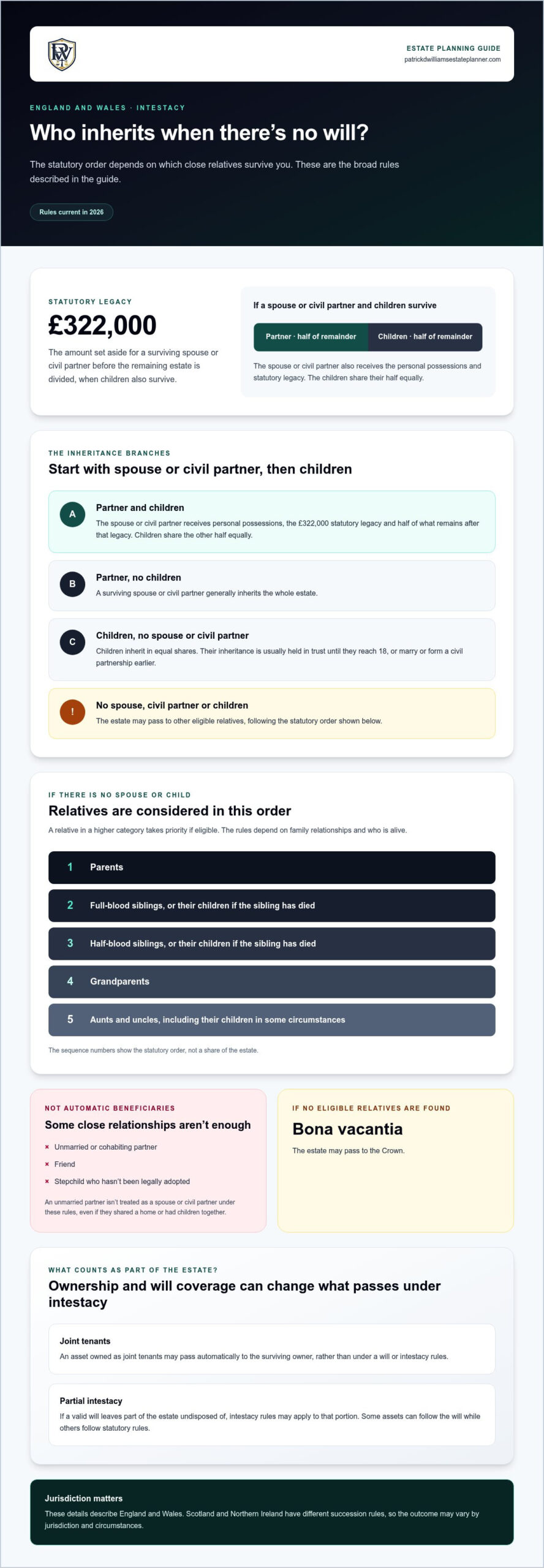
If there’s a surviving spouse or civil partner and children, the spouse or civil partner receives the personal possessions and a statutory legacy of £322,000. They also inherit half of what remains after that legacy. The children share the other half equally. The statutory legacy is the amount the law sets aside for the surviving spouse or civil partner before the remaining estate is divided.
For example, if the estate includes assets available for distribution beyond the statutory legacy, the children may receive a share of that remainder rather than an equal share of the whole estate. The precise calculation depends on the assets and circumstances. Under the rules current in 2026, the £322,000 figure applies in England and Wales. For authoritative detail, see the GOV.UK guidance on inheriting without a will.
If there’s a surviving spouse or civil partner but no children, they generally inherit the whole estate. If there are children but no surviving spouse or civil partner, the children inherit the estate in equal shares. Their inheritance is usually held in trust until they reach 18, or marry or form a civil partnership earlier. A surviving cohabiting partner isn’t treated as a spouse or civil partner under these rules, even if they shared a home or had children together.
What if there is no spouse or child?
If neither a spouse or civil partner nor children survive, the estate may pass to other relatives in a set statutory order. Eligibility depends on the family relationship and whether a relative in a higher category is alive. Broadly, the order is:
- Parents
- Full-blood siblings, or their children if the sibling has died
- Half-blood siblings, or their children if the sibling has died
- Grandparents
- Aunts and uncles, including their children in some circumstances
Friends, unmarried partners and stepchildren who haven’t been legally adopted don’t automatically inherit under intestacy. If no eligible relatives can be found, the estate may pass to the Crown as bona vacantia. That’s why the answer to “what happens if I die without a will UK” can depend greatly on family structure and legal status.
These default rules can’t name a close friend or provide specific instructions for your family. A will is a practical way to set out who you want to benefit. Professional will writing support can help you record your wishes in a bespoke document.
How do partners and jointly owned assets affect intestacy?
If you’re asking “what happens if I die without a will UK”, both the legal status of a relationship and the ownership of assets can affect the outcome. The intestacy rules in this section apply to England and Wales. They don’t give an unmarried partner the same automatic inheritance position as a spouse or civil partner, even if the couple shared a home or finances.
Does an unmarried partner inherit automatically?
No. In England and Wales, an unmarried partner doesn’t automatically inherit under intestacy. Living together, having children together or being described as a common-law spouse doesn’t give a cohabiting partner the same intestacy rights as someone who was married to or in a civil partnership with the deceased.
Personal expectations or contributions to household costs don’t, by themselves, make someone an intestacy beneficiary. A person might have a separate legal claim in some circumstances, but that’s different from an automatic inheritance under intestacy. Citizens Advice on intestacy rules explains how relationship status affects who may inherit. A will can name a cohabiting partner as a beneficiary and set out what they’re intended to receive.
What happens to a jointly owned home?
The way a home is legally owned matters. Joint owners may hold it as joint tenants or as tenants in common. These arrangements have different consequences when one owner dies. Sharing a property doesn’t, by itself, show whether the surviving partner will receive the deceased’s share.
- Joint tenants: the deceased owner’s interest usually passes automatically to the surviving owner through survivorship. It doesn’t pass under the will or intestacy rules.
- Tenants in common: each owner has a distinct share. The deceased’s share forms part of their estate and is distributed under their will or, if there’s no applicable will instruction, the intestacy rules.
For example, if two partners own a home as tenants in common and one dies without a will, the survivor keeps their own share. The deceased’s share may pass to eligible relatives under intestacy rather than to the surviving partner. If they own it as joint tenants, survivorship may instead mean the survivor becomes entitled to the deceased’s interest. These are general illustrations, not a conclusion about any particular home.
Other assets can also pass outside the estate depending on their ownership or arrangements. Living together doesn’t establish how a property is held. The title and relevant ownership records can show whether the owners hold it as joint tenants or tenants in common. Joint tenancy can be severed, changing the form of ownership; the guide Severance of the Joint Tenancy: A Clear Guide to Your Options in 2026 covers that subject. Understanding the distinction helps families see which assets may pass by survivorship and which may be distributed under intestacy.
What must happen to an estate when there is no will?
Without a will appointing an executor, someone may need to apply for legal authority to deal with the estate. In England and Wales, that person is generally called an administrator, and the authority is usually granted through letters of administration. The exact process varies across the UK and depends on the estate and the institutions holding its assets.
Letters of administration are a court-issued grant authorising an eligible person to administer an estate when there is no valid will appointing an executor. The term “probate” is often used broadly, but the application and terminology depend on the jurisdiction and circumstances. Some banks or other institutions may release assets without a grant, while others may require one. There isn’t a single requirement that applies to every estate.
Who applies to administer an intestate estate?
An eligible person, often someone entitled to inherit, may apply to administer an intestate estate. The rules determine who can apply and in what order. Eligibility and application requirements depend on the applicable jurisdiction and the family’s circumstances, so the person who takes responsibility isn’t necessarily the relative the family informally expects to manage matters.
An administrator’s role is distinct from that of an executor named in a will, although both are responsible for dealing with estate matters. The guide Executor in the UK: Roles, Responsibilities and Practical Guidance explains the executor’s role and can help clarify the difference.
What are the main administration steps?
Administration is generally handled in a considered sequence. The administrator must follow the rules governing the estate, rather than simply decide who receives what. Typically, they will need to:
- Identify assets and liabilities. Gather information about property, bank accounts, investments and other assets, alongside bills, loans and other debts.
- Establish who may apply. Work out which person is eligible to seek authority under the relevant jurisdiction’s rules.
- Apply for a grant if required. Establish whether the asset holders or the estate’s circumstances require formal authority before assets can be accessed.
- Administer the estate. Deal with assets, settle debts and applicable obligations, then distribute what remains to the people entitled under the will, if one covers the relevant assets, or under the intestacy rules.
Clear records help the administrator account for assets, debts, correspondence and distributions. If property is jointly owned, its ownership arrangement can affect whether it forms part of the estate, so it should be considered alongside other assets before distribution.
Understanding what happens if I die without a will UK means recognising that administration involves practical work as well as decisions about who inherits. A valid will can name executors and record instructions for dealing with the estate. To put your wishes into a professionally drafted will, explore will writing support.
How can a will give your family clearer instructions?
Intestacy rules provide a legal route for distributing an estate, but they can’t record every personal choice. A will lets you set out who you want to benefit and name someone to take responsibility for administering your estate. It doesn’t guarantee that every asset will pass exactly as you intend, since ownership arrangements and other legal requirements can affect how instructions operate. It does give your family a clearer record of your wishes.
What can a will clarify?
A will can name beneficiaries, explain how you want your estate divided and appoint executors to carry out those instructions. If you have minor children, it can also set out your choice of guardian where appropriate. These details can help relatives understand your intentions rather than having to rely solely on statutory defaults.
Before making a will, consider your family circumstances alongside your assets and how they’re owned. For example, a jointly owned home may pass according to its ownership arrangement rather than under the will. Reviewing the whole picture can help you identify what the will can cover and where separate arrangements may affect the outcome.
A will can also reflect relationships that intestacy rules may not recognise in the way you expect, such as a close friend or an unmarried partner. You can decide whom to include and how to express your wishes, although the legal effect of any instruction depends on the circumstances and applicable law. The aim is to make your intentions clear, not to promise a particular outcome.
How can professional will writing support the process?
Professional will writing provides a structured way to discuss your circumstances and prepare bespoke instructions. Patrick D Williams Estate Planners offers bespoke will drafting through a fixed-fee service. A structured discussion can help you consider beneficiaries, executors, family needs and asset ownership together, rather than treating each decision in isolation.
Making a will is also an opportunity to review your wishes as family circumstances or assets change. Marriage, separation, the arrival of children, a change in property ownership or a new beneficiary may prompt you to consider whether your existing instructions still reflect your intentions. Keep your will accessible and review it when circumstances change, so those responsible can locate it and understand your wishes.
If you’re weighing up what happens if I die without a will UK, a practical first step is to discuss your circumstances and the choices you’d like to record. Patrick D Williams Estate Planners offers a free 15-minute consultation by Zoom, Teams or in person. Use the conversation to talk through your situation and consider whether bespoke will writing is a suitable next step.
Put your wishes into a clear plan
Thinking about “what happens if I die without a will UK” can prompt you to consider what you want your family to know and the instructions you’d like them to follow. You don’t need to have every detail resolved before taking a first step. A focused conversation can help you identify the decisions that matter most and the information needed to shape your will.
Patrick D Williams Estate Planners provides bespoke will drafting and guidance on executing your will, so your intentions can be recorded clearly. A free 15-minute consultation is available by Zoom, Teams or in person. It’s an opportunity to discuss your circumstances and consider the next steps without pressure to decide before you’re ready.
Arrange a free 15-minute consultation to discuss putting your wishes in writing. A clear plan can give you and your family greater confidence about what lies ahead.
Frequently Asked Questions
Is a will needed if I am married?
A will can still be useful if you’re married, because marriage doesn’t itself set out your wishes for your estate. If you die without a valid will, the applicable intestacy rules determine who may inherit, and the outcome can depend on your family circumstances. Those rules differ across the UK. Reviewing your will when your family or finances change can help keep your instructions aligned with your intentions.
Can my unmarried partner inherit if I die without a will?
In England and Wales, an unmarried partner doesn’t automatically inherit under intestacy, even after many years together or if you share a home. If you’re asking “what happens if I die without a will UK”, ownership arrangements may affect particular assets, but that isn’t the same as an automatic right to inherit. Scotland and Northern Ireland have different legal frameworks. A will can record your intended provision for your partner.
What happens if I have a will but it does not cover everything?
Intestacy rules may apply to the part of the estate that the will doesn’t effectively distribute. This is called partial intestacy. For example, a will might leave a particular asset to someone but say nothing about the rest of the estate. The result depends on the document’s wording, the assets and the relevant jurisdiction. Reviewing the will alongside an up-to-date list of assets can help identify any gaps.
Can someone refuse an inheritance under intestacy?
A beneficiary may be able to disclaim an inheritance, but the effect depends on the circumstances and applicable rules. Disclaiming doesn’t usually allow that person to nominate who receives the inheritance instead; the estate is dealt with under the relevant legal provisions. The decision can have lasting consequences and may affect others entitled to inherit. Anyone considering this step should understand its effect before making a formal disclaimer.
How long does it take to settle an estate without a will?
There’s no single timetable for settling an intestate estate. The time can depend on how complex the assets and debts are, whether a grant is required, and how readily information can be obtained. Unclear ownership or difficulty identifying beneficiaries may also add work. An administrator should establish the estate and deal with relevant obligations before distributing assets, rather than relying on a standard time estimate.
Does intestacy apply throughout the UK in the same way?
No. England and Wales, Scotland, and Northern Ireland have distinct legal systems, so inheritance rules and estate administration procedures can differ. The examples in this guide focus on England and Wales unless stated otherwise. If an estate is connected to Scotland or Northern Ireland, use current official guidance for that jurisdiction before relying on a particular rule. This is especially important where family circumstances or assets cross jurisdictional boundaries.
Leave a Reply