

A trust for a child with special needs in the UK can place money under trustees’ management. The trust deed sets out how trustees manage and use the funds, and the decisions they are authorised to make. Carers need the appropriate authority to manage money on the child’s behalf. The child’s mental capacity also matters when deciding who can make particular financial decisions.
These arrangements can become especially important as a young person approaches adulthood. In England and Wales, parents who need to access a Child Trust Fund belonging to a young person who lacks mental capacity must apply to the Court of Protection. A trust and an account held directly for a child are different arrangements. Who can manage the money depends on how it is held and who has authority over it.
Planning for a child’s future means balancing financial security with their rights and independence. This guide explains how mental capacity affects financial decisions, who may manage money held in a trust, and how carers can plan for their responsibilities.
Key Takeaways
- The right trust depends on how the money should be held, who may benefit and how much discretion trustees need.
- Tax advantages for a disabled person’s trust depend on meeting specific eligibility conditions and making the required claims.
- Trust terms and the way funds are managed can affect how a child’s assets are assessed for means-tested support.
- Choose trustees who can make careful decisions, keep clear records and act in the child’s interests over time.
- Consider how mental capacity may affect financial decision-making as a child approaches adulthood.
What types of trusts can provide for a disabled child in the UK?
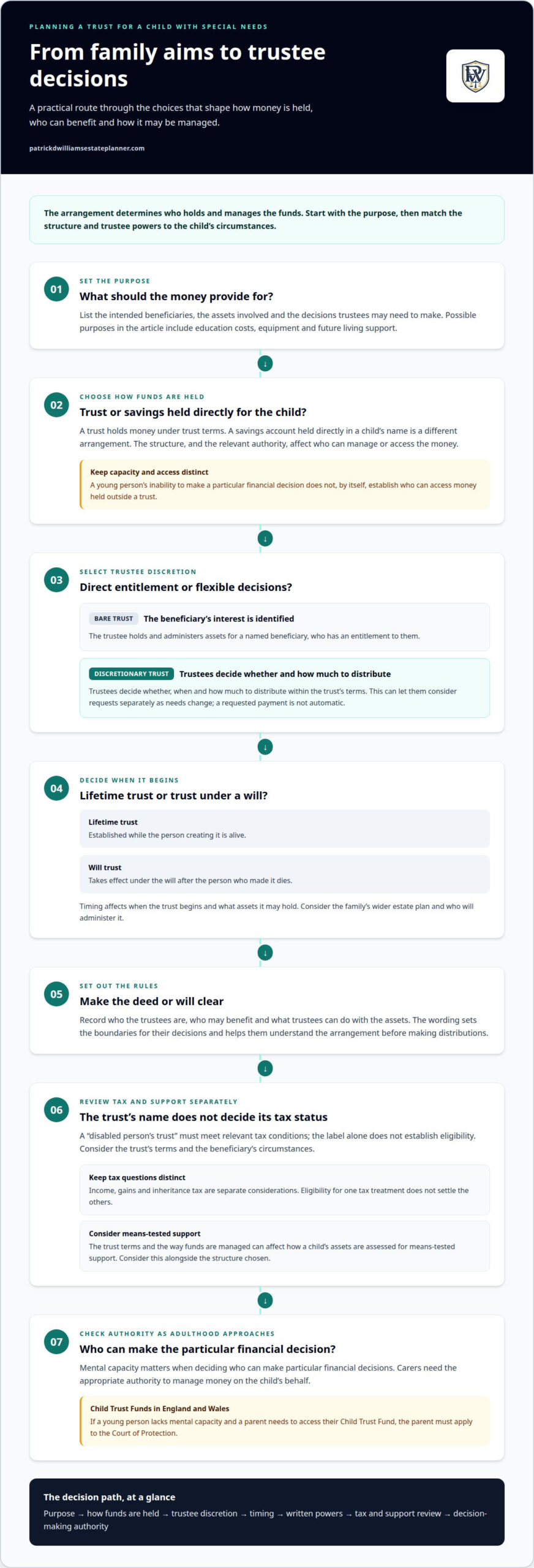
A family can arrange for money to be held for a child through a trust created during their lifetime or under a will. For example, Amira’s parents could set out in their wills how a fund should be managed if they die before her. The trust deed or will records who the trustees are, who may benefit and what the trustees can do with the assets. The right structure depends on the family’s aims, the child’s circumstances and the level of control they want.
A bare trust gives a named beneficiary an entitlement to the trust assets, which a trustee holds and administers. For example, Noah’s grandparent might want a specific gift held for him rather than managed directly by him straight away. This is a comparatively direct structure: the beneficiary’s interest is identified, rather than left for trustees to allocate among possible beneficiaries. Families should consider whether that direct entitlement fits the child’s needs and future circumstances.
A discretionary trust gives trustees discretion over whether, when and how much to distribute to beneficiaries covered by its terms. For example, trustees supporting Leila could consider a request for specialist equipment separately from a request for general spending money. The trust document sets the boundaries for these decisions. This flexibility can help trustees respond to changing needs, but it does not mean the beneficiary automatically receives every requested payment.
A will trust takes effect under the will after the person who made it dies. A lifetime trust is established while that person is alive. For example, Daniel’s parents might compare transferring assets during their lifetimes with leaving instructions for trustees in their wills. Timing affects when the trust begins and what assets it may hold. The choice should also account for the family’s wider estate plan and who will administer the arrangement.
“Disabled person’s trust” can describe a trust that meets particular tax conditions, rather than a separate everyday label for every trust structure. A trust’s name alone does not establish that it qualifies. For example, Priya’s family would need to consider the trust’s terms and her circumstances to assess whether those conditions are met. Tax treatment is a separate question from whether a bare or discretionary structure best serves the family’s purpose.
Trusts also differ from savings accounts held directly in a child’s name. For example, Oliver’s family may need to distinguish money controlled under trust terms from savings that someone else is seeking access to. The arrangement determines who holds and manages the funds. If a young person cannot make a particular financial decision, that does not by itself show who can access money held outside a trust. Both the account or trust structure and the relevant authority matter.
To compare options, write down the intended beneficiaries, the assets involved and the decisions trustees may need to make. For example, Aisha’s parents could list education costs, equipment and future living support as possible purposes, then consider whether a fixed entitlement or trustee discretion better reflects those aims. They should also consider how the arrangement may interact with tax and means-tested support. The following sections explore these issues.
How does a disabled person’s trust qualify for UK tax advantages?
A trust does not qualify for favourable tax treatment simply because its beneficiary is disabled. The trust’s terms and the beneficiary’s circumstances must meet the relevant tax conditions. For example, a family establishing a trust for Maya should distinguish its purpose from its tax status. Calling it a disabled person’s trust does not, by itself, establish eligibility.
Start by identifying who can benefit under the trust deed. If Maya is the intended beneficiary, the deed should make her position clear and explain whether others may also benefit. The wording matters because tax treatment can depend on the arrangement’s actual terms, not the family’s informal description. Trustees need to understand those terms before making distributions or treating the trust as eligible for special treatment.
Keep the tax questions separate. A trust may have income, gains and assets relevant to different taxes. For example, interest received by Maya’s trustees raises a different issue from a gain made when they sell an investment. Inheritance tax is another consideration when assets enter or leave the trust. Eligibility for one tax treatment does not settle the others.
A practical review can establish the facts trustees need to assess. They can:
- Read the trust deed and record who may benefit.
- Gather information that explains Maya’s circumstances and support needs.
- List the trust’s assets, income and transactions.
- Identify each tax question separately before deciding how to report it.
These records help connect the trust’s wording and actual administration with the tax treatment being considered. For example, a deed that permits wider beneficiaries may need closer review than one focused on a single person.
Trustees should also consider timing. If a parent creates a trust under a will, it begins under the will’s terms after the parent’s death. A lifetime trust operates under its own deed. In either case, the planned use of funds, the beneficiary’s circumstances and the trust’s assets inform the tax review. A change in circumstances or administration may also mean the original assessment needs to be reconsidered.
Do not treat a potential tax advantage as automatic or as the sole reason to choose a structure. For example, Maya’s family should weigh tax treatment alongside who controls distributions and how the trust is intended to support her. The trust deed, beneficiary information and records of transactions provide the starting point for that assessment. A clear review of trust planning arrangements can help bring those questions together before trustees make decisions.
What are the UK inheritance tax rules for trusts benefiting a disabled child?
Inheritance tax treatment cannot be decided from the label “disabled person’s trust” alone. For a family such as Elena’s, the relevant questions include how the trust is created, what property it holds and who may benefit. The trust deed and any will provide the starting documents. Trustees should understand these details before relying on a particular tax treatment.
Begin with the transfer that places assets into the trust. Elena’s parents might leave investments to trustees through their wills, while another family might establish a trust during their lifetime. These are different routes to examine. The person transferring assets, their ownership before the transfer and the wording governing the gift all form part of the inheritance tax review.
Next, identify the trust’s beneficiaries and any conditions that apply to them. If Elena is the intended beneficiary, the deed should show whether she is the only person who may benefit or whether trustees can consider others. That distinction helps clarify the arrangement. A family’s intention to support one child should be reflected in the legal documents, not left only in informal discussions.
The type of trust also affects the questions trustees need answered. A fixed entitlement and a discretionary arrangement do not give beneficiaries the same rights under their terms. For example, trustees of a discretionary trust may have choices about distributions that trustees holding assets for a specifically entitled beneficiary do not. Review the trust’s actual structure rather than assuming all trusts receive identical inheritance tax treatment.
For each arrangement, keep a clear record of:
- The person who settled the assets and how they entered the trust.
- The trust deed or will, including its beneficiary provisions.
- The assets held and any later changes to them.
- Distributions made and the reasons recorded by trustees.
These details help explain the trust’s history and operation. For example, a later change to its beneficiaries or assets may raise different questions from those relating to the original transfer.
Trustees should identify when inheritance tax advice is needed: when assets enter the trust, when its terms or property change, and when a beneficiary or settlor dies. These are review points, not a statement that the same charge applies each time. A trust’s tax position must be assessed against its documents and circumstances. Families should not assume that disability alone creates an exemption, or that one trust type automatically produces a particular outcome.
For Elena’s family, the practical step is to have the trust documents and asset history considered together. Record the intended support for her, but distinguish that purpose from the legal terms and tax analysis. This gives trustees a clear basis for understanding the inheritance tax implications before administering the fund.
How can a trust affect a child’s means-tested benefits and social care funding
A trust can affect an assessment differently from money held directly by a child. The outcome depends on the trust terms, the child’s rights and how the funds are handled. For example, a trustee holding assets for Sam under a discretionary trust makes decisions under its terms. That differs from Sam owning an account and having an immediate right to its balance.
Start by separating the trust’s assets from payments made to the child. A decision-maker assessing a benefit or care contribution needs to understand what Sam can access, what trustees control and what support he receives. For example, trustees might pay directly for a particular item rather than transfer money to Sam. The form and purpose of a payment can affect how it is considered.
The trust structure matters. Under a bare trust, a beneficiary has a defined entitlement to the assets. Under a discretionary trust, trustees decide whether and how to make distributions within the deed’s rules. For example, Sam’s trustees could consider a request for a computer, while deciding not to make another payment. The child’s rights under the deed and the trustees’ actual decisions are relevant facts in an assessment.
Social care funding is separate from benefits. For example, if Sam receives support arranged by a local authority, the assessment concerns his care needs and financial circumstances under the applicable arrangements. Do not assume a trust has the same effect on every benefit or care assessment. The scheme being assessed and the way Sam can benefit from the trust both matter.
Trustees can keep records that make the arrangement easier to explain. They should retain:
- The trust deed and any later amendments.
- Accounts showing income, assets and payments.
- Receipts or invoices for items bought for the child.
- A brief record of why each distribution was made.
For example, an invoice for Sam’s specialist equipment shows what the trust paid for, while the accounts show how that payment affected the trust funds.
Families should not treat a trust as a way to hide resources. For example, transferring Sam’s own money into a trust does not erase the history or purpose of that transfer. The origin of the funds, the timing and the rights created by the trust can all be relevant when an assessment considers financial circumstances. Trustees should keep records transparent and administer the arrangement according to its terms.
Before trustees make a payment, they can identify its recipient, purpose and route. For example, they can record whether payment goes to Sam, a supplier or a service provider, and retain supporting documents. If a benefits or social care assessment is under way, clear information about the deed, assets and distributions helps explain how the trust operates. This supports an accurate consideration of Sam’s circumstances without assuming the same trust rule applies to every assessment.
What trustees should be appointed and what duties do they have
Choose trustees who can manage the trust according to its terms and the child’s needs. For example, Amira’s parents might appoint a relative who understands her daily support, alongside someone able to manage financial records. Familiarity can help trustees understand requests, while practical financial skills support careful administration. Appointed trustees should also be willing to serve for the trust’s intended duration.
Consider how personal relationships could affect decisions. If Amira’s aunt is both a trustee and a potential beneficiary, her interests may not always align with Amira’s. The trust document should guide decisions, and trustees should identify potential conflicts before acting. Appointing people who can discuss decisions openly can help them address differing views and keep Amira’s interests central.
Trustees manage the assets and make decisions within the powers set out in the trust. For example, if the deed permits spending on Amira’s support, trustees can assess a request for specialist equipment against its terms and the available funds. They should distinguish an authorised payment from a personal preference. Clear reasons help explain how a decision relates to the trust’s purpose.
Good administration gives trustees a reliable account of the trust. They can keep:
- A copy of the trust document and any amendments.
- Accounts showing assets, income and payments.
- Invoices and receipts for purchases made for the child.
- Notes of decisions, including the purpose of distributions.
For example, a record of Amira’s equipment purchase can show what was bought, who received payment and why the trustees approved it.
Trustees should communicate with one another before making significant decisions. If Amira’s two trustees receive a request for a new item, they can review the trust terms, ask what the item is for and record their decision. If they disagree, they should return to the document’s instructions and consider the child’s interests. A consistent process matters more than relying on informal family assumptions.
Appointment planning should also address continuity. A trustee may become unable or unwilling to continue, so the trust document should set out how replacements are appointed. For example, Amira’s parents can consider who would take over and whether that person understands the responsibilities. Reviewing appointments when family circumstances change helps keep the arrangement workable.
Before naming trustees, consider their reliability, availability, financial organisation and ability to work together. If you are preparing a will or trust, discuss your trust and will planning to set out trustee roles and decision-making clearly.
Patrick D Williams Estate Planners
Patrick D Williams Estate Planners can help families consider how trust arrangements fit within their wider estate plans. This can be useful when deciding who should manage funds, how trustees should be appointed and how a child’s needs can be reflected in a will. Will Writing and Discretionary Trust planning can help families decide how assets are provided for and managed. Lasting Powers of Attorney address a different concern: appointing someone to make decisions if an adult lacks mental capacity.
These arrangements involve distinct legal and practical considerations. Discussing them together can help families understand how each fits their circumstances. Contact Patrick D Williams Estate Planners to discuss your family’s estate planning needs.
Make the next planning decision with care
A trust for a child with special needs in the UK should reflect the support your family wants to provide and the child’s developing independence. Consider how that plan fits with your wider estate arrangements, including who will act and how your wishes will be recorded. These decisions can be considered together, rather than treated as unrelated documents.
Patrick D Williams Estate Planners can help families put their intentions into an estate plan through Will Writing, Lasting Powers of Attorney and Property Protection Trusts. Each addresses a different planning need, so the relevant choices depend on your circumstances and priorities.
For a measured discussion about your family’s plans, contact Patrick D Williams Estate Planners. A clear conversation can help you identify the matters to consider and take the next step with greater confidence.
Frequently Asked Questions
What’s the solution?
First identify where the money is held and who has authority to manage it. A trust can give named trustees responsibility under its terms, while money in a child’s account follows different access rules. For example, in England and Wales, parents seeking access to a Child Trust Fund for a young person who lacks mental capacity must apply to the Court of Protection. The right route depends on the arrangement involved.
What is a trust for a child with special needs in the UK?
A trust is an arrangement in which trustees hold and manage assets for a child under written terms. Those terms can explain who may benefit and what trustees may do with the funds. For example, a grandparent could leave investments for a child, with trustees using them for purposes allowed by the trust. This differs from giving the child money outright, which would not be governed by trust terms.
How do I set up a trust for a child with special needs in England and Wales?
Begin by defining the intended support, the assets involved and who should manage them. Then decide whether to create the arrangement during your lifetime or through your will. The written terms need to identify trustees, beneficiaries and the powers trustees will use. Before transferring assets, consider how the arrangement relates to tax and means-tested support. Keep the signed documents and records of later payments together for future trustees.
How should a trust be coordinated with a will, life insurance and deputyship?
A trust can be created during a person’s lifetime or under a will, taking effect after their death. Consider it as part of the wider estate plan, and ensure carers have appropriate authority for financial decisions. The trust deed sets out how trustees manage and use the funds.
What are the risks and alternatives to a trust for a child with special needs?
A trust’s terms and administration can affect how assets are assessed for means-tested support, and favourable tax treatment is not automatic. A bare trust gives the beneficiary an identified entitlement, while a discretionary trust gives trustees flexibility but does not guarantee requested payments. Savings held directly for a child are an alternative, but access depends on the account arrangement and appropriate authority.
Leave a Reply