

Leaving an inheritance directly is not the only way to provide for a disabled young adult. In England and Wales, setting up a trust for a disabled child in the UK can be done through a will or during your lifetime, often as a discretionary trust. The tax treatment depends on whether the beneficiary meets the relevant eligibility criteria when assets are settled.
It is natural to want to provide lasting financial support while protecting your child’s independence and day-to-day security. A trust can put trustees in charge of managing funds and deciding how to use them, but its terms and payments may affect tax and means-tested benefits.
This article explains the main trust options, eligibility rules for a disabled person’s trust, and how inheritance, income and capital gains tax may apply. It also explains why a trust may be preferable to a direct inheritance and what to consider when planning for your child’s future.
Key Takeaways
- Eligibility for a disabled person’s trust depends on the beneficiary’s circumstances when assets are settled, including qualifying benefits or vulnerability criteria.
- A trust can be created through a will or during your lifetime, with trustees managing assets for the beneficiary’s needs.
- Trustee choices and clear guidance can help ensure decisions reflect the beneficiary’s interests as their circumstances change.
- Special tax treatment may be available, but inheritance, income and capital gains tax rules differ between trust types.
- Holding assets in trust may affect means-tested benefits differently from paying money directly to the beneficiary.
How do I set up a trust for a disabled young adult?
First, check whether the beneficiary meets the criteria for a disabled person’s trust. Then decide how the trust should hold and distribute assets.
Eligibility for a disabled person’s trust
A disabled person’s trust meets statutory criteria for a disabled beneficiary. Eligibility matters because it can affect the trust’s tax treatment and how trustees manage assets for that person.
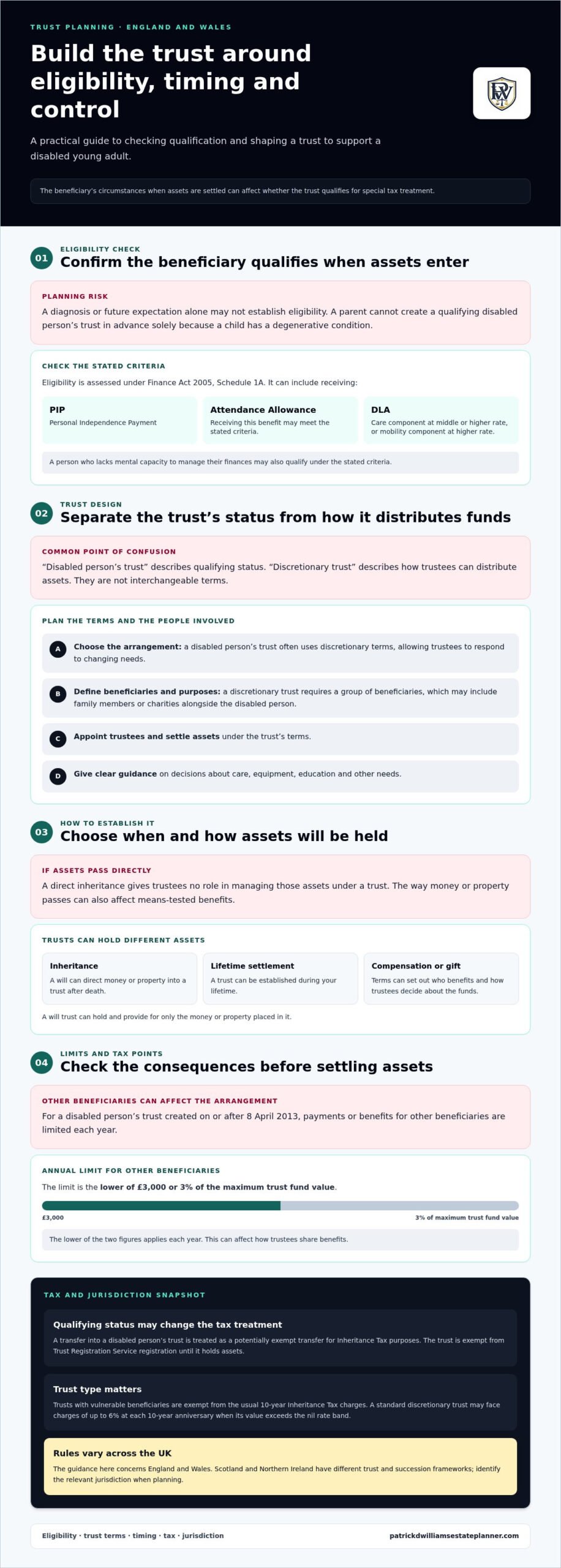
In England and Wales, eligibility can include receiving Personal Independence Payment or Attendance Allowance. Disability Living Allowance may also qualify where the person receives the care component at the middle or higher rate, or the mobility component at the higher rate. Eligibility is assessed under Finance Act 2005, Schedule 1A.
The beneficiary must generally meet the definition of disabled when assets are settled into the trust. A parent cannot create a qualifying disabled person’s trust in advance solely because a child has a degenerative condition. A person who lacks mental capacity to manage their finances may also qualify under the stated criteria.
Discretionary and disabled person’s trusts
A disabled person’s trust describes the trust’s qualifying status, while a discretionary trust describes how trustees can distribute its assets. A disabled person’s trust often uses discretionary terms, giving trustees flexibility to respond to changing needs.
In England and Wales, a discretionary trust requires a group of beneficiaries. That group may include family members or charities alongside the disabled person. For trusts created on or after 8 April 2013, payments or benefits for other beneficiaries are limited each year to the lower of £3,000 or 3% of the maximum trust fund value.
In England and Wales, you can create a trust in a will or during your lifetime. Define its beneficiaries and purposes, appoint trustees, and settle assets under its terms. The trust document should explain how trustees decide whether to pay for care, equipment, education or other needs.
Tax treatment of disabled person’s trusts
Qualifying status can change how inheritance tax applies when a settlor creates a trust during their lifetime. Qualifying status can affect the inheritance tax treatment of assets transferred into a disabled person’s trust.
A transfer into a disabled person’s trust is treated as a potentially exempt transfer for inheritance tax purposes. The trust is exempt from registration on the Trust Registration Service until it holds assets. The timing of settlement and the beneficiary’s eligibility are therefore important parts of planning.
Trust rules across the UK
Trust and succession rules vary across the UK, so the jurisdiction where the trust is created matters. In Scotland, a trust set up there for children after someone dies without a will is usually treated as a bare trust for tax purposes.
Northern Ireland has its own trust and succession framework, so arrangements for England and Wales should not be assumed to apply unchanged. The eligibility and tax points above are not a complete guide to Scottish or Northern Irish rules. Identify the relevant jurisdiction when choosing the trust’s terms and considering how assets will pass.
Should I leave my child an inheritance?
An inheritance can provide for your child, but how the assets pass matters. A trust lets trustees manage funds according to your child’s needs and the trust’s terms.
Trusts for inheritance, compensation or gifts
A trust can hold money or property intended for your child, including an inheritance, compensation or a gift. Its terms determine who manages those assets and how they may be used.
You can create a trust in your will, taking effect after your death, or establish one during your lifetime. A will trust can hold and provide for only the money or property placed in it. For compensation or a gift, trust arrangements can set out who benefits and how trustees should decide about the funds.
Inheritance tax during a trust’s lifetime
Inheritance tax treatment during a trust’s lifetime depends on its type and whether it qualifies for special treatment. Trusts with vulnerable beneficiaries are exempt from the usual 10-year Inheritance Tax charges.
A standard discretionary trust may face charges of up to 6% at each 10-year anniversary when its value exceeds the nil rate band. For a disabled person’s trust created on or after 8 April 2013, payments for other beneficiaries are limited to the lower of £3,000 or 3% of the maximum trust fund value each year. This can affect how trustees share benefits.
Inheritance tax on transfers into a trust
A transfer into a disabled person’s trust is treated as a potentially exempt transfer for Inheritance Tax purposes and does not trigger a charge on creation. A qualifying disabled person’s trust created during your lifetime also avoids the usual 20% charge on assets entering above the settlor’s nil rate band.
For a standard discretionary trust, a transfer above the £325,000 threshold may trigger an immediate lifetime Inheritance Tax charge of 20%. If you survive for 7 years after setting up a trust, you’re not charged Inheritance Tax on the transfer. HM Revenue & Customs states that a Disabled Person’s Trust may incur Inheritance Tax at 40% on the beneficiary’s death if its capital, together with available allowances, exceeds the applicable nil rate band.
Wills and leaving an inheritance
A will can direct an inheritance into a trust rather than leaving assets directly to your child. This allows trustees to manage the property or money after your death, according to the trust terms. Without a will, intestacy rules may determine how assets pass, and children inherit their share at age 18, whether or not they can manage their finances.
Consider whether pension benefits, death-in-service benefits or life cover should be directed separately, as these usually cannot be included in a will. A clear estate plan can align your wishes for inheritance with the trust’s purpose. Explore estate planning guidance to consider how your will and trust arrangements can work together.
What Form Do Disabled Person Trusts Have to Take?
A disabled person’s trust has no single required form and commonly uses discretionary terms. The trust deed or will should explain how trustees manage assets and make decisions.
Types of trust for a disabled child
A disabled person’s trust describes a trust that meets the beneficiary and tax criteria, rather than one fixed legal structure. This distinction matters because a trust’s form and its qualifying status are separate questions.
In England and Wales, a disabled person’s trust usually takes the form of a discretionary trust. It can be created during a parent’s lifetime or through a will, and its terms set out the trustees’ powers. A discretionary trust has a group of beneficiaries, which may include the disabled person, family members or charities.
The trust document should state its purposes and explain how trustees can apply income or capital. For example, parents may want trustees to consider equipment, education or support needs rather than give the beneficiary unrestricted access to the fund. A trust’s tax status depends on the eligibility criteria, not simply its title.
Choosing and appointing trustees
Trustees administer the trust and make decisions under its terms. Choose them carefully: they must act personally, agree decisions unanimously and put the beneficiary’s interests first.
Scope recommends appointing between 2 and 4 trustees for a trust supporting a disabled person, although a trust corporation can act as sole trustee. Parents can consider people who understand the beneficiary’s wishes and circumstances, can manage financial responsibilities, and can work constructively with other trustees.
Before appointing trustees, consider whether each person can stay involved over time and respond to changing needs. A trusted relative may know the beneficiary well, while another trustee may bring a different perspective on managing money. The trust document should set out trustee powers and how replacements are appointed.
Trustees must act in the beneficiary’s best interests and are accountable for investments they make. Their decisions must follow the trust terms, not personal preference. If the beneficiary has capacity to express their wishes, trustees should take those wishes seriously while retaining responsibility for decisions.
Payments need careful handling. Discretionary trust capital is generally not treated as belonging to the disabled beneficiary for means-tested benefits, although regular payments can count as income. Trustees should consider the effect of each proposed payment rather than assume an allowance or routine distribution is harmless.
For example, if trustees are considering payment for specialist equipment, they should record its purpose, the beneficiary’s needs and how the trust permits that use. Regular reviews can help trustees respond to changed circumstances and keep decisions aligned with the trust’s purposes.
Income tax and capital gains tax treatment
A trust’s structure affects how income and capital gains are taxed. Eligibility for vulnerable person treatment can also change the tax calculation.
Trust structure and tax treatment
A qualifying disabled person’s trust may receive special tax treatment, while a standard discretionary trust follows the usual trust rules. This distinction matters when trustees manage investments, receive income or sell assets.
For the 2025 to 2026 tax year, HM Revenue & Customs gives trustees of a disabled person’s trust an annual Capital Gains Tax exempt amount of £3,000. Trustees of other trusts have an exempt amount of £1,500 for the same tax year. These figures relate to gains, not the trust’s income or capital value.
A standard discretionary trust has different income tax rates. Income up to £1,000 is taxed at the stated standard rates: 7.5% for dividends and 20% for other income. Above £1,000, dividend income is taxed at 39.35%, and other income at 45%. This makes the trust’s structure relevant to the ongoing return from its assets.
Capital gains can arise when trustees dispose of an asset that has increased in value. Creating a disabled person’s trust does not currently allow capital gains tax to be held over. Transferring an appreciated asset may therefore create a tax charge at the point of transfer.
Claiming special tax treatment
Trustees claim special Income Tax and Capital Gains Tax treatment by making a Vulnerable Person Election. The election allows the relevant tax calculation to reflect the beneficiary’s vulnerable status.
Both the trustees and the vulnerable beneficiary must sign the election form. If a trust has more than one vulnerable beneficiary, trustees must submit a separate form for each person. Consider the effect of the election carefully before submitting it.
If a trust includes vulnerable and non-vulnerable beneficiaries, trustees must identify and keep separate the assets and income attributable to the vulnerable beneficiary. That share must be used only for that person for special treatment to apply. Clear records help show which income and capital gains belong to each share.
A trust from which its settlor can benefit does not qualify for special Income Tax treatment. It may still qualify for special Capital Gains Tax treatment from the 2008 to 2009 tax year. This difference means trustees need to consider income and gains separately, rather than assuming one election gives identical treatment across both taxes.
Reasons for setting up a trust for a disabled child
A trust can give trustees control over how an inheritance, gift or compensation is used. Its value depends on your child’s circumstances, the trust terms and how payments affect support.
One reason parents consider a trust is to manage funds without giving the beneficiary immediate control. A child who inherits directly at 18 may receive money before they can manage it confidently. Trustees can instead decide when payments are appropriate and what purposes they should meet, such as equipment, education or support.
Discretionary trust capital is generally not treated as belonging to the disabled beneficiary for means-tested benefits and assessments, although regular payments may count as income. Scope’s guidance says money held in trust does not count towards the savings and income limits used for means testing in England and Wales. The difference between retained capital and money paid out matters.
For example, paying money directly to a beneficiary may add to their income or savings for means-testing purposes. In the UK, savings of £6,000 can affect a disabled person’s means-tested benefits, whilst savings of around £16,000 could stop those benefits completely. A trustee considering a payment should therefore consider its timing, purpose and likely effect.
This does not guarantee benefit entitlement. The local authority assesses social care eligibility under its criteria and is legally required to pay for social care for people who meet them. A trust may help preserve assets for the beneficiary, but it does not replace an assessment or guarantee a particular funding decision.
Putting personal assets into a trust also needs care. A person who has capacity but is physically disabled may affect their means-tested benefits by settling their own assets on trust. Personal injury damages may be settled on trust while the person retains entitlement to means-tested benefits. The source of the money and the beneficiary’s circumstances therefore matter.
Inheritance tax is another consideration, but it should not be the sole reason for choosing a trust. The trust type and beneficiary’s eligibility affect the tax treatment, including possible charges during the trust’s lifetime or when the beneficiary dies. Trustees also have administrative responsibilities, such as managing investments, tax reporting and reviewing how funds are used.
Setup and running costs depend on the trust’s complexity, assets, tax reporting and administration; professional fees depend on the case and are given after a quote request. Consider these alongside the trust’s practical purpose, such as managing an inheritance or compensation over time.
To weigh the trust structure against your child’s needs and estate plans, discuss your trust and will planning.
Patrick D Williams Estate Planners: Will Writing
Patrick D Williams Estate Planners can help you put your wishes into a will and consider how a trust may support your child. Our Will Writing service can be relevant if you want an inheritance directed into a trust, with trustees managing it under the terms you set.
Support can also include a Discretionary Trust or Lasting Powers of Attorney, depending on the planning needs involved. A free 15-minute consultation is available, with discussions by Zoom, Teams or in person. This can help you explain your family circumstances and consider the next steps for your estate plan.
For guidance on will writing and trust planning, contact Patrick D Williams Estate Planners or visit patrickdwilliamsestateplanner.com.
Take the next step with a clear plan
When setting up a trust for a disabled child in the UK, focus on the wishes you want your arrangements to carry forward. Consider the support your child may need, who understands their circumstances and how your plans should adapt as life changes. These priorities can help shape a plan for your family rather than rely on a one-size-fits-all arrangement.
Patrick D Williams Estate Planners offers Will Writing, Lasting Powers of Attorney and Property Protection Trusts. These services can help you consider how your will, decision-making arrangements and wider estate planning fit together. Discuss your priorities and the choices you are weighing so your plan can reflect your circumstances.
Contact Patrick D Williams Estate Planners to discuss your plans. Thoughtful decisions made now can give your family a clearer path forward.
Frequently Asked Questions
Can I leave my money to another family member to just look after?
You can leave money to a family member, but an outright gift makes that person the owner. They are not automatically required to use it only for your child. If you want enforceable instructions about who benefits and how funds are used, a trust can set out those responsibilities. Consider what happens if the family member’s circumstances change, and make your wishes clear in the legal arrangement.
What are the duties and responsibilities of trustees, and how do they make decisions?
Trustees must follow the trust terms, act in the beneficiary’s best interests and make decisions personally. Their decisions must be unanimous, and they are accountable for investments. For example, before paying for equipment, trustees should consider the beneficiary’s needs, the trust’s permitted purposes and the effect of the payment. A written record of the reasons can help explain how they reached their decision.
What are the eligibility rules for a UK disabled person’s trust?
Eligibility is assessed under Finance Act 2005, Schedule 1A, and generally depends on the beneficiary meeting the criteria when assets enter the trust. In England and Wales, qualifying routes include certain rates of Disability Living Allowance, Personal Independence Payment or Attendance Allowance. A person who lacks mental capacity to manage their finances may also qualify. A degenerative condition alone does not establish eligibility before the criteria are met.
What are the tax rules and tax rates for a disabled person’s trust in the UK?
Tax treatment depends on the trust’s status, income, gains and whether trustees make a Vulnerable Person Election. For a standard discretionary trust, income up to £1,000 is taxed at standard rates: 7.5% for dividends and 20% for other income. Above that threshold, the rates are 39.35% and 45%, respectively. For the 2025 to 2026 tax year, HM Revenue & Customs gives trustees of a disabled person’s trust an annual Capital Gains Tax exempt amount of £3,000.
Who can be trustees, and what are their legal duties?
Trustees can be suitable individuals, and a trust corporation can act as sole trustee. Scope recommends between 2 and 4 trustees for a trust supporting a disabled person. Choose people who can work together, understand the beneficiary’s circumstances and manage decisions responsibly. Trustees must follow the trust terms, act in the beneficiary’s best interests and take responsibility for investments. The document can also provide for replacing a trustee who can no longer act.
How can a trust be created through a will or during the parent’s lifetime?
Parents setting up a trust for a disabled child in the UK can create it in a will, taking effect after their death, or during their lifetime, taking effect immediately. A will should clearly identify the assets intended for the trust and the people who will manage them. A lifetime arrangement requires assets to be settled into the trust. The choice affects when trustees gain authority and when the trust begins holding property.
What assets can be placed in a trust, and how should trustees manage them?
A trust can hold money or property, subject to its terms and how ownership is transferred. Trustees should understand what each asset is intended to provide, keep clear records and consider investment decisions in the beneficiary’s interests. Pension benefits, death-in-service benefits and life cover usually cannot be included in a will, so arrangements for those assets may need to sit separately from a will trust.
What are the risks and alternatives to a trust, including a disabled person’s trust?
Before setting up a trust for a disabled child in the UK, weigh the administration, investment decisions and tax obligations against the support it can provide. Transferring an asset that has risen in value can create a Capital Gains Tax charge, and direct payments may affect means-tested assessments. An alternative is to leave an inheritance directly, giving the beneficiary control without trustee management. Consider capacity, support needs and the intended use of the funds.
Leave a Reply