

Living together does not give an unmarried partner an automatic right to inherit. The rules of intestacy for an unmarried partner mean that, in England and Wales, an estate is generally passed to relatives entitled under the rules, not to the surviving partner. A partner who lived with the deceased as a couple for two years immediately before the death may be able to claim financial provision under the Inheritance (Provision for Family and Dependants) Act 1975, according to the UK legislation register.
It’s understandable to expect that a long relationship or shared home will provide some security. But the rules of intestacy for an unmarried partner do not provide automatic inheritance rights in England and Wales. The outcome can depend on property ownership, whether a claim may be available, and whether the deceased left a valid will. This article explains what an unmarried partner may be able to claim, how ownership affects a home and other assets, and how a will can record your wishes clearly.
Key Takeaways
- A surviving cohabiting partner may be able to seek financial provision, but eligibility and the evidence of dependency matter.
- Any claim under the Inheritance (Provision for Family and Dependants) Act 1975 must be started within six months from the Grant of Representation, according to the UK legislation register.
- Check how a home is owned: joint tenancy and tenants in common can lead to different outcomes when one owner dies.
- Living together, even for many years or with children, does not create a common-law marriage in England and Wales.
- A will can record who you want to benefit and help provide clarity about your estate.
Claims under the Inheritance (Provision for Family and Dependants) Act 1975
The Inheritance (Provision for Family and Dependants) Act 1975 may provide a route to seek financial provision from an estate. This is separate from inheriting automatically under intestacy.
Claims by people excluded from intestacy
A claim by someone excluded from intestacy seeks financial provision from the deceased’s estate, not an automatic inheritance. An unmarried partner may be able to make such a claim despite not inheriting automatically. In England and Wales, someone who meets the legal eligibility requirements may apply to court for financial provision if the death left them in a difficult financial position.
For example, a surviving partner who relied on the deceased’s income may be in a different position from someone who was financially independent. A claim does not change the intestacy order itself. It asks for provision from the estate, so evidence about the relationship and financial circumstances may be important.
If the deceased had no children but left a spouse or civil partner, that person inherits the entire estate under the intestacy rules described here. If there is no spouse or civil partner, living parents or siblings may inherit under the statutory order instead of an unmarried partner.
Eligibility and time limits for partner claims
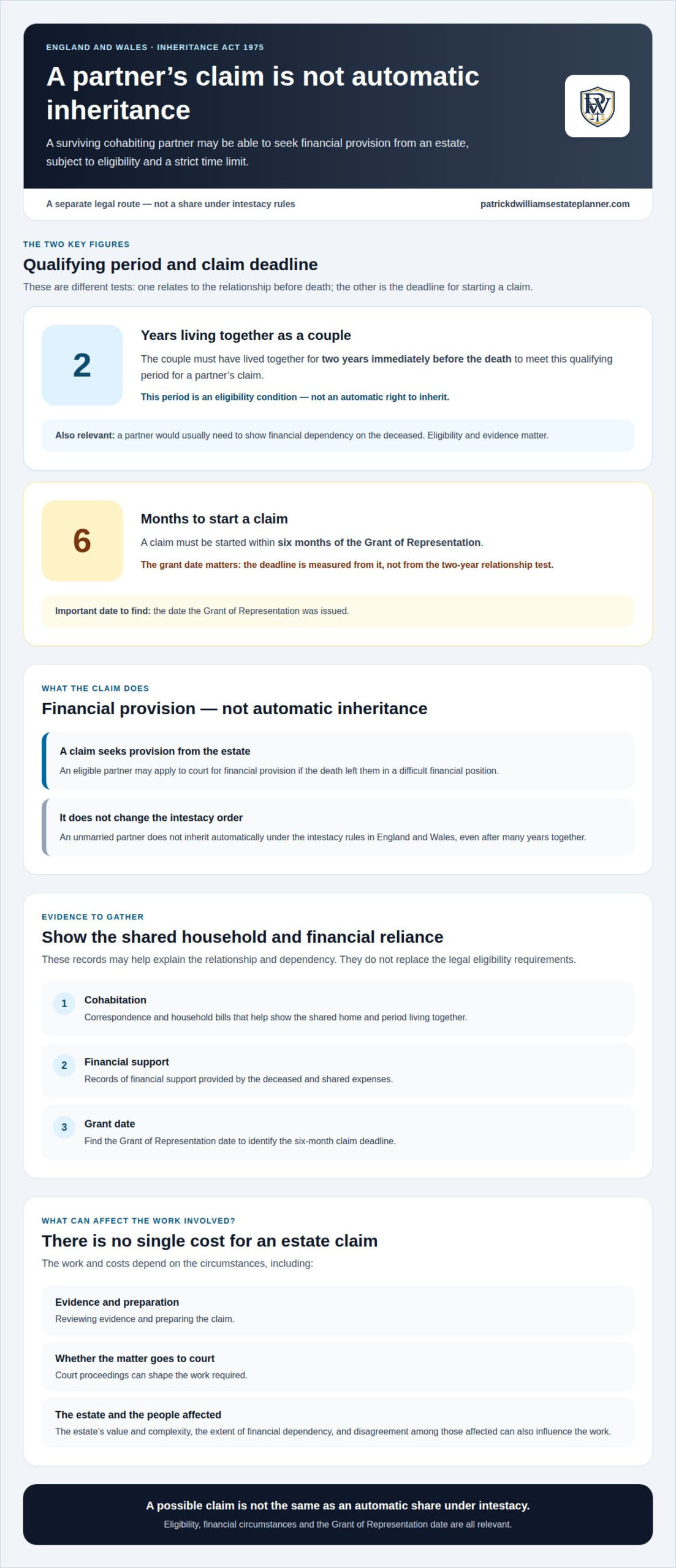
To claim under the 1975 Act as an unmarried partner, the couple must have lived together as a couple for two years immediately before the death. The UK legislation register gives this qualifying period for a surviving cohabiting partner in England and Wales. A partner would usually also need to show financial dependency on the deceased.
The claim deadline is separate from the two-year relationship test. Under the legislation, a claim must be started within six months of the Grant of Representation. The grant date is therefore important. Records showing cohabitation and financial reliance may help explain the claim.
Practical steps include finding the Grant of Representation date, gathering evidence of the shared household, and recording financial support provided by the deceased. Relevant material may include correspondence, household bills, and records of shared expenses. These examples can help describe the relationship and dependency, but do not replace the legal eligibility requirements.
There is no single cost for an estate claim. Costs depend on the work involved, such as reviewing evidence and preparing the claim, and on whether the matter proceeds through court. The estate’s value and complexity, the extent of financial dependency, and disagreement among those affected can also shape the work required. Any financial provision is not the same as an automatic share under intestacy.
Can an unmarried partner make a legal claim?
Intestacy rules determine who inherits when someone dies without a valid will. In England and Wales, an unmarried partner has no automatic inheritance right under these rules.
An unmarried partner’s inheritance rights
An unmarried partner does not inherit automatically under the intestacy rules in England and Wales. Living together, even for many years, does not give a partner the same legal position as a spouse or civil partner.
A surviving partner may have a separate route to seek financial provision under the Inheritance (Provision for Family and Dependants) Act 1975. That is a claim against the estate, not an automatic share under intestacy.
Intestacy when there are children but no spouse
If someone dies leaving children but no spouse or civil partner, their children inherit the estate in equal shares under the intestacy rules in England and Wales. This applies regardless of who their other parent is, so children from different relationships share equally.
A grandchild may inherit the share their parent would have received if that parent died before the deceased. The same applies if the parent survived the deceased but died before reaching 18.
For example, if one of the deceased’s children died earlier, that child’s own child may inherit their parent’s share. A child under 18 cannot receive their inheritance until turning 18; the inheritance is held in trust until then. An unmarried partner does not receive a share simply because they are the children’s surviving parent.
Married spouses and civil partners have specific rights under intestacy. If there are no children, the surviving spouse or civil partner inherits the entire estate. If there are children and the estate is worth more than £322,000, the spouse or civil partner receives the first £322,000 and half of the remainder. The children share the other half equally.
Separation alone does not remove a spouse’s intestacy rights in England and Wales. Someone still married to, or in a civil partnership with, the deceased at the time of death may inherit, even if they were separated. A former spouse cannot inherit under intestacy after divorce, and a former civil partner cannot inherit after the partnership legally ends.
Grandchildren’s inheritance depends on the position of their parent in the family line. If that parent died before the deceased, or survived but died before reaching 18, the grandchild may receive the share their parent would have taken. This representation rule does not give grandchildren an independent equal share alongside living children.
Inheritance Tax treatment also differs for unmarried couples. In England and Wales, an unmarried partner does not receive the spouse exemption for Inheritance Tax. This concerns tax, not who inherits under intestacy: an unmarried partner still has no automatic inheritance right under those rules.
Scotland and Northern Ireland have separate intestacy rules from England and Wales. The inheritance outcomes described here do not establish an unmarried partner’s entitlement in either jurisdiction. The applicable national rules determine the position.
Property ownership arrangements
Ownership can affect whether a surviving partner keeps a home or receives money held jointly. A property or account may pass differently from other estate assets, so the legal ownership arrangement matters alongside intestacy.
In England and Wales, a surviving partner automatically inherits the deceased’s share of a home if they owned it as beneficial joint tenants. This is known as the right of survivorship. The deceased’s share passes to the surviving joint tenant, rather than being distributed under intestacy. For example, if an unmarried couple own their home as beneficial joint tenants, the survivor automatically inherits the deceased’s share.
Tenants in common is different. Each owner has a separate share, and the deceased’s share does not automatically pass to the surviving co-owner. It forms part of the estate and is dealt with under the will or intestacy rules. An unmarried partner may therefore risk losing the home or being forced to sell if their partner owned the property solely or as a tenant in common.
The practical distinction matters. A surviving partner who owns a home as a tenant in common keeps their own share but does not automatically receive the deceased’s share. If relatives inherit that share, they may become co-owners with the surviving partner. Their interests can affect whether the survivor can remain in the property.
Joint bank accounts follow a separate rule. In England and Wales, when one joint account holder dies, the surviving partner automatically inherits all the money in the account. This differs from a sole account held by the deceased, which forms part of the estate. The account’s ownership arrangement matters, even if both partners used the money for household expenses.
To understand the likely outcome, identify how each asset is legally held. For a home, establish whether ownership is beneficial joint tenancy, tenancy in common, or solely in the deceased’s name. For money, distinguish a joint account from one held only by the deceased. These categories can produce different outcomes for the same surviving partner.
A useful review starts with property ownership documents and account details, rather than assumptions based on who paid the mortgage or bills. A couple may have shared household costs while holding property in a way that gives the survivor no automatic right to the deceased’s share. Both the inheritance order and each asset’s ownership terms affect the outcome.
For someone planning ahead, a Property Protection Trust or Joint Tenancy Severance may be relevant when considering property ownership and estate planning. The appropriate arrangement depends on what the owners intend for their respective shares. Clear records help distinguish property passing automatically to a co-owner from assets distributed through the estate.
Common-law marriage in England and Wales
“Common-law marriage” is not a legal status for couples who live together in England and Wales. Cohabiting for many years does not make partners spouses, and having children together does not change that position. The phrase may describe a committed relationship in everyday conversation, but it does not create an automatic right to inherit when one partner dies without a will.
The distinction matters because the Rules of Intestacy distribute an estate according to legal relationships and family connections. If an unmarried person dies intestate, assets usually pass to their children or other blood relatives, not their surviving partner. For example, a partner of many years may still be excluded from the automatic inheritance order, even if the couple shared a home and family life.
The length of cohabitation does not turn the relationship into a marriage. A couple who have lived together for decades remain unmarried unless they marry or enter a civil partnership. The same applies if they have children together. These circumstances do not create common-law marriage rights or give a surviving partner automatic inheritance under intestacy.
Property ownership can affect what happens to the home, but it does not create marital status. If the deceased owned the property solely, the surviving partner may risk losing their home. The same risk can arise where the property was held as tenants in common. In either case, the surviving partner’s long residence does not make them an intestacy beneficiary.
A practical distinction is the difference between relationship status and ownership. A partner may have an interest in a home because of how it is owned, but that is separate from inheriting as a spouse. Living together and contributing to household costs, for example, do not by themselves establish common-law marriage in England and Wales. The outcome depends on the ownership arrangement and estate rules.
For couples who use the phrase “common-law marriage”, a useful step is to identify what they intend to happen after either partner dies. Consider how the home is owned and whether a will records who should benefit. Without a will, intestacy rules apply, and cohabitation alone does not give the surviving unmarried partner a spouse’s automatic inheritance rights.
These rules concern England and Wales. A couple living elsewhere in the United Kingdom should identify the applicable national inheritance rules rather than assume the England and Wales rules apply. In every case described here, the key point is that years together, shared children, or a shared home do not establish common-law marriage in England and Wales.
Making a will
A will lets you record who should benefit from your estate. For an unmarried couple in England and Wales, naming a partner can address a gap left by intestacy. Without that instruction, the relationship alone does not give the surviving partner automatic inheritance. A will can also explain how you want your assets divided among your partner, children, relatives, or other chosen beneficiaries.
Start by listing the assets you want your will to cover, such as savings, possessions, and your share of a property. Then decide who should receive each asset or share. For example, you may want your partner to receive a specific item, a share of your estate, or a larger provision. Clear instructions distinguish your wishes from the outcome intestacy rules would otherwise produce.
Consider how your wishes fit your family circumstances. If you have children, decide how you want to provide for them alongside your partner. If you have children from different relationships, identify them clearly in your planning. A will can set out your intended distribution instead of leaving relatives to rely on the default inheritance order.
Review your will when circumstances change. A new child, a change in property ownership, or a change in your relationship may affect what you want to happen. Marriage is especially important: in England and Wales, a will is normally revoked by marriage, although a will can be made in contemplation of marriage. If you plan to marry your partner, include that intention in your will-planning discussion.
Keep the will’s instructions aligned with how assets are owned. A home held as beneficial joint tenants passes to the surviving joint tenant, while a tenant in common’s share forms part of their estate. A will can address assets that pass through the estate, but it does not replace a review of ownership arrangements. For example, naming your partner to receive your estate does not change how a jointly owned home passes automatically.
Unmarried partners can protect their intended inheritance by making a will that names each other as beneficiaries and clearly describes their wishes. They can also review property ownership and other arrangements alongside the will, so the documents and ownership structure work consistently.
Before completing your plans, note your chosen beneficiaries, the assets involved, and any expected changes, such as marriage. A will-writing discussion can help turn those decisions into clear instructions. For an unmarried couple, putting wishes in writing gives the surviving partner a defined place in the estate plan, rather than relying on the relationship itself to determine inheritance.
Patrick D Williams Estate Planners: Will Writing
Patrick D Williams Estate Planners provides Will Writing to help you put your wishes for your estate into clear instructions. This is a practical next step if you want your unmarried partner to benefit or need to consider your partner alongside children and other relatives.
Planning may also involve Lasting Powers of Attorney or a trust, depending on your wider wishes and circumstances. A Property Protection Trust or Discretionary Trust may be relevant when considering how assets should be managed and passed on. The aim is to make your intentions clear, rather than rely on intestacy rules to determine who inherits.
To discuss Will Writing and your estate-planning needs, contact Patrick D Williams Estate Planners.
Put your wishes into a clear plan
A useful next step is to identify the decisions that matter most to you. Note who you want to benefit, which assets need particular attention, and any family or property changes that could affect your intentions. These points can help make your planning focused and practical.
The rules of intestacy for an unmarried partner show why personal wishes should be recorded instead of leaving inheritance to assumptions about a relationship. Your priorities may change as your household, assets, or plans develop. Revisiting your arrangements after a significant change can help keep your instructions aligned with what you want for the people who matter to you.
If you are ready to discuss putting your wishes into writing, speak with Patrick D Williams Estate Planners. A considered plan can help you approach the future with greater clarity and confidence.
Frequently Asked Questions
Is there such a thing as a “common law spouse”?
No. In England and Wales, living together does not create the legal status of marriage, regardless of how long the relationship lasts or whether the couple have children. For example, a partner who has shared a home for decades does not become a spouse through cohabitation. If you want your partner to benefit from your estate, record your wishes rather than relying on that informal label.
Should my partner have a will?
A will can state who should benefit from your partner’s estate and who should manage it. This matters if you share a home, have children, or want to provide for relatives alongside one another. For example, each partner can make their own will naming their intended beneficiaries. Review those plans after major changes, including marriage, because marriage normally revokes a will in England and Wales unless it was made in contemplation of that marriage.
What happens if my unmarried partner dies without a will?
The estate is distributed under intestacy rules, rather than according to wishes expressed informally. Establish which assets belonged solely to your partner and which were jointly owned, since ownership can affect what passes automatically. For example, a home held as beneficial joint tenants passes differently from a property share held as tenants in common. Keep ownership and shared-finance records available for estate administration.
What are the intestacy rules in England and Wales if someone dies without a will and leaves an unmarried partner?
An unmarried partner has no automatic entitlement under the intestacy rules in England and Wales. The estate passes to relatives who qualify under the statutory order, such as children or other eligible family members. If the deceased had children but no spouse or civil partner, the children inherit equal shares. The surviving partner’s relationship with the deceased does not, by itself, place them in that inheritance order.
Does a cohabiting partner inherit automatically under intestacy in England and Wales?
No. Cohabitation alone does not make a surviving partner an intestacy beneficiary, even if the couple shared finances or raised children together. This concerns inheritance under intestacy, not every possible claim against an estate or the ownership of particular assets. For instance, a jointly held asset may pass according to its ownership arrangement. Consider each asset separately rather than assuming the whole estate passes in the same way.
Can an unmarried partner claim financial provision from an estate under the Inheritance (Provision for Family and Dependants) Act 1975?
Yes, a surviving cohabiting partner may be able to claim if they lived together as a couple for two years immediately before the death. They would usually need to show financial dependency on the deceased. The claim must be started within six months of the Grant of Representation. Records showing the shared household and financial support can help explain the circumstances behind a claim.
What happens to a jointly owned home when one unmarried owner dies intestate?
The outcome depends on how the home was owned. If the couple owned it as beneficial joint tenants, the surviving partner automatically inherits the deceased’s share. With tenants in common, the deceased’s share forms part of the estate and is dealt with under intestacy. For example, relatives may inherit that share, leaving the survivor and relatives with interests in the same property. The title and ownership records are important.
Leave a Reply