

A property protection trust isn’t a universal shield against care fees. It’s a trust written into a will that may help direct what happens to one co-owner’s share of a home after they die, while providing security for the surviving partner. Its effect depends on how the property is owned, the wording of the will and the family’s circumstances.
It’s understandable to want clarity about who can remain in the home and who may ultimately inherit. A trust can be structured to let a surviving partner continue living in the property, but it doesn’t automatically protect the home from care-fee assessments. Local authorities may consider the reasons for creating a trust, including whether avoiding care costs was a significant motivation.
This guide explains how a property protection trust works, why ownership as tenants in common may be important, and what the arrangement can and can’t achieve. It also sets out the family and property details to review before deciding whether this approach is suitable. With those points in view, you can discuss your options and next steps with an estate-planning professional.
Key Takeaways
- A property protection trust’s effect depends on the will, property ownership and who is intended to benefit.
- Check how the home is owned before making or changing your will, because the ownership arrangement affects what can happen to a share.
- Consider the surviving co-owner’s right to occupy the home alongside the eventual beneficiaries’ interests.
- A trust does not guarantee that a home or its value will be excluded from care-fee means testing.
- Before deciding, clarify your family’s priorities and discuss suitable terms, trustees and any Land Registry changes with an estate-planning professional.
What is a Property Protection Trust and its purpose?
A property protection trust is a trust written into a will to hold a specified property or a share of it after the person who made the will dies. The will sets out how the trust operates, who manages it as trustees and who may benefit. Its purpose depends on those terms, how the home is owned and the family members the will is intended to provide for.
The name can sound like a broad promise of protection, but it doesn’t guarantee that a home or its value is beyond every claim or assessment. A trust’s effect depends on the circumstances and the relevant rules. The legal framework differs across UK jurisdictions, so this guide focuses on England and Wales. For general background, see English trust law.
How does a trust in a will differ from owning a home outright?
If someone receives an outright gift under a will, they generally inherit it directly. With a trust, trustees hold and manage the specified share under the will’s instructions for the people entitled to benefit. Those people may have different rights, such as a right to occupy or benefit from the trust property, depending on the wording. Trustees must follow the trust terms and respect beneficiaries’ rights; they cannot simply disregard them.
This distinction can matter when someone wants a surviving co-owner to have security of occupation while also directing where their own share should eventually pass. The will needs to spell out the intended arrangement. The label alone doesn’t establish who can live in the home, make decisions about it or receive value from it.
Which families may consider a property protection trust?
Co-owners may consider a property protection trust when each wants to plan the destination of their share rather than leave the outcome unclear. For example, someone may want their share to benefit children eventually while also making provision for a surviving partner. Whether that can be achieved, and on what terms, depends on ownership, the will and the family’s wishes.
A property protection trust is a will-based arrangement for holding a specified property share under defined terms, not a guarantee that the asset is protected from every claim.
Suitability is personal. Blended families, children from previous relationships, differing contributions to a home, or a wish to provide for both a partner and other beneficiaries may affect the right approach. Check the existing ownership structure alongside your will plans, because the will can only deal with the interest you are able to pass on.
How a property protection trust can work through a will
A property protection trust is planned as part of a will. The practical steps are to check how the home is owned, decide what should happen to the relevant share, draft the will provisions, appoint trustees and define who may benefit. The terms should explain the surviving co-owner’s position as well as the interests of any eventual beneficiaries.
The arrangement takes effect under the signed will and the property ownership in place when the first co-owner dies. A change in ownership or a later will could affect the intended outcome, so consider the documents and arrangements together and review them if circumstances change.
Why ownership type matters before a trust is drafted
Joint tenants own a property together with a right of survivorship. When one owner dies, the property passes automatically to the survivor. Tenants in common each own a distinct share, which can generally be dealt with in their will. A will cannot usually direct a share of a jointly owned property as though it were already separate. Before drafting, ask a professional to check the ownership and whether it needs to change.
Confirm the relevant terms and steps against current law in England and Wales. Joint tenancy severance may be relevant where co-owners want to hold distinct shares, but whether it is appropriate depends on the ownership and the family’s circumstances.
What trustees and beneficiaries may need to understand
Trustees are responsible for carrying out the will’s instructions. They don’t have unrestricted personal control over the trust property and must act within the trust terms while respecting beneficiaries’ rights. Clear drafting should address practical questions, including whether the surviving co-owner can occupy the home, what may happen if it is sold, and how maintenance and other responsibilities are to be handled.
The trust terms and will wording must work together so trustees and beneficiaries can understand their respective rights and responsibilities.
| Arrangement | What generally happens |
|---|---|
| Outright gift | The beneficiary receives the gift directly and can generally deal with it as their own, subject to applicable law. |
| Trust holding a specified share | Trustees hold and manage the share under the will’s terms for the people entitled to benefit. |
This is a general comparison, not a substitute for reviewing the specific will and ownership records. If you’re considering an arrangement, you can discuss your will and property ownership with an estate-planning professional before deciding on the terms.
What a property protection trust may achieve, and what it cannot guarantee
A trust may help set out what happens to a defined share of a home after the person who made the will dies. Depending on its terms, it can provide for a surviving co-owner while directing who may benefit from that share later. Trustees also take on responsibilities, and the arrangement may limit how the trust property can be dealt with. Its value depends on whether the terms fit the family’s needs and can be followed in practice.
It is not a universal shield. A trust doesn’t automatically prevent a home or its value from being considered in care-fee means testing. Nor should it be treated as an automatic way to avoid inheritance tax, creditors or future disagreement among relatives. Those outcomes depend on the relevant facts, applicable rules and documents.
Does a property protection trust protect a home from care fees?
Local-authority assessments depend on the circumstances and the rules in force when the assessment is made. An authority may examine whether transferring an asset or placing it in trust was significantly motivated by avoiding care costs. If it concludes that deliberate deprivation of assets applies, it may take the value into account when assessing a person’s finances. The decision is fact-specific and is not guaranteed by the existence of a trust.
Estate planning and care-fee planning are not the same as securing an exemption from means testing. The rules can change, and a person’s reasons, timing and circumstances may all matter. Check current England and Wales legal and means-testing guidance before relying on a particular outcome.
What trade-offs should families consider?
Trust terms may affect whether and how a property share can be sold, changed or accessed. For instance, the will might provide for a surviving co-owner to occupy the home while setting conditions around a sale or move to another property. The exact position depends on the documents. A trust does not give trustees or beneficiaries unrestricted control.
Trustees may need to arrange for the property to be insured and maintained, and to make decisions in line with the will. Clear expectations can help reduce uncertainty, especially where the surviving co-owner and eventual beneficiaries have different needs. Before choosing terms, families should consider:
- how the surviving co-owner’s occupation and day-to-day needs will be addressed;
- what should happen if the home is sold or becomes unsuitable;
- who is willing and able to act as trustee, and how responsibilities will be managed.
A carefully drafted arrangement can give a family a clearer plan for a property share, but it can’t remove every uncertainty. Review the will, trust provisions and ownership arrangements together, with advice based on the family’s circumstances and current rules.
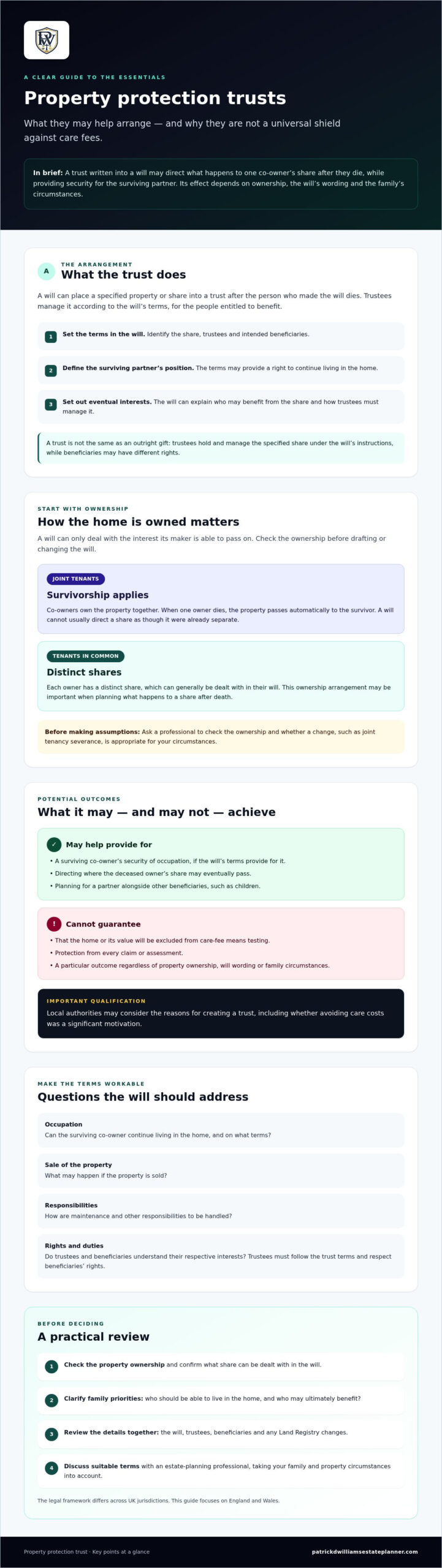
How to decide whether a property protection trust fits your circumstances
Choosing a trust starts with your family’s priorities, not with a standard formula. Work through these five points before deciding whether this arrangement reflects what you want for your home and the people who may depend on it.
- Check ownership. Review the title information and establish how the property is held. The ownership structure affects what each co-owner can direct through a will.
- Clarify who should benefit. Identify who you want to inherit your share, and whether the surviving co-owner should also benefit during their lifetime.
- Set out occupation needs. Consider whether the surviving co-owner should be able to remain in the home, and what should happen if they want or need to move.
- Think carefully about trustees. Choose people who can understand the responsibilities and follow the will’s terms fairly, including when their interests differ from those of beneficiaries.
- Get advice on the whole arrangement. Ask a qualified estate-planning professional to consider ownership, family circumstances and proposed will terms together.
An outright gift may give a beneficiary greater direct control, while a trust can set out different rights for a surviving co-owner and eventual beneficiaries. Neither option is automatically preferable. The choice depends on the intentions behind the plan and the rights each person needs.
Questions to prepare before seeking advice
Gather the property title information, any existing wills and details of all co-owners. Write down your wishes about who should benefit, whether someone should be able to occupy the home, and what you would want to happen if it were sold. Note relevant family circumstances, such as remarriage or children from earlier relationships. These details help make a discussion about suitability specific and useful.
When another estate-planning arrangement may be more suitable
If your priority is for someone to receive an asset outright, a trust may add restrictions that don’t match your wishes. Another trust structure may suit different objectives. A checklist can help organise your thinking, but it can’t determine the right arrangement for every family. Lasting powers of attorney can also form part of wider planning for decision-making if you lose capacity, but they aren’t a substitute for a will or property trust.
If you’re weighing these options, you can arrange a free 15-minute consultation to discuss your family’s circumstances and the questions you’d like considered. It’s an opportunity to explore suitability, not a promise of a particular outcome.
Setting up a property protection trust with clear, tailored advice
Putting a property protection trust in place starts with understanding what you want your estate plan to achieve. The process can then follow a clear sequence: discuss your objectives, review how the home is owned, agree terms that reflect your family’s needs, and prepare or update the relevant documents.
Ownership may need to be considered before the will is drafted. Depending on how the property is held and the advice for your circumstances, a change recorded with HM Land Registry may be appropriate. This isn’t an automatic step for every family. Ask the professional to explain whether an ownership change is relevant and how it fits with the will and proposed trust terms.
What to expect when discussing a bespoke trust
A useful discussion considers the property arrangements alongside your family’s intentions. This can include who you want to benefit, what the surviving co-owner may need, and how the trust should address occupation or a possible sale. The aim is to explore terms suited to your circumstances, not to promise a particular result.
Patrick D Williams Estate Planners provides will-writing and property protection trust services. Consultations are available by Zoom, Teams or in person. The firm charges fixed professional fees for will-writing and lasting powers of attorney, and project-based fees for trust work. The fee depends on the work agreed.
Practical next steps for your estate plan
Before a consultation, gather the property title information, any existing wills and details of the co-owners. It can also help to write down your priorities, including who should ultimately benefit and what the surviving co-owner may need. Clear notes give you a practical starting point for discussing the options.
After reviewing your circumstances, the advice can establish whether trust provisions are appropriate and what documents may be needed. Drafting, any change to the property ownership and related Land Registry steps depend on the agreed advice and the details of your case. Take time to understand the proposed terms and the responsibilities they create before deciding how to proceed.
For a measured conversation about suitability, you can discuss your property protection trust options through the firm’s free 15-minute consultation. This is an opportunity to outline your circumstances and consider possible next steps, without assuming that a trust will be right for every family.
Make your next estate-planning decision with confidence
A property protection trust can set out what should happen to a share of a home through a will, but its effect depends on ownership, wording and family circumstances. It isn’t a guaranteed way to keep a home outside care-fee assessments or other claims. Reviewing how the property is held and what the surviving co-owner and intended beneficiaries need is a sensible starting point.
Patrick D Williams Estate Planners provides will-writing and property protection trust services. The firm charges fixed professional fees for will-writing and lasting powers of attorney, and project-based fees for trust work. A free 15-minute consultation is available by Zoom, Teams or in person. It offers an opportunity to discuss your circumstances and possible options, not a promise that a particular arrangement will be suitable.
Arrange a free 15-minute consultation to discuss your estate-planning needs. With clear advice and carefully considered documents, you can take a measured next step towards a plan that reflects your family’s wishes.
Frequently Asked Questions
What is a property protection trust in a will?
A property protection trust in a will is an arrangement that holds a specified property or share after the person who made the will dies. The will sets out who the trustees are, who may benefit and what rights they have. For example, it may provide for a surviving co-owner to occupy the home while directing where the share should pass later. The effect depends on the will wording and property ownership.
Does a property protection trust protect a house from care home fees?
No, it doesn’t automatically prevent a home or its value from being considered in a local-authority means test. The assessment depends on the circumstances and rules in force at the time. An authority may examine whether placing assets in trust was significantly motivated by avoiding care costs and may decide that deliberate deprivation applies. A trust should be considered as estate planning, not as a guaranteed way to avoid care fees.
Can I put my home into a property protection trust if I own it jointly?
It depends on how you and the other owner hold the property. Joint tenants own together with a right of survivorship, so a will generally can’t direct a separate share as though one already exists. Tenants in common each have a distinct share that can generally be addressed in a will. A professional should review the title and your circumstances to establish whether any ownership change is appropriate before the will is prepared.
Does a property protection trust let a surviving partner continue living in the home?
It can be drafted to provide a surviving partner with a right to occupy the home, but this isn’t automatic. The will and trust terms need to explain the partner’s rights and any conditions, such as what happens if they want to move or the home is sold. Trustees must follow those terms and respect beneficiaries’ rights. Have the proposed arrangements checked against your family’s needs before deciding whether they are suitable.
Is a property protection trust suitable for every homeowner?
No. Suitability depends on how the property is owned, who you want to benefit and what the surviving co-owner may need. Family circumstances, including children from earlier relationships or a later remarriage, can affect which arrangement best reflects your wishes. A trust can also bring responsibilities for trustees and may limit how a property share is dealt with. Review these points with a qualified estate-planning professional rather than relying on a checklist alone.
How is a property protection trust different from leaving a home outright in a will?
An outright gift passes the relevant interest directly to a beneficiary, who generally has more direct control over it. With a trust, trustees hold and manage the specified share under the will’s terms for those entitled to benefit. The trust may set different rights for a surviving co-owner and eventual beneficiaries. The precise position depends on the drafting, so consider which balance of control, occupation and future benefit fits your intentions.
Does a property protection trust avoid inheritance tax?
No, creating a trust in a will doesn’t automatically avoid inheritance tax. The tax position depends on the estate, the assets involved, the trust terms and the rules that apply when the person dies. A trust may have tax implications of its own, so it shouldn’t be selected on the assumption that it removes a tax liability. Seek individual advice on the estate and the proposed arrangement before relying on any tax outcome.
Leave a Reply