

Living together does not give an unmarried partner automatic inheritance rights in England and Wales. Without a valid will, an estate generally passes under intestacy rules to relatives, starting with the deceased person’s parents if there are no children. A will for cohabiting couples with no children can state who should inherit and who should administer the estate.
It is understandable to expect a long-term partner to be recognised, especially when you share a home and finances. But the law does not treat cohabiting partners like spouses or civil partners, so making your wishes clear can bring greater certainty. This article explains what may happen without a will, how property ownership affects inheritance, and how to choose executors to manage your estate.
Key Takeaways
- Review how your home is legally owned, because joint tenancy and tenancy in common can lead to different outcomes when a partner dies.
- Use your will to name an executor and set out who should inherit your estate.
- Consider a Lasting Power of Attorney separately, as a will does not give your partner authority to manage your affairs if you lose capacity.
- Check how pension death benefits are directed, since they are handled through the pension provider’s Expression of Wish form rather than your will.
- Understand how inheritance tax may affect gifts to an unmarried partner before deciding how to provide for them.
Is There Such Thing as “Common Law Marriage”?
Living together does not make a couple married under common-law rules in England and Wales. This distinction matters when a partner dies: property ownership and a valid will determine what happens to their assets.
The common-law marriage misconception
“Common-law marriage” is the mistaken belief that an unmarried couple gains legal rights similar to marriage by living together. In England and Wales, time spent in a relationship does not create automatic inheritance rights, even if the couple share a home and finances.
This matters because an unmarried partner may not inherit under intestacy rules simply because they were in a long-term relationship. An agreement between partners can clarify practical arrangements, but it does not make them spouses or civil partners. A will is the legal document that names beneficiaries and states who should inherit.
Common-law marriage across the UK nations
There is no common-law marriage in England and Wales, and cohabitation alone does not give partners the inheritance rights of married couples or civil partners. The rules for making wills and distributing estates differ across England and Wales, Scotland, and Northern Ireland, so the law of the relevant nation matters.
For someone living in England or Wales, intestacy rules apply if there is no valid will. In that situation, an unmarried partner does not automatically inherit. Scotland and Northern Ireland have their own succession laws, so England and Wales rules should not be assumed to apply there. The residence nil-rate band is £175,000 when a main residence is left to direct descendants, according to HM Revenue & Customs. That allowance relates to direct descendants, not simply to a cohabiting partner.
Joint tenants and tenants in common
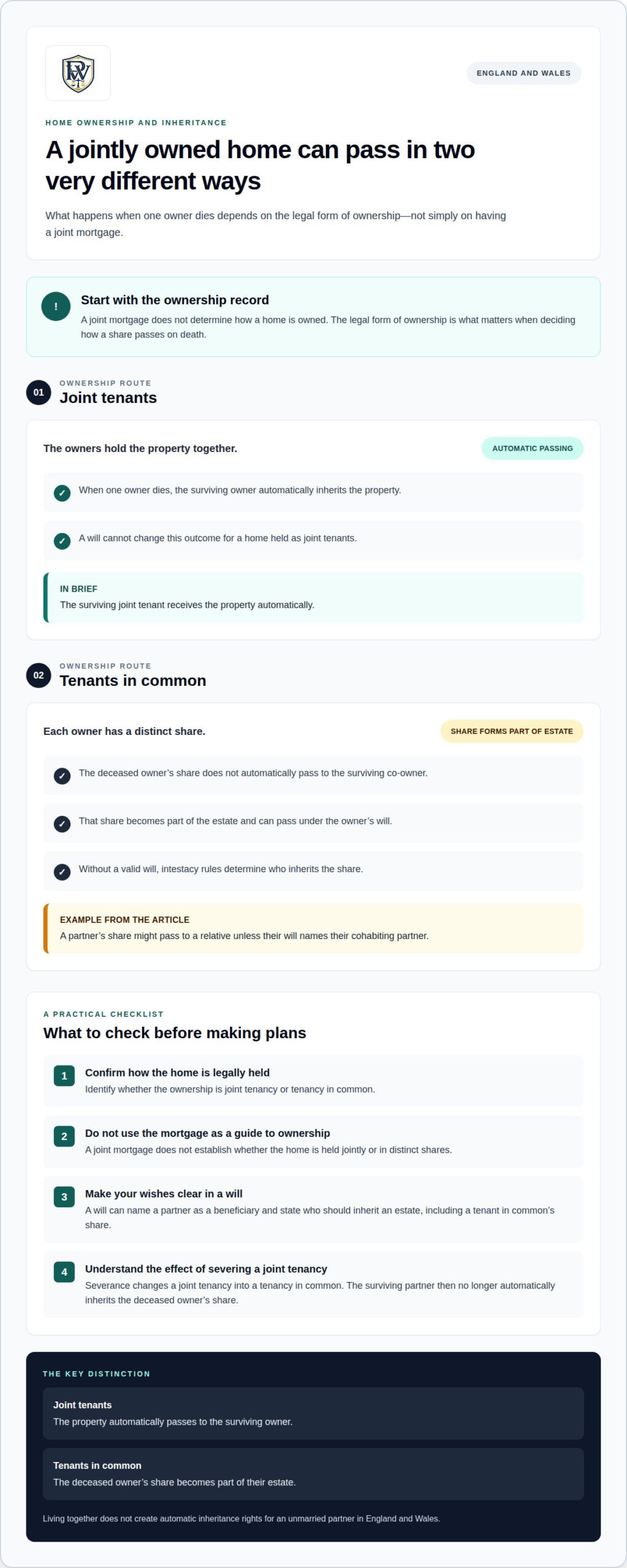
How a jointly owned home passes on death depends on whether the owners are joint tenants or tenants in common. Joint tenants own the property together. When one dies, the surviving owner automatically inherits the property, and a will cannot change that outcome.
Tenants in common each own a distinct share. When one owner dies, their share does not automatically pass to the surviving co-owner. It becomes part of their estate and can pass under their will; without a will, intestacy rules determine who inherits it. For example, a partner who owns a home as a tenant in common might leave their share to a relative unless their will names their cohabiting partner.
A joint mortgage does not determine how a home is owned. The legal form of ownership is what matters, so couples should understand how their property is held before making plans for their assets. Joint tenancy severance changes a joint tenancy into a tenancy in common, allowing each owner’s share to be dealt with separately. The effect is significant: the surviving partner no longer automatically inherits the deceased owner’s share.
What rights does a cohabiting partner have?
A cohabiting partner’s rights depend on the will, ownership records and circumstances. A written will can name a partner as a beneficiary, but it does not give them automatic access to every asset.
Providing for a partner in a will
A will lets an unmarried person name their partner as a beneficiary and specify what they should inherit. This matters because, in England and Wales, a cohabiting partner does not automatically inherit when someone dies without a will. If there are no children, the estate passes to the next category of relatives, starting with the deceased’s parents.
Each partner should make their own will. Mirror wills are separate documents with similar intentions, and either partner can update their will independently. They are not a joint will. Even when they want the same arrangements, cohabiting couples need separate wills.
A will must meet the formal requirements of the relevant UK nation to be legally valid. Review it when your circumstances or wishes change, so its instructions continue to reflect who you want to benefit.
Access to a deceased partner’s bank account
An unmarried partner cannot legally access a deceased partner’s separate bank account simply because they lived together. Being named as a beneficiary in a will does not, by itself, make someone an account holder or give them immediate access to the account.
This distinction can affect day-to-day finances after a death. For example, if one partner held savings in a sole account, the surviving partner cannot treat that money as their own. The executor or administrator manages the estate, while the will identifies who is due to inherit. Joint accounts differ from separate accounts, so the account’s ownership arrangements matter.
Gifts and tax treatment between partners
Unmarried partners do not receive the Inheritance Tax spousal exemption available to spouses and civil partners. Assets above the £325,000 nil-rate band are taxed at 40% for unmarried couples in England and Wales, according to HM Revenue & Customs.
Lifetime gifts also need consideration. Unmarried couples can give gifts of up to £3,000 per year tax-free. A larger gift or a transfer of property may have different tax consequences, depending on the asset and circumstances. A will and lifetime arrangements should therefore be considered together, rather than treating a gift as an automatic substitute for inheritance.
Rights to a home owned by one partner
Living in a home owned solely by a partner does not automatically give the other person a share or a right to remain if the relationship ends. If the non-owner can show a qualifying financial contribution or commitment, they may be able to claim an interest in the property under the Trust of Land and Appointment of Trustees Act 1996.
For example, paying towards the purchase price may be relevant evidence, but sharing a home alone does not establish ownership. Couples buying property together can use a clear agreement to record their respective interests. Where ownership is changing from joint tenancy, joint tenancy severance can allow each partner’s share to pass under their own will. Consider estate planning options when deciding how a home and other assets should be dealt with.
Why cohabiting couples without children should make wills
A will lets an unmarried person decide who should benefit and who will manage their estate. A will for cohabiting couples with no children can record arrangements for a partner, relatives, friends or a chosen charity, instead of leaving those decisions to default rules.
Without a will, a partner may not receive the assets they expected. A valid will can specify particular gifts, such as savings, personal possessions or a share of a home, and name an alternative beneficiary if the first person dies earlier. These instructions make the couple’s intentions clear, rather than relying on assumptions about their relationship. They can also specify whether a gift is for the partner alone or should eventually pass to someone else.
Choosing an executor is another practical reason to make a will. The executor handles the estate in line with the will, including identifying assets, dealing with liabilities and distributing what remains to beneficiaries. You can appoint your partner, a trusted relative or a friend. Naming someone who can manage paperwork and communicate clearly gives the estate a designated administrator.
A will can also clarify what should happen if the surviving partner dies later. For example, one partner might leave their estate to the other, then name relatives or a charity as alternative beneficiaries. Without that direction, the intended final recipient may not receive the assets. Each partner needs an individual will because one person’s instructions cannot dispose of the other’s estate. This is an important consideration when deciding how a will for cohabiting couples with no children should address longer-term wishes.
A will does not control every payment made after death. Pension benefits after death may be handled separately from instructions in a will. Cohabiting partners should treat pension nominations and will instructions as separate parts of their arrangements, with each document reflecting their intentions.
The cost of making a will depends on the circumstances and is given after a quote request. Relevant factors include the estate’s complexity, the number of beneficiaries, specific gifts and whether trust provisions are needed. A straightforward distribution may require different drafting from arrangements involving several properties or substitute beneficiaries.
A solicitor can explain how a proposed will fits with property ownership, pension nominations and other estate arrangements. Review the document after a major change, such as buying property together, ending the relationship or changing the intended beneficiaries. Clear instructions can help the chosen executor understand whom to contact and what the will-maker intended.
Choosing who administers an estate
A will should name an executor, the person responsible for administering the estate. For a couple without children, choosing an executor is as important as naming beneficiaries, because the executor puts the written arrangements into effect.
The executor identifies the deceased’s assets and liabilities, manages estate paperwork and distributes what remains according to the will. For example, if the will leaves savings to a partner and personal possessions to relatives, the executor follows those instructions. Clear wording helps them understand which gifts go to each beneficiary.
A cohabiting partner may be a natural choice, particularly if they know the household finances and shared property. But living together, even for many years, does not automatically appoint a partner to administer an estate. The common-law marriage misconception does not change that. The will must name the chosen person.
Consider whether the person is willing and able to manage practical responsibilities during bereavement. An executor may need to organise documents, communicate with beneficiaries and keep records of decisions. For example, a trusted relative who understands the deceased’s finances may be a suitable alternative if the surviving partner would prefer not to take on the administration.
Name a substitute executor as well as your first choice. This gives the will a clear alternative if the named person cannot act. Check that each person’s full name is accurate and that the will’s instructions match your intended distribution of assets. A change in your relationship or intended beneficiaries may make a review sensible.
The will should state who inherits the estate, including alternative beneficiaries if someone named dies first. A couple might leave their estate to one another, then name relatives or a charity as substitutes. Without a will, intestacy rules determine who administers and inherits the estate, rather than the couple’s preferred arrangements.
If a partner dies intestate, the surviving cohabitant does not become executor simply through their relationship. The rules for intestacy determine who can administer the estate. A cohabiting partner who lived with the deceased for at least 2 years may be able to make a court claim, but that is separate from being appointed to administer the estate.
Keep the original will somewhere accessible and tell the named executor where it is held. This can help them find the document and follow its instructions. A suitable executor, named beneficiaries and substitute arrangements together give a child-free couple a clearer plan for managing and distributing an estate.
Current legal rights of cohabiting couples
Living together does not create the same legal rights as marriage or civil partnership in England and Wales. A relationship ending does not trigger an automatic division of assets, and cohabiting partners do not have an equivalent to divorce law.
A cohabitation agreement can record each partner’s assets, financial arrangements and intentions if they separate. For example, it can describe who owns particular items, how household costs are shared and what the couple intend regarding property. It provides evidence of their agreed arrangements, rather than creating marriage-like rights. A judge may attach considerable importance to it as evidence of the couple’s intentions in separation proceedings.
Property ownership remains central when a couple separates. If one partner owns a home in their sole name, the other does not automatically acquire a share through living there or contributing to household bills. A person may be able to claim a beneficial interest under the Trust of Land and Appointment of Trustees Act 1996, where relevant conditions are met. Evidence of financial contributions or commitments may matter. A court order can include a sale, allowing each person to access their recognised share.
Daily responsibilities can depend on the names on agreements. If both partners are named on a tenancy agreement, they share responsibility for the rent and other tenancy conditions. That contractual responsibility is distinct from property ownership. If only one partner is named, simply living together does not make the other a tenant under that agreement.
Authority over a partner’s affairs is not automatic either. A partner may need formal authority to manage the other person’s affairs if they lose capacity. A partner may know their wishes well, but that knowledge alone does not give them formal decision-making authority.
Pension arrangements also need separate attention. Pension arrangements may need to be considered separately from a will, so cohabiting partners should check how death benefits are handled. Cohabiting partners should treat a will and pension nomination as separate documents, each with its own purpose.
These rules show why sharing a life does not settle every legal question. A cohabitation agreement can document financial intentions during the relationship, while property records, tenancy terms and pension nominations address different matters. Reviewing these arrangements after a change in ownership or finances helps keep the documents aligned with the couple’s wishes.
For support with formalising arrangements for incapacity, consider making a Lasting Power of Attorney.
Patrick D Williams Estate Planners: Will Writing
Patrick D Williams Estate Planners provides Will Writing to help cohabiting couples state who should inherit and who will administer their estates. This is a practical next step if you want to name your partner clearly or update your arrangements after a change in circumstances.
If your plans involve more than a straightforward inheritance, a Property Protection Trust or Discretionary Trust may be relevant. Lasting Powers of Attorney address a separate concern: appointing someone to make decisions if you lose mental capacity. The right arrangements depend on your wishes, assets and family circumstances.
You can discuss your estate planning needs in a free 15-minute consultation. Contact Patrick D Williams Estate Planners to discuss putting your wishes into a clear plan.
Put your intentions into a clear plan
Turn your wishes into practical arrangements by deciding who you want to benefit, who should carry out your instructions, and whether your plans need to address property or decision-making if you lose capacity. A will for cohabiting couples with no children can form part of a wider plan, with each document serving a distinct purpose.
Patrick D Williams Estate Planners offers Will Writing, Lasting Powers of Attorney and Property Protection Trusts. These options can address inheritance, future decision-making and property protection, according to your circumstances.
Take time to consider what you want your partner and other beneficiaries to receive, then put those intentions into writing. Contact Patrick D Williams Estate Planners to discuss your estate planning. A considered plan can give your wishes a clear place to start.
Frequently Asked Questions
What is the current law for cohabiting couples?
In England and Wales, living together does not create a marriage or automatic inheritance rights. A partner’s position depends on legal ownership, any valid will and other arrangements, such as a pension nomination. Scotland and Northern Ireland have different succession rules, so the applicable law depends on where the estate is dealt with. Sharing an address or having a long relationship does not make partners spouses.
What happens if an unmarried couple separates?
Separation does not automatically divide an unmarried couple’s assets according to fairness or how long they lived together. Ownership records, financial contributions and evidence of the couple’s intentions can matter, particularly for a home. A written cohabitation agreement can record how partners intend to manage property and finances if they separate. For example, it can clarify arrangements for a jointly purchased home.
Can I also get a share of the family home?
You may be able to claim an interest in a home by establishing a qualifying financial contribution or commitment, even if the property is registered in your partner’s name. Evidence could include payments towards the purchase or an agreement about ownership. A claim is not the same as being a registered owner. The circumstances and available evidence matter, so keep records of relevant payments and written discussions.
How can unmarried couples protect themselves now?
Make separate wills that state who should inherit, and keep pension nominations aligned with your wishes. A cohabitation agreement can record arrangements for property and finances if you separate. If you buy a home together, document each person’s share and how sale proceeds should be divided. Consider a Lasting Power of Attorney too, because a partner does not automatically have authority to manage your affairs if you lose capacity.
Married vs unmarried couples: what is the difference?
Marriage and civil partnership create legal rights that do not arise through cohabitation alone. For example, spouses and civil partners may benefit from inheritance tax treatment unavailable to unmarried partners, and intestacy rules can provide for a surviving spouse. Unmarried partners need to make their intentions clear through their own legal and financial arrangements. This distinction matters even when couples share a home and finances.
Does a cohabiting partner inherit automatically under UK intestacy rules?
No, a cohabiting partner does not automatically inherit under intestacy rules in England and Wales. If there is no valid will and no children, the estate passes to relatives in the statutory order, starting with the deceased’s parents. Scotland and Northern Ireland have separate succession laws, so the precise rules differ across the UK. A court claim may be possible in some circumstances, but it does not provide automatic inheritance.
How can an unmarried couple leave assets to each other in a will?
Each partner can make an individual will naming the other as a beneficiary and specifying the assets or share of the estate they should receive. Include substitute beneficiaries in case the intended recipient dies first, and state who should receive the remainder after specific gifts. For jointly owned property, the effect of a will depends on the form of ownership. Review the wording if your assets or intended beneficiaries change.
Can a will protect a surviving cohabiting partner’s right to stay in the home?
A will can provide for a partner to inherit a home or receive a defined benefit from it, depending on ownership and the will’s terms. It cannot override a joint tenancy or give away a share the will-maker does not own. If continued occupation is important, the will may need to address how the home is owned and what arrangements apply after the owner’s death.
Leave a Reply