
Putting a house into a trust can have inheritance tax, capital gains tax and income tax consequences, and it doesn’t automatically reduce inheritance tax. The tax implications of putting a house in a trust in the UK depend on the type of trust, who benefits from the property and whether you continue living there. Most trusts also need to be registered with HMRC within 90 days of creation, according to HM Revenue & Customs.
It’s understandable to want to protect a family home while keeping its tax and administrative responsibilities clear. A trust can organise how property is held and passed on, but the tax treatment depends on the trust arrangements and your circumstances.
This article explains when tax may arise, what trustees may need to report and how trust registration works. It also explains why a trust belongs in a wider estate plan, rather than being treated as an automatic way to save tax.
Key Takeaways
- A transfer into a trust can have capital gains tax consequences, and holdover relief may affect when tax is paid.
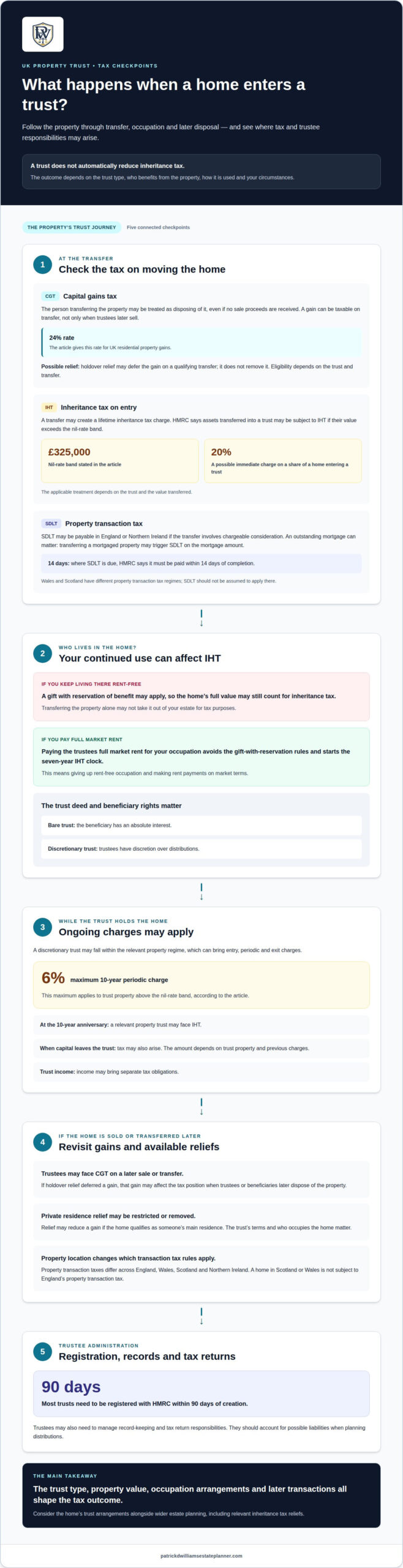
- According to HM Revenue & Customs, assets transferred into a trust may be subject to inheritance tax if their value exceeds the nil-rate band of £325,000.
- Continuing to benefit from a home after transferring it can affect its inheritance tax treatment.
- Trustees may have registration, record-keeping and tax return responsibilities to manage.
- The type of trust and the family’s aims shape how a home is held and passed on, so consider the arrangements as part of wider estate planning.
Are there any tax implications to consider when setting up a trust?
Yes. Transferring a property into a trust can trigger capital gains tax, and later sales or trust income may bring separate tax obligations. The outcome depends on the trust’s terms, how the property is used and whether relief applies.
Capital gains on trust transfers
Capital gains tax can apply when an asset is transferred into a trust or disposed of later. The person transferring the property may be treated as disposing of it, even without receiving sale proceeds, and trustees may face tax on a later sale or transfer. For UK residential property gains, the rate is 24%, according to HM Revenue & Customs.
This can matter even when the house stays within the family. A gain may be taxable when the property is transferred, not just when trustees sell it. Non-UK-resident trusts also need to consider the property’s UK location and the trust’s circumstances. Residence, ownership and the transaction affect which rules apply, so non-residence alone does not mean an exemption.
Holdover and private residence relief
Holdover relief can defer capital gains tax on a qualifying transfer into a trust, rather than remove the gain. Whether it applies depends on the type of trust and transfer, so do not assume every house qualifies. If relief is available, the gain may affect the tax position when trustees or beneficiaries later dispose of the property.
Private residence relief may reduce a gain if a home qualifies as someone’s main residence. However, putting the property in a trust can restrict or remove relief on future gains. The trust’s terms and who occupies the home matter. Consider the likely effect before transferring a home, particularly if its value has risen.
Property trust tax across the UK
The main capital gains tax questions concern the transfer, a later disposal and any available relief. Property transaction taxes differ across England, Wales, Scotland and Northern Ireland, so the property’s location matters. A home in Scotland or Wales is not subject to England’s property transaction tax.
For capital gains tax, a non-UK-resident trust holding UK property needs to consider the UK property and its own circumstances. The trustees’ residence and ownership details can affect the analysis. This is relevant if trustees or beneficiaries live abroad, or if the trust was established outside the UK.
Stamp duty on property trusts
Stamp Duty Land Tax may be payable when property is transferred into a trust in England or Northern Ireland, depending on the circumstances. A mortgage can matter: transferring a mortgaged property may trigger SDLT on the outstanding mortgage. The position depends on whether the transfer involves chargeable consideration, not simply on the property entering a trust.
Where SDLT is due, HM Revenue & Customs says it must be paid within 14 days of completion. This is separate from capital gains tax, which concerns a gain on disposal. For property in Wales or Scotland, different property transaction tax regimes apply, so SDLT should not be assumed to govern the transfer.
Inheritance tax and gifts with reservation of benefit
Inheritance tax can arise when a home enters a trust, remains there or passes to a beneficiary. The trust type, property value and your continued use of the home all affect the treatment. The tax implications of putting a house in a trust UK-wide therefore depend on both the arrangements and your circumstances.
Inheritance tax on property transfers
Moving a home into a trust can create an inheritance tax charge during your lifetime. According to HM Revenue & Customs, assets transferred into a trust may be subject to inheritance tax if their value exceeds the nil-rate band of £325,000. The immediate inheritance tax liability on a share of a home entering a trust could be 20%, according to HM Revenue & Customs.
The applicable treatment depends on the trust and the value transferred. A discretionary trust may fall within the relevant property regime, which can bring entry, periodic and exit charges. The maximum 10-year periodic charge on trust property above the nil-rate band is 6%. A trust does not automatically reduce inheritance tax liability.
Gifts with reservation and market rent
A gift with reservation of benefit can apply if you transfer a home but continue to enjoy its use. If you keep living there without paying the trustees full market rent, the home’s full value may still count for inheritance tax. The transfer alone may not take the property out of your estate for tax purposes.
Paying the trustees full market rent for your occupation avoids the gift-with-reservation rules and starts the seven-year inheritance tax clock. You give up rent-free occupation and take on rent payments on market terms. The beneficiary’s rights and the trust deed also matter: a bare trust gives its beneficiary an absolute interest, while a discretionary trust gives trustees discretion over distributions.
A relevant property trust may face inheritance tax when it reaches the 10-year anniversary of its creation, according to HM Revenue & Customs. Tax may also arise when capital leaves the trust. The amount depends on the trust property and previous charges, so trustees need to account for possible liabilities when planning distributions.
Trust ownership can also affect the residence nil-rate band and other inheritance tax reliefs. A transfer does not automatically preserve or remove these reliefs; the trust structure, estate and intended beneficiary all matter. Considering the tax implications of putting a house in a trust UK-wide means looking at these reliefs alongside your wider inheritance plans.
For example, if a parent transfers a house but continues living there rent-free, its value may still count for inheritance tax. Paying full market rent changes the gift-with-reservation position, but creates an ongoing rental commitment. Reviewing the trust terms alongside these practical consequences can help clarify the decision.
Income tax on trust income
A trust holding a house may receive rental income, while other trust assets can generate interest or dividends. Income tax treatment depends on the trust’s terms, the source of income and who is entitled to benefit. Trustees may need to account for income separately from capital, since paying income to a beneficiary can have different tax consequences from retaining it in the trust.
For relevant property regime trusts, income below £500 is free of income tax if there are no connected trusts. The threshold applies to trust income, not the property’s value. Where connected trusts exist, or income reaches the threshold, trustees need to consider the applicable tax treatment rather than assuming the small-income rule applies. A trust’s purpose and the circumstances of its beneficiaries may also affect how income is handled.
Trust income tax rates can be higher than rates applying to individuals. For trusts created after 2014, the rates stated as effective in December 2024 are 45% for non-dividend income and 39.35% for dividends. For example, rental income is non-dividend income, while income from shares may be dividend income. The type of receipt therefore matters when working out a trust’s tax charge.
Income distributions need careful distinction. A beneficiary’s tax position may depend on the nature of the trust income and their entitlement to it. This differs from receiving trust capital, such as a share of property proceeds. The trust deed determines whether someone is entitled to income or trustees decide how to distribute it. That distinction can affect both the beneficiary’s tax position and the trustees’ administration.
A settlor-interested trust has special tax rules if the settlor can benefit from its assets. For example, if the person who established the trust can receive its rental income, the settlor’s involvement may affect who is taxed. The wording of the trust and the rights it gives the settlor matter. Consider a transfer alongside the intended income arrangements, not just who will own the house in future.
In practice, trustees should identify each income source, record amounts received and distinguish income from capital before making payments. A house rented out and an investment account may generate different types of income, with different rates applying. Trustees should also follow the trust terms when deciding whether to retain or distribute income. These records help clarify the trust’s tax charge and the beneficiary’s obligations for each relevant tax year.
Trust registration and tax return obligations
Trustees may need to register the trust, keep records and report taxable events to HMRC. These duties add administration alongside legal and professional costs. An alternative is to retain ownership and set out inheritance wishes in a will.
Trust registration with HMRC
The Trust Registration Service is HMRC’s register for recording details of trusts and their beneficial owners. According to HM Revenue & Customs, a trust must be registered with HMRC’s Trust Registration Service within 90 days of creation.
Most UK trusts, including property trusts, have needed registration since 2022. Registration matters even when a trust holds a house rather than investments, because trustees must provide information about the trust and keep it up to date when relevant details change. A person appointed as trustee should understand who is responsible for submitting and maintaining the registration.
Trust tax return obligations
Trust tax returns report relevant income, gains and other tax matters to HMRC. Trustees report the sale or transfer of other trust assets in a Trust and Estate Self Assessment tax return. For a UK residential property sale, trustees must report and pay capital gains tax due within 60 days of completion.
Inheritance tax reporting may also apply. Trustees must submit an inheritance tax return if trust assets exceed 80% of the £325,000 threshold, even when no tax is due. This threshold is stated as at 2025. A return requirement can therefore arise without an immediate payment, making accurate asset records important.
Registration is not the same as filing a tax return. The Trust Registration Service records information about the trust, while returns report taxable income, gains or inheritance tax matters. For example, a trust that owns a house and later sells another trust asset may have registration duties and separate reporting obligations. Trustees should keep the trust deed, asset records and transaction dates together.
Costs can include setting up the trust, administering the property transfer, registration and ongoing tax reporting. The total depends on the trust’s complexity, property arrangements and professional work required. Risks include missed reporting duties, inaccurate records and tax charges arising from a transfer or later disposal. Keeping a house outside a trust and recording inheritance wishes in a will is an alternative, though it does not provide the same trust structure.
Property held in a trust may not require probate, but executors may still need to apply to the Probate Registry for other assets. Trust ownership does not remove every estate administration task. Trustees remain responsible for managing trust assets and paying tax due, while those handling the wider estate may have separate responsibilities.
Trusts for family estate planning
A trust is one way to decide who manages a home and who may benefit from it. In family estate planning, choose a type of trust that reflects your intentions for children, a partner or other beneficiaries. Consider who will make decisions, whether beneficiaries need access straight away and how the property might be used or sold.
Trustees become the home’s legal owners, so they need to cooperate if you later move and the property must be sold or replaced. This creates shared responsibility, but also means the ownership arrangements have changed. The trust deed sets out trustees’ powers and beneficiaries’ rights. Reviewing those provisions with an estate planner can help you understand how they work in practice.
A bare trust and a discretionary trust provide different arrangements. In England and Wales, a beneficiary of a bare trust can access its assets when they are 18 years old or over. A discretionary trust instead gives trustees discretion over how trust assets are distributed to beneficiaries. It can last up to 125 years under current law. Those differences matter when children are young or family circumstances may change.
A trust does not guarantee that a home will be excluded from a local authority’s assessment of someone’s circumstances for long-term care. Trust benefits may be taken into account. If care funding is a concern, do not treat a property transfer as a simple way to avoid an assessment. The trust’s purpose and the benefits available to the person remain relevant.
Property held in a trust might not require probate, although executors may still need to apply to the Probate Registry for other estate assets. Trust ownership addresses the home’s arrangements, not necessarily the administration of everything else. A will can complement estate planning by recording wishes for assets outside the trust, while trustees manage property held within it.
Family plans can also be challenged. Beneficiaries may dispute a trust over concerns such as lack of capacity, undue influence or deliberate deprivation of assets. In England and Wales, someone who believes they have been unfairly excluded may bring a claim under the Inheritance (Provision for Family and Dependants) Act 1975. Clear intentions and carefully considered trust terms help explain the arrangements, although they cannot remove every possibility of dispute.
The practical takeaway is to match the trust type to the family’s intended control, access and succession arrangements, then consider those alongside tax and administration duties. Discuss your family estate-planning arrangements before deciding how a home should be held.
Patrick D Williams Estate Planners
Patrick D Williams Estate Planners helps families consider how a home, trust arrangements and wider estate plans fit together. Its services include Will Writing, Lasting Powers of Attorney and trusts, including Property Protection Trusts and Discretionary Trusts. This support is useful when weighing tax responsibilities against your wishes for managing and passing on property.
Choosing a trust depends on who should benefit, how much control trustees need and whether you intend to remain in the home. Considering these aims alongside potential tax and reporting duties can bring the decisions into focus. A trust should form part of a considered estate plan, not be chosen on the assumption that it will automatically reduce tax.
Contact Patrick D Williams Estate Planners to discuss your estate planning and trust arrangements.
Make your next estate-planning decision with care
Choosing a trust also means deciding who will manage your home and how your family may benefit from it. Before moving forward, consider how those responsibilities fit your future plans, the people you want to provide for and whether you wish to keep using the property. Consider the tax implications of putting a house in a trust in the UK alongside these practical and personal aims.
The right arrangement depends on the trust terms, your circumstances and the role you want trustees to have. An estate-planning discussion can help you consider these factors together and understand how a property trust might fit into your wider plans. The details of your circumstances matter, so do not choose a trust based on tax assumptions alone.
For support in considering your options and shaping a plan around your family’s intentions, contact Patrick D Williams Estate Planners. A considered next step can help you move forward with greater clarity.
Frequently Asked Questions
When Might a Property Trust Still Be Appropriate?
A property trust may suit a family that wants trustees to manage a home for chosen beneficiaries. For example, parents may want to make arrangements for children who are not ready to manage property themselves. Consider who will control the home, who may benefit and whether the person creating the trust needs to keep living there. The trust should support those estate-planning aims, rather than be chosen solely on the assumption it will save tax.
Can You Continue to Live in a Trust-Owned Property?
Yes, but your right to occupy the home should be addressed in the trust arrangements. Continuing to live there without paying full market rent can mean the property remains relevant for inheritance tax under gift-with-reservation rules. Paying full market rent changes that treatment and starts the seven-year inheritance tax clock, but creates an ongoing payment obligation. Trustees need to manage the arrangement in line with the trust terms.
Do You Have to Pay Taxes on a House That Is in a Trust?
There is no single tax bill simply because a house is held in trust. Tax may arise from rental income, a gain when the property is transferred or sold, or inheritance tax charges connected with the trust. For example, a trust renting out a property has income to account for, while an unlet home may still raise other tax questions. The relevant tax depends on the event and trust structure.
How Can Trusts Protect Assets?
A trust can put trustees in charge of managing a home. They hold legal ownership and act under the trust terms for beneficiaries. This can organise property management for family members who need support or should not receive direct control immediately. It does not guarantee protection from every claim or assessment. In particular, trust benefits may be considered when a local authority assesses someone’s circumstances for long-term care.
What Is a Trust and How Does It Work?
A trust is an arrangement in which trustees hold and manage assets for beneficiaries under written terms. The person who creates it, called the settlor, sets out the arrangement and appoints trustees to administer it. For a home, trustees become its legal owners, while the trust document sets out who may benefit and how decisions are made. The precise rights depend on the trust’s wording, not simply on family relationships.
What Is a Trust and What Types of Trust Are There?
Trusts differ in the control beneficiaries receive and the decisions trustees can make. A bare trust gives its beneficiary an absolute interest in the assets. A discretionary trust allows trustees to decide how to distribute assets among beneficiaries. A Property Protection Trust is another estate-planning option. The suitable type depends on the family’s aims for control, beneficiaries’ needs and how the home should be managed.
What Is the Tax Regime Applicable to Trusts?
Trust taxation can involve income tax, capital gains tax and inheritance tax, with the rules depending on the trust and transaction. For relevant property regime trusts, income below £500 is free of income tax if there are no connected trusts. Trust income tax rates stated as effective in December 2024 for trusts created after 2014 are 45% for non-dividend income and 39.35% for dividends. Trustees may also have reporting duties.
How Does Putting a House into Trust Affect Capital Gains Tax in the UK?
Transferring a house into a trust can count as a disposal for capital gains tax, even if the property is not sold on the open market. The transferor may face tax on a gain, while holdover relief may defer tax on qualifying transfers. Later disposals by trustees can create further tax. For UK residential property gains, the rate is 24%, according to HM Revenue & Customs; private residence relief may also be restricted.
Leave a Reply