
The person you trust most may not be eligible to act as your lpa certificate provider. This role is more than witnessing a signature: the provider must assess whether you understand the Lasting Power of Attorney and are making your decision freely.
It’s understandable to feel uncertain about choosing someone for this important safeguard. A suitable provider may be someone who has known you personally for long enough, or a professional with relevant skills. However, independence matters, and some people are excluded. The provider’s role is also different from an attorney, who is appointed to make decisions under the LPA, and a witness, who confirms that a signature was made.
This guide explains who can act as a certificate provider, what they need to assess and what they don’t decide. It also explains how to consider possible conflicts of interest and where to check the latest Office of the Public Guardian guidance and LPA form requirements before signing. Understanding each person’s role can help you approach this step with greater confidence.
Key Takeaways
- An lpa certificate provider checks that the donor understands the LPA and is choosing freely. They assess the decision, not whether they agree with it.
- There are two routes to consider when choosing a provider: someone who has known the donor personally for at least two years, or a professional with relevant skills and experience.
- Consider whether a potential provider can assess the donor impartially, and check current official rules before relying on them.
- The provider’s conversation with the donor helps them assess understanding and whether there may be fraud or undue pressure. Check the current form guidance on how this conversation should take place.
- Before arranging signatures, confirm the provider’s eligibility and willingness, then review the latest Office of the Public Guardian guidance and LPA form.
What is an LPA certificate provider, and what is their role?
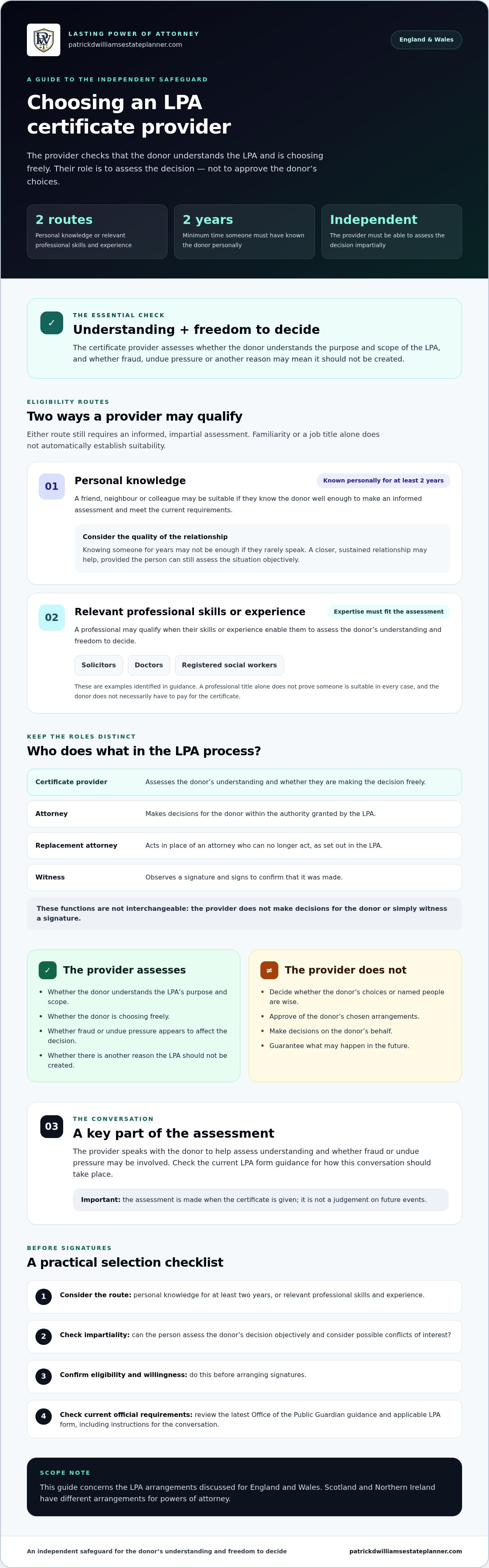
Before a Lasting Power of Attorney (LPA) can be registered, a certificate provider acts as an independent safeguard for the donor, the person making the LPA. The provider confirms that the donor understands the document and is making it freely. Their task is to assess the donor’s decision, not to approve of the choices or people named in it.
An lpa certificate provider considers whether the donor understands the purpose and scope of the LPA, whether fraud or undue pressure appears to be affecting their decision, and whether there is another reason it shouldn’t be created. This assessment is made when the certificate is given. It isn’t a guarantee about future events or a judgement on whether the donor’s preferred arrangements are wise.
The rules discussed in this section apply to England and Wales. Scotland and Northern Ireland have different arrangements for powers of attorney. For a broader overview of the English framework and how an Lasting Power of Attorney (LPA) is used, see the linked reference.
How is the provider different from an attorney or witness?
These roles have different purposes. An attorney is appointed by the donor to make decisions within the authority given in the LPA. A replacement attorney may take over if an appointed attorney can no longer act, in line with the LPA’s terms. A witness observes a signature and signs to confirm it was made. The certificate provider makes a separate assessment of the donor’s understanding and freedom to decide.
| Role | Main responsibility |
|---|---|
| Certificate provider | Assesses whether the donor understands the LPA and is making the decision freely. |
| Attorney | Makes decisions for the donor within the authority granted by the LPA. |
| Replacement attorney | Acts in place of an attorney who can no longer act, as set out in the LPA. |
| Witness | Observes a signature and confirms it by signing as a witness. |
These functions aren’t interchangeable. The certificate provider’s task is not to make decisions for the donor or simply observe a signature. Keeping the roles distinct helps everyone understand their part in the LPA process.
Who can act as an LPA certificate provider?
There are two routes to becoming an LPA certificate provider in England and Wales. The person may know the donor personally, or have professional skills and experience that enable them to assess the donor’s understanding of the LPA. In either case, they need to make a considered, impartial assessment rather than rely on assumptions about the donor.
Eligibility isn’t established just by someone’s job title or familiarity with the donor. The proposed provider must meet the relevant criteria and be able to assess whether the donor understands the LPA and is making the decision freely. The GOV.UK guide to making a lasting power of attorney sets out the official process. Check its current instructions and the applicable LPA form before arranging signatures.
Can a friend or neighbour be the certificate provider?
Possibly. Under the personal knowledge route, a friend, neighbour or colleague may be suitable if they have known the donor personally for at least two years. The length of the acquaintance alone may not be enough: the person must know the donor well enough to make an informed assessment and meet the current requirements. Familiarity shouldn’t be mistaken for automatic eligibility or impartiality.
For example, a neighbour who has known the donor for several years but rarely speaks with them may not feel able to assess their understanding. Someone with a closer, sustained relationship may be better placed, provided they’re eligible and can consider the situation objectively. The donor should check the Office of the Public Guardian’s current guidance on what counts as personal knowledge before choosing someone.
Can a professional act as the certificate provider?
A professional may qualify through relevant skills or experience. The key question is whether their expertise enables them to assess the donor’s understanding and freedom to decide, not simply whether they hold a particular job title. Solicitors, doctors and registered social workers are examples of professionals identified in guidance, but a title alone doesn’t prove that someone is suitable in every case.
This professional route doesn’t mean the donor must pay someone to provide the certificate. A suitable person who knows the donor personally may be able to act instead. Nor does arranging help with preparing an LPA automatically make a firm or adviser eligible to certify it. The proposed provider must satisfy the rules independently of any support the donor receives.
Before asking someone, consider whether they meet one of the two routes, can assess the donor without pressure and are willing to take on the responsibility. Patrick D Williams Estate Planners offers consultations about preparing Lasting Powers of Attorney. Explore LPA preparation guidance.
When might someone be unsuitable or unable to act as provider?
A suitable LPA certificate provider must be able to consider the donor’s understanding and decision impartially. Trust and familiarity can help the donor feel comfortable, but they don’t, on their own, establish eligibility or show that someone can assess the situation independently.
It helps to distinguish a legal restriction from a practical concern. Some people are excluded under the rules, while others may technically qualify but be too closely involved to offer a clear, independent view. For example, someone who expects to benefit personally from a particular decision may find it harder to assess the donor’s wishes without bias. That doesn’t automatically settle their legal eligibility, but it is a reason to consider whether another eligible person would be more appropriate.
How can a conflict of interest affect suitability?
The provider needs to form their own view, without pressure from the donor, an attorney or anyone else involved. A close friendship or family relationship isn’t automatically a disqualification in every case. However, strong involvement in the donor’s affairs, a personal interest in the outcome or difficulty speaking freely with the donor could make another eligible person a more suitable choice.
Consider whether the person can listen to the donor and assess their account independently, even if their own interests or relationships point in another direction. If the answer is uncertain, pause and check the rules rather than relying only on the donor’s trust in them.
What if the proposed provider is also connected to an attorney?
Some relationships are covered by formal exclusions. The official government guidance on LPAs explains who can and cannot act. Current guidance excludes the donor’s family members and the attorneys’ family members, as well as the attorneys and replacement attorneys named in the LPA. It also identifies restrictions concerning business partners or employees of the donor or an attorney, and people who own, manage or work at the care home where the donor lives.
These are eligibility rules, not simply indicators of possible bias. By contrast, a friend of an attorney isn’t necessarily excluded just because of that friendship, but the connection may still be relevant to whether they can assess the donor impartially. Don’t assume that every relationship creates a legal bar, or that personal trust overrides one. Check the current Office of the Public Guardian guidance and the applicable LPA form before completing or signing anything.
Patrick D Williams Estate Planners can provide support with preparing an LPA and understanding the process. You can read about LPA preparation. This does not mean the firm or any particular person will be eligible to act as the certificate provider in your circumstances.
What happens when the certificate provider speaks with the donor?
The conversation gives the certificate provider a chance to assess whether the donor understands the LPA and is making the decision freely. It isn’t a test of whether the donor has chosen the “right” attorney or made a decision the provider personally agrees with. The provider considers the donor’s understanding and circumstances before completing the certificate.
The lpa certificate provider should follow the current Office of the Public Guardian (OPG) guidance and instructions on the relevant LPA form. These explain how the certificate should be completed, including whether the provider needs to speak with the donor privately. A private conversation can help the donor express their wishes without others speaking for them or influencing what they say.
What may the provider need to establish?
The provider needs to consider whether the donor understands the purpose of the LPA and the authority they’re giving their attorney. They also assess whether fraud or undue pressure appears to be affecting the donor’s decision, and whether there is another reason the LPA shouldn’t be made. They aren’t selecting attorneys, judging the donor’s preferred choices or guaranteeing how the arrangement will work in future.
This is a considered discussion, not a medical examination or a formal interview unless current official instructions say otherwise. The provider should give the donor a fair opportunity to explain their understanding in their own words. If the provider can’t make the required assessment, they shouldn’t sign the certificate simply to keep the paperwork moving.
What if the donor needs more time or communication support?
A calm, accessible conversation can help the donor explain what they understand. The provider may need to allow time, use clear language or consider the donor’s communication needs, whilst following the form’s instructions. Support should help the donor communicate their own decision, rather than answer on their behalf.
If the donor seems unsure, needs information explained again or cannot communicate their understanding during the discussion, it’s sensible to pause. The provider can consider whether a further conversation would help, but shouldn’t rush to certify while uncertain. Check the current OPG process if the donor’s circumstances raise questions about completing the form.
Patrick D Williams Estate Planners offers consultations for people seeking support with preparing a Lasting Power of Attorney. Read about LPA preparation consultations.
How to choose an LPA certificate provider and complete the next steps
A clear selection process can help the donor choose someone suitable without rushing. Start by understanding what the certificate provider is responsible for. Then check that the proposed person meets one of the eligibility routes, can act impartially and is willing to speak with the donor.
What should the donor check before asking someone?
Before making a request, the donor can work through these points:
- Check eligibility. Compare the person’s personal knowledge or professional skills and experience with the current Office of the Public Guardian (OPG) guidance.
- Consider impartiality. The donor should feel able to explain their wishes freely, without the proposed provider having a personal interest or putting them under pressure.
- Confirm willingness. Make sure the person understands the responsibility and is prepared to have the necessary conversation with the donor.
- Read the current instructions. Review the relevant LPA guidance and form before arranging signatures. Follow the form’s instructions for completing and signing it, rather than relying on assumptions about the order or timing.
Being trusted is valuable, but it doesn’t remove the need to check eligibility. If anything is unclear, use the latest OPG guidance before proceeding. For further context on getting support with the process, read this guide to choosing support for a lasting power of attorney.
Where can someone get help preparing an LPA?
Professional drafting support can help a donor understand the wider LPA process, but hiring a professional isn’t always necessary. The donor can seek guidance about preparing the document while choosing a certificate provider separately. Anyone asked to certify must qualify under the current rules; using a service to prepare an LPA doesn’t automatically make that service or its staff eligible to act as provider.
Patrick D Williams Estate Planners prepares Lasting Powers of Attorney and offers guidance through consultations. A free 15-minute consultation is available for people who would like to discuss LPA preparation, without any obligation implied. Read more about arranging a consultation.
Take the next step with confidence
Choosing an lpa certificate provider means checking both eligibility and impartiality. The provider assesses whether the donor understands the LPA and is deciding freely. They don’t choose attorneys or simply witness a signature. Before arranging signatures, review the current Office of the Public Guardian guidance and form instructions.
If you’d like support with preparing an LPA, Patrick D Williams Estate Planners can guide you through the process. The firm offers a free 15-minute consultation by Zoom, Teams or in person. You can discuss your LPA needs, but this doesn’t mean the firm or any particular person will automatically qualify to act as your certificate provider.
Arrange a free 15-minute consultation to discuss LPA support. With clear information and a considered choice of provider, you can move forward at a pace that feels right.
Frequently Asked Questions
Can a family member be an LPA certificate provider?
No. A member of the donor’s family cannot act as the certificate provider under the current rules for LPAs in England and Wales. Family members of an attorney are also excluded. This is a formal eligibility restriction, separate from the practical question of whether someone can assess the donor impartially. If a relative is being considered, check the latest Office of the Public Guardian guidance and choose someone who meets the requirements.
Does an LPA certificate provider have to be a solicitor?
No. A solicitor isn’t required. The donor may choose someone who has known them personally for at least two years, or a professional whose relevant skills and experience enable them to assess the donor’s understanding and freedom to decide. A professional title alone doesn’t establish suitability. The donor should check the current Office of the Public Guardian guidance and confirm that the person meets the applicable criteria before asking them to certify.
Can the attorney also be the certificate provider?
No. An attorney named in the LPA cannot act as its certificate provider. The same applies to a replacement attorney named in the document. The roles are separate: an attorney may make decisions within the authority granted by the donor, while the provider assesses the donor’s understanding and freedom to make the LPA. Check the current form and official guidance if there’s uncertainty about a proposed provider’s connection to an attorney.
What does an LPA certificate provider need to confirm?
The provider needs to assess whether the donor understands the purpose and scope of the LPA and is making the decision freely. They must consider whether fraud or undue pressure appears to be affecting the donor, and whether there’s another reason the LPA shouldn’t be created. They don’t decide whether the donor has chosen the best attorney or guarantee future outcomes. Their assessment concerns the donor’s decision at the time.
Does the LPA certificate provider need to know the donor personally?
No. Personal knowledge is one route, generally requiring that the provider has known the donor personally for at least two years. The alternative is a professional with relevant skills and experience to make an informed assessment. The donor should check the current Office of the Public Guardian requirements for either route. A familiar person isn’t automatically eligible, and a professional doesn’t qualify solely because of their job title.
What happens if the certificate provider is not satisfied?
They shouldn’t sign the certificate if they can’t confirm the required matters. The donor and provider can pause and consider whether more time or a further conversation would help clarify the donor’s understanding. If the provider remains unable to assess the situation, the donor may need to identify another eligible person. If there are concerns about the donor’s ability to make the LPA, seek appropriate guidance before continuing.
Is an LPA certificate provider the same as a witness?
No. A witness observes a signature and signs to confirm that it was made. The certificate provider has a separate role: they assess whether the donor understands the LPA and is choosing freely, following the form’s instructions. The two roles aren’t interchangeable. A person may only perform each role if they meet the relevant requirements for it, so check the current LPA form before arranging signatures.
Do the same LPA certificate provider rules apply across the UK?
No. The rules described here apply to LPAs in England and Wales. Scotland and Northern Ireland have different arrangements for powers of attorney, so don’t assume that the same forms, terminology or provider requirements apply there. If the donor lives in Scotland or Northern Ireland, consult the relevant official guidance for that nation before making arrangements. For an LPA in England or Wales, check the latest Office of the Public Guardian instructions.

