

When comparing lasting power of attorney solicitors with estate-planning providers, look beyond job titles. Check relevant credentials and whether the provider clearly explains how your choices will work in practice. This can help you decide whether the service is right for your circumstances and whether your document reflects your wishes.
It’s also important to understand what each LPA allows your attorneys to do. In England and Wales, a Property and Financial Affairs LPA can be used once registered if you permit it. A Health and Welfare LPA can only be used when you lack capacity to make the particular decision. Errors or unclear choices can complicate the process, so careful guidance may be valuable.
This guide explains the two types of LPA, what an adviser may help with and what to check before you instruct someone. It covers credentials, service scope, document preparation and what to expect during the process. You’ll also find practical steps to prepare for a discussion about your circumstances and next steps.
Key Takeaways
- Understand how Property and Financial Affairs and Health and Welfare LPAs cover different decisions and when each can be used.
- Compare lasting power of attorney solicitors and other providers by checking credentials, process clarity, communication and whether the service suits your circumstances.
- Consider whom you appoint as attorney and make sure your instructions reflect the decisions that matter to you.
- Prepare for the main stages of making and registering an LPA, from choosing attorneys to reviewing and submitting the document.
- Find out how Patrick D Williams Estate Planners’ structured consultation and fixed-fee approach can support LPA preparation, including document preparation and witnessing guidance.
What lasting power of attorney solicitors can help you arrange
A lasting power of attorney (LPA) is a legal document in which a person, known as the donor, appoints one or more trusted people, called attorneys, to make specified decisions on their behalf. The donor chooses which decisions the LPA covers and can include instructions and preferences. An LPA is generally made whilst the donor has mental capacity to understand and make these choices. You can read a broader overview of the Lasting Power of Attorney and its place in English law.
This guide focuses on LPAs in England and Wales. Scotland and Northern Ireland have separate legal frameworks and processes for powers of attorney, so advice and documents should be appropriate to the jurisdiction where they will be used. Lasting power of attorney solicitors and other estate-planning professionals may explain the options, prepare documents and guide you through the process. Check their credentials and the scope of their support before deciding whom to instruct.
When an LPA may be useful
Planning ahead can give someone you trust authority to support decisions if, in the future, you’re unable to make a particular decision yourself. For example, an attorney appointed under a Property and Financial Affairs LPA might help manage bills. A Health and Welfare attorney could make decisions about care where the law permits. Having an illness, disability or diagnosis doesn’t automatically mean a person lacks mental capacity. Capacity relates to the specific decision and circumstances.
The two types of LPA at a glance
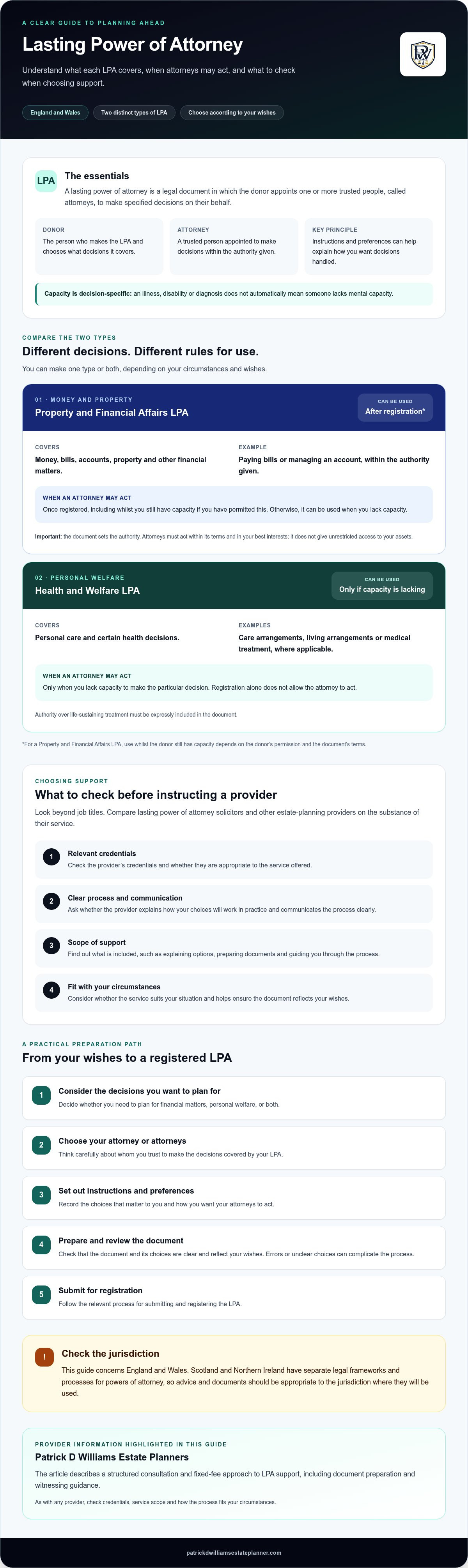
In England and Wales, there are two types of LPA. A Property and Financial Affairs LPA covers matters such as money, bills and property. A Health and Welfare LPA relates to personal welfare, including care and medical treatment decisions. They serve different purposes, so consider the decisions you want to plan for rather than treating them as interchangeable.
You can make one type of LPA or both, depending on your circumstances and wishes. A Property and Financial Affairs LPA can be used once registered if you have allowed this, including whilst you still have capacity. A Health and Welfare LPA can only be used when you lack capacity to make the particular decision. Understanding the difference is a useful starting point before choosing attorneys or discussing how an LPA should be prepared.
How the two types of lasting power of attorney differ
The two LPAs cover distinct areas of decision-making, and the rules on when an attorney can act differ. This comparison applies to England and Wales. The Office of the Public Guardian’s Make, register or end a lasting power of attorney guidance explains the official process and the scope of each type.
| LPA type | Decision area | When it can be used | Example |
|---|---|---|---|
| Property and Financial Affairs | Money, property and financial matters | Once registered, including whilst the donor has capacity if they have permitted this. Otherwise, it can be used when they lack capacity. | Paying bills or managing an account, within the authority given. |
| Health and Welfare | Personal care and certain health decisions | Only when the donor lacks capacity to make the specific decision. | Making decisions about care arrangements or medical treatment, where applicable. |
Property and Financial Affairs LPA: managing money and property
This LPA can let attorneys manage practical financial matters, such as paying household bills or managing accounts. Its authority is set by the document. It does not give attorneys unrestricted access to the donor’s assets or permission to act outside its terms. The donor can include instructions about how attorneys should act, as well as preferences that explain their wishes.
If the donor allows the LPA to be used whilst they still have capacity, an attorney may be able to help with financial tasks even when the donor can make their own decisions. The donor’s permission and the document’s terms matter. An attorney must act within their authority and in the donor’s best interests.
Health and Welfare LPA: care and personal decisions
A Health and Welfare attorney cannot make decisions under the LPA simply because it has been registered. They can act only when the donor lacks capacity for the particular decision. Depending on the authority granted, decisions may relate to daily care, living arrangements or medical treatment. Authority over life-sustaining treatment must be expressly included in the LPA.
Recorded preferences can help attorneys and professionals understand what matters to the donor, although instructions and preferences have different roles in the document. Clear wording can help ensure decisions reflect the donor’s values and circumstances. When comparing lasting power of attorney solicitors or other preparation services, ask how these choices will be explained and recorded. For information about LPA preparation, you can also explore LPA support from Patrick D Williams Estate Planners.
How to compare lasting power of attorney solicitors and providers
Choose support by checking who will handle your matter and how clearly they explain the process, rather than relying on a job title or a low headline fee. Not every service that prepares LPAs is provided by a solicitor. If a provider describes someone as a solicitor, confirm their current status and which firm they work for. The Law Society’s guidance on lasting powers of attorney offers useful context on solicitor practice, but you should still check an individual’s credentials.
What to verify about a solicitor or estate-planning provider
Ask who will discuss the donor’s circumstances, give advice and prepare the documents. If the person is a solicitor in England and Wales, check their details against the Solicitors Regulation Authority’s current register. For another professional title, ask which regulator or professional body applies and verify their status through its official register. Establish what the service includes, such as document preparation, witnessing guidance and checks for completion errors or legal compliance.
Clear answers help you understand who is responsible for each part of the work. They also help you distinguish a document-preparation service from advice provided by a regulated professional. Don’t assume that a provider’s website description confirms an individual’s status or the extent of their oversight.
Questions to ask before instructing a provider
Ask how the provider will understand the donor’s wishes, personal circumstances and choice of attorneys. Find out how you can review the draft, request corrections and get help with signing and witnessing. The process should give the donor a clear opportunity to consider the decisions being recorded and raise any questions.
Request a written explanation of the service scope and fee basis before proceeding. Check what is included, whether any work falls outside the agreed service, and whether the provider will guide you through registration or only prepare the documents. Also establish who your contact will be and how updates or queries will be handled.
Comparison checklist: Before choosing lasting power of attorney solicitors or another provider, confirm the adviser’s credentials, who prepares and checks the documents, how your circumstances and wishes will be recorded, what signing support is included, how corrections are handled and what the agreed fee covers.
Patrick D Williams Estate Planners describes its LPA service as fixed-fee, with structured consultations, document preparation, witnessing guidance and legal-compliance checks. You can review the firm’s LPA support as one option when comparing providers.
What to expect when preparing and registering an LPA
Making an LPA involves more than filling in a form. The donor’s choices, each person’s role and the signing formalities all need careful attention. In England and Wales, the Office of the Public Guardian (OPG) registers LPAs. The stages below provide an overview. Check the current forms and official guidance on making and registering an LPA before completing or signing documents.
- Choose attorneys. Consider people the donor trusts, whether they’re likely to be available when needed and how they would work together if more than one is appointed. Discuss the responsibilities with them before naming them.
- Decide the scope and record choices. Consider which type of LPA is needed and whether the donor wants to include preferences or instructions. These should express the donor’s wishes clearly. A provider can explain the difference between the two types, but the choices need to reflect the donor’s circumstances.
- Complete the document and involve a certificate provider. A certificate provider confirms that the donor understands the LPA and is making it freely. They must meet the eligibility requirements set out in the current form. Check who will prepare the document and how they will help identify and record the donor’s decisions.
- Sign and witness the LPA in the correct order. The donor, certificate provider and attorneys each have a role in signing. The sequence and witnessing requirements matter, so follow the instructions on the current form exactly. Don’t rely on an old copy or assume signatures can be added in any order.
- Submit the LPA for registration. The completed document must be registered with the OPG before it can be used. Check the current application instructions, submission route, any fee and the OPG’s processing estimates. Allow time for the application to be reviewed, and respond promptly if further information is requested.
Preparing the document and selecting attorneys
Consider whether your chosen attorneys can manage the responsibilities and act in line with your wishes. Clear preferences can guide them, whilst instructions set out requirements they must follow. A certificate provider is separate from the attorneys and confirms the donor’s understanding and freedom to make the LPA. Lasting power of attorney solicitors and other providers can explain these roles, but should not make the donor’s choices for them.
Signing, registration and avoiding preventable problems
Errors in details, missing signatures or incorrect signing order can delay registration. Read the completed form carefully before it is sent, and check the OPG’s current guidance for the latest requirements and estimated processing time. If you’d like help discussing the preparation stages, explore LPA preparation support from Patrick D Williams Estate Planners.
Choosing Patrick D Williams Estate Planners for LPA support
Once you understand the choices an LPA involves, you can assess whether a provider’s preparation service fits your needs. Patrick D Williams Estate Planners is an estate-planning provider offering bespoke Lasting Powers of Attorney. The firm describes its service as fixed-fee, so you can ask what the agreed work includes before deciding whether to proceed. It is presented here as an estate planner, not a solicitor firm.
What the firm’s LPA service includes
The service includes structured consultations to discuss your circumstances and the decisions you want the LPA to cover. Support also includes document preparation, witnessing guidance and legal-compliance checks. These steps can help you understand how your choices are recorded and what to consider before signing. They don’t guarantee that an LPA will be registered or produce a particular outcome.
When comparing lasting power of attorney solicitors and other providers, check who will prepare or advise on your documents and verify their relevant credentials and regulatory status. Clarify which parts of the process the service covers, including whether support is limited to preparation or extends to guidance around registration. This helps you compare providers by the work involved, not just how a service is described.
A considered first step towards arranging an LPA
A first discussion can help establish whether the service suits the donor’s circumstances. Prepare notes about the donor’s wishes, the people they are considering appointing as attorneys and the decisions they want to plan for. You can also ask about the two LPA types, how preferences or instructions are recorded, and what happens during preparation and signing.
Patrick D Williams Estate Planners offers consultations by Zoom, Teams or in person. Prospective clients can request a free 15-minute consultation to discuss their circumstances and understand the preparation process. Before proceeding, confirm the service scope, fee basis and professional responsible for the work. This gives you a chance to decide whether the service fits your needs.
Arrange a free 15-minute consultation to discuss LPA preparation with Patrick D Williams Estate Planners.
Take a considered next step with your LPA
Choosing lasting power of attorney solicitors or another provider is easier when you understand what each LPA covers and check who will prepare your documents, what support is included and how the process works. Consider your choice of attorneys and the instructions you want to record, then verify the provider’s credentials and service scope before proceeding.
Patrick D Williams Estate Planners offers LPA preparation through a stated fixed-fee service, including document preparation and witnessing guidance. Consultations are available by Zoom, Teams or in person, giving you an opportunity to discuss the donor’s circumstances, prospective attorneys and next steps. A free 15-minute consultation can help you understand the service and decide whether it fits your needs.
Arrange a free 15-minute consultation to discuss LPA support and ask any questions about the preparation process.
Frequently Asked Questions
Do I need lasting power of attorney solicitors to make an LPA?
No, you don’t have to use lasting power of attorney solicitors to make an LPA in England and Wales. You can complete the process yourself using the relevant official forms, or choose a solicitor or another provider for help. Professional support may be useful if your circumstances are complex or you’re unsure how to record your choices. Whoever prepares the document, check their credentials and understand what their service includes.
What is the difference between a solicitor and an LPA provider?
A solicitor is a legal professional whose status can be checked with the relevant regulator. “LPA provider” is a broader description of a service that helps prepare lasting powers of attorney. It doesn’t confirm that the person advising you is a solicitor. Ask who will advise on and prepare your documents, what professional rules apply and who is responsible for the work. Verify any claimed credentials using the appropriate official register.
Can I prepare a lasting power of attorney without a solicitor?
Yes. In England and Wales, you can use the Office of the Public Guardian’s current forms and guidance to prepare an LPA without instructing a solicitor. You’ll still need to follow the form’s instructions, including the required signing process, and arrange for a certificate provider to confirm that you understand the LPA and are making it freely. Check the latest official guidance before completing the forms, as mistakes can delay registration.
How long does it take to register a lasting power of attorney?
Registration time depends on the application route and whether the documents are complete. As of September 2026, paper applications are estimated to take around 8 to 10 weeks when there are no errors; the digital process aims for around 4 to 6 weeks. These are estimates, not guarantees. Check the Office of the Public Guardian’s current processing guidance before applying, as requirements and processing times can change.
Can an LPA be used before it is registered?
No. An LPA must be registered with the Office of the Public Guardian before an attorney can use it. Once registered, a Property and Financial Affairs LPA may be used whilst the donor still has capacity if the donor has allowed this in the document. A Health and Welfare LPA can only be used when the donor lacks capacity to make the specific decision. The LPA’s terms and legal limits still apply.
Are lasting powers of attorney the same across the UK?
No. The LPA system described in this guide applies to England and Wales. Scotland and Northern Ireland have their own legal frameworks and processes for powers of attorney, with different documents and rules. If the donor lives in, or their affairs involve, another UK jurisdiction, check the relevant official guidance and confirm that any professional you consult can advise on that jurisdiction. Don’t assume an England and Wales LPA form is suitable elsewhere.
What should I bring to an LPA consultation?
Bring notes about the donor’s wishes, the decisions they want to plan for and the people they are considering appointing as attorneys. A list of questions about the LPA type, instructions, preparation, signing and registration can help make the discussion useful. Note any circumstances that may affect the choices. Ask the provider in advance whether they need particular information or documents for the initial consultation.