
The certificate is more than a witness’s signature. A lasting power of attorney certificate provider must consider whether the donor understands the LPA, is acting freely and has no other barrier to making it; the Mental Capacity Act 2005 sets these criteria, according to UK Parliament. A family member cannot fill this role, but a solicitor may be eligible.
It’s understandable to assume that someone close to the donor is the natural choice. However, the rules distinguish personal knowledge from professional independence, so a relative or named attorney cannot act as certificate provider. Getting this choice right matters because the certificate forms part of a valid LPA.
This article explains what the provider must assess, who can act and why family members are excluded. It also covers professional fees, the appointment, signing order and registration, so you can understand how the certificate fits into the wider LPA process. A professional appointment typically takes 30 to 60 minutes, although the discussion itself is focused on the donor’s understanding and freedom to decide.
Key Takeaways
- The certificate provider assesses the donor’s understanding and freedom to decide; the role involves more than witnessing a signature.
- A personal knowledge-based provider does not charge, while a professional provider charges for their time. A professional appointment typically takes 30 to 60 minutes.
- The provider signs after the donor and witness, with the certificate dated on the same day as or after the donor’s signature.
- Family members and named attorneys cannot act as the provider, while an eligible solicitor may be able to take the role.
- Patrick D Williams Estate Planners can help you consider a Lasting Power of Attorney as part of your wider estate planning.
What is a Certificate Provider?
A certificate provider assesses whether the donor can make a Lasting Power of Attorney freely and with understanding. Their certificate supports the LPA’s legal validity; it is not simply another witness signature.
The provider’s role and duties
The provider’s role is to form an opinion about the donor’s understanding, freedom from pressure and ability to make the LPA. In England and Wales, the Mental Capacity Act 2005 sets the criteria a certificate provider must consider when certifying a Lasting Power of Attorney, according to UK Parliament. The provider must be satisfied that the donor understands the LPA’s purpose and scope, is not being pressured or defrauded, and has no other reason preventing its creation. This assessment makes the certificate a safeguard for the donor’s decision.
Checks and discussions with the donor
The provider should discuss the document with the donor privately, away from the attorneys. They need to consider whether the donor understands what the LPA allows, including who will make decisions and whether those decisions concern property and finances or health and welfare. They should also consider whether anyone is influencing the donor or whether another concern prevents the LPA from being made. What does an LPA certificate provider need to check and discuss with the donor? They must assess the donor’s understanding, freedom from fraud or undue pressure, and any other barrier to making the LPA.
Signing, refusal and unavailability
The certificate provider records their opinion by completing and signing the certificate in the LPA. The provider must read section 8, which forms part of the legal agreement, and should sign after discussing the LPA with the donor if satisfied. It may be worth arranging for someone else to witness the donor’s signature. What happens if the provider is unavailable or refuses to certify the LPA? Without a certificate, the LPA cannot be registered, so another eligible provider must assess the donor and decide independently whether they can certify it.
These rules apply to England and Wales. Scotland and Northern Ireland have separate legal systems, so do not assume that the England and Wales rules for LPA certificate providers apply there. The relevant document and process depend on the jurisdiction where the arrangement is being made.
The safeguard has practical importance, not just formal value. In TA v the Public Guardian [2023], the court found an LPA invalid where the provider had only asked whether the donor was happy about it. The case illustrates why the provider must form an opinion on the required matters, rather than treating the meeting as a brief confirmation or signature exercise.
A lasting power of attorney certificate provider therefore has a defined legal purpose: to assess the donor’s decision and certify that assessment. Their signature confirms an opinion reached after considering the donor’s circumstances, not a guarantee about every future decision made under the LPA. If the provider cannot honestly reach the required opinion, they should refuse to certify it.
Professional provider fees and appointment duration
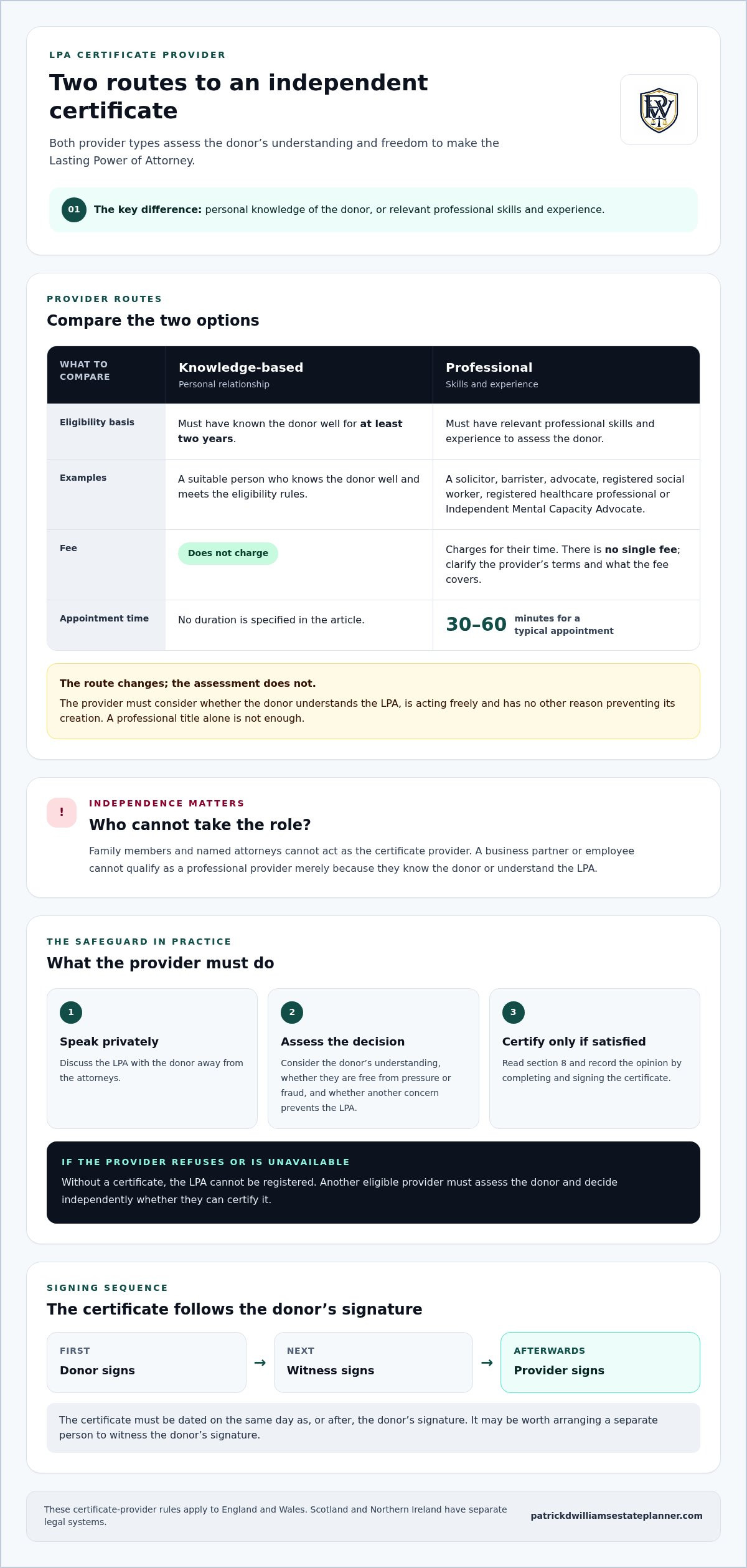
A professional certificate provider charges for their time, while a knowledge-based provider does not. A professional appointment typically takes 30 to 60 minutes. The fee and the length of the discussion are separate considerations: the appointment duration gives an indication of time, but does not establish a standard charge.
Professional skills-based certificate providers
The skills-based route allows a person with relevant professional skills and experience to assess the donor, rather than relying on a personal relationship of at least two years. Examples include a solicitor, barrister, advocate, registered social worker, registered healthcare professional or independent Mental Capacity Advocate. Their role is to reach an opinion on the donor’s understanding and freedom to make the LPA. A professional title alone does not replace that assessment.
The donor’s circumstances shape the discussion. For example, a registered healthcare professional may meet someone living in a care home, while a solicitor may explain how the LPA’s terms work. The provider needs to speak with the donor and consider whether they understand the document and can decide freely. The focus is the donor’s mental capacity to make this LPA, not a general judgement about their ability to manage every part of life.
Fees for professional certificate providers
A professional provider charges for their time; a knowledge-based provider does not. There is no single fee for every professional appointment. The amount depends on the provider’s charging terms and the work involved in considering and recording the certificate. Before arranging a paid appointment, clarify the fee and what it covers. This helps distinguish the certificate assessment from any separate legal work.
A business partner, employee or attorney cannot qualify as a professional provider merely because they know the donor or understand the LPA. The provider must meet the eligibility rules and be able to make the required assessment independently. Anyone unable to form that opinion should not certify the document.
Knowledge-based and professional providers
A knowledge-based provider must have known the donor well for at least two years. A professional provider instead relies on relevant skills and experience. The donor can consider which route is appropriate, then arrange a private discussion with someone eligible. In either case, the provider must assess the donor, not simply be present when the form is signed.
For a professional appointment, allow for the typical 30-to-60-minute discussion and the provider’s assessment of the donor’s understanding. The appointment is not a formal mental capacity test. Its purpose is to consider the particular LPA and whether the provider can certify the required matters.
Signing order and registration requirements
The order of signatures matters because the Office of the Public Guardian (OPG) checks the completed LPA before registration. In England and Wales, the certificate provider signs after the donor and witness, and must complete Section 10 in the correct sequence.
LPA signing sequence and witnesses
The donor signs and dates Section 9 first. The donor’s witness then signs, followed by the certificate provider in Section 10. The provider cannot witness the donor’s signature on that same LPA, so these are separate roles, even if someone else acts as witness. The sequence helps the OPG see that the certificate followed the donor’s signed statement.
Keep the distinction clear: the witness attests to the donor’s signature, while the certificate provider confirms their opinion of the donor’s understanding and freedom to make the LPA. The certificate is not a substitute for the witness’s signature, and the witness’s signature does not fulfil the provider’s responsibility. For example, a completed Section 9 does not make the LPA ready for registration if Section 10 remains unsigned.
Signing and dating Section 10
The certificate provider must sign and date Section 10 on the same day as, or after, the donor signs and dates Section 9. A Section 10 date earlier than the donor’s Section 9 date breaks the required order. The provider should complete the relevant details accurately, then check that the signature and date are present before the form is submitted.
Signing out of sequence can cause problems, even when everyone intends to complete the document correctly. The date is not a minor detail: it shows when the provider certified the LPA in relation to the donor’s signature. The provider’s signature confirms their certificate, not simply that they were present when the donor signed.
Registration with the OPG
The LPA cannot be registered without the certificate provider’s certificate. The OPG may reject a form if the certificate signature is missing, the date is incorrect or signatures are completed out of order. Depending on the error and the OPG’s requirements, you may need to correct the document or complete the affected part again.
Before sending the LPA for registration, review the completed sections together. Confirm that Section 9 bears the donor’s signature and date, the witness has signed, and Section 10 is signed and dated in the permitted sequence. Check that names and dates are legible and consistent across the form. These practical checks help prevent an avoidable registration delay, but nothing else can replace the required signatures.
Certificate provider eligibility
In England and Wales, an eligible certificate provider must be at least 18 and independent of the donor and their attorneys. They must qualify through personal knowledge or relevant professional skills and experience. These are alternative routes: a friend who knows the donor well may qualify, as may a suitable professional who can assess the donor’s understanding and decision-making.
The personal knowledge route requires the provider to have known the donor well for at least two years. A casual acquaintance is not enough if they cannot form a proper view of the donor’s understanding. The professional route depends on relevant skills and experience, not the length of the relationship. A formal test of mental capacity is not required simply to provide the certificate.
Relevant professionals may include a registered healthcare professional, solicitor, barrister, advocate, registered social worker or independent Mental Capacity Advocate. A professional must still be able to assess the donor in the particular circumstances. For instance, a healthcare professional’s registration does not remove the need to consider whether the donor understands the LPA and is acting freely.
Independence also rules out particular connections with the donor or attorneys. The following people cannot act as the provider:
- The donor’s family member or a family member of an attorney named in the LPA.
- An attorney appointed in the donor’s current or previous LPA, or in the donor’s enduring power of attorney.
- The donor’s business partner or paid employee.
- A person who is an employee or employer of the donor or an attorney.
These exclusions matter even when someone is trusted and familiar with the donor. For example, a business partner may understand the donor’s wishes, but that relationship prevents them from acting as certificate provider. A person’s title or closeness cannot replace the required independence.
One eligible provider can certify both the donor’s property and financial affairs LPA and their health and welfare LPA. The provider must consider the donor’s understanding of each document and be able to make the required assessment for each. If they cannot form that opinion, they should not certify it. The donor can consider another person who meets either eligibility route.
Eligibility depends both on a person’s connection to the donor and on their ability to assess the decision. Before signing, the provider should consider whether they qualify, whether any disqualifying relationship applies, and whether they can assess the donor’s understanding independently. This keeps the certificate focused on the donor’s own decision, rather than another person’s wishes.
Family members and solicitors as certificate providers
Family involvement in choosing attorneys does not make a relative eligible to certify the LPA. In England and Wales, a family member of the donor or an attorney named in the document cannot act as certificate provider. A solicitor may qualify through relevant professional skills and experience, provided they can assess the donor independently.
Can a family member, friend, solicitor or doctor certify an LPA? A family member cannot, but a friend may qualify if they are at least 18 and have known the donor well for at least two years. A solicitor or registered healthcare professional, such as a doctor, may qualify through relevant professional skills and experience.
The distinction is between personal connection and professional eligibility. A friend is not eligible merely because the donor trusts them; they must meet the personal-knowledge test and remain independent of the donor’s attorneys. A donor’s business partner, paid employee, employer or employee cannot take the role. Nor can an attorney appointed in the donor’s current or previous LPA, or enduring power of attorney.
A solicitor, barrister or advocate may act as a professional certificate provider. An estate planner who helped prepare the LPA may also be able to act if they reasonably believe they can judge the donor’s capacity. Their professional involvement does not remove the need to consider the donor’s understanding, freedom from pressure and any risk of fraud. The provider must reach an independent opinion, rather than simply witness a signature.
A doctor, including the donor’s GP, may qualify as a registered healthcare professional. The professional route depends on relevant skills and experience, not simply on a job title or existing relationship. An independent Mental Capacity Advocate is another possible professional example. In each case, the provider must be able to assess the donor’s understanding of the LPA and whether they are acting freely.
The Mental Capacity Act’s certificate requirement is intended to protect the donor’s decision, not endorse a family’s preferred arrangement. The Office of the Public Guardian relies on a properly completed certificate when considering registration. If a relative cannot act, the donor can consider an independent friend who meets the two-year test, or an eligible professional. One eligible provider can certify both the property and financial affairs LPA and the health and welfare LPA if they can assess each document.
Patrick D Williams Estate Planners: Will Writing
Patrick D Williams Estate Planners can help you consider a Lasting Power of Attorney as part of your wider estate planning. If you are preparing an LPA and want to understand how it fits alongside your will, support is available with Lasting Powers of Attorney and Will Writing. Property Protection Trusts and Discretionary Trusts may also form part of a broader plan for managing and protecting family assets.
If you understand the certificate process but would value help putting your own arrangements in place, this may be a natural next step. The right documents depend on your wishes and circumstances. Contact Patrick D Williams Estate Planners to discuss your estate planning needs.
Take the next step with confidence
Planning an LPA is also an opportunity to reflect on who you trust and how your wishes should guide future decisions. Choosing a suitable lasting power of attorney certificate provider is one part of the process; thoughtful attention to your wider plan can help keep your arrangements aligned with your priorities.
Patrick D Williams Estate Planners can help you consider how your plans fit together, including Will Writing, Lasting Powers of Attorney and Property Protection Trusts. A conversation can help you decide which matters to address and what you want your arrangements to achieve. The right approach depends on your wishes and circumstances.
When you are ready to discuss your estate planning, contact Patrick D Williams Estate Planners. A clear next step can make it easier to put your intentions into a considered plan.
Frequently Asked Questions
What is a certificate provider for a lasting power of attorney in England and Wales?
A certificate provider is an independent person who assesses whether the donor understands the LPA and is making it freely. The lasting power of attorney certificate provider completes a formal part of the document, rather than simply confirming that the donor signed. For example, if a donor seems uncertain about the authority they are granting, the provider must consider that concern before certifying the LPA.
Who can act as a certificate provider for an LPA?
An adult aged 18 or over can act if they qualify through either personal knowledge or relevant professional skills and experience. A friend who has known the donor well for at least two years may qualify. A solicitor, barrister, advocate, registered healthcare professional, registered social worker or independent Mental Capacity Advocate may also qualify professionally. In every case, the person must be able to assess the donor independently.
Who is disqualified from being an LPA certificate provider?
A donor’s family member and a family member of an appointed attorney cannot certify the LPA. The donor’s current or previous attorney, or an attorney under their enduring power of attorney, is also disqualified. The donor’s business partner, paid employee or employer, and an attorney’s employee cannot act either. These restrictions apply even if the person knows the donor’s wishes and believes they can help.
How does the certificate provider complete and sign the LPA form?
The provider reads the relevant LPA information, discusses the donor’s understanding privately, then completes the certificate in Section 10. They must read Section 8, which forms part of the legal agreement, and record their opinion through the certificate. The provider must not witness the donor’s signature on that same LPA. A separate witness still has to complete the witness part of the form.
When must the certificate provider sign the lasting power of attorney?
The provider signs Section 10 after the donor has signed and dated Section 9, and after the donor’s witness has signed. The provider must date Section 10 on the same day as, or after, the donor’s Section 9 date. For instance, if the donor signs on one day, the certificate provider cannot date their certificate earlier. An out-of-order date can affect registration.
Does an LPA certificate provider charge a fee, and how much?
A knowledge-based provider does not charge, while a professional provider charges for their time. There is no single fee applicable to every professional appointment: the amount depends on that provider’s fee arrangement and the time involved. A professional appointment typically takes 30 to 60 minutes, but this duration does not determine the fee. The donor should understand the charging basis before proceeding.
What risks arise from an incorrect or invalid certificate provider certificate?
An incomplete or incorrectly dated certificate can prevent registration and lead the Office of the Public Guardian to reject the LPA. For example, a missing Section 10 signature or a certificate dated before the donor signed can create a defect. A more fundamental concern arises if the provider has not properly assessed the donor’s understanding and freedom to decide. A certificate cannot replace that required opinion.
Leave a Reply