
The inheritance tax nil-rate band has remained at £325,000 since tax year 2009 to 2010. This guide explains the inheritance tax nil-rate band in practical terms, including what the allowance covers and how it fits with other reliefs.
It is easy to think of the nil-rate band as one amount covering everything in an estate. In practice, the calculation may also depend on whether a home passes to direct descendants, whether a spouse or civil partner has an unused allowance to transfer, and what gifts the person made during their lifetime.
This guide explains the main nil-rate band, how the residence nil-rate band may affect an estate, and when unused allowances can transfer. It also looks at how property, gifts and exemptions affect the amount that may be subject to Inheritance Tax, and briefly explains the allowance’s history to put today’s threshold in context.
Key Takeaways
- Understand how the main nil-rate band sets the starting point for calculating Inheritance Tax on an estate.
- Learn how unused allowances may increase what a surviving spouse or civil partner can pass on.
- See why a home’s value, ownership and who inherits it can affect the residence nil-rate band.
- Recognise how lifetime gifts and exemptions may change the allowance available when someone dies.
- Put today’s threshold in context by following how the nil-rate band has changed over time.
What is the nil rate band?
The nil-rate band is the part of an estate that can pass on without Inheritance Tax being charged. A separate residence nil-rate band may also apply, depending on who inherits a qualifying home.
The residence nil rate band
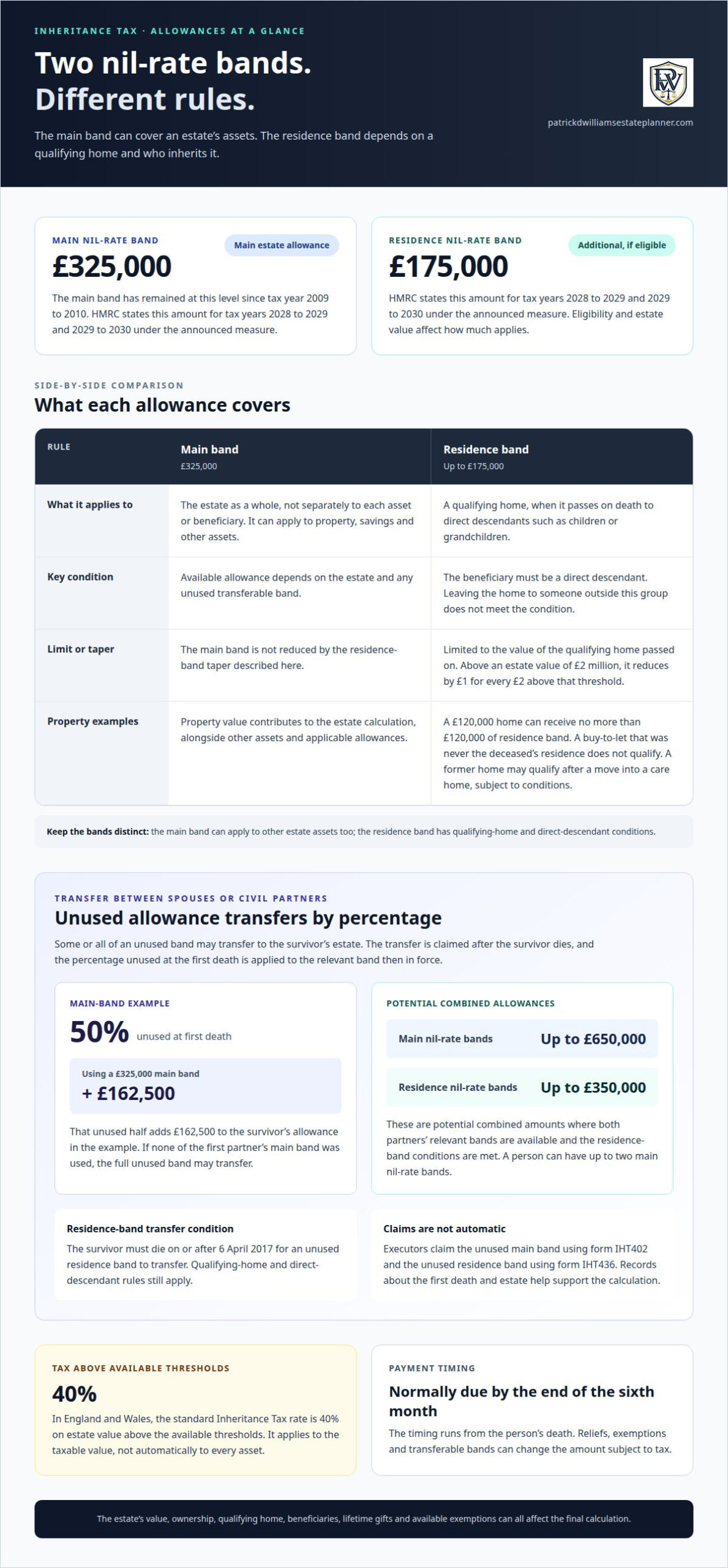
The residence nil-rate band is an additional allowance where a qualifying home passes on death to direct descendants. HM Revenue & Customs states that it is £175,000 for tax years 2028 to 2029 and 2029 to 2030 under the announced measure. It may increase the amount covered by allowances, but eligibility and estate value affect how much applies.
HM Revenue & Customs states that the residence nil-rate band taper threshold has been set at £2 million since the band was introduced. Above that threshold, the allowance is reduced by £1 for every £2 of estate value above £2 million, according to HM Revenue & Customs. Larger estates may therefore receive a smaller residence allowance.
Residences passed to direct descendants
The residence nil-rate band applies when a qualifying home passes on death to direct descendants, such as children or grandchildren. The beneficiaries matter: leaving the home to someone outside this group does not meet this condition. The allowance is also limited to the value of the qualifying home being passed on.
For example, a home worth £120,000 can receive no more than £120,000 of residence nil-rate band. A property that was never the deceased’s residence, such as a buy-to-let, does not qualify. A former home may qualify if its owner moved into a care home, subject to the relevant conditions.
Tax on estates above the nil rate band
In England and Wales, the standard Inheritance Tax rate is 40% on estate value above the available thresholds. HM Revenue & Customs states that the main nil-rate band is £325,000 for tax years 2028 to 2029 and 2029 to 2030 under the announced measure. The taxable amount depends on the estate’s value and applicable allowances.
The main nil-rate band applies to the estate as a whole, not separately to each asset or beneficiary. Property, savings and other assets may be included in the calculation, while qualifying allowances reduce the amount on which tax is due.
The main nil-rate band and residence nil-rate band are separate allowances. The residence band depends on a qualifying home passing to direct descendants, while the main band can apply to other assets too. Executors consider the estate’s circumstances and applicable allowances to work out the taxable balance.
The 40% rate applies to the taxable value, not automatically to every asset. Reliefs, exemptions and transferable bands can affect the amount subject to tax. HM Revenue & Customs states that Inheritance Tax is normally due by the end of the sixth month after the person’s death.
Transferring unused nil rate bands between spouses or civil partners
When a married person or civil partner dies, some or all of their unused nil-rate band may transfer to the survivor’s estate. The transfer is claimed after the survivor dies and can increase the allowance available for that estate. The same principle applies to an unused residence nil-rate band, although that allowance has its own conditions.
The transferable amount is based on the proportion of the first partner’s allowance that remained unused, rather than simply copying its original cash value. That percentage is applied to the relevant band in force when the surviving spouse or civil partner dies. If half of the first partner’s main allowance was unused, the survivor can receive an additional 50% of the main band then in force.
For example, using a £325,000 main nil-rate band, an unused half adds £162,500 to the survivor’s allowance. If none of the first partner’s nil-rate band was used, the full unused band may transfer. Where both partners’ main bands are available, their combined nil-rate band can reach £650,000. A person can have up to two main nil-rate bands.
The residence nil-rate band can also transfer between spouses or civil partners. If both residence bands are unused, the survivor may have a combined residence nil-rate band of up to £350,000. The survivor must die on or after 6 April 2017 for an unused residence band to transfer. The qualifying-home and direct-descendant conditions still matter when the survivor’s estate is assessed.
Transfer isn’t automatic. After the second death, the executors claim the unused main band using form IHT402. They claim the unused residence band using form IHT436. The claim establishes what percentage remained unused in the first estate, then applies that percentage to the band relevant to the survivor’s estate. Records about the first death and its estate help support this calculation.
A surviving partner’s allowance can depend on what happened when the first partner died, not just on the survivor’s own estate. If the first estate used part of the main band, for example, only the unused proportion can transfer. The calculation must also consider whether the residence band’s conditions are met. This is why the two bands should be tracked separately.
Clear records of both estates help executors establish the available transfer and support the required claims. Considering how lifetime gifts or estate arrangements affect the first estate can also clarify what may remain unused. Review your estate planning arrangements as part of understanding how your family’s circumstances may affect future claims.
How does inheritance tax apply to property?
Trusts, jointly owned assets and pensions are assessed according to ownership and the estate rules that apply to each asset. A mortgage affects the property’s net value, while the residence nil-rate band depends on a qualifying home passing to direct descendants. From 6 April 2027, most unused pension pots and death benefits are to be included in an individual’s taxable estate.
For a property, the estate calculation considers its value and any outstanding mortgage. The remaining equity contributes to the estate’s value, alongside other assets. The residence nil-rate band has a separate calculation: HMRC uses a different method to determine the estate value for this allowance than for the general estate valuation.
The residence nil-rate band cannot exceed the value of the qualifying home being passed on. For example, a home worth £120,000 can receive no more than £120,000 of this allowance. A property that was never the deceased’s residence, such as a buy-to-let, does not qualify. A former residence may qualify if its owner moved into a care home, subject to the conditions.
Who inherits the home also matters. The residence nil-rate band is available when a qualifying home passes on death to direct descendants, including children and grandchildren. A home left to other beneficiaries does not meet this condition. If the home is jointly owned, the deceased’s interest and the terms of ownership affect what forms part of their estate.
Trust ownership can affect how a home passes to beneficiaries and whether the residence band applies. A discretionary trust cannot be used to pass on a home and qualify for the residence nil-rate band, although some other types of trust may qualify. A life-interest trust gives someone a right to benefit from property, while someone else may ultimately inherit it. The trust’s terms and relevant estate rules affect the tax treatment.
Trust assets also need consideration in their own right. A lifetime transfer into certain trusts may be subject to Inheritance Tax when its value exceeds the £325,000 nil-rate band in 2026/27. Relevant-property trust charges are distinct from the estate’s ordinary calculation, so the trust structure and timing of transfers matter. The residence allowance question remains separate from any tax treatment of the trust itself.
Joint ownership does not automatically mean the entire property belongs to one person’s estate. The deceased’s ownership interest is relevant, and Joint Tenancy Severance can change how jointly owned property is held. This may affect how an interest passes under a will, but does not by itself establish that the residence nil-rate band applies.
Pensions require separate attention in estate planning. From 6 April 2027, most unused pension pots and death benefits are to be included in an individual’s taxable estate for Inheritance Tax purposes. This change may affect the estate’s overall value, including the test for the residence nil-rate band taper. Property, trust and pension arrangements should therefore be considered together when assessing the estate.
What gifts and exemptions are free of inheritance tax?
Some gifts and transfers are exempt from Inheritance Tax, while others may affect the allowance available when the giver dies. The exemption depends on the recipient and type of gift, and for some gifts, how long the giver survives afterwards.
A transfer to a spouse or civil partner may qualify for the spouse exemption. This is different from transferring an unused nil-rate band after a death: one concerns a transfer between partners, while the other concerns the survivor’s later estate. A gift to a child or another relative does not qualify for the spouse exemption just because the recipient is family.
HM Revenue & Customs says gifts made more than seven years before death are normally free of Inheritance Tax. Gifts made within that period may use up some or all of the giver’s nil-rate band, depending on their value and available exemptions. This can leave less of the allowance to cover the estate at death.
Several exemptions can cover gifts made during a tax year:
- The annual exemption allows an individual to give up to £3,000 per tax year. Unused exemption can be carried forward for one year only.
- Small gifts of up to £250 can go to each of any number of people in a tax year, provided another exemption is not used for the same recipient.
- Wedding or civil partnership gifts can be exempt up to £5,000 for a child, £2,500 for a grandchild or great-grandchild, or £1,000 for anyone else.
These exemptions help distinguish a tax-free gift from a transfer that reduces the remaining allowance. Recording the recipient, date and value can help executors understand how gifts relate to the estate calculation.
Thresholds also shape how many estates become taxable. The main nil-rate band remains £325,000 for tax years 2028 to 2029 and 2029 to 2030 under the announced measure. A fixed threshold can bring more estates into Inheritance Tax as asset values rise. The residence nil-rate band taper threshold is £2 million, and the taper reduces that allowance as estate value rises above it.
Earlier estate tax systems used different thresholds. The Inheritance Tax nil-rate band was £312,000 from 6 April 2008 to 5 April 2009, before reaching £325,000 from tax year 2009 to 2010. That history shows why an estate’s date of death matters: the applicable threshold can depend on the tax year, rather than the amount that applied when a gift was made.
For estates that require an Inheritance Tax account, reporting and payment are separate responsibilities. HM Revenue & Customs says tax is normally due by the end of the sixth month after the person’s death. Executors need to consider the estate’s reporting requirements as well as the payment deadline.
Inheritance Tax nil rate band history
The main nil-rate band has changed over time, but its more recent history is marked by a long period at the same level. It was £200,000 from 6 April 1996 to 5 April 1997, then increased through several tax years. Those earlier figures show why the deceased’s date of death matters when identifying the applicable allowance.
Between 1996 and 2009, the band rose in stages. It reached £234,000 for 6 April 2000 to 5 April 2001, and £263,000 for 6 April 2004 to 5 April 2005. It then stood at £300,000 from 6 April 2007 to 5 April 2008, before reaching £312,000 for 6 April 2008 to 5 April 2009.
From tax year 2009 to 2010, the main nil-rate band has remained at £325,000. HM Revenue & Customs states that it is £325,000 for tax years 2028 to 2029 and 2029 to 2030 under the announced measure. The period at this level contrasts with the earlier step-by-step increases, and means an estate’s allowance does not automatically rise alongside its asset values.
The residence nil-rate band followed a different path. It was introduced in 2017 at £100,000, then rose by £25,000 until reaching £175,000 in April 2020. It is available when a qualifying residence passes on death to direct descendants, adding a distinct allowance to the main band. The residence nil-rate band is set to remain at its current level until April 2031.
Its taper threshold has also shaped the allowance’s history. The threshold has been set at £2 million since the residence nil-rate band was introduced. Above that amount, the residence allowance reduces as estate value rises; an individual’s allowance is fully tapered away at approximately £2.35 million. The home and beneficiary conditions still apply separately.
These timelines matter when a surviving spouse or civil partner claims unused allowances. The transferable amount is based on the percentage of the band left unused at the first death, then applied to the relevant band when the survivor dies. The date of each death therefore helps determine the allowances in the calculation.
The key historical lesson is that the main band and residence band have followed different patterns. The main band has stayed at £325,000 since tax year 2009 to 2010, while the residence band rose after its introduction and then levelled at £175,000. Review your estate planning arrangements in light of these separate allowances and your family’s intended inheritance.
Patrick D Williams Estate Planners
Patrick D Williams Estate Planners can help you consider how your will and estate arrangements relate to the allowances explained here. Will Writing lets you record how you intend your estate to pass, while a Property Protection Trust or Discretionary Trust may suit particular family circumstances. Lasting Powers of Attorney address decision-making if you become unable to make decisions yourself.
These arrangements are relevant when your estate includes a home, when you want to provide for family members, or when you are reviewing an existing will. Their purpose is to make your intentions clear, not to promise a particular Inheritance Tax outcome. Contact Patrick D Williams Estate Planners to discuss your estate planning needs.
Shape your next estate planning decision
Understanding the inheritance tax nil-rate band gives you a starting point for considering your estate. Think about what you want your arrangements to achieve, who you intend to benefit, and whether your documents still reflect those intentions.
Family circumstances and financial arrangements can change over time. Reviewing your plans as they evolve can help you identify questions to address and keep your intentions clear.
Estate planning is personal, and the right approach depends on how your assets are held and what you want to happen to them. Patrick D Williams Estate Planners can help you consider these questions and the role your planning documents may play.
Discuss your estate planning next step with Patrick D Williams Estate Planners. A considered conversation can help you move forward with greater clarity.
Frequently Asked Questions
Can married couples combine their nil-rate bands?
Yes. A surviving spouse or civil partner may use the unused proportion of their late partner’s nil-rate band, subject to an executor’s claim after the survivor dies. If both main bands are unused, the survivor’s estate can benefit from a combined allowance of up to £650,000. The residence nil-rate bands are separate and may also transfer, where the qualifying conditions are met.
Do you pay Inheritance Tax on gifts given before death?
Not necessarily. HM Revenue & Customs says gifts made more than seven years before death are normally free of Inheritance Tax. A gift made within that period may use some of the giver’s available nil-rate band, reducing the amount left to cover the estate. When reviewing a past gift, consider its date and value, and whether an exemption applied.
How are Inheritance Tax bands calculated?
The calculation starts with the estate’s assets and relevant liabilities, then considers available allowances, exemptions and transfers. The residence nil-rate band is applied before the main nil-rate band. Lifetime gifts can also affect the calculation if they fall within the relevant period. Executors need to consider the estate and gifting history together, rather than treating each asset or beneficiary as having a separate band.
How can you reduce your Inheritance Tax liability?
Start by understanding which exemptions and allowances fit your circumstances. For instance, an individual can use the £3,000 annual gift exemption, and gifts to charity can reduce the rate on the remainder of an estate to 36% if at least 10% of the net estate is left to charity. A clear will can record your intentions, while lifetime gifts need careful timing and records.
Can an unused allowance be transferred to a spouse?
Yes, an unused nil-rate band can be transferred to a surviving spouse or civil partner, but the transfer is not automatic. Executors make the claim after the survivor’s death, using form IHT402 for the main band. Form IHT436 is used for an unused residence nil-rate band. The transferable amount depends on the proportion of the first partner’s allowance that remained unused.
What is the Inheritance Tax nil-rate band in the UK?
The main nil-rate band is the threshold that can be covered before Inheritance Tax is charged on the remaining taxable estate. The amount available may change if the deceased made relevant lifetime gifts or had a transferable allowance from a spouse or civil partner. A separate residence nil-rate band may also apply when a qualifying home passes to direct descendants.
What is the current UK Inheritance Tax nil-rate band amount?
The main nil-rate band is £325,000 for 2026/27. HM Revenue & Customs states that it is also £325,000 for tax years 2028 to 2029 and 2029 to 2030 under the announced measure. The figure is not the only consideration: a qualifying residence, unused allowances from a spouse or civil partner, and relevant gifts can all affect the estate’s final calculation.
How does the residence nil-rate band work, and who qualifies?
The residence nil-rate band can apply when a qualifying home is passed on death to direct descendants, such as children or grandchildren. It is £175,000 for tax years 2028 to 2029 and 2029 to 2030, according to HM Revenue & Customs. The allowance cannot exceed the home’s value and tapers for estates above £2 million, so both the property and estate value matter.
Leave a Reply