
The key difference in an online LPA services comparison UK readers make is not simply whether they complete the form on screen or on paper. A lasting power of attorney (LPA) lets someone appoint attorneys to make decisions on their behalf. The right route depends on how much guidance they need: online services, DIY forms and professional support offer different levels of help.
It’s understandable to want a clear, manageable way to put these arrangements in place. The choice can feel less straightforward when you need to consider the process, your attorneys’ responsibilities and registration.
This article explains what an LPA does and compares online services with completing the forms yourself or using professional support. It covers guidance, completion and registration, so you can decide which approach may suit your circumstances.
Key Takeaways
- Understand what an LPA allows attorneys to do and the responsibilities they take on.
- Compare online forms with paper-based DIY and solicitor support to identify the level of guidance that suits you.
- Distinguish between property and financial affairs decisions and health and welfare decisions.
- Allow for both completing the LPA and registering it when considering the overall process.
- See how professional LPA support can help bring clarity to your arrangements and wider estate planning.
Benefits compared with paper LPA documents
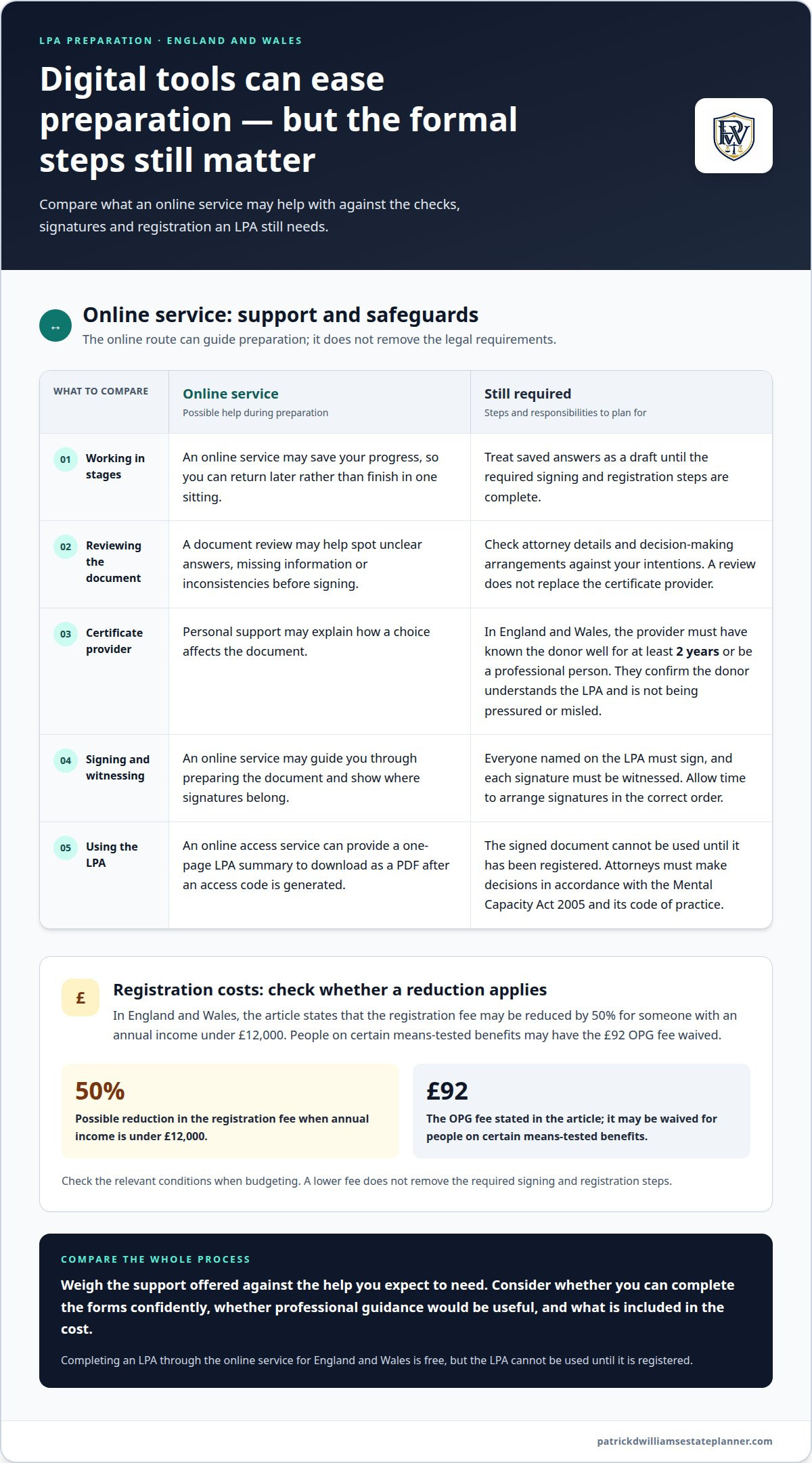
- Choose a digital process if you want to complete the document in stages. An online service may save your progress, letting you return later instead of finishing the form in one sitting. This can help when you need time to consider your choice of attorneys or discuss arrangements with family. Treat saved answers as a draft until the required signing and registration steps are complete.
- Use a document review to catch inconsistencies before signing. Check, for example, that each attorney’s details and decision-making arrangements match your intentions throughout the LPA. A review can help identify unclear answers or missing information, while personal support can explain how a choice affects the document. It does not replace the certificate provider, who confirms the donor understands the LPA and is not being pressured or misled.
- Make the certificate provider’s role part of your plan. In England and Wales, the provider must have known the donor well for at least 2 years or be a professional person, according to the Office of the Public Guardian. The provider is separate from the attorney. Their certificate addresses the donor’s understanding and freedom to make the LPA, not whether the selected arrangements suit every family situation.
- Compare the signing process, not just the screen layout. In England and Wales, everyone named on an LPA must sign, and each signature must be witnessed for the document to be valid. An online service may guide you through preparing the document, but the signing requirements still apply. Allow time to arrange signatures in the correct order and keep the completed document ready for registration.
- Assess how the arrangement will be used after registration. Attorneys in England and Wales must make decisions in accordance with the Mental Capacity Act 2005 and its code of practice, according to UK Parliament. An online access service can provide a one-page LPA summary, which can be downloaded as a PDF after an access code is generated. Consider whether this will make it easier for relevant organisations to see the LPA’s status and decision-making arrangements.
Cost is another point to weigh when comparing a digital process with paper documents. Compare the support offered with the help you expect to need, rather than assuming one format suits every budget. Consider whether you can complete the forms confidently and whether professional guidance would be useful. Check what is included before choosing, so you can compare like with like instead of deciding on the initial price alone.
There may also be help with registration costs. In England and Wales, an LPA registration fee may be reduced by 50% for someone with an annual income under £12,000. The page states that people on certain means-tested benefits can have the £92 OPG fee waived. These options may affect the overall cost, so check whether you meet the relevant conditions before budgeting. A lower fee does not remove the need to complete the required signing and registration steps. Compare the practical support, review options and likely costs together, then choose the route that gives you a manageable process and the level of assistance you need.
What is a power of attorney?
- Start by identifying the decisions you want someone to manage. A power of attorney is a legal document appointing an attorney to act for you. For an LPA in England and Wales, the donor makes this appointment while they can make the decision themselves. The arrangement can cover property and financial affairs, health and welfare, or both through separate LPAs. Choosing the type first keeps the document focused on the decisions that matter.
- Select an attorney who can understand your wishes and act responsibly. The Office of the Public Guardian says a person choosing an LPA attorney must appoint someone aged 18 or over. You might choose a relative, friend or another trusted person. Consider how that person would approach bills, care choices or discussions with organisations. An attorney’s role is to make decisions for the donor within the authority the LPA gives them.
- Choose a certificate provider before completing the signing process. The Office of the Public Guardian says a certificate provider in England and Wales must either have known the donor well for at least 2 years or be a professional person. Their role is distinct from the attorney’s. They confirm the donor understands the LPA and is not being pressured or misled. This gives the document an independent safeguard at the point of creation.
- Follow the signing instructions carefully, whether you prepare the LPA online or on paper. In England and Wales, everyone named on the LPA must sign, and each signature must be witnessed. A witness observes the relevant person signing and confirms the signature. An online service can explain where signatures belong, but the final document still needs all required signatures and witnesses. A missing signature or witness can disrupt registration.
- Arrange the required signatures, then send the completed LPA for registration with the Office of the Public Guardian. A signed document cannot be used until registered. Customer support is most useful when it clarifies a particular field, the signing order or what to do if the government process returns a document. Before choosing a service, consider whether its guidance covers both form completion and signing. For individual help with Lasting Powers of Attorney, professional support can guide the preparation process.
Completing a lasting power of attorney through the online service for England and Wales is free, but the LPA cannot be used until it is registered.
Property and financial affairs LPAs
Online services can help create property and financial affairs LPAs and health and welfare LPAs in England and Wales. People sometimes call a health and welfare LPA a health and care LPA; the two types cover different decisions.
Identify the LPA types available
- Choose a property and financial affairs LPA for decisions about managing bank accounts, paying bills and mortgages, selling property, and dealing with pensions or investments. Decide whether the attorney should act only when you lack capacity or sooner, and make your preferences clear in the document.
- Choose a health and welfare LPA for decisions about where you live, day-to-day care and medical treatment. This document may also authorise an attorney to decide about life-sustaining treatment. Read each choice carefully: authority for welfare decisions does not come from a property and financial affairs LPA.
- Prepare separate documents if you want both kinds of decisions covered. For example, the attorney managing household bills under one LPA may differ from the person making care decisions under the other. Set out any restrictions and conditions clearly, so the written arrangements reflect your intentions.
Use digital LPAs
- Use the GOV.UK View an LPA service to view a one-page summary of an eligible LPA. The service covers LPAs registered in England or Wales on or after 1 January 2016. It shows current status, including new or replacement attorneys, alongside donor details, decision-making arrangements, restrictions and conditions.
- Generate an access code before allowing an organisation to view the summary. The donor or an attorney can create codes through the service. A person adding an LPA needs its reference number and activation key. The summary can then be downloaded as a PDF, helping you provide the correct details to an organisation.
- Use an online account to make multiple LPAs for yourself and other people, keeping each donor’s documents distinct. For older arrangements, remember that an LPA registered before 1 January 2016 cannot have an online access code generated by the donor or attorney. Digital viewing does not replace registration or alter the preferences recorded in the signed document.
Before sharing a summary, compare its stated status and attorney details with the arrangement you intend to use. If you have several LPAs, generate the relevant code for each document rather than assuming one code covers every record. This keeps access specific to the correct donor and LPA.
Service availability and completion time
Online LPA services prepare documents, but registration is a separate stage. The rules and registration bodies also depend on where you live in the UK.
- Allow time for both completing the form and registration. Online services estimate around 15 to 30 minutes for completion, while a typical online LPA may take 30 to 45 minutes. GOV.UK DIY forms are estimated to take 1 to 2 hours. These are completion estimates, not registration times. After submission, Office of the Public Guardian registration currently takes 8 to 12 weeks.
- Gather the information you need before opening an online form. This includes the donor’s details, the chosen attorneys’ details and the decisions the LPA should cover. Consider who will make decisions jointly or independently, and whether you want restrictions or preferences recorded. For example, a property and financial affairs LPA needs arrangements suited to managing bills or bank accounts.
- Choose online completion or printed forms based on how you prefer to work. An online service may save your progress, allowing you to return to the document later. GOV.UK DIY forms offer a paper-based route, with a longer estimated completion time. Either way, complete the document carefully, arrange the required signatures and submit it for registration before an attorney uses it.
- Use the OPG100 form for an Office of the Public Guardian register search, not to create an LPA. Each search request needs its own OPG100 form, and a register search can take up to 10 working days. Complete every mandatory part of the form, although not every section applies to each request. Avoid password-protecting forms sent by email, as this can delay access.
- Send fewer than 25 OPG100 forms in one email attachment where possible. This is the stated preferred approach for multiple forms. Keep each request separate, since every search needs an individual form. An OPG100 search is distinct from submitting an LPA for registration, so allow for the relevant process and its separate timetable.
Check which jurisdiction applies before starting. The Office of the Public Guardian handles lasting and enduring powers of attorney registered in England and Wales, not Scotland or Northern Ireland. LPA rules and online services differ across those nations, so an England and Wales process should not be treated as UK-wide.
The section describes online services that prepare LPA documents and GOV.UK DIY forms as the available routes, but it does not name individual providers. Online services let you save progress and estimate 15 to 30 minutes to complete, while GOV.UK DIY forms provide a paper-based route estimated at 1 to 2 hours; availability and rules vary by UK nation.
Comparing online services with DIY and solicitors
In England and Wales, options include GOV.UK DIY forms, paid online services and professionally prepared LPAs. They differ in guidance, document review and personal support. A useful online LPA services comparison UK readers can make focuses on the help provided, not just the digital format.
Find available online LPA services
- Check whether the service prepares an LPA for England and Wales. GOV.UK provides forms for people completing documents themselves, while paid online providers guide users through digital questions. These routes suit different needs. Don’t assume one process applies throughout the UK, since Scotland and Northern Ireland have different arrangements.
- Read what each provider includes before entering personal details. Some services guide you through donor and attorney information, decision-making arrangements and document preparation. Others may include a review or signing instructions. Distinguish between help completing a form and advice about your choices. These are separate kinds of support, and the service description should make the difference clear.
- Consider how the provider explains decisions that affect your LPA. For example, it should distinguish property and financial affairs from health and welfare arrangements. Check whether its instructions are written prompts, access to personal support, or both. If your choices involve several attorneys or specific preferences, guidance explaining the implications may be particularly useful.
Compare online services with alternatives
- Choose DIY forms if you’re comfortable interpreting government instructions and completing the document independently. GOV.UK DIY completion is estimated at 1 to 2 hours, compared with 30 to 45 minutes for a typical online service. These estimates concern preparation, not registration. Consider how confident you are with the questions, since you will manage the form without a provider’s guided process.
- Consider a paid online provider when guided questions and saved progress would help you work through the form. Compare whether it explains choices, reviews the document and gives signing guidance. Establish whether personal support is available for questions or whether help is limited to written instructions. A completed online form still needs the required signing and registration steps.
- Consider a solicitor if you want professional advice tailored to your circumstances. This may help where attorney roles, restrictions or different documents need careful coordination. Compare the level of personal advice and document review, rather than assuming every solicitor service includes the same work. An online LPA services comparison UK families use should weigh these differences alongside ease of use.
- Match the route to the complexity of your decisions. Guided forms may suit straightforward arrangements, while uncertainty about attorney responsibilities may call for direct professional input. Think about what support would help you express your intentions accurately and complete each stage. For assistance preparing Lasting Powers of Attorney, choose an approach that gives your instructions careful attention.
Patrick D Williams Estate Planners
Patrick D Williams Estate Planners prepares Lasting Powers of Attorney for people who want professional support with their arrangements. This can help if you need to consider how your choice of attorneys fits alongside wider plans for your family and estate.
Its estate planning services also include Will Writing, Property Protection Trusts and Discretionary Trusts. A free 15-minute consultation is available to discuss your circumstances and the support you need. This provides a natural next step if you have compared online forms, DIY documents and solicitor support but would value a personal discussion.
Contact Patrick D Williams Estate Planners to discuss your LPA arrangements and estate planning needs.
Make your arrangements with clarity
The choices you make now shape how trusted people can support you later. Use this online LPA services comparison for the UK as a starting point, then consider whether your arrangements reflect your wishes, your chosen attorneys and the decisions they may need to make. A clear plan can also connect decisions about future care with wider plans for your estate.
Patrick D Williams Estate Planners offers Lasting Powers of Attorney alongside Will Writing and Property Protection Trusts. These services can help you consider related arrangements together, rather than treating each document as an isolated task. The next step is a conversation about what you want your plans to achieve and the support that would help you put them in place.
Discuss your estate planning arrangements with Patrick D Williams Estate Planners and take the next step at your own pace.
Frequently Asked Questions
How much does it cost?
In England and Wales, registering one LPA costs £92, separate from any preparation charge. Online and professional service fees depend on the work included. For a service quote, the price depends on the case and is given after a quote request. Factors include how many LPAs are needed and the level of drafting, review and guidance involved. Compare the full scope, not just the initial fee.
How much do UK online lasting power of attorney services charge?
Online LPA services set their own preparation fees, so charges vary between providers. Check whether the quoted service covers one document or more, and whether it includes document review or help with corrections. Distinguish the provider’s charge from registration costs, too. A clear breakdown helps you compare like with like and understand what work you are paying for.
How do online LPA services compare on solicitor review and legal support?
Online services generally guide you through set questions, while professional support can provide advice tailored to your circumstances. The practical difference matters if your arrangements involve specific conditions, several attorneys or decisions that need careful coordination. Check whether support means help using the form, a review of the completed document, or advice on your choices. These are distinct levels of assistance.
What risks or common mistakes should I check before using an online LPA service?
Look for errors in personal details and inconsistent choices across the document. For example, an attorney’s name entered differently in separate fields can create avoidable confusion. Read each instruction before accepting a suggested option, especially when the service presents a standard choice. Confirm that the finished document reflects your intentions rather than assuming a completed online form has resolved every decision.
Leave a Reply