
You don’t automatically have to sell your home to pay for care. A temporary care stay or a protected relative living in the property may mean it’s excluded from a council financial assessment, while a deferred payment agreement can postpone a sale; if the home is assessed, the Department of Health and Social Care says 10% of its value is deducted for selling expenses. Understanding how to avoid selling a house to pay for care in the UK starts with knowing which rules apply where you live.
It’s understandable to want to protect your home and the inheritance you hope to leave. How to avoid selling a house to pay for care in the UK depends on your circumstances, including who lives in the property, whether care is temporary or permanent, and how the home is owned.
This article explains when a home may count towards care costs, how deferred payments work, and which funding and inheritance-planning options can help you make informed decisions. It also covers why giving property away to avoid care fees can have consequences.
Key Takeaways
- A home may be excluded from a care assessment in certain circumstances, and the Department of Health and Social Care says 10% of its value is deducted for selling expenses when it is assessed.
- A deferred payment agreement can postpone the sale of a home, with the care costs repaid later from the property or the person’s estate.
- Giving property away to avoid care fees can be treated as deliberate deprivation of assets, so consider the consequences before transferring ownership.
- In England, the capital thresholds affect whether someone qualifies for local authority help, but the assessment also considers income and what assets count.
- Inheritance planning can help clarify how a property is owned and what happens to each person’s share, but it does not remove care-funding rules.
1. What can I do to avoid selling my home?
First, establish whether the home will count in the council’s financial assessment. This depends on the type of care, who lives in the property and how it is owned. If the home is included, the council assesses its value alongside other relevant capital and income.
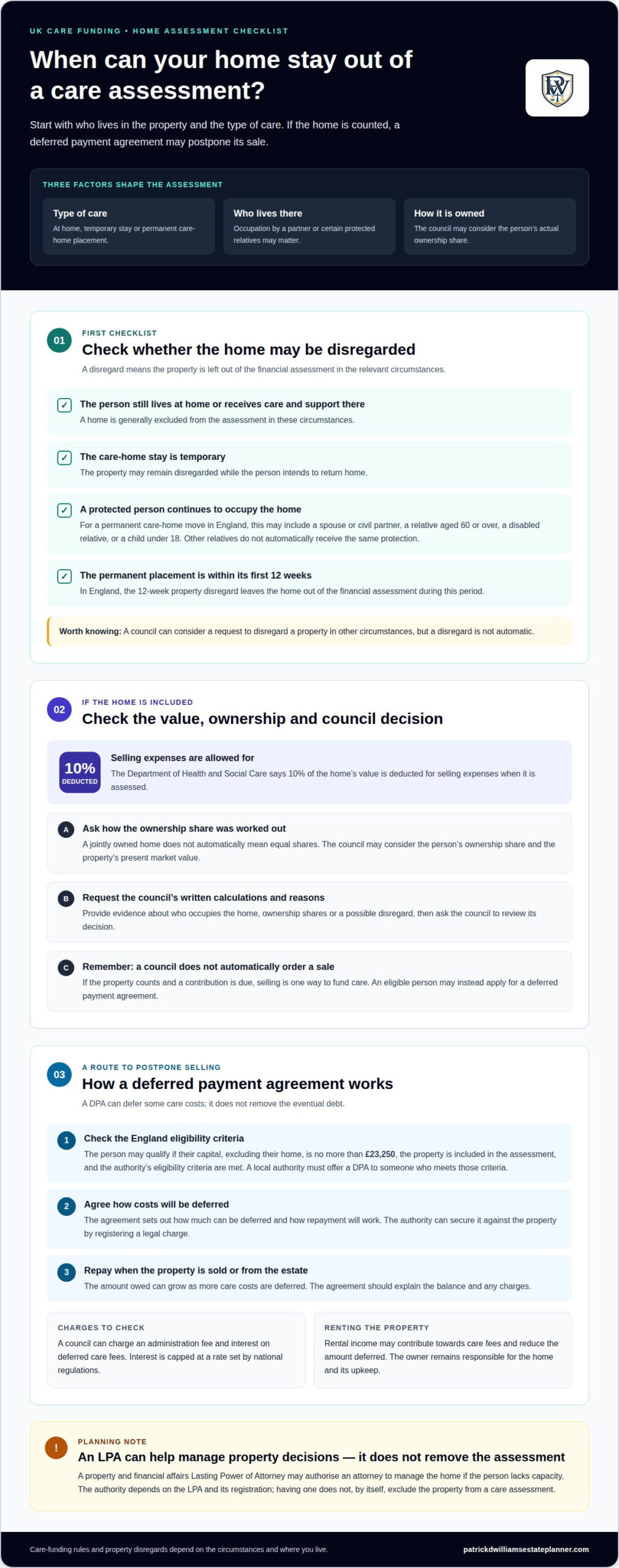
When valuing a home for a UK local council care financial assessment, the Department of Health and Social Care says 10% of its value is deducted for the expenses of selling it. The council may consider the property’s present market value and the person’s ownership share. A jointly owned home does not automatically mean equal shares.
A home is generally excluded when the person receiving care continues to live there or receives care and support at home. The property may also be disregarded during a temporary care-home stay. For a permanent move into residential care, the council considers whether a protected person continues to occupy the home.
In England, a home may be disregarded if the person’s partner, a relative aged 60 or over, a disabled relative, or a child under 18 lives there. A spouse or civil partner remaining at home is a particularly important circumstance. Other relatives don’t automatically have the same protection, although a council can consider a request to disregard a property in other circumstances.
For a permanent care-home placement in England, the 12-week property disregard means the home is left out of the financial assessment during the first 12 weeks. This gives families time to understand the assessment and consider funding arrangements. It is different from a temporary stay, where the home may remain disregarded while the person intends to return home.
Home care is commonly charged by the hour, while residential care fees cover a place in a care home. In England during 2025/26, Attendance Allowance was £73.90 a week at the lower rate and £110.40 at the higher rate.
A council doesn’t automatically order a house sale. If the property counts in the assessment and the person must contribute towards care fees, selling is one way to fund them. An eligible person may instead apply for a deferred payment agreement.
If a parent lacks capacity, a property and financial affairs Lasting Power of Attorney may authorise an attorney to manage their home and act for them. The attorney’s authority depends on the LPA and its registration. Having an LPA does not, by itself, remove the property from a care assessment.
To challenge an assessment, request the council’s written calculations and reasons for counting the property. Provide evidence about occupation, ownership shares or a possible disregard, then ask the council to review its decision. Independent legal advice can help families understand the assessment and their options.
2. What is a deferred payment agreement or DPA and how does it work?
A deferred payment agreement (DPA) lets an eligible person postpone selling their home to pay care-home fees. The local authority pays or defers some care costs, then recovers the amount when the property is sold or from the person’s estate after death. This can allow time to decide whether to sell, rent out the home or make another arrangement.
In England, a person may qualify if their capital, excluding their home, is no more than £23,250. The property must be included in the financial assessment, and the person must meet the authority’s eligibility criteria. A local authority must offer a DPA to someone who meets those criteria. The agreement sets out how much can be deferred and how repayment will work.
The authority can secure the agreement against the property by registering a legal charge. This protects the debt if the home is sold or ownership changes. As more care costs are deferred, the amount owed can grow, so the agreement should explain which charges apply and how the balance is calculated.
A council can charge an administration fee to set up a DPA and interest on deferred care fees. Interest is capped at a rate set by national regulations. These charges increase the amount eventually repaid, so understand how they accrue before agreeing to the arrangement.
Renting out the property can contribute towards care fees while a DPA is in place. Rental income may reduce the amount deferred, although the owner remains responsible for the home and its upkeep. Consider the practical work involved and how rental income is treated under the agreement before relying on rent.
Families can discuss a DPA with the local authority once the care assessment shows the home is included. Review the eligibility criteria, proposed security, charges, rental income arrangements and repayment terms. Keep copies of the assessment and agreement to track the authority’s calculations and the amount accumulating over time.
Care payment reform discussions do not themselves change the current DPA rules. In July 2026, Prime Minister Andy Burnham launched a Big Conversation on Care, and Baroness Louise Casey’s commission on a National Care Service is due to give final recommendations by summer 2027. Any future changes depend on what is proposed and adopted.
A lasting power of attorney can give an attorney legal authority to make decisions about someone’s home if they lack mental capacity. Families planning ahead can explore lasting powers of attorney as part of preparing for property and financial decisions.
3. Do I have to sell my home to pay for care?
Not always. Whether a home must be used to meet care costs depends on the financial assessment, where care is received and whether the property is disregarded. If a parent’s home is included as an asset, selling is one way to release funds, but an eligible person may be able to postpone a sale with a deferred payment agreement.
Giving away a home or other assets to reduce care costs can be treated as deliberate deprivation of assets. The local authority considers the circumstances and whether avoiding care charges was a significant reason for the transfer. If it decides the person deliberately gave assets away knowing care costs might arise, it can treat them as still owning those assets for the assessment.
There is no set period after which a gift is automatically safe. The seven-year inheritance tax rule does not prevent a local authority from investigating a transfer as possible deprivation of assets. There is no statutory time limit on how far back an authority can investigate a suspected deliberate transfer.
Gifting a home to children is therefore a risky way to try to protect it. A parent may lose control of the property or their right to live there. The home could also be exposed to a child’s divorce, bankruptcy or creditors. A transfer made for ordinary reasons is not automatically deliberate deprivation, but its timing, purpose and circumstances matter.
Care-fee capital thresholds differ across the UK, so the nation where care is received matters. In England, the financial assessment uses thresholds of £14,250 to £23,250. In Wales, the stated limits are £24,000 for care at home and £50,000 for residential care; a person in a care home with assessable capital above £50,000 is a self-funder.
Scotland’s stated assessment thresholds are £22,750 to £36,750. Northern Ireland’s are £14,250 to £23,250. These figures describe capital thresholds, not a guarantee that every person below them receives all care free. Income and the kind of support also affect a council’s assessment.
Before transferring assets, record the reason for the decision and consider its effect on ownership, housing security and future care funding. Distinguish inheritance planning from an attempt to avoid charges. If a parent has already made a gift, give the local authority accurate information about when and why. Concealing a transfer can complicate the assessment rather than protect the property.
Where the home is counted and available income or other capital cannot meet care costs, the council can require the person to contribute. This does not automatically mean an immediate sale: a deferred payment arrangement may provide time, subject to eligibility and the authority’s terms.
4. England’s savings and capital thresholds for care funding
In England, a local authority uses a means test to decide how much someone must contribute towards care. The assessment considers capital and income, not savings alone. Capital can include savings, investments and property. Income can include pensions and benefits the person is eligible for, even if they aren’t claiming them.
For 2025/26, the upper capital limit is £23,250. Someone with assessable capital above this amount isn’t entitled to local authority help with care costs and is likely to pay their fees in full. This threshold doesn’t mean every asset is counted. The council must apply the relevant disregards and consider what the person owns.
The lower capital limit for full state funding of care in England is £14,250 for 2025/26. Between £14,250 and £23,250, a person may qualify for some local authority help. They may still have to contribute from income, so support doesn’t necessarily mean care is entirely funded by the council.
These limits affect whether someone may need to use savings, investments or a home to pay for care. For example, a home included in the assessment can become relevant when other assessable capital and income cannot meet fees. A property disregard changes the calculation, so the home’s value shouldn’t be treated as automatically countable in every case.
Consider two examples from England. Mike and Louise have joint savings of £50,000, so they don’t qualify for financial help until their savings fall below £23,250. Robert has savings of £20,000 and qualifies for some help. The examples show why the upper limit matters, but a real assessment also considers income and which assets count.
Some benefits are excluded from a care financial assessment, including the mobility component of Disability Living Allowance or Personal Independence Payment. Other eligible benefits may be considered as income, even when the person hasn’t claimed them. The type of benefit matters, not simply whether money reaches the person’s account.
For a clearer picture, gather records of savings, investments, pension income, benefits and property ownership before reviewing the council’s assessment. Compare the listed assets and income with the stated thresholds, then identify any item that may be disregarded. Keep the council’s calculations and reasons for its decision together. Changes in capital or income may affect the contribution required.
The England thresholds are not UK-wide rules. Wales, Scotland and Northern Ireland use different capital limits, so the country where care is received determines which thresholds apply. Before deciding whether to sell a home, understand how the council has assessed the person’s capital, income and property.
5. Lifetime trusts and inheritance planning
Inheritance planning can clarify what happens to a home when one partner dies, but it doesn’t remove care-fee rules. A Property Protection Trust Will can place one half of a property in trust for children or other beneficiaries. The surviving partner can have a legal right to enjoy that share for life, while the trust records how it should pass later.
Ownership matters before a Will can deal with a property share. Joint tenants own the property together, and one owner’s share doesn’t pass under their Will in the same way as a separate share. Changing beneficial joint ownership to tenants in common allows each owner to deal with their share in their Will. This is a planning decision, not a guarantee against care costs.
For example, where a home is worth £200,000 when the first partner dies, the cited planning example places £100,000 in trust and ring-fences the other £100,000. That illustration describes the intended inheritance structure. It doesn’t mean the surviving partner’s own assets are excluded from a future means test, or that a local authority must disregard every trust asset.
A trust’s purpose and timing deserve careful thought. Giving away property or changing ownership to reduce care charges may lead a local authority to consider deliberate deprivation of assets. The authority can examine why the transfer happened and whether care costs were a significant reason. A trust should form part of broader estate planning, not be treated as a guarantee that care-home fees cannot affect the estate.
Before deciding, map the current ownership, any mortgage, each partner’s wishes and the intended beneficiaries. Consider what the surviving partner needs to continue living in the home, and how the chosen arrangement could affect control and future funding. A Will, Property Protection Trust, Discretionary Trust or Bare Trust has a distinct purpose; the right structure depends on the assets and the outcome sought.
Plan for inheritance and care funding together. Record who owns each share, who may benefit, and what happens if one partner dies or later needs residential care. Clear documents can reduce uncertainty for family members, but they don’t replace an accurate council assessment or change the applicable care-funding rules.
Patrick D Williams Estate Planners
Patrick D Williams Estate Planners helps families plan when care costs raise questions about a home, ownership or inheritance. Will Writing, Lasting Powers of Attorney and trusts can record who should manage property and how a share may pass to beneficiaries. These arrangements support planning, but don’t prevent a council from applying care-funding rules or guarantee that a home will be excluded from an assessment.
Consider discussing your circumstances if you’re reviewing a Will, planning for a partner’s future or want someone trusted to manage property decisions if you lose capacity. The right documents depend on your ownership arrangements, family wishes and wider plans. Contact Patrick D Williams Estate Planners to discuss your estate-planning needs.
Make your next decision with care
Planning how to avoid selling your house to pay for care in the UK is not only about protecting a property. It is also about making sure your wishes, family responsibilities and future decisions are clearly understood. A thoughtful estate plan can give relatives a clearer starting point when circumstances change, while keeping care funding decisions grounded in the rules that apply at the time.
Use what you have learned to identify which decisions need attention first. You might clarify how your property is owned, record who should act on your behalf, or review whether your estate-planning documents reflect your wishes. Taking these steps before a crisis can help family members understand your intentions and handle important matters.
For help considering your estate-planning options, arrange a conversation with Patrick D Williams Estate Planners. A clear plan can help you approach future decisions with greater confidence and keep your priorities in view.
Frequently Asked Questions
Do I have to sell my home to pay for care?
Whether a sale is needed depends on the person’s assessed resources and care arrangements. Before deciding, gather details of regular income, savings, investments, property ownership and expected care needs. This gives the family a clearer view of available funds and unanswered questions. If several relatives are involved, agree who will keep the records and speak on the person’s behalf.
What can I do to avoid selling my home?
Plan around the person’s circumstances rather than relying on a transfer of ownership to protect the property. Consider who may need authority to manage their property and finances if they lose capacity, and record their wishes in suitable estate-planning documents. A Lasting Power of Attorney can support decision-making, but it does not determine how a council assesses care funding.
Will my home have to be included in the financial assessment?
It depends on the person’s care arrangements, who occupies the property and the applicable rules. If the council includes the home, ask for its decision and reasons in writing. This gives you a clear record of the assessment and helps identify any relevant information about occupation or ownership that may not have been considered.
How will they calculate the value of my home?
The assessment should reflect the person’s actual interest in the property, rather than assume that joint owners hold equal shares. If the council’s calculation appears inconsistent with the ownership arrangements, provide documents showing how the home is held. Keep copies of the valuation and the council’s calculations so you can discuss the figures and ownership basis together.
What is a deferred payment agreement or DPA and how does it work?
A DPA’s written terms explain how the balance is tracked and repaid. Before agreeing, read how the authority treats rent from the property, which charges apply, and when repayment is due. Ask for the projected balance to be explained in plain terms. This helps the person and their family understand the future commitment, not just the immediate care arrangement.
Can I use equity release to pay for care without selling?
Equity release can provide money from a home without an immediate sale, but it is borrowing secured against the property. The loan can reduce the equity available to the owner or beneficiaries later. Consider how repayments and interest could affect the amount left in the estate, alongside the person’s care needs and other funding. The decision should fit the wider financial plan.
Can the government take your house to pay for care?
A care assessment is not the same as the government taking ownership of a home. The council assesses resources to determine a person’s contribution towards care; ownership does not simply transfer to the state. If a property is included in the assessment, the person may need a way to meet the assessed contribution. The council’s written decision explains how it has treated the property.
Does the 7-year rule apply to property?
No. The inheritance tax seven-year rule does not create a safe period for property transfers made in relation to care fees. If a transfer has already taken place, keep a clear record of its purpose and circumstances, including what changed in ownership and the reasons for the decision at the time. This context can help explain the transfer if the local authority asks about it.
Leave a Reply