

Giving a surviving partner full ownership may seem like the simplest way to provide security, but it can leave the eventual inheritance uncertain. A life interest trust offers another approach: it can give someone the right to live in a home or receive income during their lifetime, while directing what happens to the trust capital afterwards, subject to the terms of the will.
It’s understandable to want a partner to remain secure without losing sight of what you intend your children or other beneficiaries to inherit. In this arrangement, trustees manage the assets, the life tenant receives the benefit set out in the trust, and the remaindermen are usually entitled to what remains after the life tenant dies. The exact rights depend on how the trust is drafted.
This article explains how those rights and responsibilities work, then compares a life interest trust with leaving assets outright or using a discretionary trust. It also covers practical limits, administration and costs to consider, so you can assess whether the structure fits your family and your plans for your will.
Key Takeaways
- Understand the different roles of the life tenant, trustees and remainder beneficiaries before deciding how your will should provide for them.
- A life interest trust can set out who benefits during a lifetime and how the remaining assets are dealt with afterwards.
- Compare lifetime access, control of capital and trustee discretion when weighing a trust against an outright gift or discretionary arrangement.
- Balance a surviving partner’s practical needs with your intentions for the eventual beneficiaries, including how much flexibility trustees should have.
- Before drafting, identify the assets involved, choose trustees and consider whether property ownership affects what your will can leave.
What is a life interest trust, and who benefits from it?
A life interest trust separates the right to benefit from certain assets during a person’s lifetime from the destination of the trust capital afterwards. Usually created in a will, it takes effect after the will-maker’s death. The life tenant may be entitled to use an asset or receive income from it, but doesn’t automatically own the capital outright. The arrangement’s precise effect depends on the will and the assets involved.
A life interest trust gives a named beneficiary defined lifetime benefits from trust assets, whilst trustees administer those assets and the will directs who receives the remaining capital. The general concept of a Life interest also distinguishes the person with a present benefit from the person entitled to what remains.
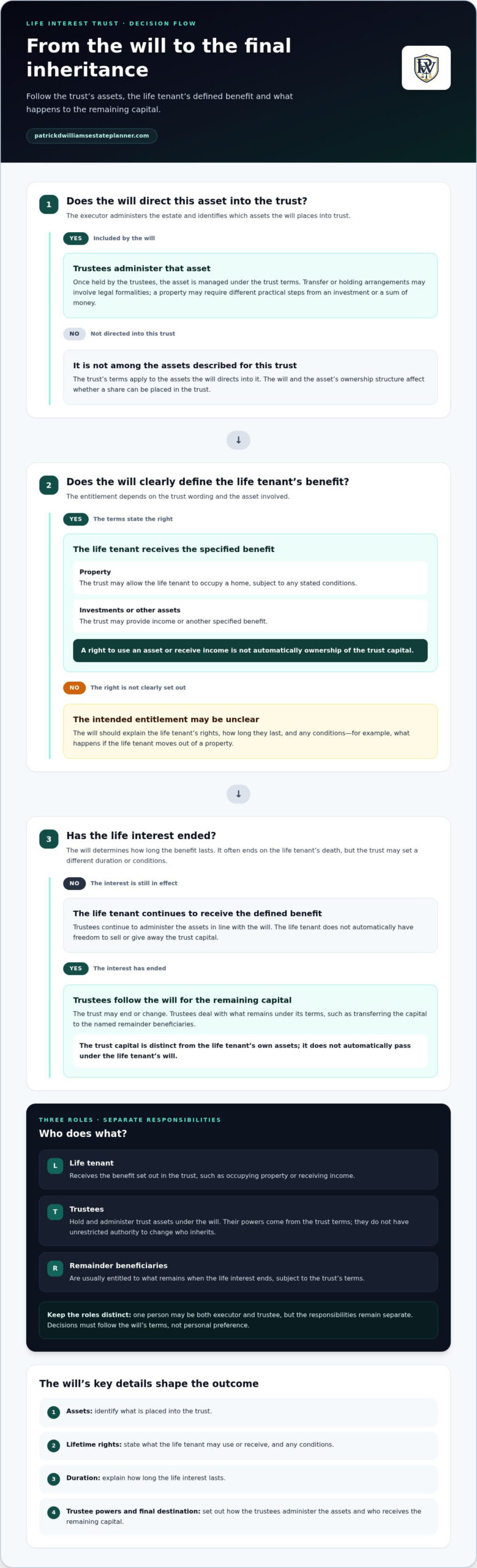
- Life tenant: the person entitled to the benefit set out in the trust, such as occupying a property or receiving income.
- Trustees: the people responsible for holding and administering the trust assets in accordance with the will.
- Remainder beneficiaries: the people named to receive the remaining trust capital when the life interest ends, subject to the trust’s terms.
The will should identify the assets placed into trust, the life tenant’s rights, how long those rights last and what powers trustees have. These details shape how the arrangement works. A right to live in a home is different from a right to receive investment income, and neither necessarily gives the life tenant freedom to sell or give away the trust capital.
What can the life tenant receive or use?
The trust wording may allow the life tenant to occupy a property, receive income from investments or benefit from specified assets in another way. The particular right depends on both the terms and the asset. For a property, check whether the will sets conditions about occupation or explains what happens if the life tenant moves out.
These are rights to benefit, not necessarily outright ownership. The life tenant generally can’t treat trust capital as their own simply because they can use an asset or receive its income. The will should make the extent of their entitlement clear, including any conditions that apply.
Who controls the trust assets after the first death?
After the will takes effect, trustees administer the assets placed in trust according to its provisions. Their role is to carry out the stated arrangements, including applying any relevant powers or conditions. The precise administration depends on the will, the asset type and applicable legal formalities.
Remainder beneficiaries are usually entitled to the capital when the life tenant’s interest ends, often on their death, though the trust may set a different duration or conditions. Trustees don’t have unrestricted authority to change who inherits: any discretion or other powers must come from the trust terms. Clear drafting helps the life tenant, trustees and eventual beneficiaries understand what is intended.
How does a life interest trust work from the will to the final inheritance?
A life interest trust follows a sequence set out in the will. After death, the executor administers the estate and identifies the assets that the will directs into trust. Once those assets are held by the trustees, the life tenant’s specified rights begin. When the interest ends, the trustees deal with the remaining assets under the trust terms.
The life tenant receives the benefit defined by the trust, whilst the remainder beneficiaries have an interest in what is left to pass on. The precise arrangements depend on the will, the type of asset and any legal formalities needed to transfer or hold it. A property, for example, may require different practical steps from an investment or a sum of money.
What happens when the will creates the trust?
The executor administers the estate under the will. The trustees administer the trust assets in line with the trust instrument and their relevant duties. One person may be appointed as both executor and trustee, but the responsibilities remain distinct. Decisions must follow the will’s terms, not personal preference.
Illustrative example: a will might direct the deceased’s share of a home into trust, allowing a surviving partner to occupy it under stated conditions. This is only one possible arrangement. The ownership structure and wording of the will affect whether and how a share can be placed into trust.
What changes when the life tenant dies?
The trust may end or change when the life tenant dies, depending on the will. The trustees then follow its instructions for the remaining assets, such as transferring them to named remainder beneficiaries. Those assets don’t automatically pass under the life tenant’s own will, because the life tenant’s rights and the trust capital are distinct. The trust terms determine the intended destination.
Administration can also involve practical and tax considerations. For example, HMRC explains relevant tax implications of a life interest trust for property income. The treatment depends on the trust and circumstances, so the will’s provisions should be drafted with the assets and intended benefits in view.
A carefully prepared will can clarify the executor’s and trustees’ roles, the life tenant’s rights and what happens to the capital afterwards. Considering these points as part of planning trust provisions in a will can help align the arrangement with your family’s circumstances.
Life interest trust compared with other ways to leave assets
The right structure depends on what you want a beneficiary to receive, how much control they should have over capital and who you intend to inherit afterwards. The comparison below highlights typical differences. The trust document and the assets involved determine the actual rights and responsibilities.
| Arrangement | Lifetime access | Control over capital | Trustee discretion and administration | Intended beneficiaries |
|---|---|---|---|---|
| Life interest trust | A named life tenant has specified rights, such as occupying a property or receiving income. | The life tenant’s benefit is distinct from outright ownership of the trust capital. | Trustees administer assets under the will; their powers depend on its terms. | The life tenant benefits first; named remainder beneficiaries may receive what remains later. |
| Outright inheritance | The recipient can generally use or benefit from assets they inherit. | They have broader control over assets they own, including decisions about their future use. | No ongoing trust administration is needed for assets inherited outright. | The recipient owns the inheritance and can decide what happens to it. |
| Discretionary trust | Potential beneficiaries may receive benefits if trustees decide to provide them. | Capital remains under the trust rather than belonging outright to a beneficiary. | Trustees decide how to exercise the discretion granted by the trust terms, with ongoing administration. | A group or class of beneficiaries may be considered, as defined by the trust. |
How does it differ from outright inheritance?
With an outright gift, the recipient generally has wider freedom to use, spend or pass on the assets they own. A life interest arrangement instead defines a lifetime benefit and can direct the remaining trust assets to chosen beneficiaries afterwards. This can help maintain the intended destination of capital, but it also limits the life tenant’s freedom to control or give away that capital.
How does it differ from a discretionary trust?
A life tenant usually has specific rights written into the trust, such as income or occupation. Under a discretionary trust, a potential beneficiary may have no fixed right to income or use of a particular asset; trustees decide whether and how to provide a benefit within the powers granted. The trust wording determines the actual entitlements and discretion in either arrangement.
No option is universally better. A family seeking a defined benefit for a surviving partner and a planned destination for capital may weigh a life interest trust differently from a family prioritising trustee flexibility. Administration and the nature of the assets also matter. A trust doesn’t automatically prevent assets being considered in a care-fee assessment or remove tax obligations. Outcomes depend on the circumstances and applicable rules.
Before choosing, consider how the will should identify the assets, set out the beneficiary’s rights and direct what happens to any remaining capital. Clear terms help trustees administer the arrangement and beneficiaries understand their respective interests.
When might a life interest trust suit a family, and what should be weighed?
A life interest trust may be worth considering when someone wants to provide for a partner during their lifetime whilst directing what happens to the remaining assets afterwards. It can be relevant in a blended family, for example, where a person hopes their surviving partner can continue living in a home and their children from an earlier relationship may inherit the remaining trust capital later.
That intention needs to be balanced against the survivor’s practical needs. Consider whether the proposed rights would provide enough security and flexibility if the survivor’s health, housing needs or financial circumstances change. A right to occupy a particular home may not meet their needs if they later need to move. Similarly, a plan to pass capital to named beneficiaries can limit the surviving partner’s ability to redirect those assets.
A trust can record your planning intentions, but it cannot guarantee a particular care-fee or tax outcome. Those outcomes depend on the trust’s terms, the assets and the individual circumstances, as well as the rules in force when the relevant assessment or tax position arises. Creating a trust does not automatically mean its assets will be disregarded for care-fee purposes or produce a tax advantage.
What family circumstances may make the structure worth considering?
The arrangement may suit a family that wants to balance two aims: supporting a surviving partner through occupation or income, and preserving a route for the remaining assets to pass to other beneficiaries. This could be relevant where children from an earlier relationship are intended to inherit later. It is not automatically suitable for every blended family, couple or household. The assets, relationships and survivor’s likely needs all matter.
For related context on planning around a home, read this property protection trust guide. It covers a related planning structure, but the right approach depends on the family’s objectives and the property arrangements involved.
What are the practical limitations and risks?
Trustees have continuing responsibilities to administer the trust in line with its terms. Depending on the assets and activity involved, this may mean keeping records, dealing with income or property matters, and making decisions within the powers granted. The life tenant may also have less control over the capital than someone who inherits assets outright. If expectations about occupation, income or later inheritance differ, those limits can become a source of family disagreement.
Careful will drafting can make the intended rights, trustee powers and destination of the remaining assets clearer. A considered review of your family circumstances can help shape those provisions. Will and trust planning can help you assess which arrangement may fit your aims.
How to plan a life interest trust in a will
Good planning starts with the family outcome, then works through the assets and wording needed to support it. A life interest trust should fit the circumstances of the people involved, not simply follow a standard formula.
- Define the objectives. Decide who needs support during their lifetime and who you intend to benefit from the remaining assets later.
- Identify the assets. Gather details of property, savings and other assets you may want the will to cover.
- Choose trustees. Consider who can take on the responsibility of administering the trust in line with its terms.
- Specify the rights. Set out the intended occupation, income or other benefits, alongside any trustee powers and conditions.
- Review the will. Check that the provisions reflect your wishes and fit with your ownership arrangements and wider estate plan.
Property ownership deserves particular attention. The way a home is legally owned can affect whether your will can direct your share into a trust. If the property is held as joint tenants, survivorship arrangements may affect what happens to the share when one owner dies. Severing a joint tenancy may be relevant to some plans, but it should be considered alongside the full circumstances and intended outcome. This property trust will guide offers related detail on planning for a family home.
What should the will explain clearly?
The will should identify the life tenant, trustees, remainder beneficiaries and assets covered. It should also state what the life tenant can do, including whether they may occupy a property or receive income, and how maintenance or other costs are handled. Trustee powers should be expressed clearly. Consider how the trust should operate if a beneficiary dies, circumstances change or an asset is sold, so the arrangements are not left open to avoidable uncertainty.
Family circumstances can change after a will is made. If you are considering how children’s inheritance may be affected by later relationships or decisions, read the sideways disinheritance guide for further context.
How can a family take the next planning step?
Before discussing the wording, gather property ownership details, your family priorities and any existing wills. Professional drafting can then align the trust provisions with the intended beneficiaries, rights and practical arrangements. A considered consultation can help you clarify those objectives and weigh options for your estate plan. Patrick D Williams Estate Planners offers a free 15-minute consultation, available by Zoom, Teams or in person.
Make your estate plan reflect your family’s priorities
A life interest trust can provide a defined benefit for someone during their lifetime while setting out who may receive the remaining assets later. Its suitability depends on the rights written into the trust, the assets involved and the balance between supporting a survivor and preserving an intended inheritance.
Compare this arrangement with an outright gift or discretionary trust, then consider the practical details: who will act as trustees, what the life tenant needs and how property ownership may affect your plans. Clear will drafting can help express those intentions, but a trust doesn’t guarantee a particular tax or care-fee outcome.
Patrick D Williams Estate Planners provides fixed-fee will-writing and bespoke trust-planning services shaped around individual family circumstances. A free 15-minute consultation is available by video call or in person to discuss your objectives and possible next steps.
Arrange a free 15-minute estate-planning consultation to discuss a plan that reflects your wishes.
Frequently Asked Questions
What is a life interest trust in a will?
A life interest trust is a will arrangement that gives someone, known as the life tenant, specified benefits from trust assets, while directing who may receive the remaining capital later. For example, the life tenant might be allowed to live in a property or receive income from investments. Trustees administer the assets under the will’s terms. The trust takes effect after death, and its wording defines the rights, assets and eventual beneficiaries.
Can a life interest trust protect a home from care fees?
A life interest trust does not automatically protect a home from being considered in a care-fee assessment. The outcome depends on the ownership and trust arrangements, the person’s circumstances and the rules applied at the relevant time. A trust may be part of wider estate planning, but it should not be treated as a guarantee of a particular assessment or financial result. Care-fee implications need to be considered on the facts of the individual case.
Does the life tenant own the assets in a life interest trust?
Not usually in the sense of owning the trust capital outright. The life tenant has the benefit defined by the trust, which may include occupying a property or receiving income, while trustees administer the assets under the will. The capital is held subject to the trust terms, which may direct it to remainder beneficiaries when the life interest ends. The life tenant’s precise rights depend on the wording and the assets involved.
Can trustees sell a property held in a life interest trust?
Trustees may be able to sell a property if the trust terms and their powers allow it, but a sale is not automatically within their authority. The will may set conditions or explain how the life tenant’s rights should be dealt with, including whether another property may be bought or proceeds held in trust. Trustees must follow the instrument and their relevant duties, rather than acting solely on personal preference. The exact terms matter.
What happens to a life interest trust when the life tenant dies?
When the life tenant dies, the trust usually ends or changes as directed by the will. Trustees then deal with the remaining trust assets according to its terms, often transferring them to named remainder beneficiaries. Those assets do not automatically pass under the life tenant’s own will, because the life tenant’s benefit is distinct from ownership of the trust capital. The will may also specify alternative beneficiaries or conditions that affect the final distribution.
Is a life interest trust better than a discretionary trust?
Neither arrangement is universally better. A life interest trust can give a named person defined rights, such as occupation or income, while directing where remaining capital should go. A discretionary trust gives trustees discretion over whether and how eligible beneficiaries benefit, subject to its terms. The right fit depends on the family’s priorities, the assets and the desired balance between certainty for a beneficiary and flexibility for trustees.
Can a life interest trust be changed after it is created?
It depends on when the trust is created and what its terms permit. Before death, a will-maker can generally review and amend their will, provided the relevant formalities are followed. Once the trust has taken effect, trustees cannot simply rewrite its terms because circumstances or preferences have changed. Any variation will depend on the trust wording and applicable law, so the available options should be assessed against the particular arrangement.
Leave a Reply