

Your wishes can guide trustees, but they should not become a second trust deed. When preparing a letter of wishes trust document, keep the distinction clear: the letter explains your intentions, while the trust deed sets out the legal terms and remains in control.
It can be difficult to decide what belongs in the letter or how to express personal guidance without accidentally creating legal terms. A letter of wishes is not legally binding, so trustees are not required to follow every request. It can, however, help them understand your priorities when making decisions within the powers set out in the deed.
This UK guide explains the letter’s role and limits, what you may wish to include, and how to use a template as a structured starting point. It also covers how to keep your wishes consistent with the trust deed and your Will, and when to review them as circumstances change. The aim is to help you record clear, practical guidance without confusing it with the formal documents that govern the trust.
Key Takeaways
- Use a letter of wishes trust document to explain your intentions and priorities in clear, personal language.
- Treat a template as a prompt for your own guidance, not a legally approved form that suits every trust.
- Understand how the trust deed, Will and letter of wishes each serve a different purpose in your estate plan.
- Organise your draft around the trust, your wishes and the reasons behind them, without trying to write legal terms.
- Review your letter alongside the trust deed and Will when family circumstances or intentions change.
What is a letter of wishes for a trust, and what is it for?
A letter of wishes is a written expression of intentions addressed to a trust’s trustees. It provides personal context and guidance about how you hope they will approach decisions, particularly where they have discretion. A letter of wishes trust document sits alongside the formal trust paperwork. It does not replace the trust deed or change its terms simply because it describes what you would prefer.
The letter can help trustees understand the thinking behind your plans. For example, you might explain why you hope funds will support a young beneficiary’s education, or describe family circumstances that could affect when financial help is appropriate. You can record the values and preferences you want trustees to consider, while recognising that their decisions must remain within the trust’s framework.
Letters of wishes are generally treated as guidance rather than legally binding instructions. Their precise legal effect can depend on the trust terms and circumstances, so a general template cannot settle a specific legal question. The Letter of Wishes Wikipedia article offers a broad introduction to the document’s customary purpose and non-binding character. Your own trust documents provide the relevant context.
How does a letter of wishes relate to a discretionary trust?
A discretionary trust deed sets out the formal framework, including the trustees’ powers and the terms they must work within. The letter can explain your reasons and preferences, helping trustees understand how you hoped they would use their discretion. It cannot give them powers the deed does not provide or require them to act contrary to its terms. For a fuller explanation of this trust structure, see the discretionary trusts guide.
Who writes the letter and who is it for?
Usually, the person creating the trust records their intentions for the trustees who will administer it. Trustees are generally the intended audience, although access and handling can depend on the trust documents and arrangements. Write for someone who may need to understand your reasoning later. Use direct explanations rather than legal-sounding commands or wording that appears to alter the deed.
The trust deed sets the formal terms; the letter explains the intentions behind them. Keeping that distinction clear makes your guidance useful without confusing personal preferences with legal powers. If the trust forms part of a wider estate plan, consider its terms and the letter alongside your Will so that the documents express a coherent intention.
What should a trust letter of wishes include?
A useful letter gives trustees relevant context, not a long account of every family detail. A template can help you organise your thoughts, but treat it as a prompt rather than a legally approved form or a document that suits every trust. The right content depends on the trust deed, the people involved and the decisions trustees may need to make.
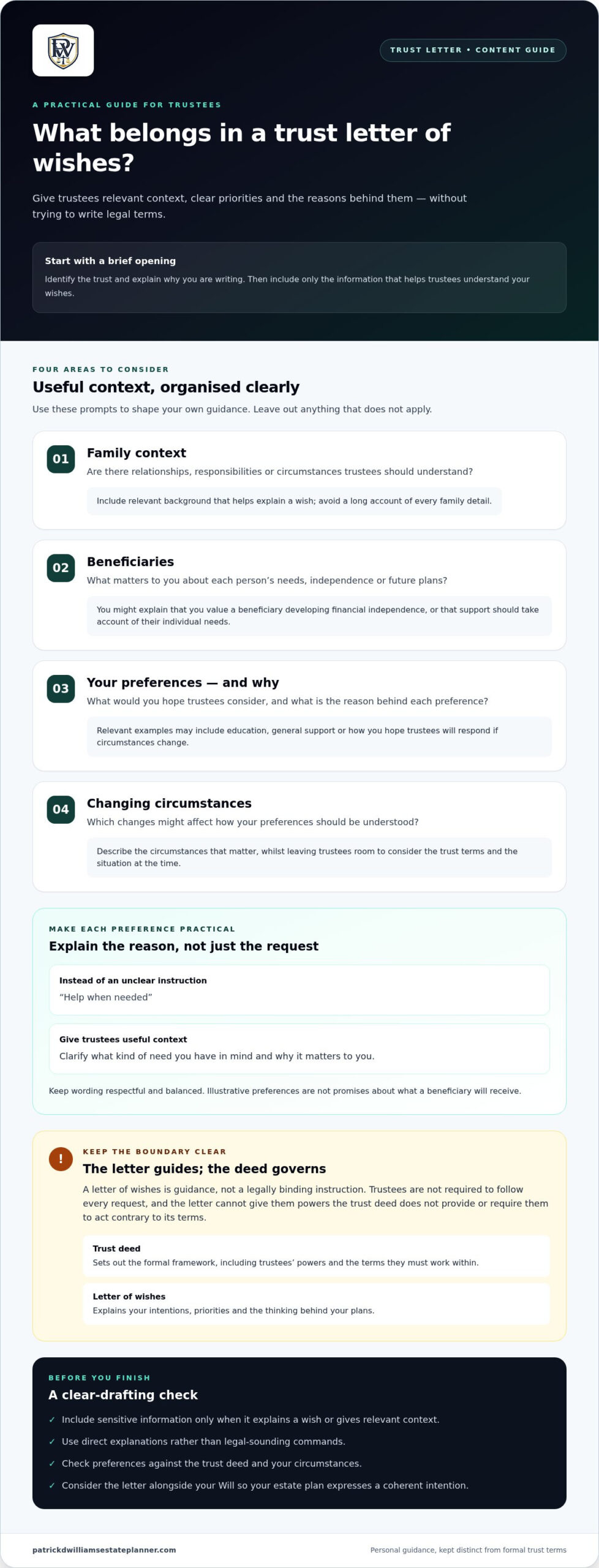
Start with a brief opening that identifies the trust and explains why you are writing. Then consider what information would help trustees understand your priorities and the reasons behind them. These prompts can help:
- Family context: Are there relationships, responsibilities or circumstances trustees should understand?
- Beneficiaries: What matters to you about each person’s needs, independence or future plans?
- Your preferences: What would you hope trustees consider, and why?
- Changing circumstances: Which changes might affect how your preferences should be understood?
Be selective. Include sensitive information only when it helps explain a wish or gives trustees relevant context. Unnecessary private details can distract from your purpose and may be difficult for others to handle appropriately. Keep the wording respectful, particularly when describing family members or explaining different preferences.
How to explain wishes about beneficiaries
Describe the priorities you hope trustees will consider, along with the circumstances behind them. For instance, you could explain that you value a beneficiary developing financial independence, or that support should take account of their individual needs. These are illustrative prompts, not promises about what a beneficiary will receive. Use balanced wording that leaves trustees room to consider the trust terms and the circumstances at the time.
How to set out practical preferences
Where relevant, you might mention education, general support or how you hope trustees will respond if circumstances change. Explain the reason behind each preference rather than writing an unclear instruction such as “help when needed”. You could clarify what kind of need you have in mind without attempting to set legal conditions or restrict the trustees’ powers. Check each example against the trust deed and your circumstances.
A letter of wishes trust template can help you capture these points in a measured way, but it should not lead you to include every suggested prompt. Leave out anything that does not apply. If you are unsure whether a preference fits the trust’s terms, pause before adding it rather than relying on wording that could be read as an instruction.
Clear drafting is easier when you consider the letter alongside the formal trust documents. If you are preparing or reviewing a discretionary trust, professional estate-planning support can help you express your intentions in plain language and align them with your wider plan.
Letter of wishes, trust deed and Will: what is the difference?
A letter of wishes, trust deed and Will can all form part of an estate plan, but they have different roles. The trust deed is the formal document that establishes the trust’s terms and powers. A Will sets out what should happen to your estate on death, subject to applicable law. A letter of wishes offers personal context and guidance. It should not be used to alter formal documents by implication.
| Document | Purpose | Status and role |
|---|---|---|
| Trust deed | Establishes the trust and sets out its terms and powers. | The formal framework trustees must work within. |
| Will | Sets out instructions for dealing with your estate after your death. | A formal legal document, subject to applicable law. |
| Letter of wishes | Explains your intentions, preferences or relevant family context. | Generally guidance for trustees, not a substitute for the deed or Will. |
These documents should be consistent, but they do not do the same work. For example, if you want to change who receives an asset under a Will, describing a different preference in a letter is not a reliable way to make that change. The formal document that governs the asset or arrangement needs to be reviewed and amended appropriately.
Is a letter of wishes legally binding on trustees?
Generally, a letter of wishes is guidance rather than a legally binding direction. The trust deed sets out the trustees’ powers and responsibilities, while the letter may explain the reasons behind your preferences. A request in the letter does not, by itself, give trustees a power absent from the deed. The effect of a particular letter, and how trustees should treat it, can depend on the trust terms and circumstances. Do not assume that trustees must follow every preference or can simply disregard the letter. Where the position matters, consider the documents together.
When might a bare trust need different guidance?
Trust structures differ. The discretion available to trustees under one arrangement may not apply in the same way under another, so guidance prepared for a discretionary trust may not fit a bare trust. The letter should reflect the specific trust and its terms, rather than relying on a generic template. A guide to bare trusts explains that separate structure and can help you see why the distinction matters.
For a letter of wishes trust to support your plan clearly, check that its wording expresses intentions without appearing to override the deed or Will. If the documents seem to point in different directions, review the formal arrangements rather than relying on an implied change in the letter.
How to draft a clear letter of wishes using a practical template
A structured draft can help you set out your intentions without trying to write legal terms. Use the prompts below as a starting point, not as a standard form suitable for every trust. Keep the letter focused on information that will help trustees understand your preferences, and use measured language that leaves the formal trust documents in control.
A section-by-section letter of wishes template
Work through these prompts in order. Add your own explanation where useful, and leave a prompt blank if it does not apply.
- Identify the trust and purpose. State the name or description of the trust, the date of the letter and why you are writing. For example: “I am writing to explain my current intentions for the trustees of [trust name].”
- Record relevant family context. Briefly note relationships, responsibilities or circumstances that may help trustees understand your thinking. Include only details that serve that purpose. Prompt: “The context I would like trustees to understand is [your explanation].”
- Set out your priorities. Explain what matters to you in relation to the beneficiaries, without assuming that every person’s needs will be the same. Prompt: “My main priorities are [your preferences], because [your reasons].”
- Explain practical preferences. Where appropriate, describe what you hope trustees will consider in relation to education, support or a change in someone’s circumstances. Prompt: “If [relevant circumstance] arises, I would hope trustees would consider [preference], because [reason].”
- Review the final draft. Read the letter as a trustee might. Check that your meaning is clear, the guidance is current and the document refers to the correct trust.
Be precise about the difference between a preference and a requirement. Phrases such as “I would like trustees to consider” or “I hope this context will assist” signal guidance more clearly than absolute wording such as “the trustees must”. A letter of wishes trust document should explain your reasoning, not appear to create new powers or impose conditions beyond the trust terms.
Review the wording before sharing it
Before treating the draft as complete, check it against the trust deed and your Will. Do not rely on the letter to change either formal document by implication. If you intend to change a legal term or instruction, the relevant document may need formal amendment rather than an added sentence in the letter.
- Replace vague phrases with a brief explanation of what you mean.
- Remove absolute wording if it could be mistaken for a direction or conflict with the deed.
- Take out preferences that no longer reflect your circumstances or intentions.
- Check names, relationships and references to the trust for accuracy.
A professional review can help you consider the wording alongside your trust deed and Will, especially where the documents cover related plans. You can arrange a review of your trust and Will planning to help ensure your written wishes sit coherently within your wider estate plan.
Keeping your trust letter relevant and aligned with your estate plan
A letter of wishes reflects your intentions at a particular point in time. If your family circumstances or priorities change, the guidance may no longer explain what you want trustees to understand. There is no single review schedule that suits everyone. Instead, revisit the letter when a meaningful change prompts you to reconsider its contents, and review it alongside the trust deed and Will rather than in isolation.
When should you revisit your letter of wishes?
A significant change in family circumstances, a beneficiary’s needs or your own intentions may be a reason to read the letter again. For example, your views about support may change as a beneficiary becomes an adult or their circumstances develop. A review lets you assess whether the existing explanation still reflects your thinking. It does not, by itself, amend the trust deed or Will.
Check that trustees can distinguish the current letter from any earlier version and that its wording remains consistent with the formal plan. Use these practical checks:
- Confirm that the letter identifies the relevant trust and reflects your current intentions.
- Look for references to family circumstances or preferences that have changed.
- Compare its guidance with the trust deed and Will, noting any apparent conflict.
- Keep track of which version is current, in keeping with the arrangements for the trust documents.
If your review reveals a change you want to make to the formal terms, do not rely on updated wording in the letter to achieve it. The trust deed or Will may need separate attention. Consider what the letter is intended to explain and whether a change belongs in a formal document instead.
Getting help to align your letter and trust documents
Considering the letter, trust deed and Will together can help identify whether they express a coherent plan. Bespoke Will writing and trust-establishment support can help you understand how these documents fit together while keeping personal guidance distinct from formal terms. This can be especially helpful if you are changing more than one part of your estate plan.
You can discuss how your wishes relate to your wider plans in a free 15-minute consultation. It is an optional first conversation, and you do not need to have every detail settled beforehand.
Arrange a free 15-minute consultation
Take the next step with confidence
Your estate plan should remain a considered expression of what matters to you, even as life changes. Treat your letter of wishes trust as part of a continuing plan, not a task to complete once and set aside. When you revisit your intentions, take time to decide what still feels right and whether the formal documents need attention too.
If you would value a measured conversation about how your wishes fit with your Will and trust arrangements, Patrick D Williams Estate Planners can help you consider the documents together through its Will writing and trust-establishment services. A free 15-minute consultation is available by Zoom, Teams or in person, with no pressure to make decisions before you are ready.
Arrange a free 15-minute consultation and take a calm first step towards an estate plan that reflects your intentions.
Frequently Asked Questions
Can I change a letter of wishes after writing it?
In many cases, you can prepare an updated letter of wishes trust document when your intentions change. Date the new version clearly and make it easy for trustees to distinguish it from earlier drafts. For example, if a beneficiary’s needs have changed, you may want to explain how that affects your current preferences. An updated letter does not automatically amend a trust deed or Will, so seek professional guidance if you are unsure about the documents or their legal effect.
Should trustees show a letter of wishes to beneficiaries?
There is no single answer that applies to every trust. Whether a beneficiary may see a letter can depend on the trust terms, circumstances and relevant legal duties. Avoid describing the letter as absolutely confidential unless that position has been properly established. Before including information you would prefer to remain private, consider who may eventually see the document and seek advice about any particular disclosure concern.
Can a letter of wishes be handwritten or kept electronically?
A handwritten or electronic format may be practical, but the right approach depends on the trust arrangements and the letter’s purpose. Make sure the intended trustees can identify and access the current version when it is relevant. Keep a dated copy, protect personal information and avoid leaving multiple versions that could cause uncertainty. Check whether any specific signing or format requirements apply before relying on a particular method.
Can I use a letter of wishes for a trust in Scotland or Northern Ireland?
This guide focuses on estate planning in England and Wales. Trust law and related procedures can differ elsewhere in the UK, so wording prepared for one jurisdiction may not suit another. If your trust, assets or circumstances involve another UK jurisdiction, get advice based on the relevant rules before using this guidance. This is particularly helpful where documents or family arrangements span more than one jurisdiction.
Should I name specific amounts for beneficiaries in my letter of wishes?
You can explain preferences involving financial support, but the wording should fit the trust deed. A precise amount might be misunderstood as a fixed requirement, particularly if it conflicts with the deed or does not allow for changed circumstances. Rather than setting out a figure without context, explain the need or purpose you hope trustees will consider. If you intend to include precise financial directions, have the wording reviewed against the trust terms.
Does a letter of wishes need to be sent to the trustees straight away?
The letter is intended to communicate your wishes to trustees, but how and when it should be shared depends on the trust arrangements and your circumstances. An unsent document may not be available to guide them when relevant. Check the trust documents and agree a suitable way to record and make the current version accessible. If you update the letter, make clear which version is current and ensure the previous one will not cause confusion.
Leave a Reply