

A meaningful legacy begins with clear, considered instructions, not complex structures. Yet the phrase “legacy wills” can mean different things, which makes it important to understand what a will can do and what belongs in a separate personal message.
A legal will can set out who should inherit your assets and include choices that reflect your priorities. A legacy letter, sometimes called an ethical will, can share your values, memories and hopes for loved ones, but it doesn’t replace legally binding instructions. Keeping that distinction clear can help prevent wishes from being misunderstood.
This article explains how to put your priorities into a will, which decisions deserve careful thought and how a will differs from trusts and other estate-planning documents. You’ll also learn when tailored professional guidance may help you decide whether a will alone can address your aims, or whether other arrangements should be considered as part of a wider estate plan.
Key Takeaways
- Use “legacy wills” as a starting point to consider both the instructions you want your will to give and the values you may wish to share separately.
- Before drafting, identify the people, assets and responsibilities that matter, then think through the reasons behind important choices.
- Compare the roles of a will, a trust and a lasting power of attorney to see which documents may be relevant to your circumstances.
- Prepare for drafting by clarifying your aims, gathering up-to-date information about assets and ownership, and noting questions for review.
- Consider professional will-writing support if your circumstances are complex or you need help checking how connected planning documents fit together.
What does a legacy will mean, and what can it put in writing?
“Legacy will” is commonly used as a descriptive phrase, not the name of a separate legal document type. In England and Wales, a will is a legal document that sets out instructions for what should happen to a person’s estate after their death. It can name executors to deal with the estate and state who should receive particular gifts or a share of what remains.
A legacy will is an ordinary will used to put post-death instructions into effect, alongside the personal values or intentions someone may choose to communicate separately. The phrase doesn’t give a will any additional legal status. A separate letter or ethical will can share family stories, beliefs and hopes. As the overview of Ethical will explains, this kind of personal writing passes on values rather than directing the distribution of property.
How can a will reflect your values and priorities?
Deciding who should benefit, and how, can express care and responsibility in practical terms. You might leave a specific item to someone who values it, provide for family members in different ways, or include a gift to a charity. A charitable gift can be written into a will, but the wording and any tax implications should be checked against your circumstances and current guidance.
Clarity matters. A binding gift belongs in the will and should identify the recipient and gift precisely. A personal letter can explain why you made that choice or share wishes that help loved ones understand your priorities, but it shouldn’t be relied on to change the legal instructions in the will. Keep the two documents consistent where possible, and make clear which contains the formal provisions.
What a legacy will cannot do on its own
Carefully drafted instructions can reduce ambiguity, but they can’t guarantee that family members will agree or prevent every dispute. Different interpretations, changing circumstances or questions about the estate may still create difficulty. Clear wording and thoughtful choices help, but they aren’t a promise of a particular outcome.
A will also deals with instructions that take effect after death. It doesn’t appoint someone to make decisions for you during your lifetime if you’re unable to make them yourself. A lasting power of attorney (LPA) is a separate arrangement for specified decisions about health and welfare, or property and financial affairs, while you’re alive.
Nor does a will, by itself, guarantee that assets are protected from tax, care fees or other claims. Its role is to record post-death instructions. Whether other planning documents may be appropriate depends on individual circumstances, so avoid assuming that one document can address every aim.
Which choices shape the legacy your will leaves behind?
Before drafting detailed wording, work through four practical areas: people, assets, responsibilities and reasons. This gives you a clearer picture of what you want your will to achieve, and helps distinguish essential instructions from thoughts better recorded elsewhere. For people considering legacy wills, the aim is not to include every personal detail. It is to make the important choices understandable and workable.
Choosing beneficiaries, gifts and executors
Start by listing the people or organisations you intend to benefit, then note what each should receive. This might be a particular possession for one person and a share of the remaining estate for another. Check that descriptions are precise enough to identify both the gift and its intended recipient.
Next, consider who could act as executor. Executors are responsible for administering the estate in line with the will, so think about whether your preferred person is willing and able to take on that practical responsibility. A planned UK Executor Guide can help explain the role. Review your choices after significant changes, such as a new relationship, a birth, a death or a change in what you own.
Family circumstances and ownership arrangements can affect how instructions work in practice. An asset may not pass in the way you expect if it is owned jointly or subject to other arrangements. If you’re unsure how an asset is held, or how a choice may affect family members, seek a tailored review rather than relying on wording alone.
Making personal wishes clear without overcomplicating the will
Keep the will focused on the instructions needed to administer your estate. Explanatory notes or a personal message can provide context, but shouldn’t be treated as a substitute for formal provisions. An ethical will is a separate, non-binding way to communicate values and beliefs; it can add personal meaning without making the legal instructions harder to follow.
Be specific about gifts and people, but don’t include account passwords, access codes or other sensitive information in a will that may be shared as part of estate administration. Keep private information secure and separate. If the wording feels difficult, ownership is uncertain or family relationships make a decision more complex, professional drafting can help turn your intentions into clear provisions.
For support with shaping instructions around your circumstances, consider professional will-writing guidance.
Does a legacy will need a trust or other estate-planning document?
Not necessarily. A will, a trust and a lasting power of attorney (LPA) address different needs, and a trust isn’t an automatic addition to a will. The word “legacy” can refer to a gift in a will or, more broadly, what someone hopes to pass on. Cornell Law School’s overview of the legal meaning of legacy offers general background on the term, rather than guidance on UK law.
| Document | Broad purpose | When it applies |
|---|---|---|
| Will | Sets out instructions for an estate, including who should inherit and who should administer it. | After death. |
| Trust | Sets out how specified assets are held or managed for beneficiaries under its terms. | Depending on the arrangement, during a person’s lifetime or after death. |
| Lasting power of attorney | Authorises chosen people to make specified decisions on someone’s behalf. | During the person’s lifetime, subject to the type of LPA and relevant requirements. |
A will, a trust and an LPA serve different purposes
A will provides instructions for after death. An LPA concerns decision-making during a person’s lifetime, so it doesn’t replace a will. Trusts operate under their own terms and may be relevant for particular planning aims. This comparison is general information, not advice on what documents you need. Rules and documents differ across England and Wales, Scotland and Northern Ireland, so check the arrangements that apply to your circumstances.
If you’re considering lifetime decision-making, consult guidance on LPAs in the relevant jurisdiction. A will and an LPA may both form part of a plan, but they address separate needs.
When might a reader ask about a trust?
A trust may be worth discussing if family circumstances, property ownership or a beneficiary’s needs raise questions about how assets should be managed or passed on. You might, for example, want to understand how a particular share of property could be dealt with. These are reasons to explore the options, not a presumption that a trust is required.
A trust doesn’t automatically save tax, avoid care fees or guarantee asset protection. Its effects depend on the arrangement and individual circumstances. Legacy wills may sit alongside trusts or other planning documents, but the right combination varies. A focused explanation of Property Protection Trust Wills can help you understand that option before seeking advice about whether it fits your aims.
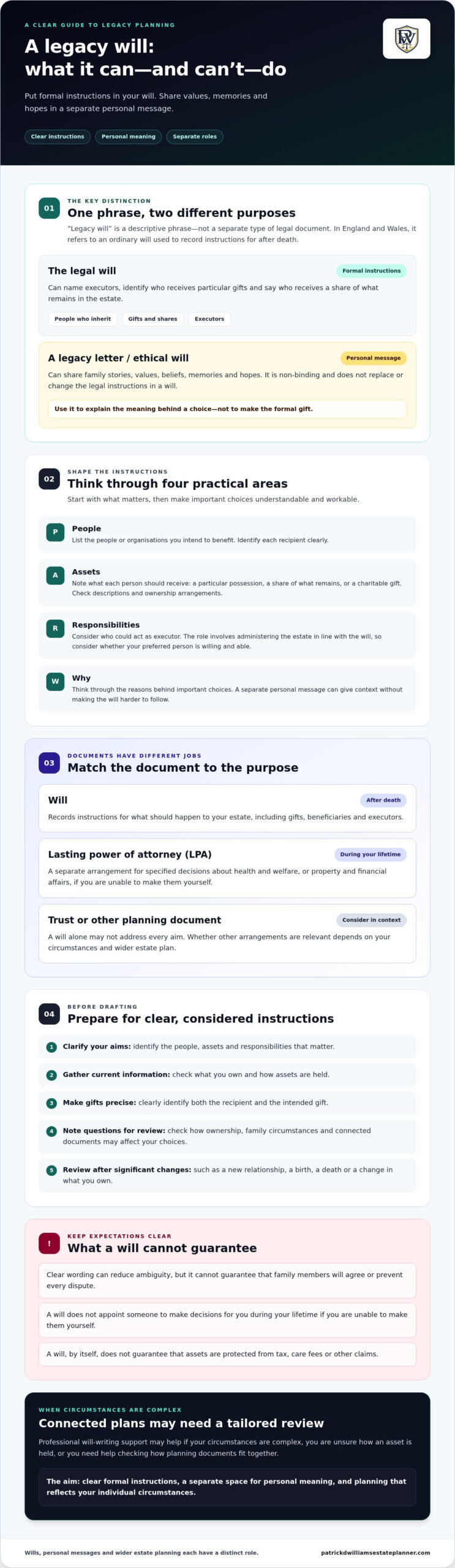
How to prepare clear instructions for a legacy will
Good preparation can make it easier to explain what matters to you and identify where professional drafting advice is needed. You don’t need to settle every legal detail before starting. Use this sequence to organise your thoughts and questions.
- Clarify your aims. Note who you want to benefit, what you hope each person or organisation will receive, and any responsibilities you want the will to address.
- Gather relevant information. Make a current overview of significant assets, how they are owned, and any beneficiary arrangements you know about. You can discuss the information without sharing account passwords or access codes.
- Record uncertainties. List questions about ownership, gifts, family circumstances or existing documents. Don’t guess at the legal effect of an arrangement; flag it for a qualified will-writing professional to review.
- Arrange a review. Discuss your aims and information with a professional who can help assess how they may be expressed clearly in the will.
Organised information helps a will writer turn your priorities into clearer, more practical instructions.
Information to organise before discussing your wishes
Prepare notes on your family circumstances, intended beneficiaries, possible executors and significant gifts. If you own property, find out what records you have about its ownership and gather relevant documents for discussion. You don’t need to include private financial details in general notes or an online enquiry.
Keep personal records secure and share them only through appropriate channels. A short list of questions can be more useful than trying to draft legal wording yourself. Legacy wills should express your intentions, but the instructions need to work alongside your actual circumstances and ownership arrangements.
Reviewing and updating a will as life changes
A marriage, separation, the arrival of a child, a death in the family or a substantial change in what you own may be a reason to review your instructions. Don’t assume that an existing will still has the effect you intend after a major life change. The legal consequences can depend on your circumstances and jurisdiction, so check them before relying on an assumption.
Review any connected documents at the same time, and note what has changed since the will was prepared. For support with the drafting process, you can discuss fixed-fee will-writing support and how your priorities may be set out clearly.
How professional will-writing support can make your legacy clearer
Professional drafting may be useful when your circumstances make it difficult to turn intentions into clear instructions. This could include having a blended family, owning property jointly, wanting to make different kinds of gifts, or needing to consider a trust alongside your will. A professional can help identify questions to resolve and review how your will relates to connected documents. The aim is to make your choices clear, not to assume that one arrangement suits everyone.
What to expect when discussing a will with a professional
A structured discussion can cover your wishes, family circumstances, assets, intended beneficiaries and the questions you’ve noted. This gives the will writer the context needed to draft provisions that reflect your priorities. Patrick D Williams Estate Planners provides fixed-fee will-writing services, so the service is arranged on a fixed-fee basis rather than described with an unspecified hourly rate. No specific price is stated here.
The firm’s stated service includes preparing will documents and guidance on signing and witnessing them. These steps matter because a document must meet the applicable legal formalities to operate as intended. The details can depend on jurisdiction, so confirm which requirements apply to your circumstances. An initial conversation can help clarify the issues to consider, but it doesn’t guarantee a particular legal outcome.
Legacy wills can involve both formal instructions and personal intentions. A professional discussion can help separate provisions that belong in the will from background notes or messages, and consider whether a trust or another planning document may be relevant. Any review should be tailored to your circumstances rather than treated as a standard package of documents.
A considered next step for your family’s plans
Before speaking with a will writer, note what you want your will to achieve and prepare questions about beneficiaries, gifts, executors, property ownership or existing documents. You don’t need to have every answer. A clear list of uncertainties can help make the discussion focused and useful.
Patrick D Williams Estate Planners offers a free 15-minute consultation, with meetings available by Zoom, Teams or in person. It can be an opportunity to outline your aims and explore whether a will alone may address them, or whether a trust or other arrangement should also be considered. The conversation is a measured first step, not a commitment to a particular structure.
Arrange a free 15-minute consultation to discuss your family’s plans and the support that may suit your needs.
Put your wishes into clear, considered instructions
Legacy wills are about more than distributing belongings. Thoughtful planning helps you decide who should benefit, choose suitable executors and make your intentions easier for loved ones to understand. A separate personal message can explain the values behind your choices, while a will records the formal instructions.
A will may be one part of a wider plan. Trusts and lasting powers of attorney serve different purposes, so consider your circumstances before deciding whether other documents may be relevant. Gathering your questions and information about assets and ownership can help make that discussion more focused.
Patrick D Williams Estate Planners provides fixed-fee professional will-writing services and offers a free 15-minute consultation by Zoom, Teams or in person. Use the conversation to explore your aims and whether a will, trust or other arrangement may be suitable. There’s no need to have every detail settled before you begin.
Arrange a free 15-minute consultation and take a considered next step towards instructions that reflect what matters to you.
Frequently Asked Questions
What is a legacy will?
“Legacy will” is usually a descriptive phrase, not a separate legal document type. It generally means a will that records instructions for dealing with someone’s estate after death, reflecting their choices about beneficiaries, gifts and executors. People may also use “legacy will” to refer to a personal letter or ethical will, which can share values and memories but doesn’t replace legally effective instructions in a will.
Can a will include a gift to charity?
Yes, a will can include a gift to a charity. You can specify a sum, an item or a share of your estate, but the recipient and gift should be described clearly so your executors can identify them. If you’re considering a charitable gift, check the wording and any possible tax implications against your circumstances and current guidance. A will-writing professional can help you record the instruction appropriately.
Do I need a trust as well as a will?
No, a trust isn’t automatically needed alongside a will. A will sets out instructions for your estate after death, while a trust is a separate arrangement for holding or managing assets under its terms. Whether one may be relevant depends on matters such as your family circumstances, property ownership and beneficiaries’ needs. Consider tailored advice before deciding, and don’t assume a trust guarantees tax savings or protection from care fees.
Can a will explain why I have made particular decisions?
A will can include formal instructions, but explanations or personal messages may be clearer in a separate letter. For example, you could explain why you left a particular possession to one person or share a family memory. A letter can offer context, but it shouldn’t be relied on to change the legal instructions in the will. Keep any personal message consistent with the will and make clear which document contains the formal provisions.
When should I review my will?
Review your will after important changes, such as marriage, separation, a new child, a death in the family or a change in your assets or property ownership. These events may affect whether your instructions still reflect your intentions, and their legal consequences can depend on your circumstances and where you live. Don’t rely on assumptions about whether a change has altered your will. Seek advice if you’re uncertain.
Does a will cover decisions if I lose mental capacity?
No. A will sets out instructions that apply after death; it doesn’t appoint someone to make decisions for you during your lifetime if you lose mental capacity. A lasting power of attorney (LPA) is a separate arrangement for specified decisions about health and welfare, or property and financial affairs. The rules and documents differ across the UK, so check which LPA arrangements apply in your jurisdiction.
Are will rules the same throughout the UK?
No. The UK has distinct legal jurisdictions: England and Wales, Scotland, and Northern Ireland. Rules concerning wills and related planning can differ between them, so information that applies in one jurisdiction may not apply in another. If you live in one part of the UK, own property in another or have connections across jurisdictions, ask a suitably qualified professional to check which rules affect your circumstances before relying on general guidance.
Leave a Reply