
A joint account usually passes to the surviving holder without a grant, even when there’s no will. If you’re asking what happens to a joint bank account when one person dies without a will, the key issue is how the account is held: with a standard joint tenancy, the surviving named holder usually keeps access and becomes the sole owner.
It’s understandable to assume the money forms part of the deceased person’s estate. In practice, access to the account and the question of who ultimately owns the money can be separate matters, especially if the holders contributed different amounts or arranged ownership differently.
This article explains who can access the funds, how the account arrangement and contributions may affect ownership, and when a grant of administration may be needed. It also explains what to expect from the bank and how planning ahead can make your wishes clearer for those handling your affairs.
Key Takeaways
- A surviving named holder can usually continue to access a standard joint account, but access does not always settle who beneficially owns the money.
- The account’s legal arrangement and who contributed the funds can affect whether any share is treated as part of the deceased person’s estate.
- With a standard joint tenancy, the funds usually pass to the surviving holder without a grant, whether or not there was a will.
- A grant may be needed when the deceased’s share does not pass automatically, and the bank’s process also matters.
- Will writing and joint tenancy severance can help clarify how assets are intended to pass and support future estate planning.
Does a Joint Account Form Part of the Estate?
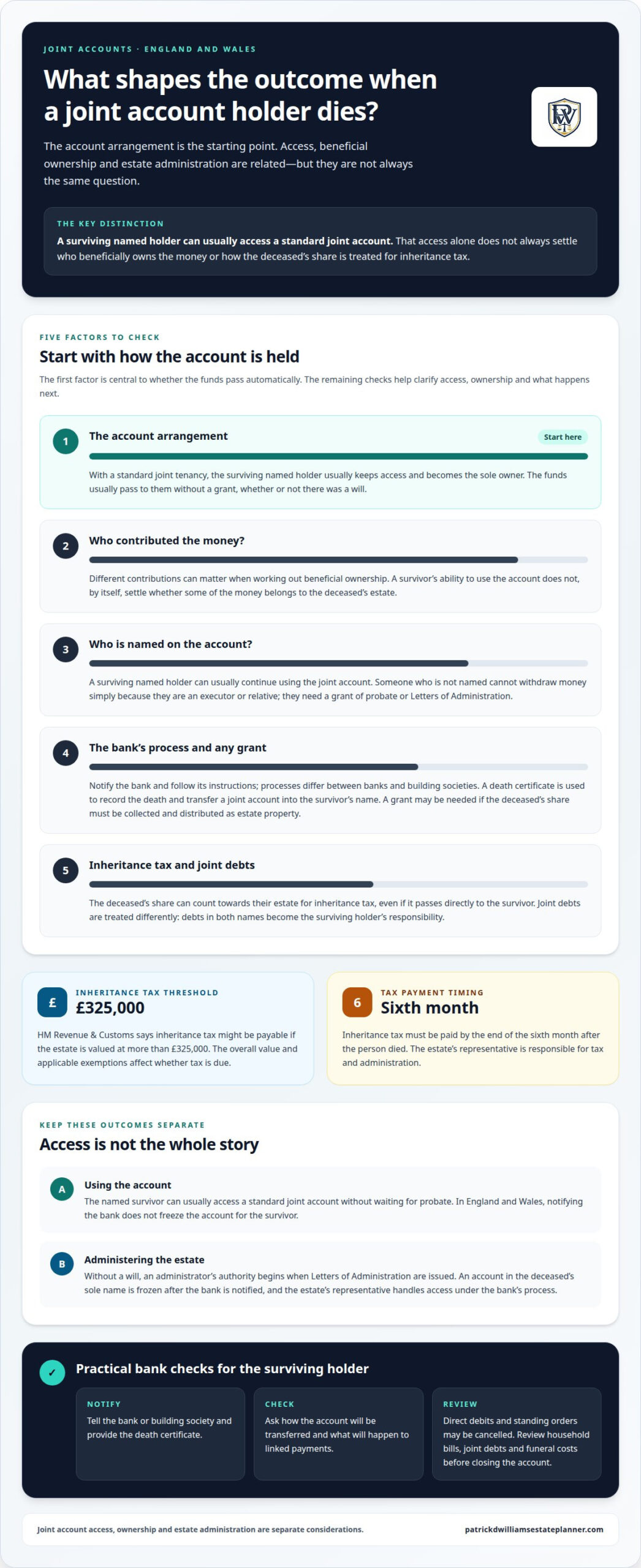
Estate property is dealt with by a personal representative, but money in a joint account may pass outside probate. For UK inheritance tax, the deceased’s share can still count towards their estate, even when the surviving holder receives the funds directly.
Estate Property After Death
An estate is the property and money a person leaves when they die, considered together for administration and distribution. In England and Wales, an executor named in a will, or an administrator when there is no will, handles the estate. This distinction matters because an executor’s authority comes from the will, while an administrator’s authority comes from a grant of Letters of Administration.
Inheritance Tax on Joint Account Funds
The deceased’s share of a joint account counts as part of their estate for inheritance tax, even if the money bypasses probate. A transfer to a surviving spouse or civil partner is covered by the spousal exemption. If the other holder is not a spouse or civil partner, the deceased’s share may form part of the taxable estate.
According to HM Revenue & Customs, inheritance tax might be payable if the estate is valued at more than £325,000. This is not a tax-free amount for every estate: the overall value and applicable exemptions affect whether tax is due. The deceased’s share of a joint account must therefore be considered alongside other estate property, rather than treated as separate simply because the account has another name on it.
Without a will, no administrator is appointed immediately after someone dies. A person entitled to administer the estate can apply for Letters of Administration, and their authority begins when the grant is issued. In England and Wales, a spouse or civil partner normally ranks ahead of adult children. The administrator then deals with estate property under the intestacy rules.
A small estate may not require a grant of probate. Whether a grant is needed depends on the estate and the relevant institution’s process. A joint account that passes automatically to the surviving holder may not need probate for that transfer, though a grant may be needed if the deceased’s share must be collected and distributed as estate property. This is why access to the account and responsibility for administering the estate are separate matters.
According to HM Revenue & Customs, inheritance tax must be paid by the end of the sixth month after the person died. The estate’s representative is responsible for dealing with tax and administration, even where some funds pass directly to a surviving account holder. Legal advice can help clarify how the account arrangement, beneficial ownership and wider estate affect the next steps.
What Happens to a Joint Account When Someone Dies?
A surviving named holder can usually continue using a UK joint account after the other holder dies. They should notify the bank before arranging to close or transfer it.
What Happens to Joint Account Funds
With a standard joint account, the surviving holder usually retains access, and the bank can transfer the account into their name. This differs from an account in one person’s name, where the money is dealt with as part of the estate. The distinction matters because access to joint funds does not by itself settle their inheritance tax treatment.
Joint debts are treated differently from the account balance: debts held in both names become the surviving holder’s responsibility. In rare cases involving an insolvent estate, creditors may seek recovery from the deceased’s share through an Insolvency Administration Order. The deceased’s share can also matter for inheritance tax, even if the survivor can use the account.
Access to a Joint Account
A named surviving holder can usually use a joint account without waiting for probate. In England and Wales, notifying the bank of the death does not freeze the account for the survivor. The bank can update the account details, using the death certificate to transfer it into the surviving holder’s name.
Someone whose name is not on the joint account cannot withdraw money simply because they are an executor or relative. They need a grant of probate or Letters of Administration before withdrawing from the account. For an account in the deceased’s sole name, the bank freezes it after notification, and the estate’s representative handles access under the bank’s process.
Documents for Notifying the Bank
The death certificate is the key document for notifying a UK bank and transferring a joint account into the survivor’s name. The bank records the account holder’s death before changing the account details. The certificate also matters when seeking access to accounts held solely by the deceased.
Each bank or building society has its own process for handling a death. The surviving holder should provide the deceased account holder’s details and the account information, then follow the bank’s instructions for submitting the certificate. This keeps the notification and any transfer request together.
Steps for the Surviving Account Holder
First, notify the bank or building society and provide the death certificate. Then ask how it will transfer the account into the survivor’s name and handle linked payments. Direct debits and standing orders may be cancelled, so review household bills and arrange replacements where needed.
Before closing the account, consider regular payments, joint debts and funeral costs. Funds from a deceased person’s account can be used to pay a funeral invoice before probate is granted when probate is required to close it. If you are considering how jointly held assets should be arranged for the future, joint tenancy severance is one planning option.
How contributions affect beneficial ownership
A joint account can give both named holders access, but that does not always mean they beneficially own equal shares. For inheritance tax, the deceased’s share should not automatically be treated as 50/50. Where siblings or friends share an account, the amount included in the deceased’s estate is based on who deposited the funds.
This distinction matters if one holder paid money into the account while the other mainly used it for payments. For example, if a parent adds savings to an account shared with an adult child, the names on the account alone do not establish how much each person beneficially owned. The source of the funds can help establish the deceased’s share.
Family members or beneficiaries may dispute whether the surviving holder beneficially owned all the money. The central issue is evidence of ownership, including who paid funds into the account and how the money was treated. A disagreement about that evidence may require advice from a solicitor.
When administering an estate, the executor or administrator considers which property belongs to it. Bank statements and transfer records can help show where deposits came from. For instance, regular payments from one holder’s account can help distinguish that person’s contributions from money paid in by the other holder.
How the account works in practice is not the only consideration. A surviving holder may have authority to access it, while the deceased’s beneficial share may still matter for inheritance tax. This distinction can be important when the survivor withdraws funds or beneficiaries ask how the estate has been valued.
The deceased’s beneficial share in a joint account may depend on the circumstances, so the account holders’ names alone may not settle it. That example should not be applied automatically to every account. The relationship between holders and the source of deposits matter, especially where siblings or friends have paid different amounts into the account.
Banks and building societies record account holders and transactions, but those records alone may not explain each person’s beneficial interest. If an executor is dealing with a disputed balance, transaction history can help clarify contributions and payment patterns. It can be important to consider whether any of the money belonged beneficially to the deceased, rather than assuming the survivor owned it all because their name remains on the account.
Joint tenancy and tenants in common
Whether money passes automatically depends on how the account is held. Under a standard joint tenancy, the surviving holder automatically becomes the sole owner, whether or not the deceased left a will.
What Happens to the Deceased’s Share
A joint tenancy includes a right of survivorship: when one holder dies, the account passes to the other holder. In England and Wales, a standard joint-tenancy account passes to the survivor without going through probate. The account arrangement, not whether the deceased made a will, determines whether this automatic transfer applies.
Tenants in common work differently. Each holder has a distinct share, and the deceased’s share does not pass automatically to the surviving account holder. It is dealt with under the deceased’s will or, if there is no will, the intestacy rules. A grant may be needed to distribute that share as part of the estate.
The account agreement or another relevant document can help establish how the holders arranged ownership. Account holders can ask their bank or building society about the account terms. This matters because seeing both names on a statement does not, by itself, confirm that the right of survivorship applies.
For example, if two people hold an account as joint tenants, the survivor becomes its sole owner when the other dies. If they hold it as tenants in common, the deceased’s share is dealt with through the estate instead. The distinction affects who receives the money and whether estate administration is needed.
Unmarried Holders and Civil Partners
Being unmarried does not, by itself, prevent a surviving joint tenant from receiving the account under the right of survivorship. The same rule applies whether the holders are partners, friends or relatives. The account’s ownership arrangement, rather than the relationship between the holders, is central.
Inheritance tax is a separate matter. A transfer from a deceased spouse or civil partner to the survivor is covered by the spousal exemption. If the surviving holder is an unmarried partner, friend or relative, the deceased’s share may form part of the estate for inheritance tax purposes. Automatic transfer of access or ownership does not remove this tax consideration.
If unmarried holders own an account as tenants in common, the deceased’s share is dealt with under their will or the intestacy rules, rather than passing automatically to their partner. The surviving holder’s share remains separate from the deceased’s estate share. The survivor may have access to the account while the administrator handles the deceased’s interest.
Before relying on survivorship, check whether the relevant account document identifies the arrangement as a joint tenancy or tenancy in common. A bank or building society can explain how the account is held. This helps the surviving holder, family and estate administrator understand whether the funds pass directly or require estate administration.
Whether a grant is needed for a joint bank account
Understanding what happens to a joint bank account when one person dies without a will involves more than the joint balance. A grant is formal evidence of authority to deal with estate assets, and whether it is needed may depend on other accounts and property the deceased held. The treatment of the joint account does not, by itself, determine whether the wider estate needs a grant.
For example, a surviving holder may be able to continue using a joint account, while a separate account in the deceased’s sole name requires the estate representative to provide a grant. Each institution has its own process and limits. A grant may be needed because of the assets that must be collected, rather than the balance or arrangement of one joint account alone.
It helps to consider the estate asset by asset. A representative can list accounts held jointly and solely, then find out which institutions require a grant before releasing money. If one institution accepts other evidence but another requires formal authority, the estate may still need a grant to complete its administration. A grant can therefore be relevant even when the joint account itself passes outside the estate.
A grant also supports the orderly handling of estate funds. Once authorised, the representative can gather assets that form part of the estate, meet liabilities and distribute what remains under the applicable rules. Clear records of balances, payments and documents help distinguish estate transactions from the survivor’s use of a joint account.
In some cases, funds in the deceased’s account can be used to pay inheritance tax before a grant is issued, where probate is required to close the account. This can matter when the estate must settle tax before the account can be fully dealt with. The representative should keep evidence of any payment and record it in the estate accounts.
So, the practical question is not simply whether a joint account needs probate. Consider which assets require formal authority, what each institution requires, and whether the representative must collect other estate property. This broader view helps explain what happens to a joint bank account when one person dies without a will, without assuming the joint account determines whether the entire estate needs a grant.
Planning how jointly held assets should pass can clarify your intentions. Consider joint tenancy severance as part of that planning.
Patrick D Williams Estate Planners: Will Writing
Patrick D Williams Estate Planners can help you put your wishes in writing and consider how jointly held assets fit into your wider estate plan. A will records how your estate should be distributed, while joint tenancy severance may be relevant if you want to change how a jointly owned asset passes after death.
Planning can also include Lasting Powers of Attorney for decisions during your lifetime and, where appropriate, a Property Protection Trust. The right arrangements depend on your assets, relationships and intentions. Considering these matters together can help clarify your wishes for the people who may need to administer your estate.
Contact Patrick D Williams Estate Planners to discuss Will Writing and your estate planning needs.
Make your wishes clear for the future
Understanding what happens to a joint bank account when one person dies without a will can prompt a wider conversation about how you want your affairs handled. Use that opportunity to consider whether your arrangements reflect your intentions, including how jointly held assets should pass and who may need to manage your estate.
A clear plan gives those close to you a helpful starting point when they need to make decisions. Will Writing can record your wishes, while Lasting Powers of Attorney and trust planning may address other parts of your arrangements. The right choices depend on your circumstances and what you want to achieve.
Patrick D Williams Estate Planners can help you consider these estate planning matters. Contact Patrick D Williams Estate Planners to discuss the next step for your plans. A considered conversation can help you move forward with greater clarity.
Frequently Asked Questions
Can I take money out of a joint account after death?
If you’re a named surviving holder, you can usually continue using the joint account. Before withdrawing money, consider whether some funds may represent the deceased’s beneficial share, particularly if you contributed different amounts. Keep records of withdrawals and account activity, especially if you’re also helping administer the estate. If you’re not named on the account, being a relative or beneficiary alone does not give you authority to withdraw money.
Can next of kin withdraw money from a deceased person’s bank account?
No. Next of kin cannot withdraw from an account solely because of their family relationship. Someone not named on a joint account needs a grant of probate before withdrawing from it. If there is no will, an eligible person can apply for Letters of Administration and gains authority when the grant is issued. For an account held solely by the deceased, the bank’s release process and limits also affect access.
How long does it usually take the bank to process the documentation?
There is no single processing time that applies to every bank and account. If you notify participating financial institutions through the UK Death Notification Service, each will contact the notifier within 10 working days to explain its next steps. That period is for a response, not a promise that an account transfer or estate payment will be completed within that time. The bank’s process and the documents needed affect what follows.
What happens to a joint bank account when one account holder dies in the UK?
A surviving named holder can usually continue accessing a standard joint account, and the bank can transfer it into their name. Tell the bank about the death before arranging to close the account. If household bills are paid from it, check which payments will continue and which may be cancelled. Access to the balance does not automatically establish who beneficially owned each contribution.
How do joint bank accounts differ between joint tenants and tenants in common in the UK?
With a standard joint tenancy, the right of survivorship means the surviving holder automatically becomes sole owner. With tenants in common, the deceased’s share does not pass automatically to the survivor; it is dealt with under the will or intestacy rules. The account arrangement affects whether the survivor receives the whole balance directly or the deceased’s share must be handled through the estate.
Can a bank freeze or restrict a joint account after one account holder dies?
A joint account is not usually frozen for the surviving holder when the bank is told of the death. The survivor can generally keep using it while the bank updates its records. However, direct debits and standing orders may be cancelled, affecting household payments. Ask the bank how it will handle linked payments and transfer the account, rather than assuming every instruction will continue unchanged.
Is probate or letters of administration needed to access a joint bank account after a death in the UK?
A grant is not normally needed to transfer a standard joint-tenancy account to its surviving holder. If the account is held as tenants in common, the deceased’s share may need to be distributed through the estate, and a grant may be required. Someone not named on the joint account needs a grant before withdrawing money. For an account held solely by the deceased, the bank’s threshold and process determine whether a grant is needed.
Leave a Reply