

A married couple’s inheritance tax threshold in the UK can reach £650,000 through transferable basic allowances, or up to £1 million when both residence allowances also apply. Transfers between spouses are generally exempt from Inheritance Tax, so the unused allowance from the first death may be available to the survivor.
It’s understandable to expect that marriage automatically doubles the amount that can pass on tax-free. The key is how the allowances work together: the basic threshold is £325,000 per person, according to HM Revenue & Customs, and an additional residence allowance may apply when a home is left to direct descendants. These amounts depend on the estate and how it is passed on.
This guide explains the inheritance tax threshold for married couples in the UK, how unused allowances may transfer, and when the home-related allowance can increase the tax-free amount. It outlines the main eligibility conditions to help you understand how planning for both deaths may affect what your family inherits.
Key Takeaways
- Transfers between spouses are generally exempt from Inheritance Tax, but planning for the survivor’s estate still matters.
- The basic threshold is £325,000, and any tax due is charged at 40% on the part of the estate above the applicable threshold.
- A home left to direct descendants may qualify for an extra residence allowance, subject to the rules on the property and estate.
- Unused allowances may be transferable, but eligibility depends on the couple’s relationship at the first death and the percentage of the allowance used.
- Review how your Will distributes your home and other assets to understand which allowances may apply to your family.
What is the Current Inheritance Tax Threshold for Married Couples?
Each person has a basic allowance, and any unused portion may transfer to a surviving spouse or civil partner. An estate can include property, money, investments and possessions. Gifts made in the seven years before death may also count, subject to exemptions.
Individual inheritance tax threshold
The basic Inheritance Tax threshold in the UK is £325,000, according to HM Revenue & Customs. It is the amount an individual can pass on before Inheritance Tax may apply. HM Revenue & Customs states that the charge is 40% on the part of an estate above the threshold. For couples, understanding each person’s allowance helps explain how a survivor may benefit from an unused proportion.
Transferring an unused allowance
A surviving spouse or civil partner may be able to claim the unused percentage of the first partner’s basic threshold. The calculation uses the threshold in force when the first partner died, then applies the unused percentage to the survivor’s threshold. For example, if 60% of the first partner’s allowance was unused, the survivor’s £325,000 basic threshold could increase to £520,000. The couple must have been married or in a civil partnership when the first death occurred.
Spouse and civil partner exemptions
Transfers between spouses and civil partners are generally exempt from Inheritance Tax, both during life and when assets pass on death. One partner can therefore leave assets to the other without using the basic allowance at that point. This may defer tax rather than remove it from the couple’s overall planning, since the survivor’s estate may later be assessed. The exemption may also be limited when only one partner is long-term UK tax resident.
Inheritance of a home by a spouse
A home left to a spouse or civil partner forms part of the estate, but the spouse exemption generally applies to the transfer. The survivor may continue living in the property, whose value can matter when their own estate is assessed. If a home passes to someone other than a spouse or civil partner, its value counts towards the estate alongside other assets.
Giving a home away during life does not automatically remove it from Inheritance Tax calculations. According to HM Revenue & Customs, there is normally no Inheritance Tax to pay on a home given away if the giver moves out and lives for another 7 years. If the giver continues benefiting from the property, the gift-with-reservation rules can affect whether it remains part of the estate. The timing and terms of a property transfer therefore matter alongside the spouse exemption.
Residence-related threshold when leaving a home to descendants
The residence nil-rate band can increase the basic allowance when a qualifying home passes to direct descendants. Eligibility depends on who inherits the property and the estate’s value.
Residence nil-rate band for descendants
Each spouse may qualify for an additional £175,000 residence nil-rate band when their main residence is left to direct descendants, according to HM Revenue & Customs. Direct descendants include children and grandchildren. When both spouses’ allowances are available, the combined residence band can reach £350,000. This allowance is linked to a qualifying home, rather than being a general addition for cash, investments or other property.
For the allowance to apply, the property must pass to direct descendants. Leaving the home to a sibling, friend or someone else outside that category does not meet this condition. The allowance cannot exceed the value of the qualifying residence being passed on. If the home is worth less than the available band, the unused difference cannot simply be set against other assets.
Conditions for the residence nil-rate band
The deceased must have owned a residence at death, or the estate must meet the rules for a former residence. The allowance can apply to only one property that was the deceased person’s home at some point. Executors need to identify the qualifying property and establish that it passes to direct descendants under the estate arrangements.
Downsizing or selling a home to move into residential care does not automatically remove eligibility. Special rules may preserve access to the allowance in some cases, depending on the assets left and the circumstances. The value of the qualifying residence remains central. A larger estate does not make a non-qualifying property or beneficiary eligible.
Estate taper and the residence nil-rate band
The residence nil-rate band starts to taper when an estate is worth more than £2 million. It is reduced by £1 for every £2 above that threshold. This reduction applies to the residence band, not the basic nil-rate band.
At sufficiently high estate values, the residence nil-rate band may be reduced to nothing. The estate’s value therefore affects how much residence band remains, even when a home passes to children. For married couples, the relevant estate and available transferred allowance must be considered for the survivor’s estate too. A Will’s terms can affect who inherits the home and whether the descendant condition is met.
Reviewing how a Will deals with the family home can clarify whether descendants inherit it in a way that meets the allowance’s conditions. Will and home arrangements are one part of understanding how the residence band may apply alongside other estate allowances.
Eligibility for transferring the threshold
Transferring an unused Inheritance Tax threshold can increase the allowance available to a surviving spouse or civil partner. Eligibility depends on the couple’s legal relationship when the first partner died, how much of that partner’s threshold was used, and the claim process applicable to the date of death.
The couple must have been married or in a civil partnership when the first death occurred. The survivor can claim the unused proportion of the deceased partner’s basic threshold, rather than a fixed amount based on today’s threshold. This percentage calculation uses the threshold in force at the time of the first death.
For example, suppose the first civil partner died when their threshold was £250,000. If £50,000 was left to a friend, that gift uses 20% of the threshold, leaving 80% unused. The surviving civil partner’s £325,000 basic threshold could then increase by 80% to £585,000. This illustrates why the value and destination of gifts or other assets can affect the unused percentage.
For deaths on or after 1 January 2022, any unused basic Inheritance Tax threshold can be transferred. The claim should be made when applying for probate. HM Revenue & Customs requires a claim within 2 years of the surviving spouse or civil partner’s death. Keeping records of the first estate and its distributions helps establish the percentage being claimed.
Earlier deaths have a separate process for some estates. For deaths on or before 31 December 2021, a claim for an excepted estate can only be made for the full unused threshold using form IHT217. This differs from the percentage-based claim route available for later deaths, so the date of the first death affects the paperwork and the calculation.
Where the person who died lived in Scotland, form C1 is used in the unused-threshold transfer process. The relevant form and claim route therefore depend on where the deceased lived, as well as the date of death and estate circumstances. These details are important when an executor prepares the survivor’s probate application.
The basic threshold and the residence nil-rate band have separate transfer claims. The survivor’s estate may therefore involve more than one allowance calculation. Executors should distinguish between the basic threshold and the residence allowance, and keep details of the first partner’s estate, gifts and beneficiaries. These records support a clear calculation of the unused percentage and the allowance claimed.
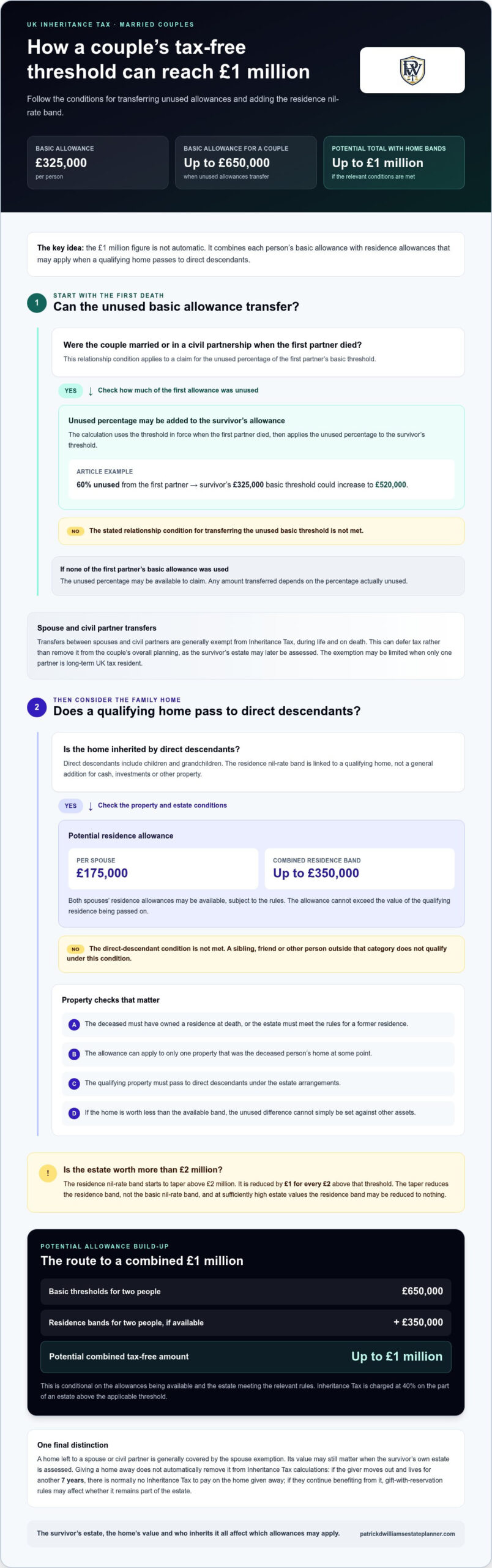
The combined inheritance tax-free amount for married couples
The inheritance tax threshold for married couples in the UK can reach £1 million when the relevant basic and residence allowances are available. This is a potential combined amount, not an automatic joint allowance. The figure depends on the first partner’s unused threshold, whether a qualifying home passes to direct descendants, and the value of the survivor’s estate.
The basic thresholds can total £650,000 when the first spouse leaves their entire estate to the survivor and the unused allowance is transferred. The transfer uses the unused proportion of the first partner’s threshold, so earlier gifts or other distributions may affect the amount available. This is one reason the inheritance tax threshold for married couples in the UK needs to be considered across both estates, rather than as a single fixed figure.
A further £350,000 may be available through the residence nil-rate bands, based on £175,000 for each spouse. This home-related allowance applies when a qualifying residence passes to direct descendants, such as children or grandchildren. The property’s value and the beneficiaries who inherit it affect whether the full allowance is available. It cannot be used against unrelated assets.
For example, if both basic thresholds are available after a transfer, they can provide £650,000 in combined basic allowances. If a qualifying home also passes to children and both residence bands apply, those bands may add £350,000. Together, the allowances can reach £1 million. Each part depends on its own eligibility conditions, so the total is not available in every couple’s circumstances.
The residence allowance is reduced when an estate exceeds £2 million. It falls by £1 for every £2 above that point and is lost completely when the estate reaches £2.2 million. The taper can therefore lower the combined amount, even when the home passes to descendants. The value of the whole estate matters, not only the value of the family home.
HM Revenue & Customs states that Inheritance Tax is charged at 40% on the part of an estate above the applicable threshold. For a couple, the available threshold depends on the transferred basic allowance, any qualifying residence allowance, and how assets pass to beneficiaries. Reviewing these factors together helps explain how much may pass tax-free and which conditions shape the potential £1 million figure.
What is the UK inheritance tax threshold for an individual?
The basic Inheritance Tax threshold in the UK is £325,000, according to HM Revenue & Customs. This is the nil-rate band: the amount an individual can pass on before Inheritance Tax may be charged. HM Revenue & Customs states that the tax is 40% on the part of an estate above the applicable threshold. The calculation concerns the estate’s value, not simply the cash held in a bank account.
An estate can include property, savings, investments and personal possessions. Gifts made during the seven years before death may also count, subject to exemptions. A lifetime gift can therefore affect the taxable estate as well as the assets still owned at death. The value and timing of gifts, and any applicable exemptions, help determine how much remains above the threshold.
A person who leaves a qualifying home to children or grandchildren may also qualify for the residence nil-rate band. This can increase an individual’s tax-free threshold to £500,000 when the estate is worth less than £2 million and the other conditions are met. The residence band is linked to the home passing to direct descendants, so it cannot simply be applied to unrelated assets.
The £2 million estate taper can reduce this home-related allowance. It falls by £1 for every £2 above the taper threshold and is lost completely when an estate reaches £2.2 million. The basic threshold remains a separate part of the calculation.
Some lifetime gifts may be exempt, including gifts of up to £3,000 in each tax year. Other gifts made during the seven years before death may count towards the estate, depending on the circumstances and exemptions. Keeping a clear record of gifts, their dates and recipients helps establish what needs to be considered when the estate is valued.
An unused basic threshold may transfer to a surviving spouse or civil partner. This can increase the survivor’s available allowance, but does not change the basic threshold for an individual. The residence band has separate eligibility and transfer rules, including the requirement for a qualifying home to pass to direct descendants.
Understanding the individual threshold is a useful starting point for reviewing how a Will distributes property, gifts and other assets. Arrange Will Writing to set out who should inherit and make your intentions clear.
Patrick D Williams Estate Planners: Will Writing
Patrick D Williams Estate Planners can help you record your estate wishes in a Will. This is a practical step if you want to clarify who should inherit your home and other assets, and how your estate should be distributed. Clear instructions help your family understand your intentions and support the practical administration of your estate.
If your plans involve protecting property or supporting family members, a Property Protection Trust or Discretionary Trust may also be relevant. Lasting Powers of Attorney address another part of planning: appointing someone to make decisions if you cannot make them yourself.
A free 15-minute consultation is available to discuss your estate-planning needs. To explore Will Writing with Patrick D Williams Estate Planners, contact the team or visit patrickdwilliamsestateplanner.com.
Put your estate plans on a clear footing
Make sure your documents reflect the decisions you want your family to follow. Consider who should inherit, how your home should be treated, and who could make decisions on your behalf if you were unable to do so. Clear instructions connect your wishes with the practical arrangements your family may need.
The inheritance tax threshold for married couples in the UK is one part of estate planning. Patrick D Williams Estate Planners offers Will Writing to record your wishes, Lasting Powers of Attorney for decision-making arrangements, and Property Protection Trusts for property planning. The right focus depends on what you want to protect and how you want your estate handled.
Taking time to set out those choices can give your family a clearer framework for the future. Contact Patrick D Williams Estate Planners to discuss your estate-planning needs and take a considered next step.
Frequently Asked Questions
How does Inheritance Tax work?
Inheritance Tax is calculated on the taxable value of a person’s estate after applicable exemptions and allowances are considered. The estate can include property, savings, investments and possessions, with some gifts made before death also relevant. HM Revenue & Customs states that the standard charge is 40% on the part above the available threshold. The amount due therefore depends on the estate’s composition and which allowances apply.
What’s exempt from Inheritance Tax?
Transfers between spouses or civil partners are generally exempt, including gifts made during life and assets passed on death. Gifts of up to £3,000 in each tax year are also exempt. A lifetime gift may become exempt if the giver survives for seven years, but a gift with reservation is treated differently. For example, giving away a home while continuing to benefit from it can leave its value within the estate.
How much is the residence nil-rate band and who qualifies?
The residence nil-rate band is £175,000 for each spouse when a qualifying main residence is left to direct descendants, according to HM Revenue & Customs. Children and grandchildren can qualify as direct descendants. The band is limited by the value of the qualifying home and cannot be used against unrelated assets. It begins to taper for estates above £2 million, reducing by £1 for every £2 over that point.
Can married couples transfer unused inheritance tax allowances to each other?
Yes. A surviving spouse or civil partner can claim the unused percentage of the first partner’s basic threshold, provided they were married or in a civil partnership when that partner died. The percentage calculation uses the threshold in force at the first death. HM Revenue & Customs requires the transfer claim within 2 years of the survivor’s death. Unused residence nil-rate band is transferred and claimed under separate rules.
What is the combined inheritance tax threshold for married couples or civil partners?
The combined amount can reach £1 million when both partners’ basic thresholds and residence nil-rate bands are available. This comprises up to £650,000 in basic thresholds and £350,000 in residence allowances. The home-related bands depend on a qualifying residence passing to direct descendants, while the estate’s total value affects tapering. The £1 million figure is therefore a potential combined allowance, not an automatic amount for every couple.
How does inheritance tax apply when assets pass to a spouse or civil partner?
Assets passing from one spouse or civil partner to the other are generally exempt from Inheritance Tax, whether transferred during life or on death. The first transfer usually does not use the recipient’s own basic threshold. The survivor’s estate is assessed separately when they die, and any unused threshold from the first estate may be claimed. The spousal exemption may be limited where only one partner is long-term UK tax resident.
What are the UK inheritance tax rates and how are they calculated?
HM Revenue & Customs states that the standard Inheritance Tax rate is 40% on the taxable amount above the available threshold. Executors assess the estate’s value, account for applicable exemptions and allowances, then calculate tax on the remaining amount above the threshold. If at least 10% of an estate is left to charity, a reduced rate of 36% may apply to what remains. The final calculation depends on the estate and qualifying reliefs.
What inheritance tax exemptions and reliefs can married couples claim?
Couples may benefit from the spouse or civil partner exemption, transferring an unused basic threshold, and transferring an unused residence nil-rate band. Other relevant provisions include the £3,000 gift exemption in each tax year and the residence allowance where a qualifying home passes to direct descendants. Leaving 10% or more of an estate to charity may reduce the rate on what remains to 36%. Each provision has its own conditions and calculation.
Leave a Reply