

A notice of severance changes how co-owners hold the beneficial interest, but the process doesn’t end with sending a letter. If you’re researching how to sever joint tenancy, you may be unsure whether the other owner must agree, how to serve notice and what HM Land Registry needs to record the change.
In England and Wales, one joint owner can sever a joint tenancy without the other owners’ consent by serving written notice. The practical steps matter: you’ll need to consider how to give the notice, keep evidence of service and apply to HM Land Registry using Form SEV to enter a Form A restriction on the title.
This guide explains the sequence, documents and records involved, and how to check that the register has been updated. It also explains what severance means for your share of the property and why reviewing your will as part of your estate planning can help make your intentions clear.
Key Takeaways
- Follow a clear sequence for how to sever joint tenancy, from checking the title to submitting the relevant application.
- Understand how written notice, agreement between co-owners and a Land Registry application each play a different part.
- Keep copies of the notice and evidence of service, then check the title register to see whether the change has been recorded.
- Review the title and mortgage details before acting, and understand which arrangements severance does not change.
- Consider how severance fits with your will or trust planning so your intentions for your share are clearly addressed.
Severing Joint Tenancy: What Changes for Co-owners?
In England and Wales, severing a joint tenancy ends the right of survivorship in the beneficial ownership of a property. The co-owners instead hold their beneficial interests as tenants in common. This guide covers the process in England and Wales; property ownership rules and procedures differ in Scotland.
The registered legal title identifies who holds the property legally, while beneficial ownership concerns who is entitled to its value and how that interest passes. Severance changes the beneficial ownership arrangement. By itself, it doesn’t transfer the registered legal title, change who is named on it or require the property to be sold.
What changes from joint tenants to tenants in common?
Joint tenants hold the beneficial interest together, with no distinct share passing under an individual owner’s will. If one owner dies, the right of survivorship generally means their interest passes automatically to the surviving joint tenant or tenants, regardless of what their will says about the property.
After severance, each owner has a separate beneficial share. When an owner dies, that share may pass under their will or, if there is no valid will dealing with it, under the rules of intestacy. The outcome depends on the circumstances, including the terms of any will and the applicable rules. Severance therefore makes it sensible to review your will and ensure it reflects your intentions. For a closer comparison, see tenants in common versus joint tenants.
When might a co-owner consider severance?
People may consider severance as part of estate planning, following separation, or when co-owners have made unequal contributions and want to review their ownership arrangements. These are reasons to consider the implications, not automatic grounds for a particular division of the property. Severance itself doesn’t determine the size of each owner’s share.
The right approach depends on the co-owners’ circumstances, existing arrangements and intentions. A change that affects survivorship can also affect how a share is dealt with on death, so consider it alongside your will or wider trust planning. Understanding how to sever joint tenancy starts with being clear about the intended change: it concerns beneficial ownership, not an automatic transfer of the legal title or a sale of the home.
How to sever joint tenancy step by step in England and Wales
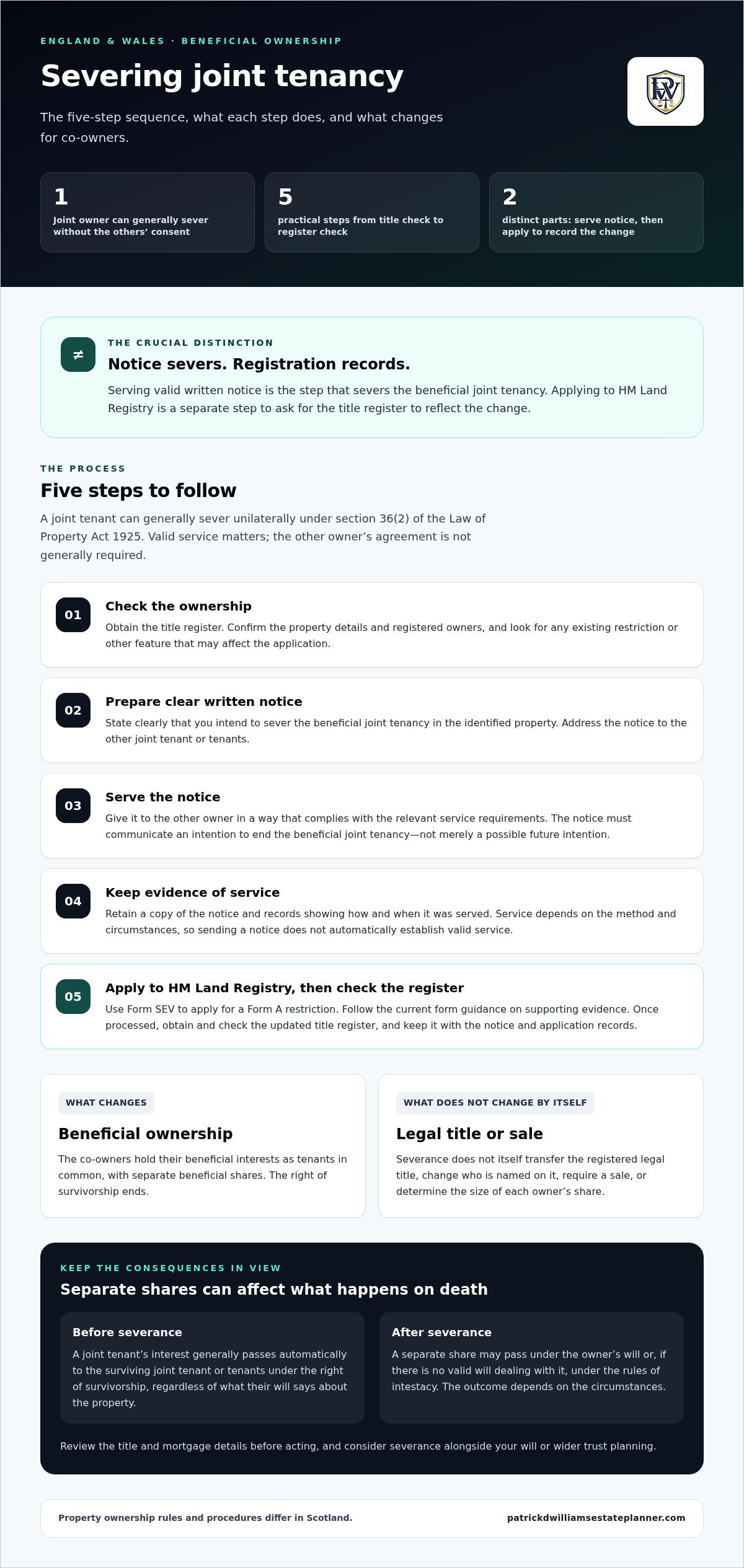
A joint tenant can generally sever unilaterally under section 36(2) of the Law of Property Act 1925. The other owner’s agreement isn’t necessarily required, but the notice must be validly served. Keep the two parts of the process distinct: serving notice is the step that severs the beneficial joint tenancy; applying to HM Land Registry is a separate step to record the change on the title.
The sequence is straightforward: check the title, prepare and serve written notice, keep evidence of service, then apply to HM Land Registry using Form SEV and check the updated register.
- Check the ownership. Obtain the title register and confirm the property details and registered owners. Look for any existing restriction or other feature that may affect the application.
- Prepare the notice. State clearly that you intend to sever the joint tenancy in the beneficial ownership of the identified property. Address the notice to the other joint tenant or tenants.
- Serve the notice. Give it to the other owner in a way that complies with the relevant service requirements. The other owner’s consent is not generally needed for unilateral severance, but the facts and law matter.
- Keep evidence. Retain a copy of the notice and records showing how and when it was served. This evidence may be important if service is later questioned.
- Apply to HM Land Registry. Use Form SEV, “Application to enter a Form A restriction on severance of a joint tenancy”. Follow the current form guidance on supporting evidence. HM Land Registry may enter a Form A restriction, which records the relevant restriction on the title.
Preparing and serving a notice of severance
The notice should communicate an intention to end the beneficial joint tenancy, rather than simply express a possible future intention. Keep the notice and proof of service together. Service rules can depend on the method used and the circumstances, so don’t assume that sending a notice automatically establishes valid service. The GOV.UK guidance on severing joint tenancy sets out the official process.
Applying to HM Land Registry after notice
Form SEV does not serve notice on the other owner. It is the application to update the register, and the required supporting evidence depends on the route taken. Use the latest HM Land Registry instructions when preparing the application. Once it has been processed, obtain and check the updated title register. Keep it with copies of the notice, evidence of service and application documents. Professional support with joint tenancy severance can help coordinate the paperwork with your will or trust planning.
Notice, agreement, and Land Registry: how the routes differ
Agreement, notice and registration serve different purposes. An agreement can record a shared decision, a valid notice may allow one owner to sever without consent, and an application to HM Land Registry asks for the title register to reflect the change. The register entry is not, by itself, what creates the underlying severance.
| Route | What it does | What it doesn’t do | Records to keep |
|---|---|---|---|
| Joint agreement | Records that the co-owners agree to hold the beneficial interest as tenants in common. | Doesn’t itself transfer the legal title or require a sale. | Keep the signed agreement and any related correspondence or advice. |
| Written notice by one owner | Can sever the beneficial joint tenancy without the other owner’s agreement, if legal requirements are met. | Doesn’t itself update the register or establish that disputed service was valid. | Keep the notice, evidence of how and when it was served, and any response. |
| Land Registry application | Uses Form SEV to apply for a Form A restriction to be entered on the register. | Doesn’t replace the notice or, on its own, create the change in beneficial ownership. | Keep the application, supporting documents and updated title register. |
Can one joint tenant sever without the other’s agreement?
Generally, yes. Section 36(2) of the Law of Property Act 1925 provides for severance by written notice, so disagreement alone doesn’t give the other owner a veto over a notice that is legally effective. The details matter, however. Ownership, capacity, the wording of the notice and how it was served can all be relevant. If any of these are disputed, don’t assume the matter is settled simply because a notice was sent.
What does a Form A restriction do?
A Form A restriction is an entry on the register that affects how certain dispositions can be registered. It serves a different purpose from the notice: the notice concerns severance of the beneficial joint tenancy, while the restriction records a limitation relevant to dealings with the registered property. It doesn’t prove the precise size of each co-owner’s beneficial share or resolve a disagreement about those shares.
For a practical understanding of how to sever joint tenancy, treat each route as a separate record of a different step. Check the current HM Land Registry instructions for Form SEV, supporting evidence and any procedural exceptions before applying.
What to check before and after severing a joint tenancy
Careful checks help keep the legal paperwork aligned with your intentions. Before acting, compare the title register with your documents and note any mortgage or planned property transaction that could affect your next steps.
- Title details: Check the property description and title number, and confirm the registered owners’ names are correct.
- Mortgage information: Review the mortgage documents and note who is liable. Severance doesn’t, by itself, change the mortgage or release anyone from their obligations.
- Notice and service: Keep a complete copy of the notice and evidence showing how and when it was delivered.
- Application records: Retain the HM Land Registry application, supporting documents and correspondence.
- Ownership intentions: Consider whether the arrangement reflects what each co-owner intends, particularly if contributions or future plans differ.
Severance changes the form of beneficial ownership, but it doesn’t automatically reallocate the co-owners’ shares, change who is named on the legal title or alter anyone’s right to occupy the property. It also doesn’t require a sale. Separate agreements or legal steps may be needed to address those matters.
How severance can affect a will and estate plan
Once the beneficial joint tenancy is severed, an owner’s share may pass under their will or, where relevant, the rules of intestacy, rather than automatically passing to the surviving co-owner. The effect depends on the ownership arrangements and wider circumstances. Severance alone doesn’t create a trust or decide who ultimately benefits from a share.
Review your will after a change in ownership to check that it reflects your intentions. If a trust forms part of your plans, consider how it fits with the property arrangements. The property protection trust guide explains one way property ownership may interact with trust planning.
Records to keep and details to re-check
After applying, obtain the updated title register and check the property details, owners’ names and any relevant restriction. If the register doesn’t appear to reflect the application, address the discrepancy before relying on it. Keep the updated register with your notice, delivery evidence, application and correspondence so there’s a clear record of each step.
A planned sale or remortgage, or a disagreement about service or ownership, may make the next steps more complex. Tailored advice can help clarify how to sever joint tenancy in a way that fits the documents and your estate-planning intentions. Arrange support with your joint tenancy severance and related planning.
When professional help can make joint tenancy severance clearer
A straightforward situation may not need extensive support. A document review can be useful if there’s uncertainty about the ownership record, how notice was served or what the change means for a will or trust plan. Resolving these points can help you understand the steps and keep the paperwork consistent with your intentions.
When an individual review may be appropriate
Consider a tailored review if a co-owner disputes whether notice was received, the beneficial shares are unclear, or the title and other documents don’t appear to align. These details can affect how the severance process should be approached. A planned sale or remortgage may also make it helpful to understand how the change fits with the wider arrangements.
Estate-planning support can consider the notice and ownership documents alongside your intended outcomes. This is particularly relevant where severance forms part of a review of your will or trust planning. Severance doesn’t itself establish a trust or decide who ultimately benefits, so the wider plan should be considered on its own facts. Professional help is not a requirement in every straightforward case, but it can bring clarity when documents or intentions need careful coordination.
Plan the next step with estate-planning support
Patrick D Williams Estate Planners provides support with joint tenancy severance alongside wills and trust planning. A free 15-minute consultation gives you an opportunity to discuss your circumstances and intended next steps. Support is available by Zoom, Teams or in person.
As you plan, keep the practical sequence in view:
- Confirm ownership: Review the title details and registered owners.
- Understand the consequences: Consider how severance may affect the beneficial ownership and your estate plan.
- Serve notice correctly: Prepare the notice and retain evidence of service.
- Check the register: After applying, review the updated title and keep the relevant records together.
If you’d like to discuss how to sever joint tenancy in the context of your estate-planning intentions, arrange a free 15-minute consultation.
Take the next step with clarity
Understanding how to sever joint tenancy means keeping two stages distinct: serving a valid notice to change the beneficial ownership, then applying to HM Land Registry to record the relevant restriction. Keep copies of the notice, evidence of service and application, and check the updated title register after the application has been processed.
Severance can also affect how a share may pass on death, so review your will and wider estate plan alongside the ownership change. The right arrangements depend on your circumstances, documents and intentions. Joint tenancy severance forms part of Patrick D Williams Estate Planners’ estate-planning support, which can help you consider the paperwork alongside wills and trusts.
A free 15-minute consultation offers an opportunity to discuss your circumstances and possible next steps. Arrange a free 15-minute consultation to discuss the process and your estate-planning intentions.
Frequently Asked Questions
Can I sever a joint tenancy without the other owner’s consent?
Generally, yes. In England and Wales, one joint tenant may sever the beneficial joint tenancy by serving written notice, without the other owner’s agreement. The notice must meet the applicable legal requirements, and disputes about ownership, capacity or service may affect whether it is effective. Keep a copy and evidence of delivery. If the circumstances are contested or unclear, obtain advice before relying on the severance.
How do I serve a notice of severance?
Prepare a written notice that clearly states your intention to sever the joint tenancy in the beneficial ownership of the identified property, then serve it on the other joint tenant or tenants in accordance with the applicable rules. The precise effect can depend on the method and circumstances, so don’t assume that sending a letter alone proves valid service. Keep the notice and reliable evidence of how and when it was delivered. This is a key part of how to sever joint tenancy.
Do I need to register a severance with HM Land Registry?
A valid notice of severance and the Land Registry application are separate steps. The notice is the act that severs the beneficial joint tenancy; applying to HM Land Registry does not replace it. You can apply to enter a Form A restriction on the title, which records a restriction relevant to certain dealings with the property. Check the updated title register after the application and keep a copy with your notice and supporting records.
What form do I use to sever a joint tenancy?
Use Form SEV, titled “Application to enter a Form A restriction on severance of a joint tenancy”, to apply to HM Land Registry. It is an application to update the register, not the notice served on the other owner. Follow the current Form SEV instructions for the relevant route and supporting evidence. There is no HM Land Registry fee for filing Form SEV, according to the current information used for this guide.
How long does it take to sever a joint tenancy?
The timing depends on the steps involved. A validly served notice and the application to HM Land Registry are distinct parts of the process. HM Land Registry typically takes 2 to 6 weeks to process a Form SEV application and enter the restriction, though processing can vary. Keep your notice and evidence of service while the application is being dealt with, then check the title register to confirm the entry has been made.
Does severing a joint tenancy change my mortgage?
No. Severing a joint tenancy changes the beneficial ownership arrangement, but it does not by itself change the mortgage, remove a borrower or alter anyone’s mortgage liability. It also doesn’t automatically change the registered legal title or the co-owners’ right to occupy the property. If you’re planning a remortgage, sale or other change to the borrowing, consider how the existing mortgage arrangements affect your plans and seek advice tailored to your circumstances.
Does severing a joint tenancy automatically change my will?
No. Severance does not amend or replace your will. It changes how the beneficial interest is held, so your share may pass under your will or, if relevant, the rules of intestacy rather than automatically passing to the surviving owner. Review your will after severance to check that it reflects your intentions. The effect depends on your ownership documents, will and wider circumstances, and severance alone does not create a trust.
Leave a Reply