

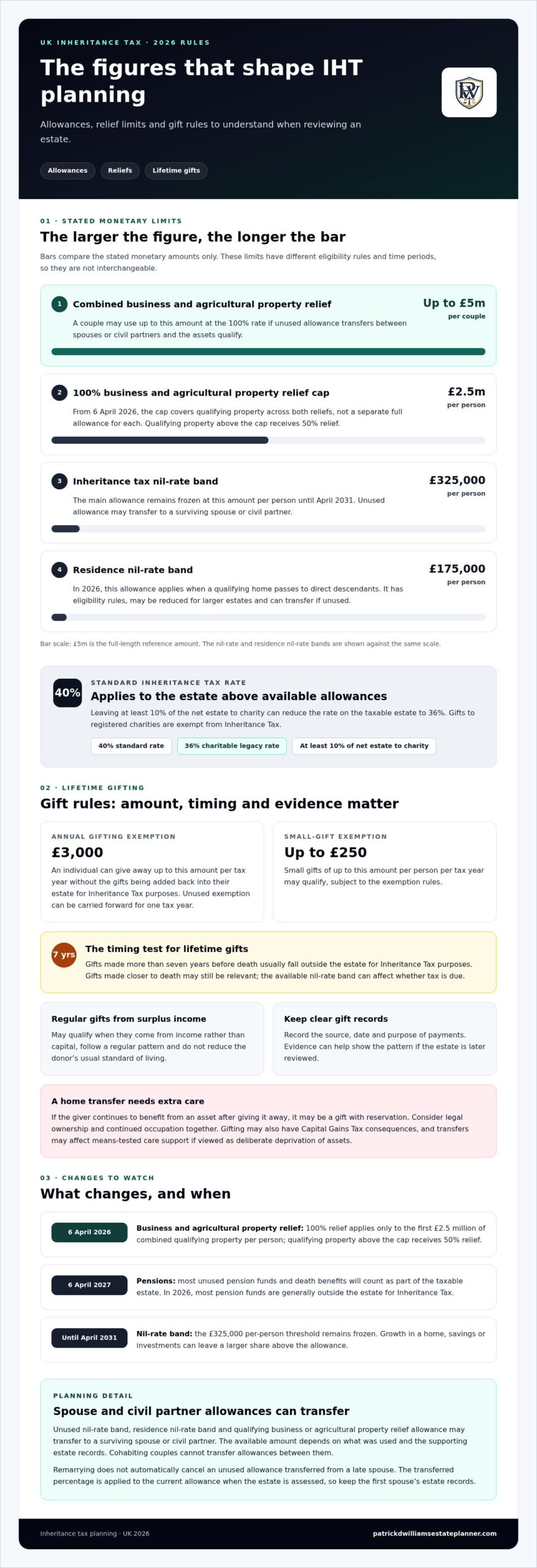
The 2026 changes don’t remove Inheritance Tax, but they do make careful planning more important. According to HM Revenue & Customs, the nil-rate band remains £325,000 per person, frozen until April 2031, while the residence nil-rate band is £175,000 per person in 2026. From 6 April 2026, 100% business and agricultural property relief applies only to the first £2.5 million of combined qualifying property per person.
It’s understandable to want to protect what you’ve built and pass as much as possible to your family. This guide explains how to avoid inheritance tax in the UK in 2026 through legitimate use of allowances, exemptions and reliefs, and what the rule changes mean for different estates.
Gifting, leaving a home to direct descendants, spouse and civil partner exemptions, and business or agricultural relief can all affect an estate’s Inheritance Tax position. The right approach depends on how your assets are owned and passed on, so understanding the rules is a practical first step when planning for your family.
Key Takeaways
- Review how the nil-rate band and residence nil-rate band apply to your estate, including who will inherit your home.
- Consider whether the residence nil-rate band taper could affect your plans if your estate exceeds the threshold.
- Use gifting exemptions thoughtfully and keep clear records of gifts and their timing.
- Reassess business and agricultural assets under the relief changes taking effect in 2026.
- Include spouse or civil partner exemptions and transferable unused allowances in your estate planning, while recognising that cohabiting couples cannot transfer allowances between them.
What will happen to inheritance tax in 2026?
In 2026, the main allowances remain in place, while relief rules for qualifying business and agricultural property change. The new limits, frozen thresholds and future pension changes make it useful to review how your estate is structured.
Relief allowances and spouse transfers
From 6 April 2026, 100% business and agricultural property relief applies only to the first £2.5 million of combined qualifying property per person, according to HM Revenue & Customs. The allowance covers qualifying property across both reliefs, rather than providing a separate full allowance for each. Qualifying property above the cap receives 50% relief.
The combined allowance matters when an estate includes a business or farm. Unused allowance can transfer between spouses or civil partners, allowing a couple to use up to £5 million at the 100% rate. The transfer can shape succession plans, but the assets must meet the relevant qualification rules. An adviser can help assess ownership and eligibility.
Nil-rate band allowances
According to HM Revenue & Customs, the inheritance tax nil-rate band is £325,000 per person and is frozen until April 2031. The residence nil-rate band is £175,000 per person in 2026, according to HM Revenue & Customs. It applies when a qualifying home passes to direct descendants.
Some allowances can be combined, but the residence nil-rate band has eligibility rules and may be reduced for larger estates. Unused nil-rate band and residence nil-rate band allowances can transfer to a surviving spouse or civil partner. The available threshold may therefore depend on both partners’ estates and how much allowance was used when the first partner died.
Frozen thresholds and allowances
A frozen threshold stays at the same amount even as an estate’s value changes. The £325,000 nil-rate band freeze until April 2031 means growth in a home, savings or investments can leave a larger share above the allowance. The standard inheritance tax rate is 40% on the estate above available allowances, according to HM Revenue & Customs.
From 6 April 2027, most unused pension funds and death benefits will count as part of the taxable estate, according to HM Revenue & Customs. In 2026, most pension funds are generally outside the estate for inheritance tax. A life insurance payout may also be kept outside the estate when the policy is written in trust.
Inheritance Tax follows UK rules, while Scotland has distinct succession law and Wales and Northern Ireland have different legal systems. For people who are not UK-domiciled, the tax treatment depends on residence status and where their assets are located.
I’ve inherited my spouse’s unused IHT allowance – will I lose it if I remarry?
Remarrying does not automatically cancel an unused Inheritance Tax allowance transferred from a late spouse. The transferred percentage is applied to the current allowance when the estate is assessed. Keep the first spouse’s estate records, because the amount used and supporting paperwork affect the claim. A new marriage does not make the earlier transfer disappear.
Lifetime gifts and the seven-year rule
A lifetime gift may reduce the estate eventually liable for Inheritance Tax, but its timing and terms matter. HM Revenue & Customs says gifts made more than seven years before death usually fall outside the estate for Inheritance Tax purposes. Gifts made closer to death may still be relevant, and the available nil-rate band can affect whether tax is due.
HM Revenue & Customs says an individual can give away up to £3,000 per tax year under the annual gifting exemption without gifts being added back into their estate for Inheritance Tax purposes. Unused annual exemption can be carried forward for one tax year. Small gifts of up to £250 per person per tax year may also qualify, subject to the exemption rules.
Gifts from surplus income may qualify when they come from income rather than capital, follow a regular pattern and do not reduce the donor’s usual standard of living. Keep records showing the source, date and purpose of each payment. This can help demonstrate the pattern if the estate is later reviewed.
For a family home or jointly owned property, both legal ownership and each person’s continued use matter. A transfer described as a gift may still have Inheritance Tax consequences if the giver continues to benefit from the asset. This is commonly called a gift with reservation. Consider ownership and occupation together before transferring a home.
Gifting can also have Capital Gains Tax consequences, particularly if an asset has increased in value. The tax position depends on the asset and the relationship between giver and recipient, so consider potential gains before deciding. Giving away assets may also affect eligibility for means-tested care support if the transfer is viewed as deliberate deprivation of assets.
Regular gifts from income may be exempt if they meet the conditions above. Annual and small-gift exemptions can reduce the value transferred from an estate, but each has separate rules. Record gifts clearly, and do not treat an exemption as permission to give away assets needed for future living costs.
Charitable gifts offer another route: gifts to registered charities are exempt from Inheritance Tax. Leaving at least 10% of the net estate to charity can reduce the rate on the taxable estate from 40% to 36%. Compare the charitable legacy with the amount and form of inheritance intended for family members.
Joint ownership or a retained right to live in a property can complicate a gift. Joint tenancy severance can change how a jointly owned home passes on death, while a Property Protection Trust may form part of wider planning. These arrangements need to reflect the intended beneficiaries and the donor’s ongoing needs.
Changes to business property relief and agricultural property relief
From 6 April 2026, the rules limit how much qualifying business and agricultural property receives full relief. The effect depends on the assets, ownership structure and any transferable allowance.
Relief reforms and allowance caps
Business Property Relief and Agricultural Property Relief reduce the value of qualifying assets counted for Inheritance Tax. From 6 April 2026, the combined allowance for 100% relief is £2.5 million per person. Qualifying property above that cap receives 50% relief, so the remaining value may still be exposed to Inheritance Tax after other allowances.
The relief is shared across qualifying business and agricultural property, rather than providing a separate full allowance for each category.
Spouses and civil partners can transfer unused allowance, allowing a couple to shelter up to £5 million at the 100% rate. This can matter where a farm or business passes between spouses before ultimately going to children. Qualifying assets that already receive 50% relief continue to receive that relief without using the 100% relief allowance.
Qualification still matters. Business and agricultural assets generally need to have been owned for at least two years before death to qualify for the relief described. The allowance for property qualifying for the 100% rate is to be indexed in line with CPI from 6 April 2031.
Assets in companies and trusts
If agricultural assets are held through a non-UK company or trust, consider both the structure and the underlying property. Calling something a “farm” or “trust” does not establish that its assets qualify for relief or that the full allowance applies.
Map who legally owns each asset, how it is used, and whether the relevant ownership period is met. Then identify which assets fall within the combined £2.5 million allowance and whether any unused allowance can transfer between spouses or civil partners. This gives a clearer picture of how the cap may affect the estate.
A trust can also influence who benefits from property and when. Its terms, the assets it holds and the relationship between trustees and beneficiaries all matter to succession planning. Review those details alongside the relief conditions, rather than assuming that placing agricultural land in a trust or company preserves 100% relief.
For a married couple holding a farm through a company, consider the shares and underlying assets separately when planning the estate. Record ownership, how the assets are used and any previous transfers. These details help clarify how the reforms may affect the value passing to family members.
How can I legally minimise the impact of Inheritance Tax changes?
The residence nil-rate band can increase the amount passed on without Inheritance Tax when a qualifying home goes to direct descendants. For 2026/27, the basic allowance and full residence allowance can provide an individual with a £500,000 threshold. The residence allowance depends on eligibility and estate value, so a home’s intended beneficiaries and the wider estate both matter.
The residence nil-rate band is £175,000 per person in 2026, alongside the £325,000 nil-rate band. It is not automatic: the estate must include a qualifying home, and that home must pass to direct descendants. A will should clearly state who inherits the property. This helps make the intended distribution clear when the estate is assessed.
The residence nil-rate band begins to taper when an estate exceeds £2 million. It falls by £1 for every £2 above that threshold.
The taper applies to the estate’s value, not only the home’s value. Savings, investments and other property can therefore take the total estate above £2 million, even when the home itself is worth less. Include all relevant assets in your planning.
For anyone considering how to avoid inheritance tax in the UK in 2026, the frozen thresholds are also important. The nil-rate band and residence nil-rate band are fixed at their current levels for tax year 2030 to 2031. HM Revenue & Customs states that the £325,000 nil-rate band is frozen until April 2031. As assets grow, a larger portion of an estate may sit above its available allowances.
Spouses and civil partners may transfer unused allowances, subject to the rules for each band. A qualifying couple may pass on up to £1 million without an Inheritance Tax liability when both partners’ nil-rate bands and residence nil-rate bands remain unused. The residence allowance can still be reduced by the taper, so the surviving partner’s available amount depends on the estate’s value.
Understanding how to avoid inheritance tax in the UK in 2026 also involves checking how each allowance works alongside the others. Identify the estate’s assets, confirm whether a qualifying home will pass to direct descendants, and account for any unused allowance transferred from a spouse or civil partner. Business or agricultural property relief may affect the taxable estate, but it does not remove the residence band’s separate £2 million taper test.
These checks help clarify how the residence allowance fits into an estate plan. Consider the property’s ownership, the beneficiaries named in the will and the estate’s overall value together. This gives you a more useful basis for planning than looking at the home’s value alone.
Spouse and civil partner exemption
Transfers between spouses or civil partners are exempt from Inheritance Tax, regardless of the amount. One partner can therefore leave assets to the other without using their own nil-rate band on that transfer. This may preserve allowances for later, when the surviving partner’s estate passes to children or other beneficiaries.
Unused Inheritance Tax allowances may also transfer between spouses and civil partners. The survivor can claim the percentage of the deceased partner’s unused allowance, applied to the current allowance. For example, if half of a partner’s nil-rate band remained unused, the survivor may claim an equivalent percentage of the allowance in force when their estate is assessed.
The nil-rate band is £325,000 per person, and the residence nil-rate band is £175,000 per person in 2026. If both partners’ nil-rate bands and residence nil-rate bands remain unused, a qualifying estate may pass on up to £1 million without an Inheritance Tax liability. The residence allowance may depend on how the home is passed on and the size of the estate.
Keeping records matters. When the first spouse or civil partner dies, retain the estate accounts and details of gifts, assets and allowances used. These records help establish the unused percentage available for transfer. The claim is based on what remained unused at the first death, not simply on whether the deceased left a will.
The exemption applies to spouses and civil partners, not simply to couples who live together. Cohabiting couples cannot transfer unused Inheritance Tax allowances between them. They should bear this distinction in mind when deciding how property is owned and who inherits it. For example, joint ownership alone does not give an unmarried partner the spouse exemption.
Registered charity gifts receive different treatment. Gifts to registered charities are exempt from Inheritance Tax. If at least 10% of the net estate is left to a registered charity, the rate on the taxable estate falls from 40% to 36%. A charitable legacy can therefore change the tax calculation, as well as the amount passing to family.
Spouse exemption defers tax on transfers between partners; it does not automatically remove Inheritance Tax from the survivor’s estate. The value of assets retained, allowances used and beneficiaries named in the will all affect the eventual calculation. Review these details together, especially if the surviving partner’s estate includes a home or substantial investments.
For a considered plan, review your estate arrangements and how they reflect your spouse or civil partner’s unused allowances.
Patrick D Williams Estate Planners: Will Writing
Patrick D Williams Estate Planners can help you record your wishes in a will and consider how your estate should pass to your chosen beneficiaries. Will Writing is a useful next step when you want your plans to reflect your family circumstances, property ownership and the allowances discussed above.
Depending on your needs, planning may also involve a Property Protection Trust or Discretionary Trust, alongside Lasting Powers of Attorney for future decision-making. A clear will sets out who should inherit and gives your estate plan a practical structure. It does not automatically remove tax, but it can ensure your intentions are recorded and considered together.
To discuss Will Writing and your estate plans, contact Patrick D Williams Estate Planners.
Make your estate plan reflect what matters next
Planning how to avoid Inheritance Tax in the UK in 2026 starts with decisions about who should benefit, how assets are held and who can act on your behalf. Review those arrangements when family circumstances or your priorities change, so your plans continue to reflect your intentions.
Patrick D Williams Estate Planners can bring these decisions together through Will Writing, Lasting Powers of Attorney and Property Protection Trusts. These arrangements serve different purposes, from recording who inherits to setting out who may make decisions if you cannot. A considered plan can give your family clearer direction and keep your wishes central.
When you are ready to put your intentions into writing, contact Patrick D Williams Estate Planners to discuss your estate planning. Taking a clear, considered step now can help you feel more prepared for the future.
Frequently Asked Questions
Can I get the main residence allowance if I’m not married?
Yes. Marriage is not required for an individual to claim the residence nil-rate band. The key conditions are that the estate includes a qualifying home and that it passes to direct descendants, such as children or grandchildren. The allowance can be reduced when the estate exceeds £2 million. An unmarried person should therefore consider the home’s beneficiaries and the value of the whole estate, not marital status alone.
Can I give my house to my son to avoid inheritance tax?
You can give your house to your son, but the transfer does not automatically remove it from your estate for Inheritance Tax. If you continue to benefit from the property, it may be treated as a gift with reservation. HM Revenue & Customs says a gift made more than seven years before death usually falls outside the estate. Before proceeding, consider where you will live and how the transfer affects your son.
Can I leave my property to my children without paying Inheritance Tax?
Possibly, but leaving a home to children does not by itself make the whole estate tax-free. In 2026/27, the basic allowance and full residence allowance can provide an individual with a £500,000 threshold when a home passes to direct descendants. The estate’s value and eligibility affect the available residence allowance. Include other assets when assessing the estate, because the taper applies to total estate value.
Can a trust reduce Inheritance Tax?
A trust can help control who benefits from assets and when, but setting one up does not automatically reduce Inheritance Tax. The result depends on the trust type, assets transferred and terms governing access. Some trust arrangements can trigger Inheritance Tax when the trust has existed for 10 years. Consider the tax treatment alongside control, beneficiaries and administration before transferring property into a trust.
How does the UK seven-year rule for potentially exempt transfers work, including taper relief?
A potentially exempt transfer is a lifetime gift to an individual that may fall outside the estate if the donor survives long enough. HM Revenue & Customs says gifts made more than seven years before death usually fall outside the estate for Inheritance Tax purposes. If the donor dies sooner, the gift may affect the tax calculation. Taper relief can reduce tax on some taxable gifts, but it does not remove the gift’s value from consideration.
How are trusts treated for UK inheritance tax, and what tax charges and costs can apply?
Trust treatment depends on its structure, the assets transferred and who can benefit. Some arrangements may face Inheritance Tax charges when the trust reaches its 10-year anniversary; tax can also arise when assets enter or leave certain trusts. Trustees may also need to meet administration and professional costs, which depend on the trust’s terms, assets and work involved. Professional fees depend on the case and are given after a quote request.
What inheritance tax reliefs apply to UK businesses, farms and agricultural property in 2026?
Business Property Relief and Agricultural Property Relief may reduce Inheritance Tax on qualifying assets. From 6 April 2026, 100% relief applies to the first £2.5 million of combined qualifying property per person. Qualifying property above the cap receives 50% relief. Assets generally need to have been owned for at least two years before death to qualify for the relief described, so ownership history matters.
What are the UK inheritance tax rates, filing deadlines and payment options for an estate?
The standard Inheritance Tax rate is 40% on the estate above available allowances. Tax is due within six months of the end of the month of death. Interest-free instalment options were extended to a wider set of business and agricultural property from April 2026. Whether instalments apply depends on the asset and estate circumstances; the executor must also handle the estate’s reporting and payment obligations.
Leave a Reply