
The health and welfare lasting power of attorney cost includes a £92 Office of the Public Guardian registration fee per application in England and Wales, according to the Office of the Public Guardian, as of March 2026. A donor with gross annual income below £12,000 qualifies for a 50% reduction, and certain benefits may qualify an applicant for a full exemption. The rules and fees described here apply to England and Wales.
The registration fee is only one part of the health and welfare lasting power of attorney cost. This LPA lets your chosen attorneys make decisions about your care and personal welfare, but they can act only after it is registered and when you lack mental capacity to make the relevant decision yourself.
It’s understandable to want clarity about both the cost and the authority you would give someone. This article explains what the LPA can cover, how registration fees work, and when a low-income reduction or exemption may apply, so you can weigh the arrangements with a clear understanding of their purpose and limits.
Key Takeaways
- A health and welfare LPA can give attorneys authority over care and personal decisions, but only when it is registered and you lack capacity to make the relevant decision.
- It does not cover money or property. A separate Property and Financial Affairs LPA is needed for financial decisions.
- In England and Wales, registering one LPA costs £92 per application, according to the Office of the Public Guardian, as of March 2026.
- If your gross annual income is below £12,000, you may qualify for a 50% reduction in the registration fee; certain benefits may qualify you for an exemption.
- Understanding the choices the LPA allows can help you set clear instructions for the people you appoint and plan for the care decisions that matter to you.
What Does a Power of Attorney for Health And Welfare Do?
In England and Wales, a registered health and welfare LPA gives your chosen attorneys authority to make relevant care decisions on your behalf. They can act only when you lack mental capacity to make the particular decision. For example, if you cannot decide where to live, your attorney may decide whether you can remain at home with support or move into residential care.
The authority can cover everyday matters such as your diet, clothing, routine and contact with other people. It may also cover medical treatment, activities and care arrangements. Decisions should reflect your wishes and any guidance or restrictions in the LPA. Appointing an attorney does not give them unlimited authority.
Life-sustaining treatment requires a clear choice on the health and welfare form. Under section 11 of the Mental Capacity Act 2005, an attorney cannot consent to or refuse that treatment unless the LPA explicitly grants the authority. Selecting Option A grants attorneys authority over life-sustaining treatment decisions. The form lets you specify whether your attorneys should have authority over life-sustaining treatment.
An advance decision, sometimes called a living will, records a person’s decision to refuse particular medical treatment. In England and Wales, a valid and applicable advance decision takes priority over an LPA when both address the same circumstances. If you have both documents, make sure their instructions do not conflict. A health and welfare LPA can also include guidance and limits for your attorneys.
Common reasons for rejection or delay include mistakes, incomplete details or unclear wording in the application. Take care that the form is completed clearly and that its instructions accurately express your choices. The Office of the Public Guardian received more than 50,000 rejected LPA applications in 2023-2024, so careful preparation matters.
Yes. The rules and fees described here apply to England and Wales. Scotland and Northern Ireland have separate legal arrangements, so do not assume that the England and Wales LPA form and registration process applies there.
You can update your arrangements by preparing a new LPA that reflects your wishes, or cancel an existing one through formal revocation. A registration charge applies to each LPA application. Whether a later change involves a fee depends on whether it requires a new application.
Does a health and welfare LPA include my finances?
No. In England and Wales, a health and welfare LPA does not authorise an attorney to manage your finances. It covers personal welfare and care decisions, not access to bank accounts, paying bills or dealing with property. To give someone authority over your financial affairs, you need a separate Property and Financial Affairs LPA.
This distinction matters because health and financial decisions can arise together but require different authority. For example, an attorney under a health and welfare LPA may decide whether you should receive particular care when you lack mental capacity for that decision. The LPA does not, by itself, let them withdraw money to pay care fees or manage your home.
A Property and Financial Affairs LPA covers financial matters such as managing bank accounts, paying bills and dealing with property. In England and Wales, it can be used while you still have mental capacity if you have authorised that arrangement. A health and welfare LPA, by contrast, can be used only when you lack capacity to make the relevant welfare decision.
Many people choose to make both documents because they cover separate areas of decision-making. You can appoint the same trusted person under each, or choose different attorneys. You can also specify that attorneys act together, independently for some matters, or independently for other matters. Your choice affects how decisions can be made, so consider whether joint action would be practical for everyday tasks such as paying regular bills.
An attorney appointed under a Property and Financial Affairs LPA cannot be bankrupt. This restriction concerns the financial role, not the health and welfare role. A Trust Corporation can also be appointed for a Property and Financial Affairs LPA. These details show why the documents should be considered separately, even if the same family member may help with both care and money matters.
A Property Protection Trust is another distinct part of estate planning. It is not a substitute for a Property and Financial Affairs LPA, which gives an appointed attorney authority over financial affairs. If you are considering how property planning fits alongside your arrangements, advice on a Property Protection Trust can help clarify its separate role.
Before deciding which documents to make, consider what decisions you want someone to handle. A health and welfare LPA covers personal care; a Property and Financial Affairs LPA covers money and property. If you want both kinds of support, each LPA must be prepared and registered separately. Clear choices about your attorneys and how they can act make their responsibilities easier to understand.
Low-income fee reductions and exemptions
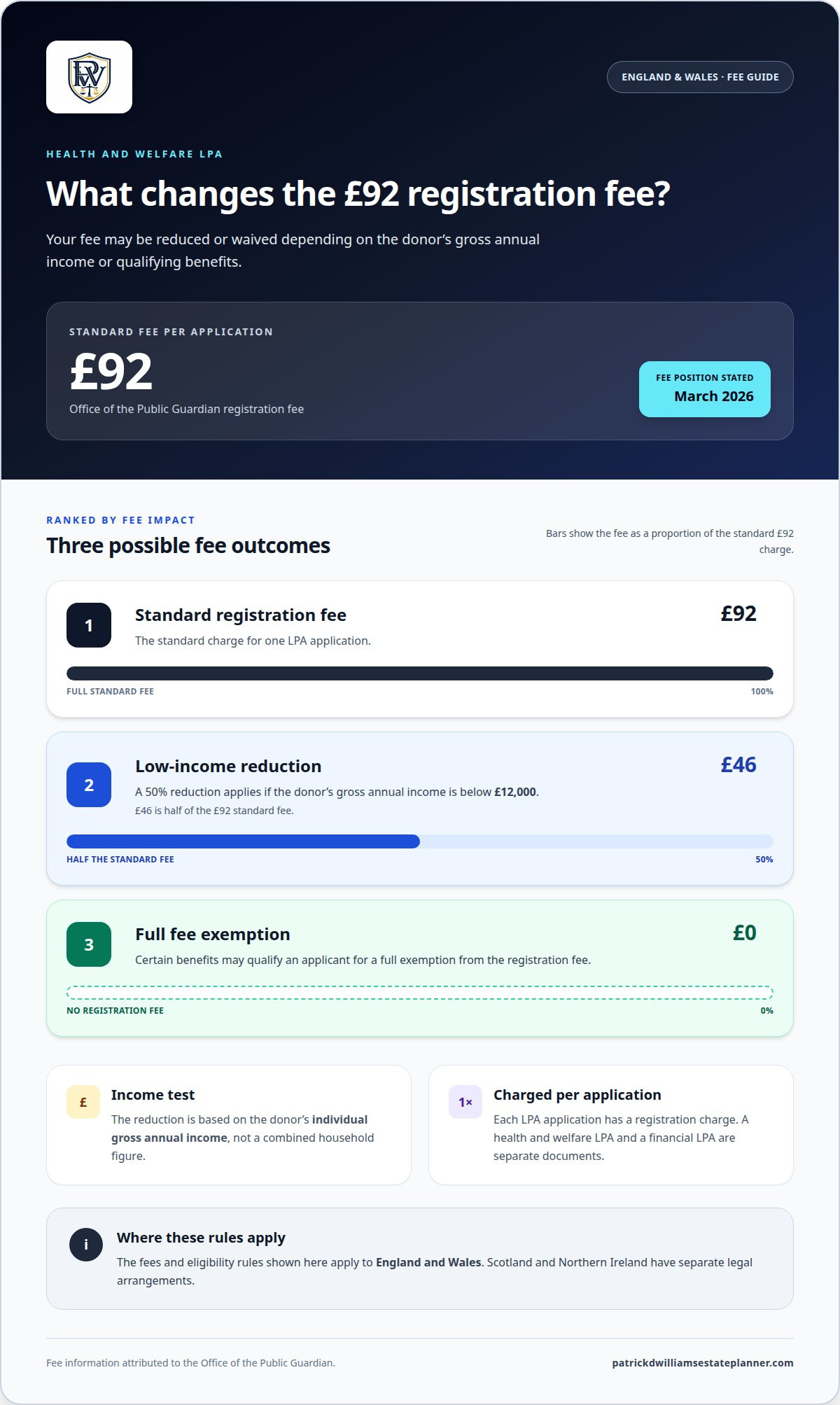
In England and Wales, the Office of the Public Guardian registration fee is £92 per LPA application, according to the Office of the Public Guardian, as of March 2026. A donor whose gross annual income is below £12,000 qualifies for a 50% reduction. Certain benefits may qualify an applicant for a full exemption from the registration fee.
The reduction is based on the donor’s individual gross annual income. It is not a calculation of an attorney’s income or the household’s combined income. For example, if the donor’s gross annual income falls below the stated threshold, the 50% reduction applies to the OPG registration fee. The relevant figure is the donor’s income before deductions.
Fee remission means that the registration fee is reduced or waived under the relevant eligibility rules. The reduced fee for an eligible donor is £46. A full exemption means no OPG registration fee is payable for an eligible application. Certain means-tested benefits may qualify, so benefit entitlement can affect whether the exemption route applies.
These reductions and exemptions apply to the OPG registration fee, not to the cost of help preparing the document. Professional preparation fees are separate from registration charges. When working out the overall cost of making an LPA, distinguish the government registration fee from any professional fee.
Eligibility depends on the donor’s circumstances, not on whether the LPA covers health and welfare or Property and Financial Affairs. The donor’s income or qualifying benefit status is relevant to a fee reduction or exemption. The attorney’s finances do not determine the donor’s eligibility for a fee reduction.
A reduction changes the amount payable for registration, not the authority granted by the LPA. It does not change the donor’s wishes, the attorneys appointed or the decisions covered by the document. An eligible donor can still set out guidance and restrictions; the fee relief applies only to the registration charge.
Preparing an LPA can involve complex choices, particularly when instructions need to express personal wishes clearly. A fee reduction does not simplify those decisions or change the need to complete the document correctly. Consider the questions separately: first, whether the donor qualifies for fee relief; then, whether the LPA records the intended arrangements.
For a donor with low income, checking the individual annual income threshold and relevant benefit entitlement helps identify the possible registration charge. The standard fee is £92 per application; the reduced fee is £46 for an eligible donor, and certain benefits may qualify an applicant for a full exemption. These amounts concern OPG registration, not professional preparation.
Office of the Public Guardian registration fee
In England and Wales, the Office of the Public Guardian registration fee for one LPA is £92 per application as of March 2026, according to the Office of the Public Guardian. This is the fee to register the legal document, separate from any professional charge for preparing it. The registration fee applies to each LPA application, so making both types usually means two fees.
This total covers registration only. If a solicitor prepares the documents, their professional fees are separate. The overall cost therefore depends on whether you complete the forms yourself or pay for professional help.
Registration is required. The LPA cannot be used until the Office of the Public Guardian has registered it. Applications also include a mandatory four-week objection period before they are finalised. This allows objections to be raised before registration is complete, so it is part of the process, not an optional delay.
The Office of the Public Guardian aims to register applications within 8 to 10 weeks. Processing can differ by submission method: the published average for online submissions is approximately 4 weeks, while paper applications average approximately 20 weeks. These processing figures describe different routes and should not be treated as interchangeable deadlines.
Digital registration is part of the modernised LPA service being rolled out throughout 2025 and 2026. Online submission may be associated with a shorter average processing time than paper submission. However, the application still needs to be completed and registered before the attorneys can use it. Choosing digital submission does not change the donor’s preferences or the powers granted in the document.
Registration time matters when planning ahead. If an attorney may need to make decisions after the donor loses capacity, the LPA must already be registered, and the donor must lack capacity for those decisions. Starting the application early leaves time for registration and for resolving any issues that need correction.
A solicitor’s preparation work and the OPG registration charge are separate parts of the total cost. The registration fee is charged per application, while professional fees depend on the preparation service. If you make both LPAs, account for two registrations as well as any separate professional work. Eligible donors may receive a reduction or exemption from the registration charge.
What a Lasting Power of Attorney does
A Lasting Power of Attorney lets you appoint trusted people to make specified decisions if you cannot make them yourself. In England and Wales, you must be over 18 and have mental capacity when making a Health and Welfare LPA. The document records who you appoint and the authority you choose to give them. It does not hand control of your decisions to them immediately.
Registration and capacity determine when attorneys can act under a health and welfare LPA. The LPA must be registered with the Office of the Public Guardian, and you must lack capacity for the particular decision. Capacity is decision-specific: difficulty making one choice does not automatically mean you cannot make another. For example, you might be unable to decide about a care arrangement but still express a preference about meals.
Planning ahead is practical as well as personal. Decisions about welfare may arise over time, and without an LPA, loved ones may need to make repeated applications to the Court of Protection. A legally binding LPA lets you name your chosen decision-makers in advance, rather than leaving those arrangements until you can no longer make the relevant decisions.
You can appoint more than one attorney and specify how they make decisions. In England and Wales, attorneys may act together, independently for some matters, or independently for other matters. For instance, you could require joint agreement on major care arrangements while allowing attorneys to decide separate matters independently. Choose an arrangement that reflects how you want decisions handled and how your attorneys can work together.
Choosing an attorney means considering trust, judgement and willingness to follow your preferences. An attorney appointed under an LPA must be over 18. Your closest relatives do not automatically have authority to make decisions for you under a Health and Welfare LPA. Naming someone gives them a defined role, while guidance and restrictions in the document can help express your wishes.
A health and welfare LPA does not replace other planning documents. For example, a valid and applicable advance decision takes priority when it covers the same circumstances. If you make both documents, ensure their instructions work together. The key question is whether the people you appoint can make relevant decisions in line with your stated preferences.
If you want support putting those choices into a clear legal document, arrange help with a Lasting Power of Attorney.
Patrick D Williams Estate Planners: Lasting Powers of Attorney
Patrick D Williams Estate Planners can help you prepare a Lasting Power of Attorney that reflects your care preferences and choice of attorneys. This can be a helpful next step if you want support understanding the form, setting out instructions or considering how a health and welfare LPA fits with a Property and Financial Affairs LPA.
LPA planning can sit alongside Will Writing or trust arrangements, including a Property Protection Trust or Discretionary Trust. Each serves a different purpose, so the right combination depends on the decisions and arrangements you want to make.
You can discuss your circumstances in a free 15-minute consultation, with support available via Zoom, Teams or in person. Contact Patrick D Williams Estate Planners to discuss preparing a Lasting Power of Attorney.
Make your wishes part of your future planning
Start by considering the decisions that matter most to you. Think about whose judgement you trust, what guidance would help them act in keeping with your values, and how your care arrangements fit with your wider plans. Understanding the health and welfare lasting power of attorney cost can help you plan, but clarity about your wishes matters just as much.
Thinking through these choices can make it easier to discuss them with the people close to you. You can also get support turning your instructions into a clear document and considering how it fits with your wider estate planning.
Contact Patrick D Williams Estate Planners to discuss your arrangements and the support you need. A considered conversation can help you move forward with greater clarity and confidence.
Frequently Asked Questions
How much does a Lasting Power of Attorney cost?
For one Health and Welfare LPA in England and Wales, the Office of the Public Guardian registration fee is £92 per application as of March 2026. The health and welfare lasting power of attorney cost also depends on whether you prepare the document yourself or use professional help. Preparation fees are separate from registration. Making another LPA involves a separate application fee.
Are There Hidden Costs to Watch Out For?
Possible additional expenses include a professional certificate provider, a medical capacity assessment or tracked postage for paperwork. These are separate from the Office of the Public Guardian registration fee and depend on the circumstances. For example, a professional assessment can add to the overall expense if one is needed. Ask for a clear breakdown of preparation and registration charges before proceeding.
Can I Make an LPA Myself for Free?
You can complete the LPA form yourself without paying a professional to prepare it. The Office of the Public Guardian still charges a registration fee unless you qualify for a reduction or exemption. Take care with the wording and completion: mistakes or unclear instructions can lead to rejection or a document that does not reflect your wishes. Professional help may be useful for complex instructions.
How Can You Save Money on Your LPA?
First, consider whether you can prepare the form yourself, while allowing for the registration charge. Then check whether the donor’s income or qualifying benefits make them eligible for fee relief. In England and Wales, gross annual income below £12,000 qualifies for a 50% reduction. Certain benefits may qualify for a full exemption. Avoiding errors can also reduce the risk of having to correct and resubmit an application.
How Much Is the OPG Registration Fee?
The Office of the Public Guardian registration fee for one LPA is £92 per application as of March 2026, according to the Office of the Public Guardian. This covers the application’s registration, not professional preparation. If you are applying for both a Health and Welfare LPA and a Property and Financial Affairs LPA, each is a separate application with its own registration fee.
How much does it cost to register a health and welfare LPA?
Registering one Health and Welfare LPA in England and Wales costs £92 per application as of March 2026, according to the Office of the Public Guardian. This is the registration charge only. It does not include any professional fee for drafting or preparing the form. If the donor qualifies for a reduction or exemption, the amount payable may be lower.
How much does it cost to make a health and welfare lasting power of attorney in England and Wales?
The total combines the registration charge with any separate preparation costs. The Office of the Public Guardian registration fee for one application is £92 as of March 2026. Preparing the document yourself avoids a professional drafting fee, whilst using a service adds a separate charge. The final amount depends on the preparation option and whether fee relief applies to the donor.
How much do solicitors or LPA services charge to prepare a health and welfare LPA?
Preparation fees vary by service and the work involved, and are separate from the OPG registration fee. Patrick D Williams Estate Planners charges fixed professional fees for bespoke Lasting Powers of Attorney. The work includes consultations, document preparation, witnessing guidance and legal compliance checks. The applicable fee is provided after a quote request, taking account of the preparation required for your circumstances.
Leave a Reply