

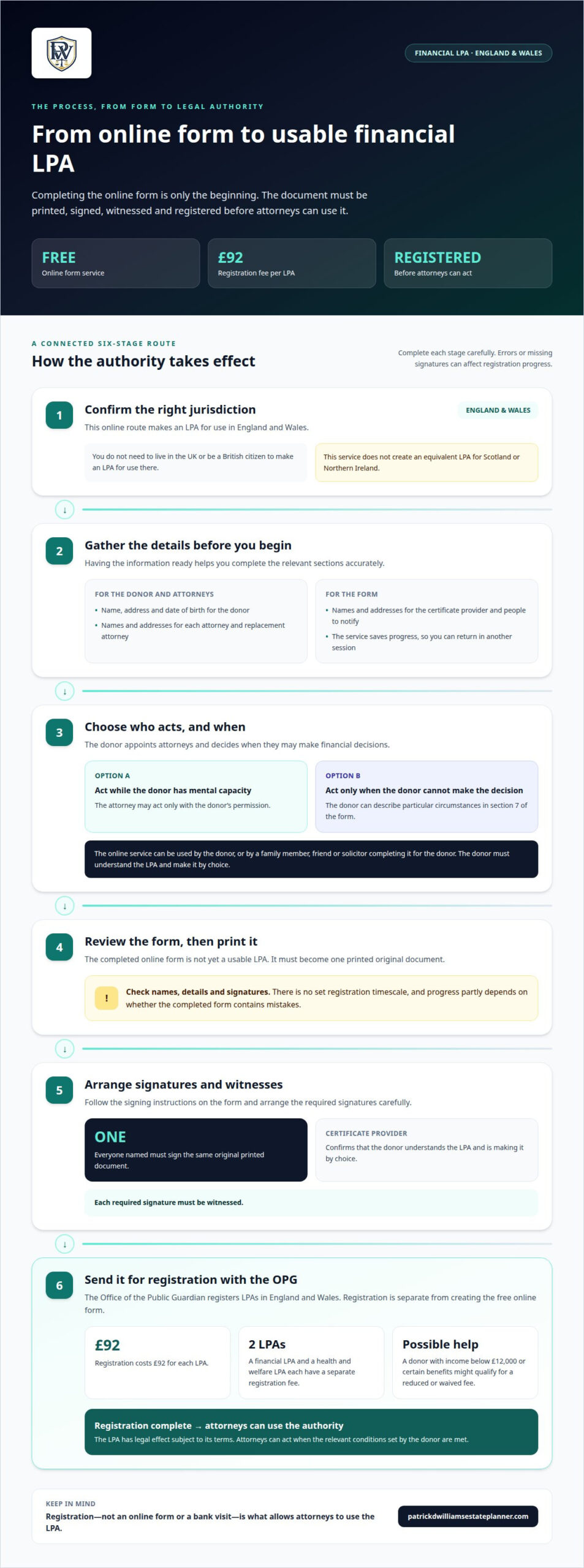
An online form is only the beginning. A financial lasting power of attorney online can be made for use in England and Wales, but it must be printed, signed and registered before an attorney can make decisions. According to the Office of the Public Guardian, registering each LPA in England and Wales costs £92. You don’t need to live in the UK or be a British citizen to make an LPA for use there.
Before choosing someone to manage financial decisions on your behalf, understand how the authority works. The person making the LPA, known as the donor, chooses their attorneys and sets out when they may act.
This guide explains what a power of attorney does, who can use the online service and how to complete the signing process. It also covers the duties attorneys must follow, helping you approach this important decision with greater clarity.
Key Takeaways
- A lasting power of attorney lets you appoint people you trust to make specified decisions about your finances or welfare.
- The online service is for LPAs registered in England and Wales on or after 1 January 2016, and you don’t have to live in the UK or be a British citizen to make one for use there.
- Plan the signing carefully: the form must be printed, and everyone named must sign the same original document with signatures witnessed.
- Attorneys must follow the Mental Capacity Act 2005 and can make a decision only when you’re unable to make it yourself, even with support.
- Compare general, specific and lasting powers of attorney to understand how their scope and effect differ, including what happens if you lose mental capacity.
What is a power of attorney?
A power of attorney gives someone authority to make decisions for another person, called the donor. A lasting power of attorney, or LPA, appoints attorneys to make decisions about the donor’s property and financial affairs, health and welfare, or both. The donor chooses who to appoint and sets out how and when they may act. The financial form is called a property and financial affairs LPA.
Making an LPA and registering it are separate steps. The online service for making an LPA is free, but attorneys cannot use the document until registration is complete. In England and Wales, the Office of the Public Guardian registers lasting powers of attorney. Registration gives the LPA legal effect, subject to its terms, and allows an attorney to act when the relevant conditions are met.
For a financial LPA, the donor decides when the attorney may start acting. It can permit action while the donor has mental capacity, but only with the donor’s permission. Alternatively, it can limit action to circumstances where the donor cannot make the relevant decision. The donor can describe particular circumstances in section 7 of the form.
How long does online LPA registration take in the UK? There is no set timescale for registering an LPA in England and Wales. Progress depends partly on whether the completed form contains mistakes, so review the details and signatures before sending it to the Office of the Public Guardian.
The registration fee is separate from creating the document. According to the Office of the Public Guardian, registering each lasting power of attorney in England and Wales costs £92. If someone registers both a financial LPA and a health and welfare LPA, each has its own registration fee. A donor registering two LPAs should therefore account for two separate charges.
Some donors might qualify for a reduced or waived registration fee. According to the Office of the Public Guardian, a donor in England and Wales with an income below £12,000 or who receives certain benefits might qualify. Eligibility depends on the donor’s income or benefits, so consider this before paying the registration fee. A reduced fee affects registration, not the free online form service.
Registration takes place with the Office of the Public Guardian, not at a bank or building society branch. A branch visit does not replace sending the LPA for registration. Keep the completed original form and follow the registration instructions; the guardian must register it before attorneys can use their authority.
A certificate provider also has a specific role before registration. They confirm that the donor understands the LPA and is making it by choice. This safeguard helps ensure the donor’s wishes, the attorney’s authority and the timing of decisions are clear in the completed document.
Eligibility for using the online service
You can make a lasting power of attorney online for use in England and Wales. You don’t need to live in the UK or be a British citizen. A financial lasting power of attorney online is intended for use in England and Wales, so the donor’s location does not determine eligibility. What matters is where the LPA will apply. This online route does not create an equivalent document for Scotland or Northern Ireland.
The online service can also help people access information about an existing LPA. It can be used for LPAs registered in England and Wales on or after 1 January 2016. For an LPA registered on or after 17 July 2020, the activation key is in the letter notifying the recipient that registration is complete. The service can help show organisations who the attorneys are and when they can act.
To create a financial lasting power of attorney online, enter the donor’s details, appoint attorneys and any replacements, choose when they may act, and provide details for the certificate provider and people to notify. Review the information, arrange the required signing, then submit the form for registration.
Have the donor’s name, address and date of birth ready, along with those details for every attorney and replacement attorney. You’ll also need the names and addresses of the certificate provider and anyone to notify. Gathering this information first helps you complete the relevant sections accurately.
The service saves your progress, so you can return to the form in another session. A family member, friend or solicitor can use the online service or fill in paper forms for the donor. The donor must still understand the LPA and make it by choice. A certificate provider confirms both points.
You cannot make an LPA online for use in Scotland or Northern Ireland through this service. The online route described here is for England and Wales, and the LPA is legally binding only there. If you need an arrangement for another jurisdiction, consider the rules that apply there.
An online form is not the same as a fully advised service. The online route lets you enter choices and details yourself, while professional guidance can help you consider whom to appoint, what authority to give them and when it should begin. This difference matters when family circumstances, finances or the donor’s wishes need careful discussion.
Before starting, decide who should act and whether replacement attorneys are appropriate. Gather names and addresses for everyone involved, then consider which people or organisations may need notification. A clear plan helps you complete the online service and gives the certificate provider specific choices to discuss with the donor.
Signing and witnessing LPA forms
Filling in the online LPA form is only the first step. Print it, arrange the signatures in the correct order and make sure each required signature has a witness.
Signing the LPA forms
Use the printed form as one original document. Everyone named must sign that same original; copies and digital signatures cannot be used. The donor signs first, followed by the certificate provider, then the attorney. This order matters because each person’s signature confirms their part in making the LPA. Leave space for the relevant witnesses to sign alongside the donor’s and attorneys’ signatures.
Witnessing signatures
Every witness and certificate provider must be at least 18 years old. The donor’s signature and each attorney’s signature must be witnessed. An attorney may witness another attorney signing, but cannot witness the donor’s signature or act as the certificate provider. The person appointing the attorneys cannot act as a witness. Keep these roles separate as you arrange the signing.
Before anyone signs, check that the printed form reflects the donor’s choices and the details provided for each attorney. Names and other information should be consistent throughout. A correction or missing signature can affect the application, so review every page and signature box before sending the original to the Office of the Public Guardian.
Follow this order when completing the signing process:
- The donor signs the LPA first, with an adult witness present.
- The certificate provider signs next, confirming the donor is making the LPA by choice and understands it.
- Each attorney signs after the certificate provider, with their signature witnessed.
- Check that all named people have signed the same original document before submitting it.
Do not replace the original with a photocopy after collecting signatures. The signing process applies to the paper document, even if you entered the details through an online service. If you appoint several attorneys, plan their signatures and witnesses so each attorney signs the original and has their signature witnessed.
A solicitor may act as a professional certificate provider, but the certificate provider cannot also witness the donor’s signature. An attorney who witnesses another attorney must still sign the LPA in their own role. Keeping everyone’s role clear helps prevent a witnessing error from disrupting the registration application.
Once the form is signed, check for the donor’s signature, the certificate provider’s signature, each attorney’s signature and all required witnesses. Then send the original for registration. The Office of the Public Guardian cannot register a form with a missing required signature or separate signed copies instead of one original.
Attorney duties and the donor’s best interests
An attorney’s authority comes from the registered LPA and its instructions. In England and Wales, decisions must follow the Mental Capacity Act 2005 and its code of practice.
Attorney decision-making duties
An attorney may make a decision only when the donor cannot make that particular decision themselves, even with support. Capacity is assessed for the specific decision at the time it needs to be made. For example, difficulty managing one financial matter does not by itself mean the donor cannot make other decisions.
Before acting, identify the decision that needs to be made and consider whether the donor can make it with suitable support. If they can, the attorney must not take the decision away from them. The LPA’s terms also matter: an attorney’s authority covers only the decisions the donor has authorised.
Acting in the donor’s best interests
The Mental Capacity Act 2005 and its code of practice set the principles attorneys must follow. The donor’s best interests guide decisions made under the LPA. This means an attorney should focus on the donor’s circumstances and the particular decision, rather than treating the appointment as general control over the donor’s affairs.
Start by recalling what the donor said when making the LPA. Their choices about when an attorney may act and the authority they granted provide essential context. Before making a financial decision, consider the donor’s stated wishes and the scope of the LPA. Keep the action focused on the matter the donor cannot decide.
Attorney signatures and duties
An attorney’s signature on the LPA confirms their appointment, but it does not give unrestricted authority. The LPA must be registered before the attorney can use it. Once acting, the attorney remains responsible for following the Mental Capacity Act 2005 and its code of practice, and for respecting any limits or conditions in the document.
If a financial LPA allows an attorney to act while the donor has mental capacity, the attorney may do so only with the donor’s permission. The donor can therefore remain involved in managing their affairs. Permission to help with a particular task does not give the attorney authority to make every financial choice independently.
Pause before each significant decision. Identify what the donor needs, whether they can decide with support and whether the LPA permits the attorney to act. For instance, when considering a bank transaction, distinguish that specific transaction from unrelated financial decisions. This keeps the attorney’s actions within the donor’s authority and the LPA’s purpose.
The Office of the Public Guardian sends activation codes to the donor and attorneys on the understanding that the LPA was created with consent and that they discussed the donor’s wishes and when attorneys can act. These conversations help attorneys remember the donor’s intentions when a decision arises. They do not remove the need to assess capacity for that particular decision at that time.
General, specific and lasting powers of attorney
The right document depends on which decisions you want someone to make and when they may act. In England and Wales, a lasting power of attorney is designed to continue if the donor loses mental capacity.
Types of power of attorney
A general power of attorney gives someone authority to act on another person’s behalf across a range of matters. A specific power limits that authority to a defined task or decision. A lasting power of attorney names appointed attorneys and sets out the decisions they can make under the document.
Consider the purpose before choosing. If someone needs help with a particular financial matter, they may want authority limited to that task. A donor planning for possible future loss of capacity needs to consider a lasting document, since a general power of attorney usually ceases to be accepted if the donor loses mental capacity.
Financial LPAs and enduring powers
What is the difference between a financial LPA and an enduring power of attorney? A financial LPA is the current document for appointing attorneys to manage property and financial affairs. A new enduring power of attorney cannot be made in England and Wales, although one set up before October 2007 remains valid.
A financial LPA lets the donor decide when attorneys may start acting. It can allow them to act while the donor has mental capacity, but only with the donor’s permission, or only if the donor loses capacity. An enduring power of attorney is an older arrangement, so check the document’s date and terms before relying on it.
The key difference is whether the authority is limited, broad or designed to continue if capacity is lost. A general power of attorney may suit a temporary need, but it does not provide the same future-planning function as a lasting document. A specific power focuses on a stated matter; a financial LPA covers property and financial decisions within the authority the donor sets.
Read the document carefully before anyone acts on the donor’s behalf. Check which decisions it covers, any conditions the donor included and when the attorney may act. For example, permission to help with financial affairs while the donor has capacity differs from authority that starts only if the donor cannot make decisions.
For an older enduring power of attorney, the date it was set up matters: one created before October 2007 remains valid, while a new one cannot be made in England and Wales. A financial LPA is the route for making a new lasting arrangement. The donor should choose attorneys and instructions that reflect the intended scope of their authority.
If you’re considering a new LPA, explore lasting power of attorney support to help shape the document around your decisions and chosen attorneys.
Patrick D Williams Estate Planners: Will Writing
Patrick D Williams Estate Planners can help you put lasting powers of attorney in place and consider how they fit alongside your will. This can help if you want support choosing attorneys, setting out their authority or coordinating future planning with your wishes for your estate.
Will Writing and Lasting Powers of Attorney address different parts of your plans, while a Property Protection Trust or Discretionary Trust may also be relevant to wider estate planning. The right next step depends on the decisions you want to plan for and the documents you need.
For guidance on your own arrangements, contact Patrick D Williams Estate Planners.
Make your plans reflect your priorities
Creating a financial lasting power of attorney online is also an opportunity to consider how you want financial decisions handled and whom you trust to make them. Before moving forward, discuss your priorities with the people you may appoint. These conversations can help clarify what matters to you and how you want decisions approached.
Think about the practical arrangements that will support your plans. Consider how your chosen attorneys can understand your wishes and find relevant information when needed. A clear record of your intentions can connect the authority in the document with the values behind your choices.
Patrick D Williams Estate Planners offers Will Writing, Lasting Powers of Attorney and Property Protection Trust services. These can help you consider your LPA alongside wider estate planning. For guidance on the next step, contact Patrick D Williams Estate Planners. A considered plan can give you and those close to you a clearer way forward.
Frequently Asked Questions
How much does it cost?
The online form service is free, while registration has a separate fee. According to the Office of the Public Guardian, registering each LPA in England and Wales costs £92. A professional drafting service may also charge for preparing documents; Patrick D Williams Estate Planners states that its professional service fees are fixed. These are distinct from the government registration fee, so identify which charge you’re considering.
What should I do if I’m having problems with my attorney?
Start by identifying the specific concern, such as a payment you don’t recognise or a decision that seems outside the LPA’s authority. Keep relevant correspondence and financial records, then discuss the issue with the attorney if appropriate and safe. Review the document’s instructions and limits. For suspected misuse or a serious dispute, seek independent legal advice about the options available in your circumstances.
Can I use a digital version of my LPA?
No, a digital copy cannot replace the signed original for making and registering an LPA. The document must be printed, and everyone named must sign the same original; digital signatures and separate copies cannot be used. You may keep a digital copy for your records, but don’t treat it as a substitute for the original during the formal process.
How can my attorney be sure they’re acting in my best interests?
An attorney should consider the donor’s wishes, the LPA’s instructions and the decision that needs to be made. For example, before arranging a payment, they can check whether it supports the donor’s needs and falls within the authority granted. They must follow the Mental Capacity Act 2005 and its code of practice, and avoid treating the appointment as permission to make every decision.
How does an LPA work?
An LPA records whom the donor appoints and which decisions those attorneys may make. For example, a property and financial affairs LPA can cover managing bills or dealing with a bank, within the document’s terms. Registration is required before attorneys can use their authority. The donor’s instructions determine when a financial attorney may act, including whether the donor’s permission is needed.
How should my attorney make decisions?
Before deciding, the attorney should identify the exact matter and consider whether the donor can make that decision with support. Capacity relates to the particular decision at the time, rather than a person’s ability in general. If the donor can decide, the attorney should let them do so. If not, the attorney must follow the LPA and the Mental Capacity Act 2005 principles.
What do I need to complete the form?
Gather the donor’s name, address and date of birth, along with the same details for each attorney and replacement attorney. You’ll also need the names and addresses of the certificate provider and anyone to notify. Having these details ready helps you enter consistent information and avoid pausing to find contact details midway through the form.
What is mental capacity?
Mental capacity concerns whether someone can make a particular decision at the time it needs to be made, even with support. It is not a general label for a person’s overall abilities. For example, someone may be unable to manage a complex financial decision but still be able to make a different choice. An attorney’s authority relates to decisions the donor cannot make themselves.
Leave a Reply