

Being named an executor can feel like an honour, but it also brings practical decisions and legal responsibilities at a sensitive time. The role involves more than applying for probate: an executor may need to identify estate assets, deal with paperwork and debts, and keep beneficiaries informed.
If you’re unsure what accepting the role would involve, that’s understandable. Executors and administrators have different roles, and probate is a legal process rather than a person. This guide explains what an executor does, the decisions and tasks that may arise, and where the role’s limits lie. It also explains how clear will planning can give an executor better direction and make estate administration more manageable.
For those planning ahead, an Executor Package can support relevant estate-planning arrangements. The following sections cover key responsibilities and explain when professional guidance may help keep matters organised.
Key Takeaways
- An executor is named in a will to deal with the estate after death. This guide focuses on England and Wales, where procedures differ from elsewhere in the UK.
- Estate administration involves identifying assets, dealing with liabilities and distributing what remains under the will.
- Understand the distinction between an executor, an administrator and a grant of probate, and why keeping clear records matters.
- The demands of the role vary between estates. Organised paperwork, timely communication and guidance when uncertainties arise can help keep matters manageable.
- Use a practical framework to choose a suitable person, discuss the appointment and keep the will under review as circumstances change.
What is an executor, and when does the role begin?
An executor is a person named in a will to deal with the deceased person’s estate after their death. The role involves carrying out the will’s instructions and handling practical matters connected with the estate. This section explains the position in England and Wales; procedures differ across the UK.
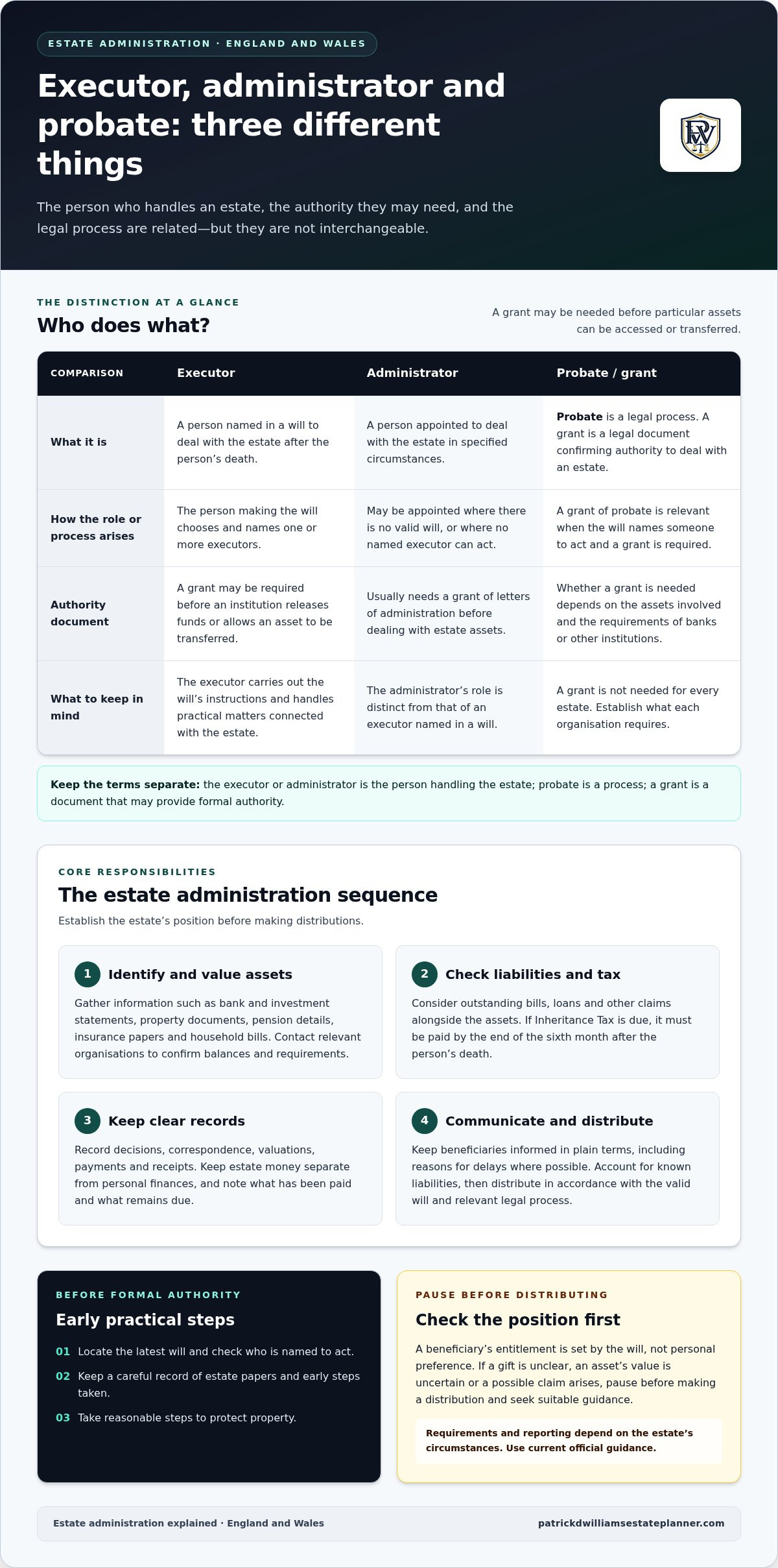
The will names the executor, but their responsibilities arise after the person’s death. An administrator is different: they may be appointed where there is no valid will, or where no named executor can act. An administrator usually needs a grant of letters of administration before dealing with estate assets. The Executor (law) entry gives a broader overview of the term, while the detail here focuses on England and Wales.
How is an executor appointed in a will?
The person making a will chooses and names one or more people to carry out its instructions. They may select someone they trust to keep records, communicate carefully and make decisions in line with the will. Before agreeing to take on the role, an appointee should understand that it can involve paperwork, financial information and contact with beneficiaries. The demands depend on the estate and its circumstances.
Being named does not mean every estate needs a grant of probate. A grant is a legal document confirming authority to deal with an estate. Whether one is needed can depend on the assets involved and the requirements of banks or other institutions. If an appointee is unsure about accepting, getting guidance before taking steps to administer the estate can help clarify their position.
When does an executor’s work start?
The executor’s work concerns administration after the person has died. Some practical steps can begin early, such as locating the will, identifying important papers and taking reasonable steps to protect property. These actions help establish what the estate contains, but they do not necessarily provide authority to access or transfer every asset.
Formal authority may be required before an institution releases funds or allows an asset to be transferred. Requirements vary, so the person handling the estate may need to establish what each organisation needs. A grant of probate is generally relevant when the will names someone to act and a grant is required. Where an administrator is appointed, the corresponding grant is usually letters of administration.
- Locate the latest will and check who is named to act.
- Keep a careful record of estate papers and early steps taken.
- Establish which institutions require a grant before assets can be dealt with.
Keeping early practical tasks separate from actions that depend on formal authority helps prevent confusion. It also gives the person responsible a clearer starting point for the administration that follows.
What responsibilities does an executor have during estate administration?
The core duties are to identify and value estate assets, deal with liabilities and any tax obligations, keep accurate records, and distribute the estate in accordance with the will and applicable legal process. A methodical approach helps because decisions about assets, debts and beneficiaries can affect one another. Establish the estate’s position before making distributions.
How are assets, debts and estate information identified?
Start by gathering information about what the deceased owned and owed. This may include bank and investment statements, property documents, pension details, insurance papers, household bills, and records of loans or credit. Contacting relevant organisations can help establish balances and what is required before an asset can be transferred or released. Keep copies of requests and responses, along with notes of decisions and transactions.
Consider liabilities alongside assets. Check for outstanding bills, loans and other claims, and avoid treating the estate’s apparent value as money available to beneficiaries until its obligations have been considered. Tax reporting may also be required. Inheritance Tax must be paid by the end of the sixth month after the person’s death if it is due, so identifying potential tax issues early can matter. HMRC reporting requirements and probate procedures depend on the estate’s circumstances; use current official guidance rather than relying on an old form or checklist.
A grant may be required before particular assets can be accessed or transferred. GOV.UK explains the application process in its guide to Applying for probate in the UK. Whether a grant is needed depends on the assets and the organisations holding them, so consider it as part of the wider administration rather than assuming it is necessary in every case.
How should beneficiaries and distributions be handled?
Beneficiaries may want updates, especially if administration takes time. Explain progress in plain terms and, where possible, give a clear reason for delays. Considerate communication cannot guarantee agreement, but it can help people understand what stage the estate has reached and why a decision is taking time.
Before distributing assets, account for the estate’s known liabilities and follow the valid will and relevant legal process. A beneficiary’s entitlement is set by the will, not by personal preference. If a gift is unclear, an asset’s value is uncertain or a possible claim arises, pause before making a distribution and seek suitable guidance.
- Record decisions, correspondence, valuations, payments and receipts.
- Keep estate money and personal finances clearly separate.
- Note what has been paid, what remains due and the basis for each distribution.
These records create a clear account of how the estate has been handled and help answer reasonable questions from beneficiaries. For those planning ahead, an Executor Package can support relevant estate-planning arrangements.
Executor, administrator and probate: what is the difference?
These terms describe different things. An executor is a person named in a will, an administrator is a person authorised to deal with an estate when no executor can act, and probate is the process of establishing authority to administer an estate or the grant that provides it. Keeping these distinctions clear helps you understand who is responsible and what paperwork may be needed.
Executor
A person named in a valid will to carry out its instructions. If a grant is required, they can apply for a grant of probate.
Administrator
A person authorised to deal with the estate when there is no executor able or entitled to act. They apply for the appropriate grant of letters of administration.
Probate
A legal process, and a term often used for the grant confirming authority to deal with estate assets. The particular grant depends on the circumstances.
What is the difference between an executor and an administrator?
In England and Wales, a will names an executor. An administrator is appointed under different rules, commonly where someone dies without a valid will or no named executor can act. The roles are related, but the terms are not interchangeable. An administrator receives authority through the relevant grant rather than being named as executor in the will.
The precise route depends on the circumstances, including whether there is a will and whether any named executor is able to act. Where the position is not straightforward, establish the applicable probate rules and the correct application process before taking steps that depend on formal authority.
Is probate always required?
No. Some estates can be dealt with without a grant, depending on the assets, how they are held and the requirements of the organisations that hold them. For example, an institution may ask to see a grant before releasing or transferring an asset, while another may have a different process. No single threshold determines the answer for every estate.
It is useful to distinguish the need to administer an estate from the need to obtain a grant. A will can name someone to act even where a grant is not required for the particular assets. Conversely, a named executor may need a grant before dealing with certain estate property.
- Identify the assets and how they are held.
- Establish what each relevant bank, registry or other asset-holder requires.
- Use the appropriate grant process if formal authority is needed.
This distinction also helps explain why probate is not another name for the person carrying out the work. The grant concerns legal authority; the appointed person is responsible for acting within that authority and following the applicable process. Requirements depend on the estate and the institution involved, so avoid relying on a universal rule when deciding whether a grant is needed.
What challenges can an executor face, and how can they prepare?
The role carries responsibility, but the demands vary considerably between estates. One may involve straightforward accounts and clear instructions, while another may include property, several financial arrangements, missing paperwork or unresolved liabilities. Delays can follow when information is incomplete or an organisation needs further evidence. These difficulties don’t mean that every estate is contentious; they make a steady, organised approach especially useful.
Can an executor be personally responsible for mistakes?
An executor should act carefully, follow the will and applicable process, and keep a clear record of decisions. Personal exposure can depend on the circumstances and the nature of an error. For example, distributing assets before understanding outstanding liabilities may create problems if the estate cannot meet what it owes. This is a reason to pause when information is uncertain, not to assume that every mistake leads to personal liability.
Keep correspondence, notes of decisions and records of estate transactions together. If a tax question, unclear instruction or complex asset makes the right course uncertain, tailored professional guidance can help clarify the options before action is taken. The appropriate support depends on the issue; not every estate needs a professional to handle its administration.
What can make an estate harder to administer?
Incomplete financial records can make it difficult to identify accounts or understand outstanding commitments. Assets held in different ways may involve separate organisations and requirements. Liabilities may take time to establish, and beneficiaries may have different expectations about timing or progress. Clear, measured updates can explain what is known and what remains unresolved, without suggesting that a final date can always be given early.
A clear will and orderly information can reduce avoidable uncertainty. Notes about where important papers are kept, current details of assets and a properly recorded appointment give the person dealing with the estate a more useful starting point. They can’t remove every complication or guarantee agreement between family members, but they may help prevent confusion about the deceased’s intentions and the next steps.
Preparation need not mean trying to predict every eventuality. Make information accessible, record decisions as they arise and communicate at a sensible pace. If an issue has legal or financial implications that are unclear, avoid guessing or making an irreversible decision simply to keep matters moving.
- Keep estate documents and correspondence organised in one accessible place.
- Explain delays calmly, distinguishing confirmed information from matters still being resolved.
- Seek guidance where the will, an asset or an outstanding liability raises uncertainty.
For those planning ahead, clear will arrangements can help an appointed person understand the intentions they are expected to carry out. Explore support with will planning to make those instructions clearer.
How can thoughtful will planning support an executor?
An up-to-date will can name the person or people intended to carry out its instructions and explain how the estate should be dealt with. Clear, carefully considered wording gives the appointed person a point of reference when decisions arise. It can also help distinguish the testator’s intentions from assumptions made by family members.
Choosing someone suitable is a personal decision. The right choice depends on relationships, the person’s circumstances and the nature of the estate. A trusted relative may be well placed to act, while someone else may prefer to appoint another person. No single choice is right for every family.
How should someone choose an executor?
Consider whether the person is reliable, willing and likely to have time to manage the administration. They may need to handle financial information, communicate with beneficiaries and make decisions carefully. Discussing the proposed appointment allows them to understand what may be involved and say whether they feel able to take it on. Avoid assuming that a close relative will automatically be the most suitable choice.
What steps can make an appointment clearer?
A simple framework can help make the decision a considered part of will planning:
- Consider suitability. Reflect on the person’s reliability, availability and the likely complexity of the estate.
- Discuss the role. Explain the appointment and give them the opportunity to consider it.
- Record the appointment. Name the chosen person or people clearly in the will, with the document prepared and signed in accordance with the applicable requirements.
- Review the will. Revisit the appointment and instructions when relationships, circumstances or the estate change.
This review matters because a suitable choice at one stage of life may not remain practical indefinitely. A change in the named person’s health, location or willingness to act can be a reason to reconsider the appointment. Reviewing the will also gives the testator an opportunity to check that its instructions still reflect their intentions.
When may professional estate-planning support help?
Guidance can be useful where the estate includes complex assets, trust arrangements or instructions that feel difficult to express clearly. A trust can affect how property is planned for, so anyone considering one may find it helpful to understand the relevant arrangements, including a Property Protection Trust. The aim is to make the will and wider planning coherent, rather than assume every estate needs the same approach.
Patrick D Williams Estate Planners offers an Executor Package for people seeking relevant planning support. A free 15-minute consultation is available by Zoom, Teams or in person. It is an opportunity to discuss will-writing and executor-planning needs, rather than a promise of estate administration after a death.
To consider how clear instructions and an appropriate appointment can support your plans, explore will-writing and executor-planning support.
Give your estate plans a clear next step
Planning ahead is a practical way to make your wishes easier to understand and give the person you appoint a clearer foundation for their role. Your arrangements should reflect your circumstances and remain under review as life changes. You don’t need to resolve every detail at once. A considered conversation can help you identify what needs attention and decide on a suitable way forward.
Patrick D Williams Estate Planners offers an Executor Package for people seeking support with relevant planning. A free 15-minute consultation is available by Zoom, Teams or in person. Use it to discuss your will-writing and executor-planning needs; not every estate requires professional help.
Arrange a free 15-minute estate-planning consultation to take a calm first step towards clearer plans for the people who matter to you. Thoughtful preparation can bring greater confidence to decisions made now and in the future.
Frequently Asked Questions
Can an executor also be a beneficiary of the will?
Yes. A person can be appointed to administer an estate and also inherit under the will. These are separate roles: as beneficiary, they receive what the will provides; as executor, they must follow the will and applicable process. For example, an executor who is left a specific item must still ensure the estate is administered properly before that gift is transferred. Their inheritance does not give them authority to alter anyone else’s entitlement.
Can an executor refuse to act?
Yes, an appointed person may be able to decline the role, but the position depends on what steps they have already taken. If they have not begun administering the estate, they can usually explore formally renouncing their appointment. If they have already acted, stepping aside may be more complicated. An executor who is unsure should seek legal guidance before taking further action, so the correct procedure can be considered for their circumstances.
How long does an executor have to settle an estate?
There is no strict legal deadline to distribute every estate, but 12 months from the date of death is commonly known as the executor’s year. This is a general guideline, not a guarantee that administration will be complete within that time. Missing information, tax matters or complex assets can take longer to resolve. Beneficiaries generally cannot require distribution before the executor’s year has ended.
Does every executor need to apply for a grant of probate?
No. Whether a grant is needed depends on the estate’s assets and the requirements of the organisations holding them. For instance, a bank may require a grant to release funds, while another asset may be dealt with without one. The need for a grant is also distinct from any tax or estate-reporting obligations. Establish the requirements for the specific assets rather than assuming the same process applies to all.
What happens if there is no executor named in a will?
If a valid will exists but no executor is named, or no named person is able to act, someone with the appropriate entitlement may need to apply for a grant of letters of administration with the will annexed. This allows the estate to be administered according to the will. If there is no valid will, the estate is generally dealt with under intestacy rules, and an eligible person can apply to administer it.
Can an executor change the terms of a will?
No. An executor cannot change the will or decide to give a beneficiary a different entitlement simply because they think it would be fairer. In some circumstances, beneficiaries may agree to vary how an inheritance is distributed, but that is separate from the executor’s authority and may have legal or tax consequences. Anyone considering a variation should obtain advice on the proposed arrangement before relying on it.
Leave a Reply