

Estate planning is more than deciding who inherits your home. It brings together practical choices about your property, finances and care, so the right people can act and your wishes are understood. A will is one part of that plan, but it cannot cover every decision.
It’s understandable to feel unsure about what happens without clear arrangements, or to wonder whether planning is only for older people or those with substantial wealth. Changes in health, relationships or family circumstances can make a will, a Lasting Power of Attorney (LPA) or a trust relevant at different stages of life.
This guide explains how these arrangements work, how they can complement one another and which circumstances may call for professional guidance. You’ll also find practical first steps to help you consider your options without feeling pressured to decide everything at once. Some rules and documents differ across England and Wales, Scotland and Northern Ireland, so your location matters.
Key Takeaways
- Use estate planning to organise lifetime decisions and what should happen to your assets after death.
- Compare wills, Lasting Powers of Attorney and trusts by purpose, timing and the people involved.
- Gather an overview of your assets, how they are owned and any existing documents before seeking guidance.
- Consider professional advice if your family or property arrangements make it less clear which documents may suit you.
- Before choosing support, clarify the service scope, responsibilities, drafting process and any fixed-fee arrangements.
What is estate planning, and what can it help you put in order?
Estate planning means arranging how decisions, assets and responsibilities should be handled if you can’t make or communicate decisions yourself, and after your death. It is a coordinated set of choices, not a single document. A general overview of the concept and its common tools is available in Estate planning. The legal effect of particular arrangements depends on the rules that apply where you live.
This guide focuses on England and Wales. Scotland and Northern Ireland have different legal systems, so check the relevant rules separately if you live there or own property there. What may be appropriate depends on your family, finances, property ownership and personal wishes. A parent with dependent children, for example, may have different priorities from someone who owns a home jointly or wants trusted people to manage decisions if their health changes.
What does an estate plan usually include?
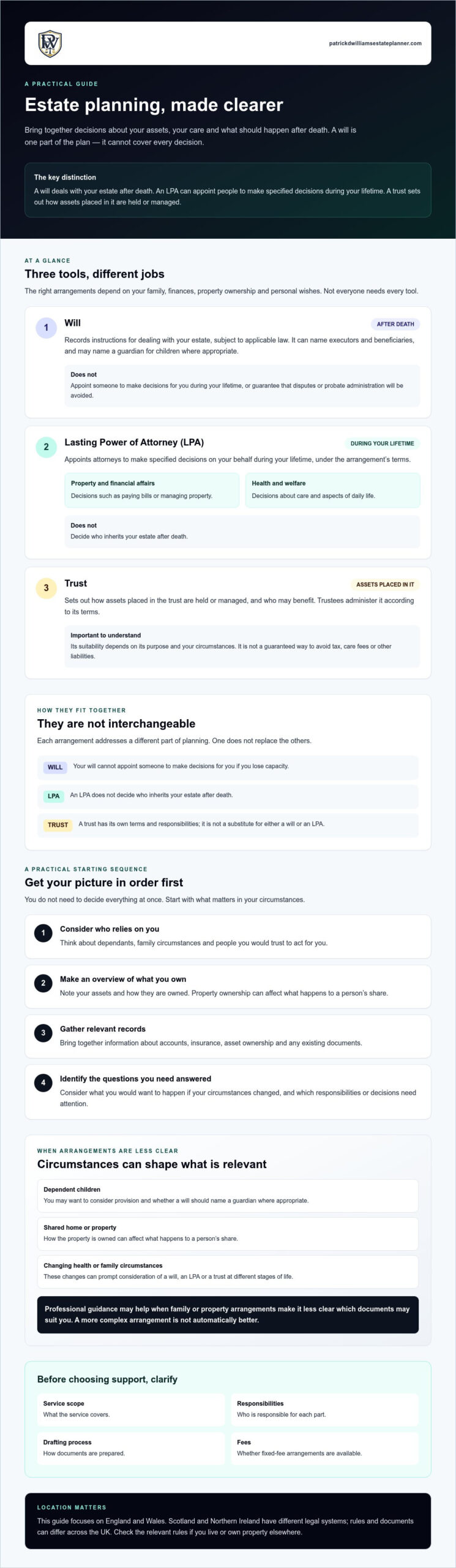
Three tools often considered are a will, a Lasting Power of Attorney (LPA) and a trust. Each has a different role:
- A will records instructions for dealing with your estate after death, subject to applicable law.
- An LPA appoints attorneys to make specified decisions on your behalf during your lifetime, under the arrangement’s terms.
- A trust sets out how assets placed in it are held or managed, and who may benefit. Its suitability depends on its purpose and your circumstances.
Property ownership matters too. The way a home is held can affect what happens to a person’s share. Clear records of accounts, insurance, existing documents and asset ownership can also help those dealing with your affairs understand what needs attention. These tools aren’t interchangeable, and not everyone needs each one. The aim is to identify arrangements that address your priorities.
Is estate planning only for wealthy or older people?
No. Practical arrangements aren’t limited to a particular age or level of wealth. Dependants may need clear provision and guidance, while people who share a home may want to understand how its ownership affects their plans. A change in health can also prompt someone to consider who they would trust to make decisions on their behalf.
Start with your circumstances, not a checklist of documents. Consider who relies on you, what you own and how it is held, who you would trust to act for you, and what you’d want to happen if your situation changed. These priorities can help you decide whether further guidance is needed, without assuming that a more complex arrangement is automatically better.
How do wills, LPAs and trusts work in estate planning?
A will, a Lasting Power of Attorney (LPA) and a trust can form part of a wider plan, but they serve different purposes. A will sets out your wishes for your estate after death, subject to applicable law. An LPA appoints one or more attorneys to make specified decisions for you during your lifetime. A trust sets out how assets placed within it are held or managed, and who may benefit.
These arrangements don’t replace one another. A will cannot appoint someone to make decisions for you if you lose capacity, and an LPA doesn’t decide who inherits your estate after death. A trust has its own terms and responsibilities, so it shouldn’t be treated as a substitute for either document.
What does a will do, and what does it not do?
A will can name executors to administer your estate and beneficiaries to receive gifts or a share of it. If you have children, it may also name a guardian where appropriate. Choosing people and explaining your wishes clearly can help those responsible understand your intentions, but a will can’t guarantee that disputes or probate administration will be avoided.
A will also doesn’t cover decisions during your lifetime. Naming an executor, for example, doesn’t give that person authority to manage your bank accounts or make care decisions while you’re alive. Those arrangements need separate consideration.
When might an LPA or trust be considered?
An LPA may be relevant if you want trusted people to make specified decisions on your behalf during your lifetime. In England and Wales, LPAs cover two areas:
- Property and financial affairs: decisions about matters such as paying bills or managing property.
- Health and welfare: decisions about care and aspects of daily life.
A trust may be considered where there’s a particular reason to set terms for how assets are managed or who can benefit. Trustees are responsible for administering the trust according to its terms, while beneficiaries may receive a benefit under those terms. The detail depends on the trust’s purpose and structure. It isn’t a guaranteed way to avoid tax, care fees or other liabilities.
For example, someone with a dependent child might consider how a will and any trust arrangements could provide for them, while separately thinking about who could make financial or welfare decisions during their lifetime. Whether those documents are suitable, and what their legal consequences may be, calls for a review of the individual circumstances. Learn more about will, LPA and trust options.
Estate planning choices compared: will, LPA or trust?
Each arrangement addresses a different need. Use this comparison to identify what to ask about, rather than assume one document is automatically better or that every plan needs all three.
| Arrangement | Purpose | When it applies | People involved and common use |
|---|---|---|---|
| Will | Records instructions for dealing with an estate after death, subject to applicable law. | After death. | Executors administer the estate; beneficiaries may receive gifts or a share. A will may also name guardians for children where appropriate. |
| Lasting Power of Attorney (LPA) | Authorises appointed attorneys to make specified property and financial, or health and welfare, decisions. | During the donor’s lifetime, under the LPA’s terms and relevant rules. | The donor appoints attorneys. An LPA may be considered for decisions the donor could be unable to make themselves. |
| Trust | Sets terms for holding or managing assets and who may benefit. | Depending on its structure, it may be established during life or created through a will. | Trustees manage assets under the trust’s terms for beneficiaries. Uses depend on the purpose and circumstances. |
Will versus Lasting Power of Attorney
A will concerns your estate after death; an LPA concerns specified decisions during your lifetime. They have different roles, so an executor named in a will doesn’t automatically have authority to make decisions for you while you’re alive. In England and Wales, an LPA must be registered with the Office of the Public Guardian before it can be used. Its scope depends on the type made and its terms.
Will versus trust
A will gives instructions for the estate, while a trust involves trustees managing assets according to defined terms. Some trusts are set up during a person’s lifetime; others can be created through a will and take effect after death. The consequences depend on the arrangement, including its legal, tax and administrative effects. Take individual advice before deciding whether a trust fits your circumstances.
In practice, estate planning may involve one arrangement or several that address separate priorities. A will and an LPA, for example, deal with different periods of life, while a trust may have a particular role in managing assets. A review of your circumstances can help clarify how the options interact and what responsibilities each would involve.
How to start estate planning: a practical preparation sequence
A useful first step is to organise what you know before deciding which documents to make or change. This gives you a clearer picture of your priorities and helps a professional identify questions that need closer attention. You don’t need to have every answer ready.
- List your priorities. Note who depends on you, what decisions you want clarified and what you’d like to happen to your assets. Separate lifetime concerns, such as who could help manage decisions, from your wishes for after death.
- Gather an overview of your assets and ownership. Record property, savings, investments, pensions and other relevant assets, along with how they’re owned. This is an overview, not a request to share account passwords or security codes.
- Find existing documents. Collect any current will, LPA or trust paperwork, and note where original documents are held. Include relevant records about property ownership and any changes you’ve already made.
- Consider who might take on key roles. Make a private shortlist of possible executors, attorneys and beneficiaries. Think about whether each person understands the responsibility and is willing to take it on. You can discuss suitability before making a final choice.
- Check which jurisdiction applies and arrange a review. This article focuses on England and Wales. If you live elsewhere in the UK, or have property in another jurisdiction, check the rules that apply there. Seek tailored guidance before implementing complex arrangements.
What information should you gather first?
Keep your notes practical: list assets and ownership, family responsibilities, existing documents and the decisions you want to clarify. Add contact details for people who may have a role, but handle sensitive records and access information securely. A clear inventory can help you identify gaps without making assumptions about which legal arrangements you need.
When should an estate plan be reviewed?
Consider reviewing your arrangements after a major change, such as a new child, a separation, buying or selling property, or a change in health. Check whether the people named in your documents are still suitable and whether the instructions reflect your current wishes. There’s no need to treat a fixed review interval as a legal requirement; revisit documents when your circumstances or intentions change.
Patrick D Williams Estate Planners offers a free 15-minute consultation to discuss which will, LPA or trust arrangements may be relevant. Find out more about planning options.
Choosing estate planning support and deciding your next step
Professional support can help you understand which documents may fit your circumstances, how they work together and what is involved in preparing and completing them. Before choosing a service, ask for a clear explanation of its scope. This makes it easier to compare support based on what you need, rather than assuming every document is included or suitable.
What should you clarify before choosing a planning service?
Use an initial discussion to establish what the service covers and whether its recommendations take your circumstances into account. Useful points to clarify include:
- Documents included: Ask whether the work concerns a will, a Lasting Power of Attorney, a trust or a combination, and why each may be relevant to you.
- Responsibilities: Find out what information you need to provide and what the service provider will prepare or explain.
- Completion guidance: Clarify what guidance is available on signing, witnessing and any other steps needed to complete the documents correctly.
- Fees and follow-up: Ask whether a fixed-fee arrangement applies, what it includes and whether follow-up support is part of the service.
- Jurisdiction: Check that the guidance relates to the relevant part of the UK, particularly if you live or own property in more than one jurisdiction.
Clear answers help you understand the boundaries of the service before deciding whether to proceed. They also give you a chance to raise concerns about family arrangements, property ownership or existing documents that may affect the discussion.
How can Patrick D Williams Estate Planners help?
Patrick D Williams Estate Planners provides will writing, Lasting Powers of Attorney and bespoke trust arrangements, including property protection, discretionary and bare trusts. These options serve different purposes, and a discussion can help establish which, if any, may be relevant to your circumstances. Preparing a document or trust does not by itself guarantee a particular outcome.
Consultations are available through Zoom, Teams or in person. The firm’s services include fixed-fee professional work for wills and Lasting Powers of Attorney, as well as project-based fees for trust arrangements. More information about the firm’s estate planning services is available online.
Take a clear first step towards a plan that fits
Estate planning is most useful when its parts address your actual circumstances. A will records wishes for after death, an LPA covers specified decisions during your lifetime, and a trust may help manage assets under defined terms. These tools have distinct purposes, so start by identifying what you want to put in order.
Gather your existing documents and a broad outline of your assets, ownership and family responsibilities. Then consider who you may trust to act as an executor or attorney, and whether your wishes still reflect your circumstances. Tailored guidance can help clarify document choices, the steps involved and which jurisdiction’s rules apply.
Patrick D Williams Estate Planners provides will writing, Lasting Powers of Attorney and bespoke trusts. Consultations are available through Zoom, Teams or in person. Arrange a free 15-minute consultation to discuss your priorities and possible next steps when you’re ready.
Frequently Asked Questions
What is included in estate planning?
Estate planning can bring together arrangements for your assets after death and for decisions during your lifetime if you can’t make them yourself. Depending on your circumstances, this may include a will, one or more Lasting Powers of Attorney (LPAs), or a trust. Property ownership, family responsibilities and existing documents can also affect what needs attention. There’s no standard set of documents that suits everyone.
Do I need estate planning if I already have a will?
A will sets out wishes for your estate after death, but it doesn’t appoint someone to make decisions for you during your lifetime if you lose capacity. An LPA may cover specified property and financial affairs, or health and welfare decisions. You may also want to review property arrangements or consider whether a trust is suitable. Whether any additional arrangement is appropriate depends on your circumstances and merits careful consideration.
What happens if I die without a will in England and Wales?
If you die without a valid will in England and Wales, intestacy rules determine who may inherit. The result depends on your family circumstances and the applicable rules, and may not reflect your personal wishes. Don’t assume that an unmarried partner will inherit in the same way as a spouse or civil partner. Check current official guidance or seek advice tailored to your circumstances before relying on assumptions.
Can I make an LPA as part of estate planning?
Yes. An LPA can form part of arrangements for decisions during your lifetime. In England and Wales, there are separate LPAs for property and financial affairs, and for health and welfare. The donor must meet the relevant requirements, and the LPA must be registered with the Office of the Public Guardian before it can be used. Check current official guidance and consider which decisions you want attorneys to handle.
Are trusts necessary for estate planning?
No. A trust is one possible arrangement, not a requirement for everyone. Its suitability depends on your aims, the assets involved, who may benefit and the responsibilities trustees would take on. Trusts can have legal, tax and administrative consequences, so don’t choose one based on broad claims alone. Get advice that considers your circumstances and current rules before deciding whether a trust, such as a discretionary or bare trust, may be appropriate.
How often should I review my estate plan?
Review your arrangements when circumstances change, such as after a marriage, separation, birth, death, property change or significant change in health. Check that your documents still reflect your wishes and that the people named remain appropriate for their roles. There isn’t one review interval that suits everyone. A professional review can help you identify whether any document needs updating or whether further arrangements should be considered.
Does estate planning include inheritance tax planning?
Estate planning may include considering how inheritance tax could affect an estate, but this isn’t the same as individual tax advice. The tax treatment depends on current rules and your circumstances, so general examples may not apply to you. A planner can help identify questions to raise, while complex tax matters may need advice from a suitably qualified tax professional. Check current guidance before relying on figures or rules.
Leave a Reply