
A jointly held home or bank account may pass to the surviving owner rather than under intestacy rules. For other assets in England, the consequences of dying intestate with children depend on whether a married or civil partner survives: for deaths on or after 26 July 2023, that partner receives the first £322,000 and all personal possessions, with the remaining estate shared between the partner and children. If there is no surviving spouse or civil partner, the children inherit the estate.
It’s understandable to expect that everything will simply be divided between close family members. In practice, the type of ownership matters as well as the family relationship, and the rules differ across the UK. This article explains how intestacy affects children, bank accounts and jointly owned assets, including what happens when a child is under 18. It also outlines the role a will can play in setting out how your estate should pass to your family.
Key Takeaways
- Who inherits depends on whether a spouse or civil partner survives, as well as the children’s legal relationship to the deceased.
- Children’s inheritance may be held in trust until they reach adulthood, with trustees able to use it for their benefit.
- Joint bank accounts and jointly owned property may pass to the surviving owner rather than through the estate.
- Intestacy rules differ across the UK, so the rules that apply depend on where the deceased lived.
- A will can set out how assets should pass to children and provide for arrangements that intestacy rules do not cover.
What happens to a bank account when someone dies without a will?
A sole-name bank account forms part of the estate and is distributed under intestacy rules. In England, what happens depends on the surviving family and whether the account was held jointly.
Children’s inheritance with a surviving partner
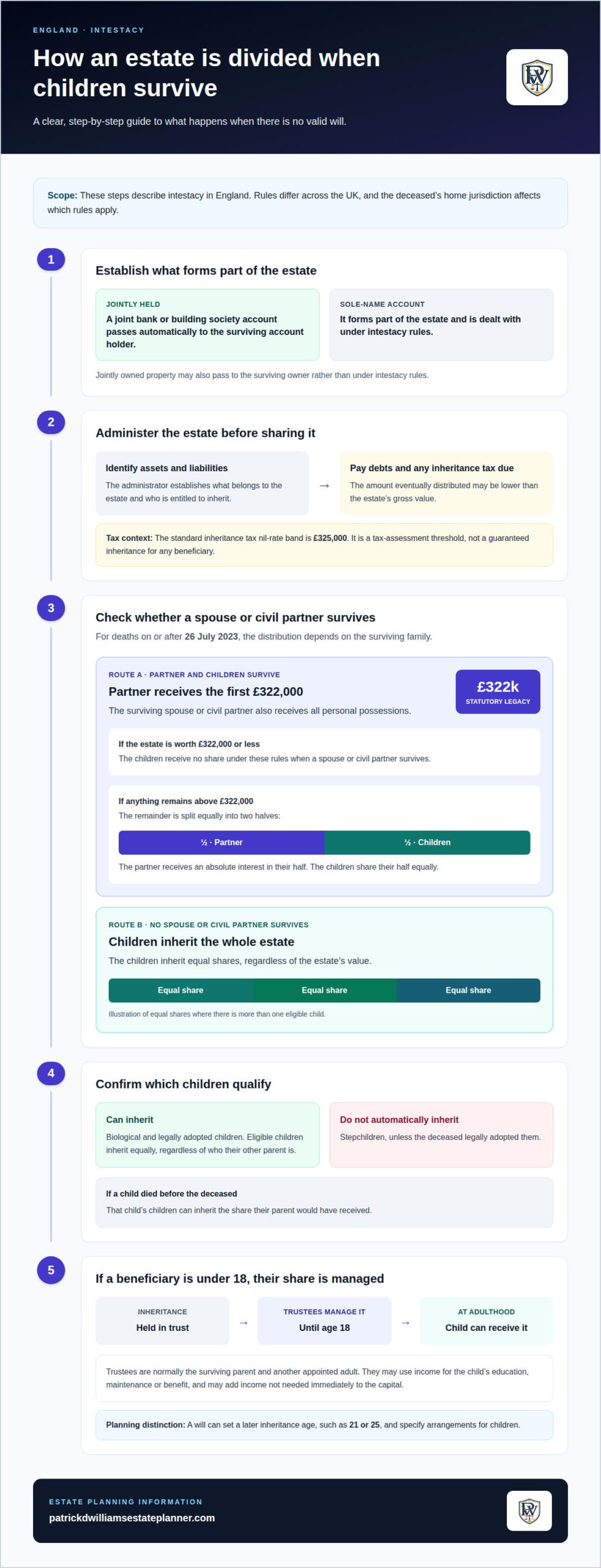
When someone dies intestate leaving a married or civil partner and children, the partner receives the first £322,000 of the estate for deaths on or after 26 July 2023, plus personal possessions. If the estate is worth £322,000 or less, the children receive no share under these rules. Above that threshold, the remaining estate is divided between the partner and children. This distinction affects how much may ultimately be available for each child.
Children’s inheritance without a surviving partner
If no spouse or civil partner survives, the children inherit the whole estate, regardless of its value. Where there is more than one child, they inherit equal shares. A child under 18 cannot receive their inheritance until turning 18, so trustees hold and manage that share in the meantime. Trustees are normally the surviving parent and another appointed adult, and may use income for the child’s education, maintenance or benefit.
Which children can inherit
In England and Wales, biological and legally adopted children can inherit under intestacy rules. Stepchildren do not automatically inherit unless the deceased legally adopted them. All eligible children inherit equally, regardless of who their other parent is. These rules may differ from personal expectations, particularly in blended families where a stepchild has been raised as part of the family.
If a child died before the person who died intestate, that child’s children can inherit the share their parent would have received. If a minor inherits and later dies, their children hold the inheritance on the same basis. If the minor has no children, it passes to whoever was next entitled when the minor died.
For a child’s trust, trustees may add income not needed immediately to the capital. This keeps the inheritance managed until the child reaches 18, rather than making it available outright earlier. A will can set a later inheritance age, such as 21 or 25, and specify arrangements for children.
Adult beneficiaries may agree to change the distribution through a deed of variation, provided everyone aged over 18 who would inherit agrees and the change is made within 2 years of death. Separately, the Inheritance (Provision for Family and Dependants) Act 1975 allows a cohabiting partner who lived with the deceased for at least two years to apply to court for reasonable financial provision.
In England, a jointly held bank or building society account passes automatically to the surviving account holder. A sole-name account is different: it forms part of the estate, and the person entitled to deal with the estate’s money, property and possessions needs to apply for probate.
What are the intestacy rules in the UK?
Intestacy rules determine who receives an estate when someone dies without a valid will. The outcome depends on the surviving family and where the person lived.
Finding and administering the estate
Administration involves identifying the deceased’s assets and liabilities, then distributing what remains to beneficiaries. Because no executor was appointed in a will, someone must take on these tasks. A person entitled to a share of the estate needs to apply for probate. The administrator then establishes which assets form part of the estate and identifies those entitled to inherit.
Debts and inheritance tax before distribution
Estate debts and any inheritance tax due are dealt with before beneficiaries receive their shares. This means the value eventually distributed can be lower than the estate’s gross value. The standard inheritance tax nil-rate band is £325,000. That figure is a threshold used when assessing tax, not a guaranteed amount each beneficiary receives. The administrator must account for liabilities and tax before dividing the estate under intestacy rules.
The statutory legacy and remaining estate
In England, a surviving spouse or civil partner with children receives the statutory legacy of £322,000 for deaths on or after 26 July 2023, plus the deceased’s personal possessions. This initial allocation matters because it determines what remains for the spouse and children. If the estate exceeds that amount, the remainder is divided: the spouse receives an absolute interest in half, and the other half is divided equally between the children. UK Parliament describes this division of the remainder under the rules for England and Wales.
Dividing the estate between a spouse and children
For a family with two children, the children share the half of the remainder equally, rather than receiving a share of the entire estate. The spouse receives the statutory legacy, personal possessions and half of the remainder. If the estate is worth £322,000 or less, children do not inherit under these rules when a spouse or civil partner survives. A legally separated spouse may still inherit if the marriage or civil partnership remained in place at death.
In England and Wales, UK Parliament identifies the Administration of Estates Act 1925 and related legislation as the basis for distributing intestate estates. The rules are not identical throughout the UK. Scotland has different intestacy rules, including prior rights for a surviving spouse or partner. The deceased’s home jurisdiction therefore affects which distribution rules apply.
Where a valid will covers only some assets, the uncovered part can still be distributed under intestacy rules. A will can help specify how an estate should pass to children and a spouse. Clear planning for how your estate passes can address choices the default rules do not make for you.
Distribution when there are children but no spouse or civil partner
In England and Wales, children inherit the estate when no married spouse or civil partner survives. Their parents’ relationship status does not remove a child’s inheritance rights. The consequences of dying intestate with children therefore depend partly on whether a spouse or civil partner is still alive.
Unmarried partners and stepchildren
An unmarried partner does not automatically inherit under intestacy rules, even after a long relationship. This matters when someone dies leaving children and a cohabiting partner: the children may inherit while the partner receives no automatic share. Stepchildren also do not inherit automatically unless the deceased legally adopted them. A family relationship alone does not give a stepchild the same intestacy entitlement as an adopted child. As a result, a surviving partner may receive no automatic share, even if they shared a home with the deceased.
Children’s inheritance after unmarried or divorced parenthood
Children can inherit whether their parents were unmarried or divorced. In England, all eligible children inherit equally, regardless of who their other parent is. A divorced former spouse cannot inherit under intestacy rules because the marriage has ended. For example, if someone dies divorced with two eligible children and no surviving spouse or civil partner, the children share the estate equally.
If there is one child and no surviving spouse, the whole estate passes to that child under the rules in England and Wales. If there are several children, they share it equally. Grandchildren can inherit the share their parent would have received if that parent died before the person whose estate is being distributed. This means that branch of the family may still receive a share.
The outcome differs if a married spouse or civil partner survives. For deaths on or after 26 July 2023, that partner receives the first £322,000 of the estate, plus personal possessions. If the estate is worth £322,000 or less, children do not inherit under intestacy rules. Above that statutory threshold, the remainder is divided between the surviving partner and children. These rules are among the consequences of dying intestate with children that families may wish to understand when planning ahead.
A cohabiting partner may apply to court for reasonable financial provision under the Inheritance (Provision for Family and Dependants) Act 1975. A partner must have lived with the deceased for at least two years before death to make this application. The Act also provides a route for a dependant to apply. A claim is separate from an automatic inheritance, so it does not change who initially qualifies under intestacy.
When a child inherits before reaching 18, their share is held in trust until adulthood. Trustees may use income for the child’s education, maintenance or benefit, and may add unused income to the capital. These arrangements affect when a child can access an inheritance, not whether they qualify. The surviving partner’s status and each child’s legal relationship to the deceased shape how the estate is first distributed.
Intestacy rules in England and Wales
When someone dies intestate in England and Wales with children, the estate is distributed under statutory rules. The outcome depends on whether a spouse or civil partner survives and which relatives are legally entitled to inherit.
According to UK Parliament, intestate estates in England and Wales are distributed under the Administration of Estates Act 1925 and related legislation. These rules identify the beneficiaries and set the order in which an estate passes. They apply when there is no valid will, and may also cover assets a valid will does not deal with. That second situation is called partial intestacy.
If a spouse or civil partner survives alongside children, the partner receives the statutory legacy of £322,000 for deaths on or after 26 July 2023, plus personal possessions. If the estate is worth no more than £322,000, children do not inherit under these intestacy rules. When the estate exceeds that threshold, the remainder is divided. UK Parliament describes the surviving spouse or civil partner as receiving an absolute interest in half of the remainder.
The other half of the remainder is divided equally between surviving children. All children entitled under the rules receive equal shares, regardless of who their other parent is. If a child died before the person whose estate is being distributed, that child’s own children can inherit the share their parent would have received. This keeps that branch of the family within the inheritance.
With no surviving spouse or civil partner, children inherit the whole estate. One child receives it all; several children share it equally. A grandchild may inherit through a parent who died earlier, rather than being treated as an additional child alongside surviving siblings. These rules determine who inherits, not how family members might prefer to divide specific possessions or property.
Scotland has different intestacy rules from England and Wales. A surviving spouse or partner may claim prior rights to a share of property and assets. The English statutory legacy and division of the remaining estate should not be assumed to apply in Scotland. The relevant rules depend on whether the estate is dealt with under Scottish law or the law of England and Wales.
These differences matter when relatives, property or family circumstances span more than one UK nation. For example, the order of entitlement for a surviving partner and children may differ in Scotland and England. In England and Wales, the estate’s value, whether a spouse or civil partner survives, and which children are entitled to inherit shape the distribution. In a partial intestacy, some assets may pass under a will while others follow statutory rules.
Jointly owned assets and intestacy
Not every asset owned by someone who dies without a will is distributed under intestacy rules. In England, jointly owned property and bank accounts may pass to the surviving joint owner instead. The way an asset is legally held can matter as much as which family members are entitled to inherit.
When a bank or building society account is held jointly, the surviving account holder automatically receives the money. The funds pass outside the deceased’s estate, so they are not divided between children under intestacy rules. For example, children may inherit other estate assets while the surviving account holder receives the joint account funds.
Jointly owned property can also pass automatically to a surviving joint tenant. The deceased’s share then does not pass to their children through intestacy. This may affect expectations if a parent and child assume the parent’s share of the home will form part of an inheritance. The ownership arrangement, not the family’s assumption, determines whether that share enters the estate.
Start by identifying which assets were held jointly and which were in the deceased’s sole name. Bank statements, account records and property ownership documents can help establish how each asset was held. This distinction matters because only assets that form part of the estate are distributed through intestacy. For instance, in England, a joint account’s full balance passes to its surviving holder.
Probate concerns the estate’s money, property and possessions, not every asset associated with the deceased. A person entitled to inherit from an intestate estate needs to apply for probate. Before distribution, the administrator must distinguish estate assets from jointly held assets that pass to someone else. This helps prevent the same property or account balance being treated both as an automatic transfer and as an intestate inheritance.
For children, this distinction can change the practical value of an inheritance. If a home passes to a surviving joint tenant, children cannot inherit that share under intestacy rules, even if the deceased intended otherwise. The estate may still include assets held solely by the deceased, which are distributed according to the family’s position under intestacy rules. Each asset needs to be considered separately.
Joint tenancy severance addresses the ownership form of jointly held property and can be relevant when planning how a property share should pass. Consider this before circumstances change, rather than assuming intestacy will direct every jointly owned asset to children. Explore joint tenancy severance as part of planning how your property is held and who may inherit your share.
Patrick D Williams Estate Planners: Will Writing
Patrick D Williams Estate Planners helps families record their wishes through Will Writing. A will lets you name who should inherit, including children and stepchildren, and set out how your estate should pass instead of relying solely on intestacy rules.
It may be useful to consider a will when your family includes children under 18, a blended family, or jointly owned property. Depending on your circumstances, a Property Protection Trust or Discretionary Trust may also form part of your estate planning. Lasting Powers of Attorney can address who makes decisions if you lose capacity during your lifetime.
For support with planning how your estate should pass to your family, contact Patrick D Williams Estate Planners.
Put your wishes into a clear plan
Understanding the consequences of dying intestate with children can help you decide what you want your arrangements to achieve. Think about the people and priorities that matter to you, including how you want your children and property considered in your plans.
A written plan gives you the opportunity to record your wishes rather than leave decisions to default rules. You can also consider whom you trust to manage important matters and what support your family may need if circumstances change. Setting out these choices can bring greater clarity to conversations with those close to you.
Patrick D Williams Estate Planners can help you consider suitable estate planning arrangements for your family. Discuss your estate planning with Patrick D Williams Estate Planners and take a considered next step towards recording your wishes.
Frequently Asked Questions
What happens if you die without a will?
If someone dies without a valid will, intestacy rules determine who can inherit their estate. The rules do not account for personal wishes that were never formally recorded. For example, a close friend or stepchild who was not legally adopted may not inherit automatically. Joint ownership can also affect which assets enter the estate. A written will lets you name beneficiaries and record how you want your estate handled.
What Is the Order of Inheritance Without a Will?
The order of inheritance depends on the deceased’s surviving family and the relevant UK jurisdiction. In England and Wales, a surviving spouse or civil partner and children have priority under the statutory distribution rules. If no spouse or civil partner survives, children inherit. If no children qualify, other relatives may be entitled according to the statutory order. A family tree can help identify potential beneficiaries, especially if a child died before the deceased.
Does Inheritance Tax Still Apply If There Is No Will?
Yes. Inheritance tax can apply whether or not the deceased left a will. The standard inheritance tax nil-rate band is £325,000. That threshold concerns the estate’s tax position, not the amount each beneficiary receives. The administrator must consider the estate’s value and any applicable allowances before distributing assets. For example, a property, savings and investments may all affect the estate’s taxable value, even if they pass to different beneficiaries.
How Can Intestacy Be Avoided?
You can avoid intestacy by making a valid will that covers your estate and reflects your wishes. In England and Wales, a will must be witnessed in the presence of two adults aged 18 or over. Review it after important family changes, such as a marriage, separation or new child, so its instructions remain suitable. Patrick D Williams Estate Planners offers Will Writing to help you record your intentions clearly.
What About Debts and Taxes?
Debts and any inheritance tax due must be considered before beneficiaries receive their inheritance. The amount available to distribute may therefore be less than the estate’s total value. For example, a property may form part of the estate, while outstanding liabilities must also be accounted for. The administrator works out what the estate owns and owes before calculating what remains for eligible beneficiaries.
What Are Letters of Administration?
Letters of administration are the grant that authorises an administrator to deal with an intestate estate in England and Wales. The administrator is commonly someone entitled to inherit and applies for the grant before administering the estate. For example, they may need it to collect assets held in the deceased’s sole name. The grant is separate from a will and does not change who inherits under intestacy rules.
What Does Intestate Mean?
Intestate means a person has died without a valid will. In England and Wales, someone may also die partially intestate if their will does not deal with the whole estate. For instance, a will might leave a particular asset but not say who inherits the rest. The written instructions apply to the assets they cover, while intestacy rules determine who receives the portion left undisposed of.
How are an intestate estate and personal possessions divided between a spouse or civil partner and children in England and Wales?
For deaths on or after 26 July 2023, a surviving spouse or civil partner receives the first £322,000 of the estate and all personal possessions, regardless of their value. If the estate exceeds £322,000, the partner receives an absolute interest in half of the remainder. The other half is divided equally between the children. The statutory distribution applies to the estate; jointly owned assets may pass separately to the surviving owner.
Leave a Reply