

A gift does not become safe from scrutiny simply because seven years have passed. In England, there is no seven-year rule for care-fee assessments. A council may consider past gifts, transfers or spending if it believes avoiding care costs was a significant reason for them.
It is understandable to want to protect what you have built for your family. Ordinary gifts and spending are not automatically treated as deliberate deprivation of assets. The circumstances matter, including whether you knew you might need care and why you made the decision. To understand deliberate deprivation of assets and what to avoid, look beyond the transaction itself to its purpose and timing.
This article explains what may count as deliberate deprivation, how councils assess financial decisions and what evidence can help explain why an asset was given away or spent. It also outlines what may happen if a council decides assets were deliberately reduced, so you can consider your options with greater confidence.
Key Takeaways
- A council looks at the purpose and circumstances behind a financial decision, not simply whether money or property changed hands.
- Keep records that explain the reason for gifts, transfers and major spending, as the context can help show why they were made.
- Consider how unusual spending or buying an asset to give away may be viewed differently from an ordinary gift or purchase.
- There is no fixed seven-year look-back period for councils assessing possible deprivation for care fees in England.
- Estate planning can help clarify how your assets are managed and passed on, but it should reflect your circumstances rather than be used to disguise their ownership.
How Does a Local Authority Decide if Deprivation Has Occurred?
In England, councils assess a person’s finances and the reasons behind relevant transactions. The Care Act 2014 gives local authorities provisions to address deliberate avoidance of care charges when a person intentionally deprives themselves of an asset or income, according to UK Parliament.
Financial assessments of income, savings and property
A financial assessment reviews income, savings and other assessable assets to work out how much someone should contribute towards care and support. This matters because the assessment can affect charges for care, including residential care. A person’s property could be considered if they need to move into residential care. When capital falls to £23,250, people will usually qualify for means-tested social care funding, according to the Department of Health and Social Care.
Reviewing asset transfers and disposals
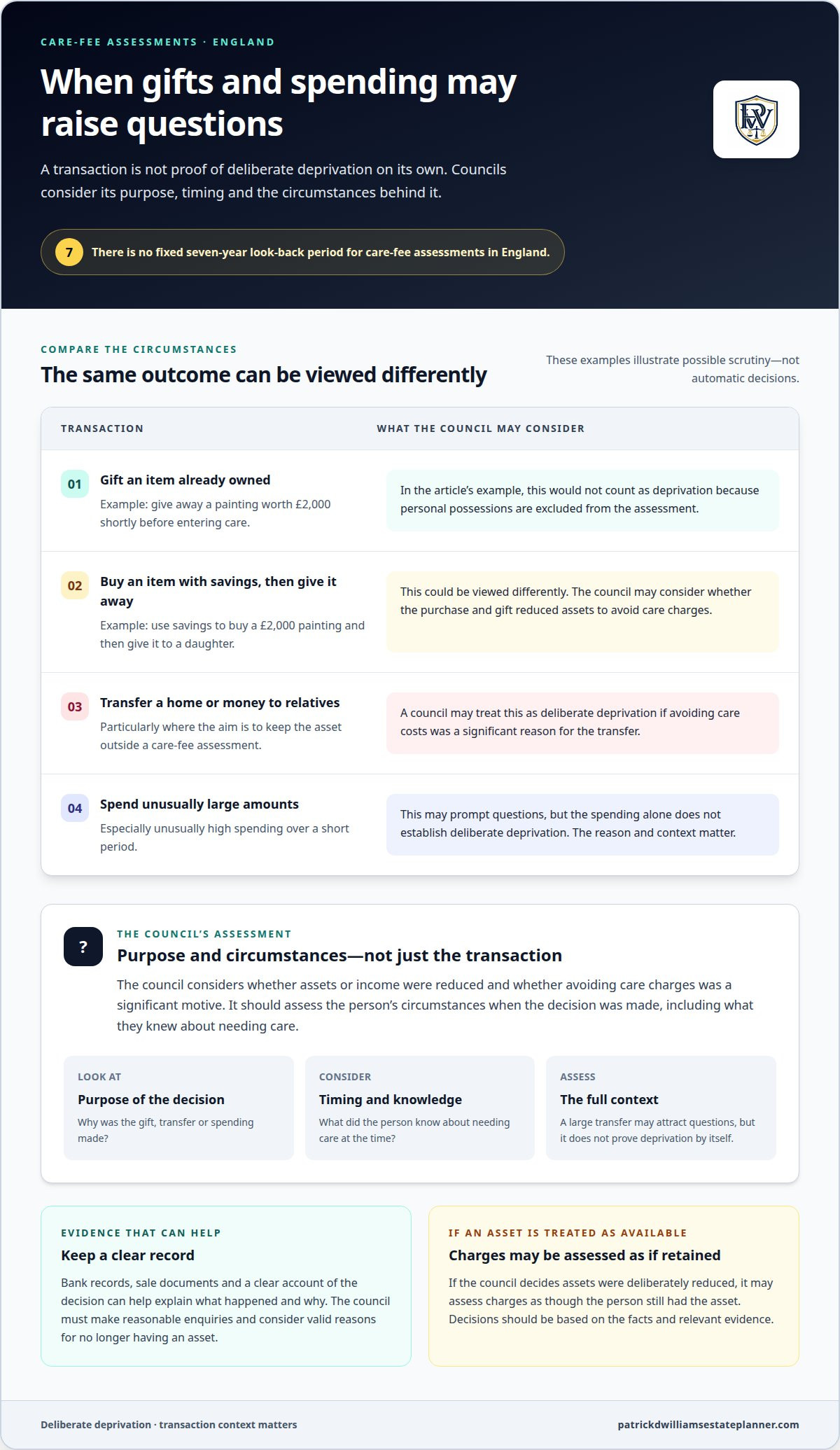
When assessing care funding, a council may review financial history from the time the person first needed care. It can examine whether they gave away money, transferred property, sold an asset or disposed of income. The council considers whether the person knew they would need care and support, and whether avoiding care costs was a significant reason for the transaction. An extravagant purchase or large transfer may prompt questions, but the transaction alone does not establish deliberate deprivation.
A council must make reasonable enquiries, rather than rely only on the person’s or carer’s declarations. Bank records, sale documents and a clear account of the decision can help explain what happened. The council should consider valid reasons why a person no longer has an asset and assess the facts in context. If you are considering deliberate deprivation of assets and what to avoid, remember that concealing a transaction or giving an incomplete account can undermine your explanation.
Assessing possible deprivation
The council decides whether a transaction reduced assets or income to lower care charges, and whether avoiding those charges was a significant motive. It should consider the person’s circumstances when the decision was made, not just the later care assessment. If it treats an asset as still available, it may assess charges as though the person retained it. The person can submit relevant evidence, and the council must base its decision on the facts. Understanding deliberate deprivation of assets and what to avoid means being open about transactions and explaining their purpose.
Do deprivation rules differ in Scotland, Wales and Northern Ireland? The rules described here concern England. Social-care charging arrangements differ across the UK, so do not assume the English assessment approach applies in another nation.
Are deprivation rules different for NHS Continuing Healthcare? NHS Continuing Healthcare is assessed separately from a council’s means-tested social-care financial assessment. The deprivation discussion here concerns local-authority charges for care and support.
Can a council recover care costs from someone who received gifted assets? A council may seek to recover from a recipient the difference between the care charge that would have applied and the amount paid. Recovery from that person cannot exceed the benefit they received from the transfer.
What should I do if a council says I deliberately deprived myself of assets? Ask for the decision and reasons through the council’s formal complaints procedure, then provide relevant evidence about the transaction and its purpose. If the person remains dissatisfied after the council’s complaint process, they can take the complaint to the Local Government and Social Care Ombudsman.
Is there a seven-year rule for care fees?
No. In England, there is no seven-year limit on a council investigating past transactions when assessing possible deprivation. The purpose and circumstances of a transfer matter more than its age alone.
The seven-year rule and historical transfers
The seven-year rule is sometimes confused with inheritance tax rules, but it does not set a care-fee look-back period. A council may investigate historical transactions without a fixed time limit when deciding whether assets were deliberately reduced to avoid care charges. This can matter even if a gift was made years before a care assessment. The council considers what the person knew and why they made the transfer at the time.
Transactions councils may review
A council may review gifts, property transfers, sales, unusual spending and other changes to a person’s assets or income. It can consider whether a transaction reduced what the person would otherwise contribute towards care costs. A large gift or property transfer may attract scrutiny, but neither automatically proves deprivation. The council should consider the transaction’s context and any valid reason for it.
Suspicious gifts, transfers and spending
Giving a home or money to relatives to keep it outside a care-fee assessment may be treated as deliberate deprivation. Unusually high spending over a short period can also raise questions. By contrast, gifting a painting already owned, worth £2,000, shortly before entering care would not count in the stated example, because personal possessions are excluded from the assessment. Buying a £2,000 painting with savings and then giving it to a daughter could be viewed differently.
What transactions may be treated as deprivation? A council may examine gifts, property transfers, asset sales and unusually high spending. It considers whether avoiding care charges was a significant reason, rather than treating every transfer as proof.
Lawful estate transfers and planning
Estate planning can organise how property is held and passed on, but it does not create an automatic exemption from care-fee scrutiny. For example, using part of a care-home resident’s share of a home sale to help their civil partner buy a smaller, suitable home may not be deprivation if avoiding care fees was not the reason. A Property Protection Trust may form part of wider planning, but a council can still consider the circumstances and purpose of asset transfers.
What is the time limit for investigating deprivation of assets for social care? There is no fixed time limit in England, so a council may review historical transactions. Anyone who disputes its decision can use the council’s formal complaints process.
If you are reviewing how property is held as part of wider estate planning, consider the role of a Property Protection Trust without treating it as a way to avoid care charges.
What counts as deprivation of assets?
In England, deprivation concerns reducing assets or income in a way that may lower charges for care and support. The transaction’s purpose and the person’s circumstances help distinguish deprivation from an ordinary change in finances.
The meaning of deprivation of assets
The Care and Support Statutory Guidance describes deprivation as an adult reducing their assets to decrease charges they may have to pay for care and support. An asset can include money, property or another financial resource. Income can also be relevant. This matters because a local authority may assess a person as though a disposed asset remains available, affecting the amount they contribute towards social care.
This is not limited to handing money to relatives. A person might give away a lump sum, transfer a property, spend unusually heavily or put funds into a trust they cannot withdraw from. The key issue is how the action affects the financial assessment, not simply whether ownership changed. A transaction made for another purpose must be considered in its full context.
Deliberate deprivation
Deliberate deprivation is an intentional action taken to reduce assets or income so care charges will be lower. The local authority considers whether avoiding care costs was a significant reason for the decision. Timing can provide context, but a transfer made before a care assessment is not automatically deliberate deprivation. The person’s knowledge and reasons at the time help explain the decision.
For example, transferring property to a relative specifically to keep its value out of a future care assessment may raise concerns. By contrast, a transfer made for another genuine reason needs to be assessed on its own facts. A council should not assume deprivation simply because someone no longer owns an asset. It must consider the reasons and relevant evidence.
Context and meaning
Context means looking at the transaction alongside the person’s needs, intentions and financial position when it happened. A local authority may ask whether the person could foresee needing care and whether reducing charges was a significant motive. A family gift, property sale or investment cannot be judged in isolation from those circumstances.
Purpose is not the only practical detail. The amount transferred, what the person received in return and how their finances changed can all help explain an apparent reduction. For instance, selling an asset and receiving its full value differs from giving it away without payment. Records showing the reason for a decision can help clarify the account during an assessment.
Incorrectly omitting wealth from a financial assessment is also treated as deprivation in the guidance described here. A clear declaration matters because the council assesses the information provided alongside its enquiries. If a person disagrees with the conclusion, they can challenge it through the council’s formal complaints procedure and provide evidence about the transaction’s purpose and circumstances.
Gifts and unusual or extravagant spending
Gifts and spending are assessed in context, not by a simple rule that every transfer reduces care funding. The reasons for giving money, the person’s usual habits and the available evidence can all help explain a decision.
Gifts and established gifting patterns
An established gifting pattern is a history of regular gifts made for familiar reasons, such as family occasions. A council may consider that history when deciding whether a gift was made intentionally to reduce assets for care fees. Records of earlier gifts and their purposes can help show the pattern. A new, substantial transfer shortly before care is considered may look different from longstanding family giving.
HM Revenue & Customs states that each individual in the UK has an annual gift exemption of £3,000. That inheritance tax exemption does not, by itself, determine how a local authority treats a gift in a care-fee assessment. The council considers the purpose and circumstances of the transfer separately.
Unusual or extravagant spending
Unusual or extravagant spending means spending that departs markedly from a person’s ordinary financial habits. A council may examine large purchases, repeated withdrawals or a sudden fall in savings when assessing available assets. The question is whether the spending was genuine expenditure or an intentional reduction of assets to lower contributions towards care costs.
For example, buying an expensive possession shortly before entering residential care and giving it to a relative may attract scrutiny. The council can consider the purchase and later gift together. Receipts and an explanation of the purchase can help show what happened and why.
Gifts made by attorneys and deputies
Attorneys and deputies have limited authority to make gifts on another person’s behalf. A relative’s role in managing someone’s finances does not give them unrestricted power to transfer that person’s assets. Significant gifts or asset transfers often require approval from the Court of Protection.
An attorney acting under a Lasting Power of Attorney should distinguish routine financial management from giving away the person’s wealth. A transfer that reduces funds available for care can raise questions about authority and purpose. Clear records of decisions can help explain the action during a financial assessment.
Gifts and inheritance tax
Inheritance tax rules and care-fee assessments address different questions. The HM Revenue & Customs exemption described above concerns gifts for inheritance tax purposes; it does not automatically protect a gift from scrutiny by a council assessing care costs.
For example, a gift within the exemption may still be considered in its care-assessment context if avoiding care charges was a significant reason for giving it. Conversely, the council should consider the actual reasons and circumstances rather than treating the tax position alone as proof. Evidence of the gift’s purpose can help explain the decision.
Examples of asset deprivation
Examples show why a transaction cannot be judged by its label alone. A council considers what changed, who benefited and whether avoiding care charges was a significant reason. These distinctions can affect whether the authority treats an asset as still available when assessing capital and contributions.
Giving money or property to someone else. A person who transfers savings or a home to relatives to keep it outside a care assessment may be treated as having deliberately reduced their assets. The family relationship does not settle the issue. The council considers the person’s reasons, knowledge of likely care needs and the timing of the transfer.
Buying an asset before giving it away. Spending savings on possessions and then transferring them to another person can look different from gifting an item already owned. The council may examine both steps together. It can ask whether the purchase served a genuine purpose or converted accessible capital into something intended for someone else.
Moving funds into a trust or bond. Putting assets into a trust the person cannot withdraw them from may be considered. Buying an investment bond with life insurance can also prompt scrutiny. The authority looks at the effect on the person’s available resources and the reason for choosing that arrangement, not merely its legal form.
Converting an asset into something of lesser value. If someone exchanges an asset for a lower-value resource, the difference may be treated as notional capital or income in the financial assessment. This means the council may calculate contributions as though some value remained available. The precise transaction and its purpose form part of the assessment.
Using a home share to support a partner. Consider a person who owns a 50% share of a home with their civil partner. If the person enters residential care, using part of their share of a sale to help their partner buy a smaller, suitable home may not count as deprivation when avoiding care fees was not the reason. The partner’s circumstances and the purpose of the decision help explain the outcome.
Keeping a home while a partner remains there. In the stated example, a person’s share of a home is ignored in the financial assessment while their civil partner continues living there. This illustrates why ownership alone does not establish that capital is available for care costs.
For each example, keep the transaction’s purpose clear and retain relevant evidence, such as sale or transfer records. If planning property arrangements, discuss estate planning options in light of your circumstances.
Patrick D Williams Estate Planners
Patrick D Williams Estate Planners can help you put your estate-planning wishes into clear legal documents. If questions about care assessments have prompted you to review how your assets are managed, Will Writing and Lasting Powers of Attorney can help formalise your arrangements and appoint people to make decisions if needed. Property Protection Trusts and Discretionary Trusts may also be considered as part of wider planning. These arrangements should reflect your circumstances and intentions, not be used to disguise ownership or avoid care charges. A trust or transfer does not prevent a local authority from examining the reasons behind changes to your assets. For guidance on planning your estate in light of these considerations, contact Patrick D Williams Estate Planners.
Plan your next steps with clarity
Decisions about family assets deserve a clear purpose and careful thought. Rather than making changes in response to uncertainty, consider how your plans reflect your responsibilities, the people you wish to support and the decisions you may need others to make on your behalf. A coherent estate plan can help bring those intentions together.
If you are considering deliberate deprivation of assets, what to avoid is treating a transfer or trust as a way to guarantee a particular care-fee outcome. Focus instead on arrangements that reflect your genuine wishes and can be explained openly. If you are reviewing your plans, a conversation about your circumstances can help you identify which estate-planning steps are relevant.
Contact Patrick D Williams Estate Planners to discuss your estate-planning needs. Taking time to put your wishes into order can help you move forward with greater confidence.
Frequently Asked Questions
Can Gifts Still Be Made?
Yes, people can make gifts, but a gift is not automatically disregarded in a care assessment. Its purpose, timing and place within the person’s usual financial choices can matter. For example, a regular family celebration gift may have a different context from a sudden transfer made as care needs emerge. Keep a clear record of the reason and circumstances, rather than assuming any particular gift is exempt.
Can I transfer my house to my children to avoid care fees?
Transferring a home to children to avoid care fees can be treated as deliberate deprivation. A change to the legal title does not necessarily prevent a council from considering the property’s value in its assessment. The recipient could also face a claim for the benefit received from the transfer. Consider the purpose and consequences carefully before changing ownership, rather than relying on the transfer itself to protect the home.
Can an attorney make gifts on behalf of someone else?
An attorney has limited authority to make gifts using someone else’s money or property. This authority does not allow unrestricted transfers, and significant gifts or asset transfers often require approval from the Court of Protection. For example, an attorney should not treat a family relationship as permission to give away a person’s savings. A Lasting Power of Attorney does not remove these limits.
How do my home and savings affect what I pay for social care?
Your income and savings help determine your contribution through a financial assessment. The Department of Health and Social Care states that, in the circumstances described, people whose capital falls to £23,250 will usually qualify for means-tested social care funding. Property may also be considered if you need residential care. The council assesses the relevant financial circumstances, so ownership and living arrangements can affect how a home is treated.
What Types of Transactions Are Commonly Investigated?
Councils can look into gifts of money or property, sales or transfers of assets, unusual spending and changes affecting income. They may also examine purchases made with savings, including possessions later given to someone else, or assets placed in a trust that the person cannot withdraw from. The central issue is whether the transaction was intended to reduce care charges, not its label alone.
What counts as deliberate deprivation of assets in the UK?
In England, deliberate deprivation means intentionally reducing assets or income to lower charges for care and support. A gift, property transfer or unusually high expenditure could be considered, but none proves the purpose by itself. The council considers the person’s reasons and circumstances when the decision was made. Rules and charging arrangements differ across the UK, so do not assume the English approach applies in every nation.
How do councils assess deprivation of assets for care costs in England?
A council reviews the person’s financial circumstances and relevant transactions, including what they knew about their care needs and why they acted. It must make reasonable enquiries rather than relying only on the person’s or carer’s account. The assessment should consider relevant evidence and valid reasons for no longer owning an asset. If the person disagrees with the decision, they can use the council’s formal complaints procedure.
What evidence shows a transfer was made to avoid care fees?
No single document proves the purpose of a transfer. A council can consider timing alongside records that explain the decision, such as correspondence about the transfer, financial records or documents showing what the person received in return. Evidence of a planned purpose unrelated to care charges may also help explain the circumstances. Present a coherent account connecting the records to the person’s reasons at the time.
Leave a Reply