

An executor’s authority stops short of rewriting the deceased’s wishes. If you’re concerned that gifts or beneficiaries might be changed, it’s understandable to ask, “can an executor change a will” after someone has died. In England and Wales, an executor must administer the estate according to the will, not alter it to suit their own preferences.
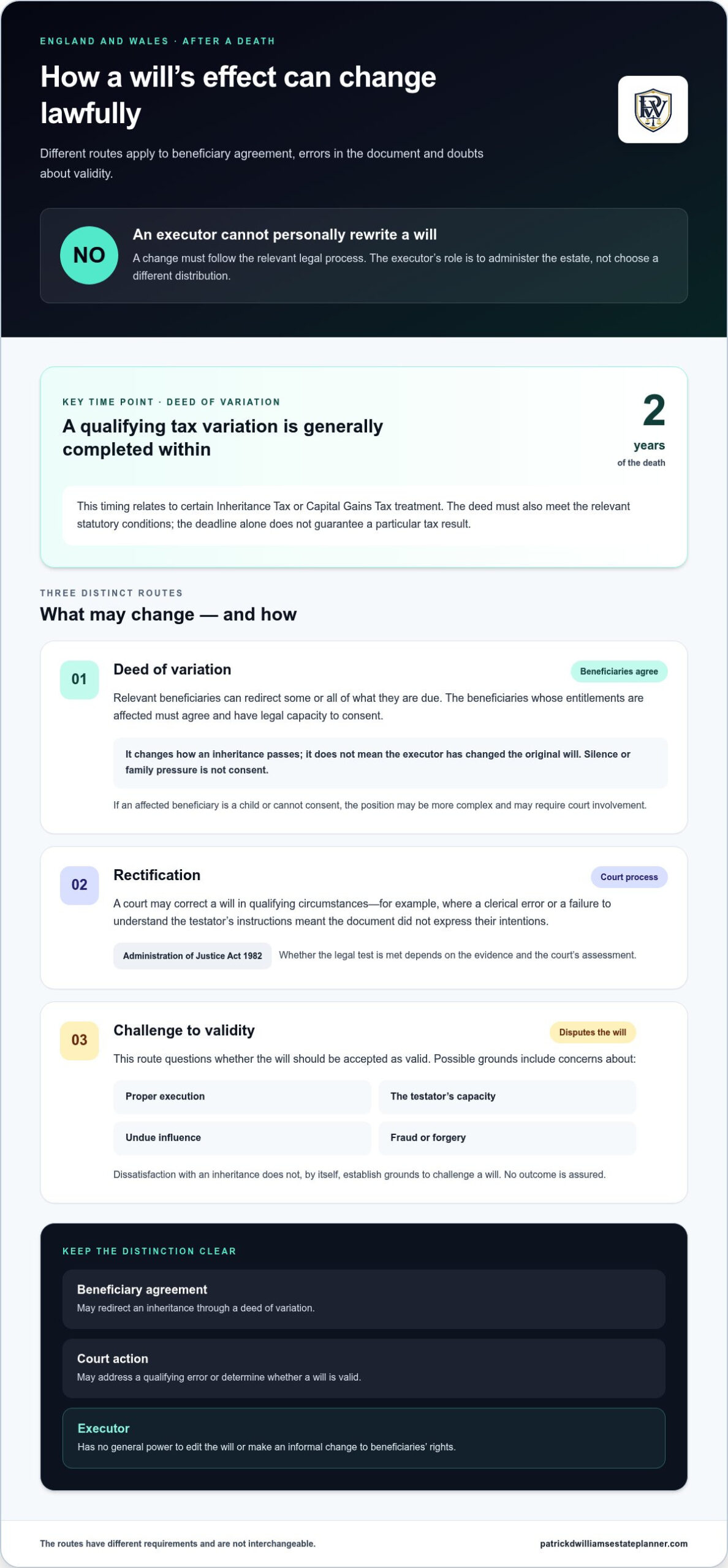
That doesn’t mean the way an estate passes can never be changed. Beneficiaries may be able to redirect an inheritance through a Deed of Variation, usually within two years of the death for certain tax purposes. Challenging a will’s validity is a separate route, with different grounds and considerations.
This guide explains what an executor can and cannot do, how a lawful variation differs from changing or contesting a will, and what information may help if you’re concerned about the estate’s administration. It focuses on England and Wales, where the rules differ from those in Scotland and Northern Ireland.
Key Takeaways
- An executor administers the estate under the will. They do not have authority to rewrite its instructions.
- Beneficiaries may be able to agree to redirect an inheritance, but this is different from correcting or challenging a will.
- If a distribution seems inconsistent with the will, establish the facts first. Debts, asset ownership or interpretation may explain the difference.
- If asked to change a will, an executor should pause, review the document and keep a record before taking action.
- Clear will drafting and considered executor appointments can help families understand the testator’s wishes.
Can an executor change a will after death? The legal boundary
No. In England and Wales, an executor cannot rewrite a will because they disagree with it or believe a different distribution would be fairer. Their role is to administer the estate in line with the will’s valid instructions and applicable legal requirements. The distinction is straightforward: an executor carries out the will; a lawful variation or court order may affect its effect.
This applies to the gifts and beneficiaries named in the document. An executor may need to work out what a clause means or make practical decisions during administration, but that is not the same as replacing a beneficiary or changing who receives a gift. Scotland and Northern Ireland have separate legal systems, so this section focuses on England and Wales.
What authority does an executor receive from a will?
Being named as executor gives someone responsibility for dealing with the deceased’s estate, not unrestricted ownership of its assets. The executor must identify what the deceased owned, deal with liabilities and administer the estate before distributing what remains according to the will. This is the central role described in the general overview of an Executor of will.
A grant of probate may be needed before an executor can deal with some assets. It is an official document confirming their authority to administer the estate, although whether it is required depends on the assets and circumstances. Until administration is complete, the executor must handle estate assets appropriately, rather than treat them as their own.
What an executor must not change on personal preference
An executor cannot substitute one beneficiary for another or redirect a specific gift simply because the family asks, or because the executor thinks a different outcome would be more suitable. Family pressure and personal views do not amend a will. A change needs a proper legal basis and must follow the relevant process.
Practical administration can affect what is available for distribution, but it does not automatically alter anyone’s entitlement. For example, estate liabilities may need to be settled before beneficiaries receive their inheritances. An asset may also fall outside the estate, depending on its ownership arrangements. These matters can affect what passes under the will without giving the executor permission to rewrite its terms.
Where wording is unclear, the executor may need to establish how a provision should be understood rather than assume it allows a different distribution. Carrying out an interpretation is not a licence to change the intended recipient. If the will appears to conflict with itself or there is doubt about its meaning, the executor should avoid making an informal decision that could affect beneficiaries’ rights.
In practice, an executor should treat the will as the governing document, identify the estate’s assets and liabilities, and distinguish administrative decisions from changes to gifts. The next sections explain the separate lawful routes that may affect how an estate passes, and what to consider if a distribution appears inconsistent with the will.
How can a will’s effect change lawfully after someone dies?
Although an executor cannot make a personal amendment, separate legal routes may affect how an estate passes. The right route depends on whether beneficiaries agree to redirect an inheritance, the will contains a qualifying error, or there is a genuine concern about its validity. These processes have different requirements and are not interchangeable.
A consensual variation changes how beneficiaries receive an inheritance; a court order may correct a qualifying error or determine whether a will is valid. Neither route gives the executor a general power to edit the document. If you’re asking whether can an executor change a will, the answer remains no: any change must follow the appropriate legal process.
Deed of variation: when beneficiaries agree to redirect an inheritance
A deed of variation allows the relevant beneficiaries to redirect some or all of what they are due. It is made by the beneficiaries whose entitlements are affected, not unilaterally by the executor. Those beneficiaries must agree and have the legal capacity to consent. The deed changes how an inheritance passes; it does not mean the executor has altered the original will.
For certain Inheritance Tax or Capital Gains Tax treatment, the variation generally needs to be completed within two years of the death and meet the relevant statutory conditions. The tax result depends on the circumstances, so meeting the deadline alone does not guarantee a particular treatment. If an affected beneficiary is a child or cannot consent, the position may be more complex and may require court involvement. The executor should not treat silence or family pressure as consent.
Court action: rectification or a challenge to validity
Rectification is a court process for correcting a will in qualifying circumstances, such as where a clerical error or a failure to understand the testator’s instructions meant the document did not express their intentions. In England and Wales, the power is set out in the Administration of Justice Act 1982. Whether the legal test is met depends on the evidence and the court’s assessment.
A challenge to validity is different. It disputes whether the will should be accepted as valid, for example because of concerns about proper execution, the testator’s capacity, undue influence, fraud or forgery. Being dissatisfied with an inheritance does not, by itself, establish grounds to challenge a will. A court application is not an administrative decision for the executor to make, and no outcome is assured.
Before deciding which route may apply, establish what the will says, who would be affected and what evidence supports the concern. Tax consequences and the position of beneficiaries who cannot consent need particular care. For people planning ahead, clear will writing and estate planning can help record wishes in a form executors and beneficiaries can understand.
What if an executor distributes the estate differently from the will?
A distribution that appears inconsistent with the will deserves a careful explanation, but it doesn’t automatically mean the executor has changed its terms or acted improperly. The difference may relate to how a clause has been interpreted, debts or expenses paid from the estate, or an asset that passes outside the estate. It may also be an administrative error. Establishing which explanation applies is a sensible first step.
A beneficiary’s concern does not give them authority to amend the will either. If you believe a gift has been redirected, focus first on the facts: what the will says, what the estate contains, and what has already been paid or transferred.
First steps for a beneficiary who has concerns
Read the relevant clauses and identify the specific gift, beneficiary or distribution in question. Then write to the executor in measured terms. Describe the discrepancy you have noticed and request an explanation and relevant information about the estate administration. Keeping the communication factual can clarify a misunderstanding without escalating tensions unnecessarily.
Keep copies of the will, the grant of probate if one has been issued, correspondence and any statements or distribution details you have received. Note dates and retain documents that explain what you were told. A clear record can help distinguish a delay or accounting issue from a genuine difference between the will’s terms and the distribution.
Why timing and distribution status matter
It may be more practical to raise a concern before assets are distributed, while the estate is still being administered. That does not guarantee a particular remedy, and a transfer already made does not by itself establish what legal options remain. The executor should administer the estate in accordance with their duties, keep appropriate records and be able to account for estate transactions.
For broader context about the executor’s role and responsibilities, see this executor in the UK guide.
A separate issue may arise if someone believes the will fails to make reasonable financial provision for them. A claim under the Inheritance (Provision for Family and Dependants) Act 1975 is not a way to change the will by agreement; it is a distinct legal claim with eligibility requirements and a court process. In England and Wales, the usual time limit is six months from the date the grant of representation is issued. Exceptions and procedural requirements can affect the position, so anyone considering this route should verify the current rules promptly.
If you’re unsure whether the concern is about interpretation, estate accounting or a possible legal claim, keep the relevant documents together and describe the specific discrepancy in writing. The question can an executor change a will is different from whether an administration decision was made incorrectly. Identifying that distinction helps establish what information may be needed next.
What should an executor do when asked to change a will?
A request to distribute an estate differently can come from a beneficiary, a relative or someone who believes the will doesn’t reflect the deceased’s wishes. The executor should respond methodically, rather than agree under pressure or dismiss the concern without considering it. The question can an executor change a will has a clear answer, but the request may point to a separate process that needs careful consideration.
A practical response to a request for a different distribution
Begin by asking the person making the request to identify the clause they are concerned about, the outcome they believe should apply and the reason for their view. Then review the signed will and relevant estate records. Keep the original document intact. Record the request, the information considered and the steps taken, so there is a clear account of how the administration proceeded.
A measured sequence can keep the discussion focused:
- Pause before acting. Don’t promise that a gift or beneficiary will be changed, and don’t distribute assets contrary to the will while the issue remains unclear.
- Clarify the request. Ask for the specific provision and the change being sought, preferably in writing.
- Check the documents. Review the will and relevant records, noting any ambiguity or information that may affect the estate.
- Keep a record. Retain correspondence and make a clear note of decisions and the reasons for them.
- Identify the possible route. Consider whether the concern involves interpretation, a beneficiary-led variation or a matter that may require a court’s decision.
An executor who is also a beneficiary has two distinct roles. They must carry out their responsibilities as executor separately from their personal interest in the estate. Their own preference, whether to receive more or less, does not determine how the will should be administered.
When the matter needs careful legal review
Some requests raise issues that cannot safely be resolved by a family agreement or an informal reading of the will. These include disputed wording, a suspected drafting error, allegations of undue influence, questions about a beneficiary’s capacity to consent, tax consequences or competing claims. Before taking an irreversible step, the executor should obtain advice appropriate to the issue and keep the estate’s administration transparent.
A deed of variation and a court process are not interchangeable. A variation depends on the relevant beneficiaries agreeing to redirect their entitlements, while rectification or a challenge to validity involves a court and different legal requirements. Neither should be assumed to apply simply because someone asks for a different result. The executor should avoid predicting who will succeed and focus on preserving the estate and following the correct process.
Clear wishes can help reduce uncertainty before a will is needed. If you’re planning or reviewing your own arrangements, you can arrange a free 15-minute will-planning consultation with support available by video call or in person.
How clear will planning can reduce uncertainty for executors and families
Clear planning cannot guarantee that a will will never be questioned, but it can make the testator’s wishes easier to understand and administer. Precise wording, considered executor appointments and a plan for reviewing the document can reduce uncertainty for the people left to carry it out. Will writing is a lifetime planning step, not a way for an executor to change a will after the testator has died.
Planning choices that make a will easier to administer
A will should identify beneficiaries and gifts clearly, including what should happen if a named beneficiary dies before the testator. Describing a gift precisely can also help avoid uncertainty about which asset or share is intended. The testator should consider whether the appointed executors are willing and able to take on the practical responsibilities, and whether substitute executors should be named in case circumstances change.
Useful points to consider during planning include:
- Whether each beneficiary and intended gift is identified unambiguously.
- What alternative arrangement should apply if a beneficiary cannot inherit.
- Whether the chosen executors can manage the responsibilities involved.
- Whether a change in family circumstances, relationships or assets makes a review appropriate.
Life changes may mean an existing will no longer reflects a person’s intentions. Reviewing it after a significant change gives the testator an opportunity to consider whether the instructions remain clear and appropriate. Any amendment must be made correctly during the testator’s lifetime; an informal note or family discussion does not itself change the will.
When professional will-writing support may help
Professional support can help a testator express their wishes in clear, organised language and consider how those instructions may be understood during estate administration. A will writer can also provide guidance on completing the document properly. This supports planning before death, but cannot guarantee that no later disagreement will arise or determine a dispute after the event.
For families who have already experienced uncertainty, the distinction matters: clear drafting may support smoother administration, but it does not give an executor authority to change the document. The executor must follow the valid will unless a lawful process affects how it operates. That boundary protects the testator’s instructions while leaving separate legal routes available where circumstances justify them.
If you’re considering a new will or reviewing your arrangements, a calm first conversation can help identify the points that need attention. You can arrange a free 15-minute consultation to discuss your will-planning needs.
Take a considered step towards clearer planning
Thinking about what you want your will to achieve is a practical way to give your family and chosen executors clearer direction. You don’t need to resolve every detail at once. Begin by considering whether your current arrangements still reflect your wishes and which decisions would benefit from a careful review.
Patrick D Williams Estate Planners provides professional will writing and estate planning support across England and Wales. If you’d like to discuss your planning needs, a free 15-minute consultation is available by Zoom, Teams or in person. Arrange a consultation about your will planning.
Understanding can an executor change a will is one part of protecting the intentions you record. Clear planning gives you a thoughtful next step and can help those who may one day administer your estate understand your wishes.
Frequently Asked Questions
Can an executor change a will if all the beneficiaries agree?
No. Even if every beneficiary supports a different distribution, the executor cannot personally amend the will. Beneficiaries may be able to document an agreed redirection through a deed of variation, subject to the relevant rules and the rights of anyone whose entitlement is affected. The executor can administer that arrangement only if it has been properly made. Agreement in a family conversation or email alone does not alter the will.
Can an executor change a will before probate is granted?
No. Whether probate has been granted does not change an executor’s authority to rewrite gifts or substitute beneficiaries. A grant provides formal proof of authority for dealing with assets that require it, but it is not permission to amend the will. Before acting, the executor should distinguish the will’s instructions from any separate beneficiary agreement or court process, and avoid distributing assets while a genuine issue remains unresolved.
Can an executor also be a beneficiary of the will?
Yes. A person can be named both as an executor and as a beneficiary. Receiving a gift under the will does not, by itself, prevent them from carrying out the executor role. They must still administer the estate according to the will and keep their personal interest separate from their responsibilities. If a decision directly affects their own inheritance, recording the reasons and seeking appropriate advice can help manage the potential conflict.
What happens if an executor does not follow the will?
The consequences depend on what happened and whether the estate suffered loss. An executor may have to account for their administration and could face a claim or an application for removal from the role. A beneficiary concerned about a distribution can keep relevant documents and correspondence, then request a clear explanation in writing. A discrepancy alone does not prove misconduct, so the circumstances and records matter.
Can an executor refuse to distribute an inheritance?
An executor may need to delay distribution while dealing with estate liabilities, confirming who is entitled or resolving a genuine question about the will. That is different from withholding an inheritance without a proper reason. A beneficiary can ask what remains outstanding and request an explanation of the delay. The executor should keep appropriate records and should not use control of estate assets simply to pressure a beneficiary.
Can an executor change a will because they think it is unfair?
No. An executor’s personal view that a gift is unfair does not give them authority to change it. They must not substitute their preferred outcome for the testator’s instructions. A person who believes the will or its effect should be addressed needs to consider a legally recognised route, rather than relying on the executor’s discretion. Dissatisfaction with the size or distribution of an inheritance does not, by itself, establish a right to alter the will.
Does probate confirm that a will cannot be challenged?
No. A grant of probate gives the executor formal authority to administer the estate on the basis of the will, but it does not make the will immune from challenge. If concerns later arise about its validity, the grant and the estate administration may be affected by further proceedings. Anyone with a specific concern should keep relevant evidence and seek timely advice, as the appropriate process depends on the facts.
Leave a Reply