

“Bear trust” may look like the name of a distinct legal arrangement, but it is usually a mistaken search term for “bare trust”. If you have encountered both phrases, the uncertainty is understandable. In trust planning, a small difference in wording can raise a much bigger question: who owns, controls and benefits from the assets?
A bare trust generally means that trustees hold assets for a named beneficiary, who is entitled to the trust property and its income. Trustees have responsibilities, but their role is not to decide freely who should benefit. Before considering a bare trust as part of a will, it is important to understand what the beneficiary is entitled to and how much control the trustees have.
This guide explains what people usually mean by “bear trust”, how a bare trust works and which common assumptions need a closer look. It also sets out practical questions to consider, including who the intended beneficiaries are, what responsibilities trustees may have and whether this type of trust fits your wishes.
Key Takeaways
- “Bear trust” is usually a search for a bare trust, the established term for this arrangement in UK guidance.
- In a bare trust, trustees administer the assets, while the beneficiary’s entitlement is central. Trustees do not freely choose who benefits.
- Compare bare trusts with discretionary and interest in possession trusts to understand how beneficiary rights and trustee discretion differ.
- A trust does not automatically reduce tax or protect assets from claims. Outcomes depend on the circumstances and current rules.
- Before considering a bear trust in a will, identify the intended beneficiary, the asset, the trustee’s role and how much control you want to retain.
“Bear trust” or bare trust: what does the search term mean?
People searching for “bear trust” usually mean “bare trust”. A spelling mistake or voice-dictation error can change the words shown in search results without changing the underlying question. In UK guidance, bare trust is the established term. “Bear trust” is not a separate category of trust to treat as an equivalent legal arrangement.
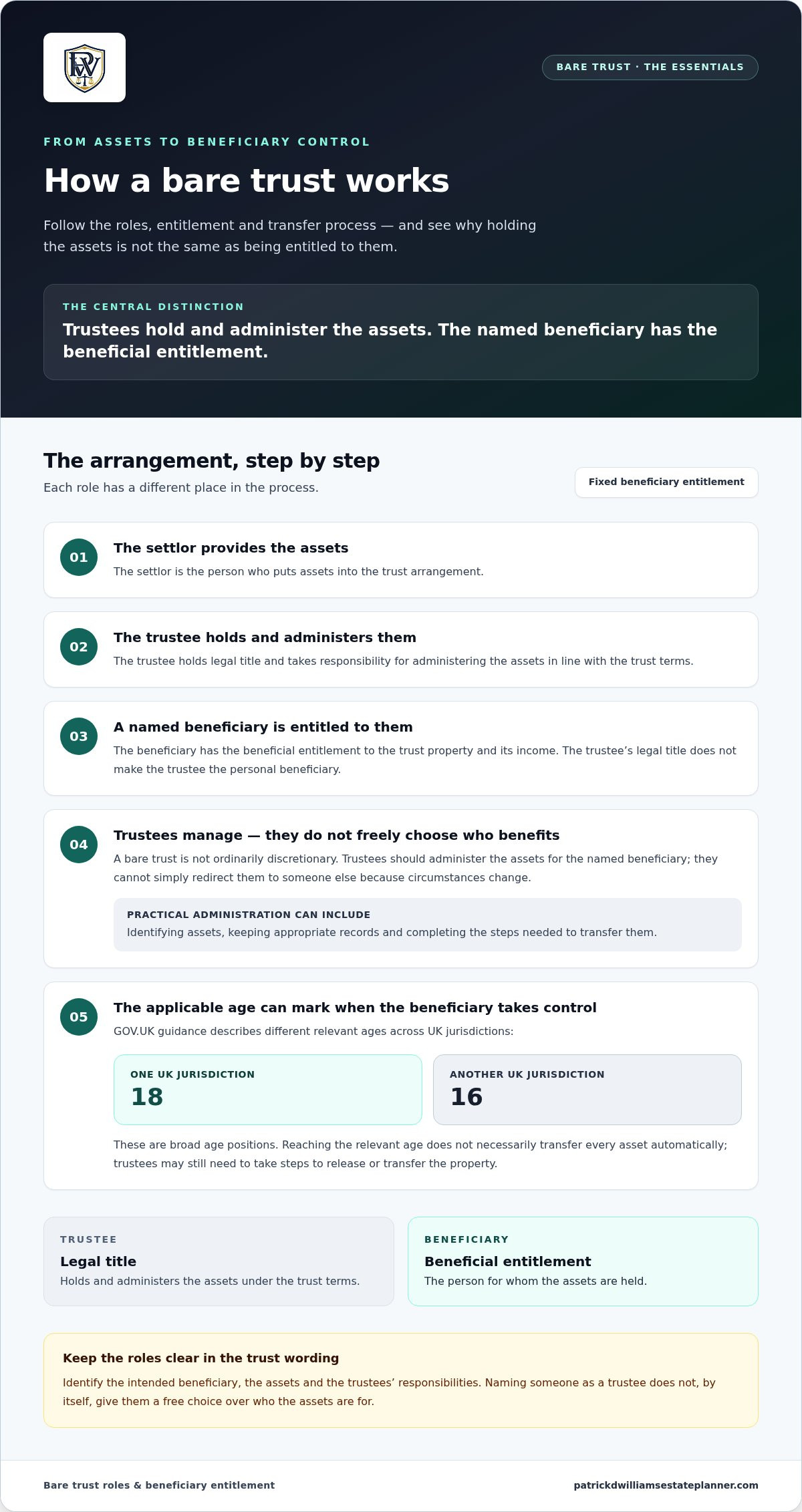
A bare trust is an arrangement in which a settlor provides assets, a trustee holds them and a named beneficiary is entitled to them. The roles are distinct: the trustee holds legal title and administers the assets, while the beneficiary has the beneficial entitlement. In plain terms, holding the assets and being the person they are held for are different parts of the arrangement.
The label alone is not enough when considering a trust in a will. The intended beneficiary, the assets and the trustee’s role all need to be clear. A bare trust can involve different assets and circumstances, so examples found online may not match the arrangement you are considering.
Why “bear trust” and “bare trust” are easy to confuse
The words sound alike, and search engines may return results for a likely spelling even when someone has dictated the phrase or typed it quickly. This can make “bear trust” look like a legal term in its own right. For clarity, this article uses bare trust for the established arrangement and treats “bear trust” as a likely search-term error, not another name for it.
“Bearer trust” should not be assumed to identify a separate established UK trust type either. If this wording appears in a document or conversation, focus on the details: what arrangement is being described, who is named and what the document says about the assets.
The basic roles in a bare trust
The settlor is the person who puts assets into the arrangement. The trustee holds and administers those assets. The beneficiary is the person for whom they are held and who has the beneficial entitlement. A trustee’s legal title does not make the trustee the intended personal beneficiary.
For example, a will-maker might intend a particular asset to go to a named person, with trustees holding it under the terms of the will. The document should identify the intended beneficiary and explain the trustees’ responsibilities. Using the word “trustee” does not, by itself, give trustees a free choice over who the assets are for.
The Bare trust on Wikipedia page provides a broader overview, including how the term is used in different jurisdictions. For more detail on the arrangement and how it works in practice, the existing Bare Trusts Explained guide can provide further context.
Bare trust myths about beneficiary rights and trustee control
A common misunderstanding behind a search for “bear trust” is that trustees control the assets as they might under a trust that gives them discretion. In a bare trust, the beneficiary’s entitlement is central. Trustees have an important administrative role, but that does not ordinarily give them freedom to choose a different recipient.
Myth: trustees can decide who gets the assets
Fact: A bare trust is not ordinarily a discretionary arrangement. The trust terms identify the beneficiary, and trustees should administer the assets in line with those terms and the beneficiary’s entitlement. They cannot simply redirect the assets to someone else because family circumstances have changed or another person now seems more suitable.
For example, if a will names one child as the beneficiary of an asset held on bare trust, the trustees’ role is to manage and transfer it in accordance with the trust, not to choose a sibling instead. If you want trustees to select beneficiaries or decide how much each receives, that is a different planning intention and may call for a different trust structure. The wording should reflect whether you want a fixed entitlement or trustee discretion.
Beneficial entitlement and practical administration are connected, but they are not the same. Before assets can be transferred, trustees may need to identify them, keep appropriate records and complete the relevant transfer steps. An asset held through an account or registered in a trustee’s name may require paperwork before the beneficiary can take direct control. These steps do not, by themselves, give trustees authority to change who is entitled to the assets.
Myth: one age rule applies throughout the UK
Fact: The age distinction depends on the jurisdiction. GOV.UK guidance states that the relevant age for a beneficiary to take control of bare trust assets is 18 in one UK jurisdiction and 16 in another. These ages describe the broad position when a beneficiary reaches the applicable age. The precise arrangements and transfer process can depend on the trust and circumstances.
Reaching the relevant age does not necessarily mean every asset moves automatically into the beneficiary’s hands that day. Trustees may still need to take the steps required to transfer or release the property. The beneficiary’s entitlement remains distinct from the practical administration involved in putting assets under their direct control.
Do not assume that one age rule answers every question. Clear will and trust drafting can record the intended beneficiary and trustees’ responsibilities, helping reduce uncertainty about what should happen and when. Families considering a will-based bare trust can explore bare trust planning for a will as part of a considered estate-planning discussion.
Bare trust compared with discretionary and interest in possession trusts
Someone searching for a “bear trust” may be trying to understand which trust structure gives a beneficiary a fixed entitlement and which leaves decisions to trustees. The differences are practical as well as legal. A bare trust, discretionary trust and interest in possession trust can each reflect different intentions, so none is universally the better choice.
| Trust type | Beneficiary entitlement | Trustee discretion | Typical planning purpose |
|---|---|---|---|
| Bare trust | A named beneficiary is entitled to the trust assets. | Generally limited to administering the assets in line with the trust terms. | Providing for a specific beneficiary where a fixed entitlement is intended. |
| Discretionary trust | Potential beneficiaries are identified under the trust terms, but no one beneficiary necessarily has a fixed entitlement to specific assets. | Trustees decide who benefits, when and to what extent, within the trust terms. | Allowing decisions about distributions to reflect circumstances over time. |
| Interest in possession trust | A beneficiary is entitled to trust income, but not necessarily to the capital itself. | Trustees administer the assets and follow the terms governing income and capital. | Providing for one person’s use of income whilst preserving capital for another or for later distribution. |
Bare trust versus discretionary trust
A bare trust centres on an identified beneficiary’s entitlement. By contrast, a discretionary trust gives trustees a role in deciding which eligible beneficiaries receive benefits, and how much or when, as permitted by its terms. This flexibility may help a plan respond to changing needs, but it also gives trustees decisions to make and responsibilities to carry out. Discretion alone does not guarantee protection from claims or a particular tax result.
The central planning question is whether you want to name a beneficiary with a fixed entitlement or give trustees discretion among a defined group. The trust wording should match that intention.
Bare trust versus interest in possession trust
An interest in possession trust separates the right to benefit from income from the right to receive capital. For example, the terms might provide one person with income generated by trust assets during their lifetime, while the capital is intended for another person later. This is a simplified illustration, not advice on an individual arrangement.
With a bare trust, the named beneficiary’s entitlement is to the trust assets, rather than only to income from them. Consider who should benefit, from what and when, as well as how much decision-making authority trustees should have. For a fuller explanation of how a bare trust operates, the Bare Trusts Explained guide can provide further context. Weigh the intended beneficiary, the asset and the desired degree of control together before settling on a structure.
Bare trust myths about tax, flexibility and asset protection
Searching for a “bear trust” can lead to assumptions that a trust is a ready-made way to reduce tax or keep assets beyond reach. Neither follows simply from setting one up. The consequences of a bare trust depend on how its terms, assets and beneficiary fit together, so consider them before transferring assets.
Myth: a bare trust automatically saves tax
Fact: Creating a trust does not, by itself, guarantee a tax saving. Tax treatment depends on the structure and circumstances, including the assets involved and the relevant tax rules.
Separate the existence of the trust from the tax questions that may arise. A gift into a trust, income produced by trust assets and a later disposal of an asset can raise different issues. The effect may also depend on who made the gift and who is treated as benefiting. Do not choose a trust on the assumption that it will automatically reduce tax or remove a tax liability.
Tax rules can change, and a general article cannot assess the effect on an individual estate. For current information, consult HMRC and GOV.UK guidance relevant to the particular tax question. If a decision involves significant assets or a complex family situation, take advice based on the full circumstances before acting.
Myth: trust assets can always be reclaimed or protected
Fact: A bare trust should not be treated as a general-purpose shield against creditors, care costs or other claims. The beneficiary’s entitlement is central to the arrangement, and transferring assets can have lasting consequences. If a gift has been completed, the settlor should not assume they can simply take the assets back or change the beneficiary when their plans change.
That limited flexibility is a defining feature to weigh carefully, not a hidden technicality. A bare trust may suit an intention to benefit a particular person, but may not suit someone who wants to retain broad control, choose between potential beneficiaries later or respond freely to future changes. Any effect on claims or liabilities depends on the relevant facts and law. No general statement about a trust can establish that particular assets will be protected.
Before transferring significant assets, consider what is being given, who is intended to benefit and whether the arrangement leaves enough flexibility for your circumstances. Individual legal advice can help you understand the implications before making a commitment. Clear documentation should reflect the intended beneficiary and the trustees’ responsibilities.
If you are considering a bare trust as part of your will, discuss bare trust and will planning in light of your intended beneficiaries, assets and wishes.
When a bare trust may fit into will and estate planning
A bare trust may be considered when a will-maker intends a particular beneficiary to receive specified assets, with trustees administering them under the terms set out in the will. It is a considered planning choice, not a standard addition for every family. A fixed entitlement may suit some wishes but offer less flexibility than the will-maker needs.
Before including this arrangement, work through four connected decisions:
- Identify the beneficiary. Decide who is intended to benefit and whether their entitlement should be fixed, rather than left for trustees to decide later.
- Identify the asset. Be clear about what the trust is intended to hold. Different assets can involve different practical steps for trustees to administer or transfer.
- Consider the trustee role. Decide who should take responsibility for administering the assets and what records they may need to keep to carry out the instructions.
- Set the level of control. Consider whether the beneficiary should have a defined entitlement or whether the plan needs trustees to retain discretion as family circumstances develop.
Questions to settle before including a bare trust in a will
Consider these decisions together. Naming a beneficiary without thinking through the asset and trustee responsibilities can leave practical details unclear. A bare trust may also be a poor fit if you want the freedom to change who benefits or how assets are distributed as circumstances change. Let the intended outcome guide the structure, rather than choosing based on the label alone.
A bare trust does not replace a will. The will sets out broader instructions for the estate, while a bare trust provision addresses how particular assets are held for a beneficiary. The documents should work coherently, with the intended beneficiary, assets and trustees’ responsibilities clearly recorded. This article offers general information, not a decision on what is suitable for an individual family.
How professional drafting can bring the plan together
Bespoke will drafting can set out the intended arrangement clearly, including who is to benefit and what trustees are expected to do. This is useful when the plan involves a specific beneficiary, but drafting cannot make a bare trust flexible if the structure does not provide for that flexibility. The decision should reflect your wishes and the practical responsibilities involved.
For a calm discussion about whether will writing and bare trust planning fit your circumstances, arrange a free 15-minute consultation.
Shape your next steps around your wishes
A search for “bear trust” can start a more useful conversation about what you want your estate plan to achieve. Consider who you intend to benefit, how much control trustees should have and whether the arrangement reflects your family’s circumstances. There is no need to choose a trust simply because it appears straightforward. The plan should follow your intentions.
Patrick D Williams Estate Planners provides will writing and bare trust establishment, with clear documentation shaped around the arrangement being considered. A measured discussion can help you set out your priorities and consider how a trust may fit alongside your will.
Book your free 15-minute conversation about will and trust planning to explore your options. Thoughtful planning and clearly recorded wishes can help you take a considered step towards putting your intentions in order.
Frequently Asked Questions
Can a person who is not a parent create a bare trust for a child?
Yes. A grandparent or another person can create a bare trust for a child if the arrangement is properly established and identifies the intended beneficiary. Before transferring money or another asset, consider whether the gift is meant to be final, who will act as trustee and what their responsibilities involve. The beneficiary’s entitlement and the effect on the person making the gift should also be understood. Appropriate advice can help address the details of the particular arrangement.
What happens if the beneficiary of a bare trust dies before taking control of the assets?
The outcome depends on the trust terms, the beneficiary’s circumstances and the applicable law. Do not assume the assets automatically return to the person who created the trust or pass to a particular relative. The trust documents may need to be considered alongside the beneficiary’s estate and any relevant will. If this happens, the trustees should preserve the records and obtain advice based on the documents and circumstances before distributing or transferring the assets.
Does every bare trust have to be registered with the Trust Registration Service?
Not every bare trust has the same registration outcome, as exceptions may apply. As at October 2026, most UK trusts, including bare trusts, generally need to be registered with HMRC’s Trust Registration Service, even if there is no tax to pay. Certain exemptions, including some low-value trust arrangements, may be relevant under current rules. Check HMRC guidance for the specific trust when it is created and if its circumstances change.
Can a bare trust hold property as well as money?
A bare trust can relate to property as well as money, but property brings practical matters beyond those involved in holding cash. Consider the ownership records, trust documentation and any steps needed to update Land Registry records together. For example, a home intended for a named beneficiary may raise questions about how legal ownership is recorded and how trustees administer it. The consequences depend on the property and circumstances, so an account-based example alone may not be enough.
How much does it cost to establish a bare trust through a will?
The fee depends on the work and details of the estate-planning project, so a single figure would not describe every case. Drafting a will-based bare trust may require the intended arrangement and relevant documents to be considered together. Patrick D Williams Estate Planners offers a free 15-minute consultation to discuss the planning involved and explain the applicable professional service fee. This gives you an opportunity to outline your requirements before deciding on the next step.
Can a trustee also be a beneficiary of a bare trust?
It may be possible for one person to hold both roles, but whether it is appropriate depends on the trust arrangement and applicable law. The trustee’s administrative responsibilities remain distinct from any entitlement that person has as a beneficiary. For instance, if a trustee-beneficiary must make decisions affecting their own interests, the trust terms and suitable safeguards need careful consideration. Clear drafting can help set out duties, entitlements and how decisions should be handled.
Leave a Reply